
A return and refund management system is software that automates the entire post-purchase return lifecycle from customer return requests and RMA (Return Merchandise Authorization) generation to reverse logistics, inventory restocking, and refund disbursement. It reduces manual processing time, cuts reverse logistics costs, and improves customer retention by resolving returns in under 5 business days.
Return and refund management is one of the highest-cost operational processes in e-commerce. The average return rate for online retail sits between 20% and 30%, compared to 8–10% in physical retail, according to the National Retail Federation.
Every unmanaged return drains warehouse labor, reverse logistics bandwidth, and customer lifetime value simultaneously.
A return management system (RMS) solves this by centralizing the entire reverse commerce workflow into a single, automated pipeline from the moment a customer clicks “request return” to the moment a refund lands in their account or a replacement ships out.
What Is a Return Management System in E-Commerce?
A return management system is a software platform that handles the end-to-end lifecycle of product returns within an e-commerce operation.
It connects the customer-facing return portal, the warehouse management system (WMS), the payment gateway, and the logistics carrier into one synchronized workflow.
The system eliminates manual coordination between these four layers, which is the primary source of return processing delays.
The core components of a return management system include:
- Self-service return portal: Customers initiate returns without contacting support, selecting reason codes, return types, and preferred resolution methods.
- RMA (Return Merchandise Authorization) engine: Automatically generates RMA numbers, validates return eligibility against policy rules, and routes requests to the correct fulfillment node.
- Reverse logistics management: Integrates with carriers to generate prepaid return labels, schedule pickups, and track inbound shipments in real time.
- Inspection and grading workflow: Assigns restocking, refurbishment, or liquidation status to returned SKUs based on condition rules configured by the retailer.
- Refund and exchange automation: Triggers refund disbursement or store credit issuance directly through the payment gateway once inspection is complete.
- Analytics and reporting dashboard: Tracks return rates by SKU, category, return reason, and customer segment to identify product quality and sizing issues upstream.
How the Return and Refund Lifecycle Works
The return lifecycle in e-commerce follows 6 sequential stages. Each stage is a failure point when managed manually and a cost-reduction opportunity when automated.
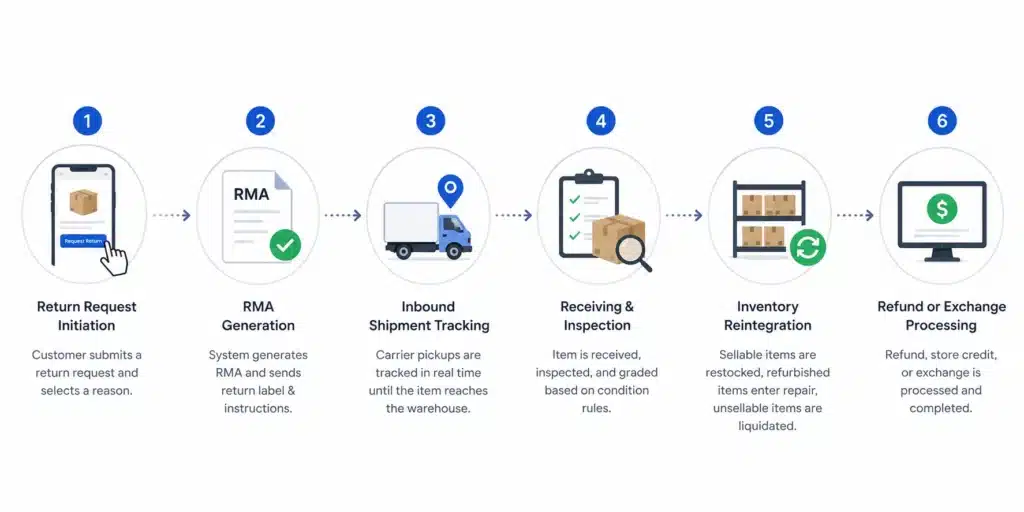
- Return Request Initiation: The customer submits a return request through the self-service portal, selecting a return reason from a predefined list (wrong size, defective item, changed mind, etc.). The system validates the request against the return policy — checking order date, item eligibility, and return window.
- RMA Generation: The system issues an RMA number and sends the customer a prepaid return shipping label along with packaging instructions. This stage replaces 100% of the inbound customer support contacts related to “how do I return this.”
- Inbound Shipment Tracking: The system monitors the carrier scan events on the return label and notifies warehouse staff of inbound volume 24–48 hours before arrival, enabling labor pre-allocation.
- Receiving and Inspection: Warehouse staff scan the returned item against the RMA. The system displays the expected item, original order details, and condition criteria. Staff grade the item as Sellable, Refurbishable, or Unsellable based on configured rules.
- Inventory Reintegration or Liquidation: Sellable items are restocked to available inventory automatically. Refurbishable items enter a repair queue. Unsellable items route to liquidation or disposal workflows.
- Refund or Exchange Processing: The system triggers a full refund, partial refund, store credit, or replacement shipment based on the customer’s selected resolution and the inspection outcome. Refund processing time drops from the industry average of 7–10 business days to 2–3 business days with full automation.
What Types of Returns Does an RMS Handle?
An RMS handles 5 distinct return types, each requiring different processing logic:
- Standard customer-initiated returns: Customer changes mind or finds a defect within the return window. The most common type, representing 60–70% of total return volume in apparel and electronics.
- Exchange requests: Customer wants a different size, color, or variant. The RMS processes the inbound return and triggers a new outbound shipment simultaneously, reducing the time-to-resolution compared to sequential processing.
- Warranty claims: Defective items within the manufacturer warranty period. These route to a separate inspection workflow and often involve vendor chargeback processing.
- Carrier damage claims: Items damaged in transit require the RMS to initiate a carrier insurance claim in parallel with issuing a replacement or refund to the customer.
- Fraud-flagged returns: The RMS applies fraud detection rules — such as high return frequency per customer ID, missing item returns, or item substitution patterns — and routes suspicious requests to manual review before issuing any resolution.
The Direct Business Impact of Return Management Systems
The financial case for an RMS is grounded in 4 measurable cost categories that reverse logistics creates in unmanaged operations.
Reverse Logistics Cost Reduction
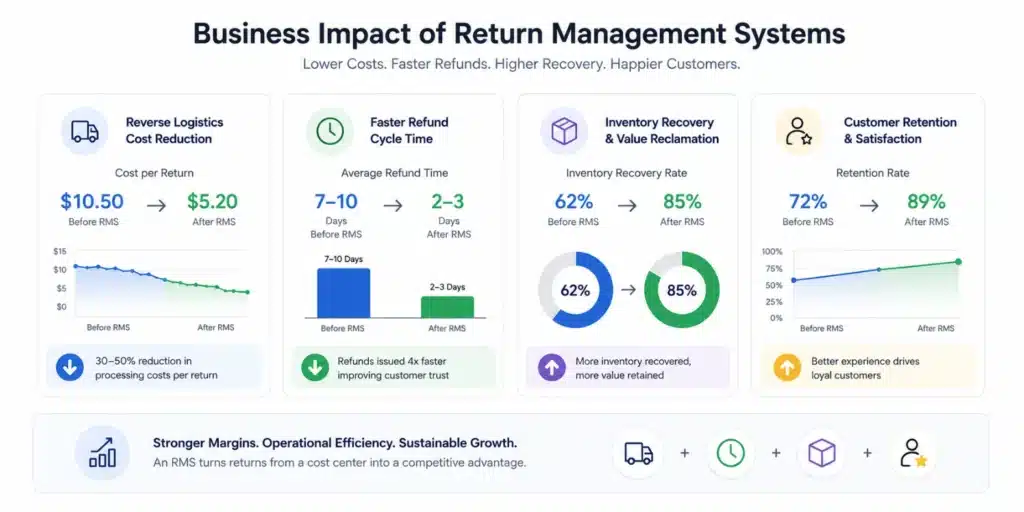
Reverse logistics costs between $10 and $20 per return on average for mid-market e-commerce brands, covering labor, shipping, and processing. An RMS reduces per-return processing costs by 30–50% through automation of the receiving, inspection, and restocking workflow.
The primary savings come from eliminating manual data entry, reducing warehouse dwell time for returned inventory, and optimizing carrier selection for return shipments.
Inventory Recovery Rate
Unmanaged returns result in an average of 25–35% of returned inventory being misclassified as unsellable due to inadequate inspection processes. An RMS with structured inspection workflows recovers 15–20% more inventory into sellable stock, directly reducing write-off losses.
For a brand processing 500 returns per month at an average item value of $40, this represents $3,000–$4,000 in recovered revenue per month.
Customer Retention Impact
Research from Narvar’s Consumer Report found that 96% of customers who have a positive return experience report willingness to purchase from the same retailer again.
Conversely, a poor return experience is the second most common reason customers cite for switching to a competitor, after product quality.
An RMS that resolves returns in under 5 business days with proactive status notifications directly improves customer lifetime value (CLTV).
Support Cost Reduction
Return-related inquiries account for 40–60% of post-purchase customer support ticket volume in e-commerce operations without self-service return portals.
An RMS with a self-service portal and automated status notifications reduces this ticket volume by 60–80%, freeing support capacity for higher-complexity customer interactions.
What Is the Difference Between a Return Policy and a Return Management System?
A return policy is a set of rules it defines what is returnable, for how long, and under what conditions. A return management system is the operational infrastructure that enforces and executes those rules at scale.
Without an RMS, a return policy exists only on paper; customer service agents enforce it manually, inconsistently, and at high labor cost.
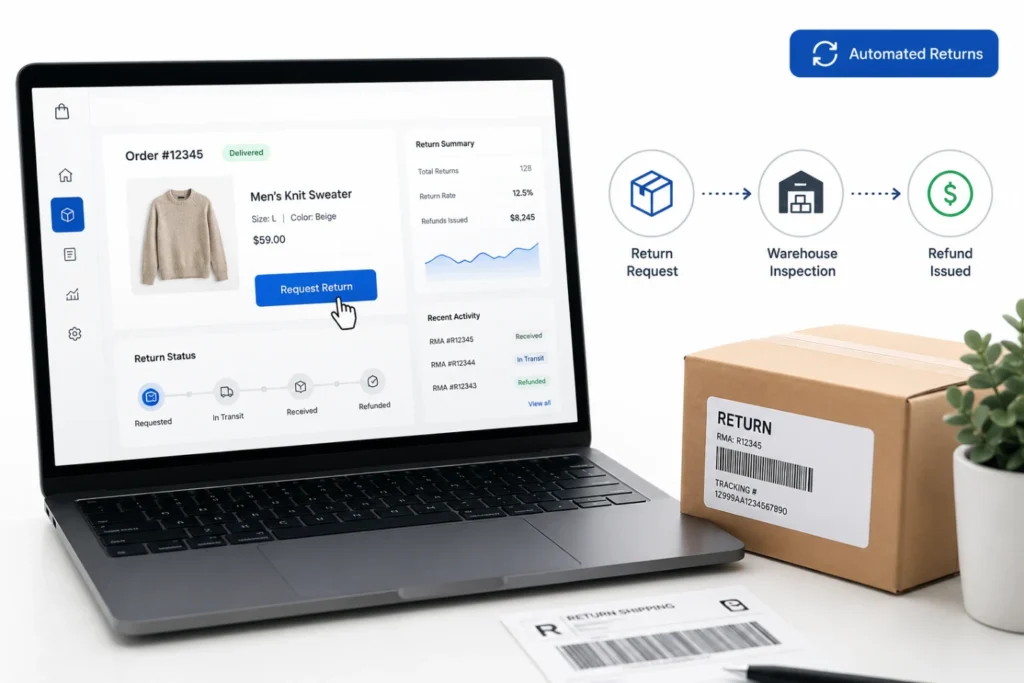
The RMS translates the policy into automated decision trees that process return requests in real time, without human intervention for standard cases.
The practical distinction matters for e-commerce businesses at the growth stage. A brand processing 50 returns per month can manage returns manually.
A brand processing 500+ returns per month requires an RMS, or return processing becomes a bottleneck that delays refunds, misroutes inventory, and generates customer complaints at scale.
Key Integrations a Return Management System Requires
An RMS does not function as a standalone platform. It requires 5 core integrations to deliver its full operational value:
- Order Management System (OMS): Pulls original order data — SKU, price, purchase date, customer ID to validate return eligibility and auto-populate inspection records. Learn how a fully integrated custom web application can connect your OMS to your return management workflow without data silos.
- Warehouse Management System (WMS): Receives inventory reintegration commands from the RMS when returned items pass inspection as sellable, updating available stock levels in real time.
- Payment Gateway: Executes refund disbursements triggered by the RMS after inspection completion, supporting full refunds, partial refunds, and store credit issuance.
- Carrier API: Generates prepaid return labels, tracks inbound shipments, and files carrier damage claims directly within the RMS workflow.
- E-commerce Platform: Syncs return status, refund confirmation, and exchange order creation back to the storefront, ensuring customer-facing order history reflects the current return state accurately.
Building these integrations on a custom-developed e-commerce platform gives retailers full control over data flow and processing logic. A custom web development approach ensures the RMS connects directly to proprietary OMS and WMS architectures without middleware limitations.
Return Management System vs. Built-In Platform Returns Features
| Feature | Platform Built-In Returns | Dedicated RMS |
|---|---|---|
| Self-service return portal | Basic (limited customization) | Fully branded, configurable |
| Return policy rule engine | Static rules only | Dynamic rules by SKU, customer segment, region |
| Carrier integration | 1–2 carriers | Multi-carrier with rate shopping |
| Inspection workflow | Not included | Configurable grading rules |
| Fraud detection | Not included | Rule-based and ML-assisted flagging |
| Analytics by SKU/return reason | Aggregate only | Granular, segmented reporting |
| WMS integration | Manual or webhook only | Native bi-directional sync |
When Should an E-Commerce Business Invest in a Dedicated RMS?
An e-commerce business reaches the threshold for a dedicated RMS when it crosses 3 operational triggers:
- Return volume exceeds 300 per month: Below this volume, manual processing is operationally feasible. Above it, manual handling creates refund delays exceeding 7 days, which directly increases chargeback rates and reduces repeat purchase probability.
- Return-related support tickets exceed 20% of total ticket volume: This ratio indicates that return process friction is generating avoidable customer contacts, which a self-service portal and automated notifications eliminate.
- Cross-border or multi-warehouse operations are active: International returns require carrier-agnostic label generation, customs documentation automation, and currency-specific refund processing capabilities that built-in platform tools do not provide.
Businesses that sell in multiple product categories with different return windows and eligibility rules, such as electronics, apparel, and consumables, simultaneously also require a dedicated RMS.
Built-in platform return features apply uniform rules across all SKUs, which creates policy enforcement errors at scale.
Return Fraud: How RMS Platforms Detect and Prevent It
Return fraud costs U.S. retailers an estimated $101 billion annually, according to the National Retail Federation’s 2023 Loss Prevention Report. An RMS reduces return fraud through 4 detection mechanisms:
- Return frequency scoring: The system flags customer accounts with return rates exceeding a configurable threshold (e.g., more than 40% of orders returned within 90 days) for manual review before processing refunds.
- Item verification at receiving: Warehouse staff scan the returned item’s barcode against the RMA record. Mismatches — indicating item substitution fraud — trigger an immediate hold on the refund and escalation to a fraud review queue.
- Address and account clustering: The RMS identifies multiple accounts returning to the same address or using the same payment method, flagging potential organized return fraud rings.
- Photo documentation requirement: The customer portal requires photographic evidence of defects or damage before issuing an RMA for damage-claim returns, eliminating fraudulent defect claims.
Return Data as a Product Intelligence Source
Return reason data is one of the most underutilized sources of product intelligence in e-commerce. When an RMS captures structured return reason codes at scale, the analytics layer reveals patterns that directly inform product development, sizing, and content decisions.
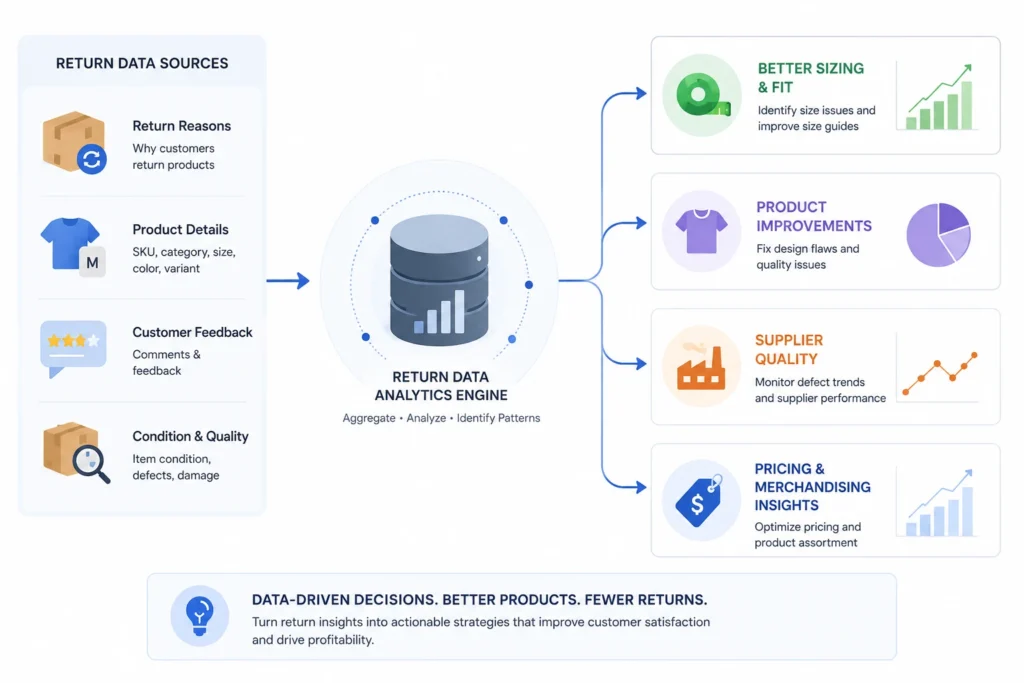
4 actionable signals return data produces:
- Sizing accuracy gaps: High return rates for “wrong size” on specific SKUs indicate that product dimensions or size guide information on the product page is inaccurate. Correcting size guide data reduces return rates for those SKUs by 15–25%.
- Product description accuracy: Returns coded as “not as described” or “color different from image” identify product listing content gaps. Updating photography and copy for high-return SKUs reduces expectation mismatch returns.
- Supplier quality issues: Clusters of defect returns on specific SKUs from specific production batches identify supplier quality control failures, enabling targeted vendor chargebacks and purchase order adjustments.
- Category-level pricing validation: High return rates in a specific category combined with “found cheaper elsewhere” return reasons signal competitive pricing pressure that merchandising teams can act on.
Need a Custom Return Management System Built for Your E-Commerce Operation?
CodeSol Technologies builds custom e-commerce systems, including integrated return management platforms that connect your OMS, WMS, payment gateway, and carrier APIs into a single automated workflow.
We eliminate the middleware limitations imposed by off-the-shelf RMS platforms on growing operations.
Final Words
Return and refund management systems are not an optional upgrade for e-commerce brands with more than 300 monthly returns they are an operational requirement.
The cost of unmanaged returns accumulates across four dimensions simultaneously: logistics, inventory, support, and customer retention.
The brands that treat returns as a data source, not just a cost center, gain a compounding advantage. Every return processed through a structured RMS generates SKU-level intelligence that reduces future return rates, improves product listings, and tightens supplier accountability.
That feedback loop is where the real long-term value sits.