
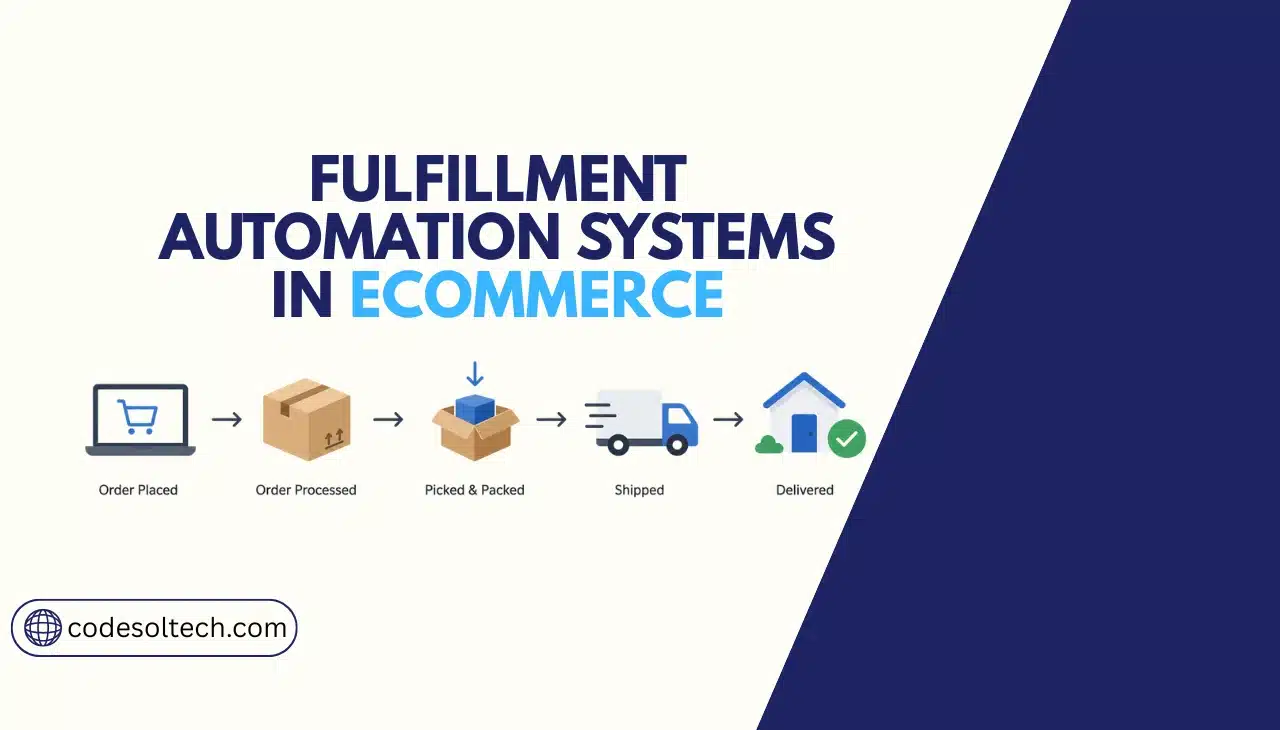
Fulfillment automation systems are software and hardware solutions that automate order picking, packing, sorting, and shipping inside ecommerce warehouses. They integrate Warehouse Management Systems (WMS), robotics, barcode scanning, and AI-driven demand forecasting to reduce manual labor, cut order errors, and speed up delivery.
Businesses that deploy these systems reduce fulfillment costs by 25–40% and improve order accuracy to above 99.9%.
What Is a Fulfillment Automation System?
A fulfillment automation system is a combination of software platforms and physical machinery that replaces manual tasks in the order fulfillment process. It covers the entire workflow from the moment a customer places an order to the moment a package leaves the warehouse.
The system eliminates 4 primary labor-intensive steps: receiving inventory, locating items, packing orders, and generating shipping labels.
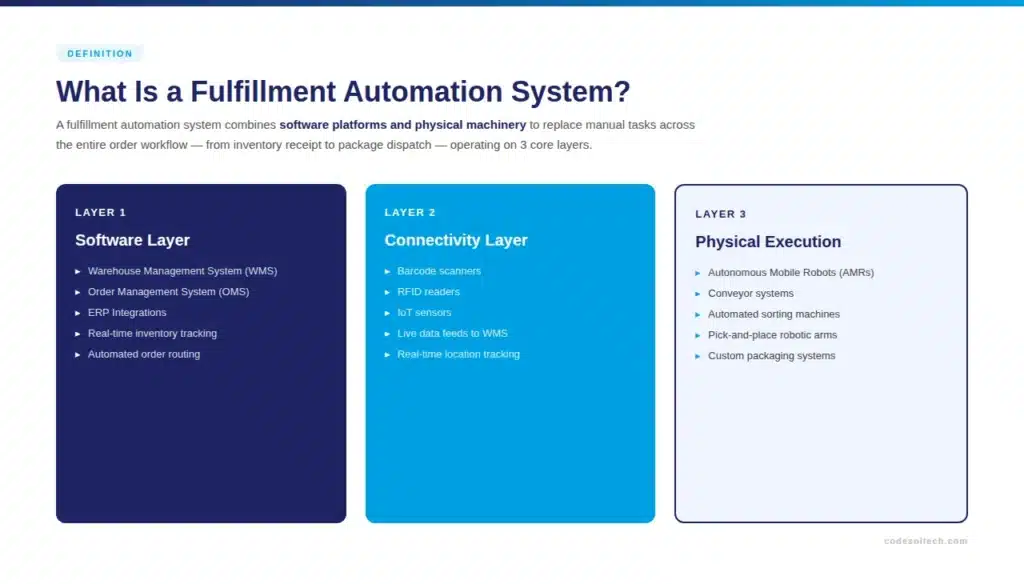
These systems operate on 3 core layers:
- Software layer: WMS, Order Management Systems (OMS), and ERP integrations that track inventory in real time and route orders to the correct fulfillment path.
- Connectivity layer: Barcode scanners, RFID readers, and IoT sensors that feed live data into the software layer.
- Physical execution layer: Autonomous Mobile Robots (AMRs), conveyor systems, automated sorting machines, and pick-and-place robotic arms.
A custom web application connects the customer-facing storefront directly to this fulfillment infrastructure, ensuring orders trigger automation workflows within milliseconds of purchase confirmation.
Core Components of Fulfillment Automation
1. Warehouse Management System (WMS)
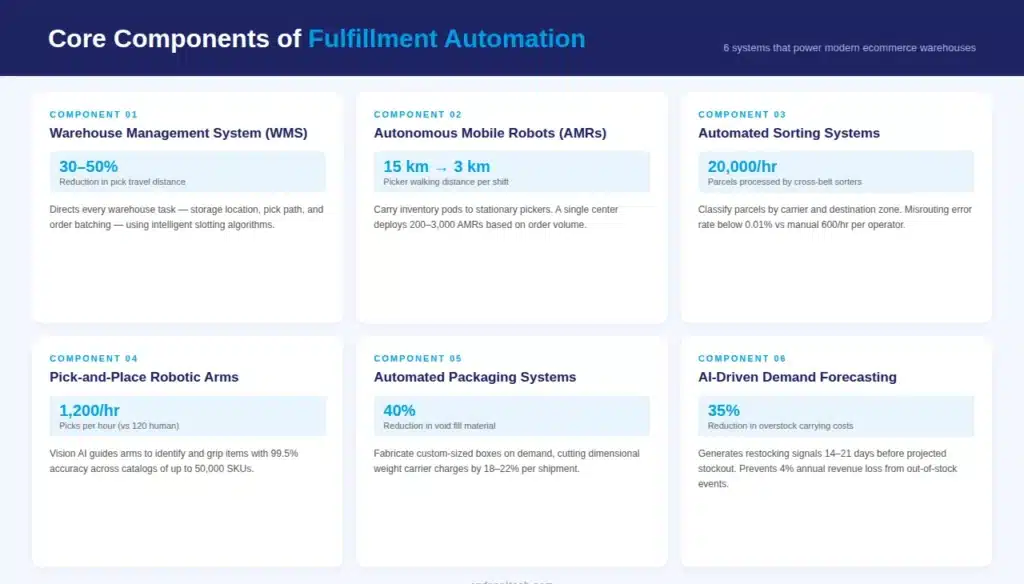
A WMS is the operational brain of a fulfillment center. It directs every task: where to store inventory, which pick path is most efficient, and how to batch orders for parallel processing. Modern WMS platforms process thousands of orders per hour and reduce average pick travel distance by 30–50% through intelligent slotting algorithms.
2. Autonomous Mobile Robots (AMRs)
AMRs navigate warehouse floors without fixed tracks. They carry shelving pods directly to human pickers at static stations, a model made famous by Amazon Robotics (formerly Kiva Systems).
This system reduces picker walking distance from an average of 15–20 km per shift to under 3 km per shift. A single fulfillment center deploys between 200 and 3,000 AMRs depending on order volume.
3. Automated Sorting Systems
Sorting systems classify packed parcels by carrier, destination zone, and delivery speed using barcode or QR code scanning. Cross-belt sorters process up to 20,000 parcels per hour with a misrouting error rate below 0.01%. These systems replace manual sorting lanes that average 400–600 parcels per hour per operator.
4. Pick-and-Place Robotic Arms
Robotic arms handle SKUs that are uniform in size and weight, such as boxed consumer electronics or beverage cans. They execute 600–1,200 picks per hour, compared to 80–120 picks per hour for a trained human picker.
Vision AI systems guide these arms to identify and grip items with 99.5% accuracy across SKU catalogs of up to 50,000 unique products.
5. Automated Packaging Systems
These machines measure each order’s contents and fabricate a custom-sized box on demand, cutting void fill material by 40% and reducing dimensional weight charges from carriers by an average of 18–22%. Neopost and Packsize are 2 common systems deployed in mid-to-large fulfillment centers.
6. AI-Driven Demand Forecasting
AI forecasting engines analyze 3–5 years of sales data, seasonal trends, promotional calendars, and external signals like weather or social media demand spikes. They generate restocking recommendations 14–21 days before projected stockout events.
Accurate forecasting reduces overstock carrying costs by 20–35% and prevents the stockout-driven revenue loss that accounts for 4% of annual ecommerce revenue on average.
How Does Fulfillment Automation Reduce Ecommerce Costs?
Fulfillment automation reduces costs across 5 measurable categories:
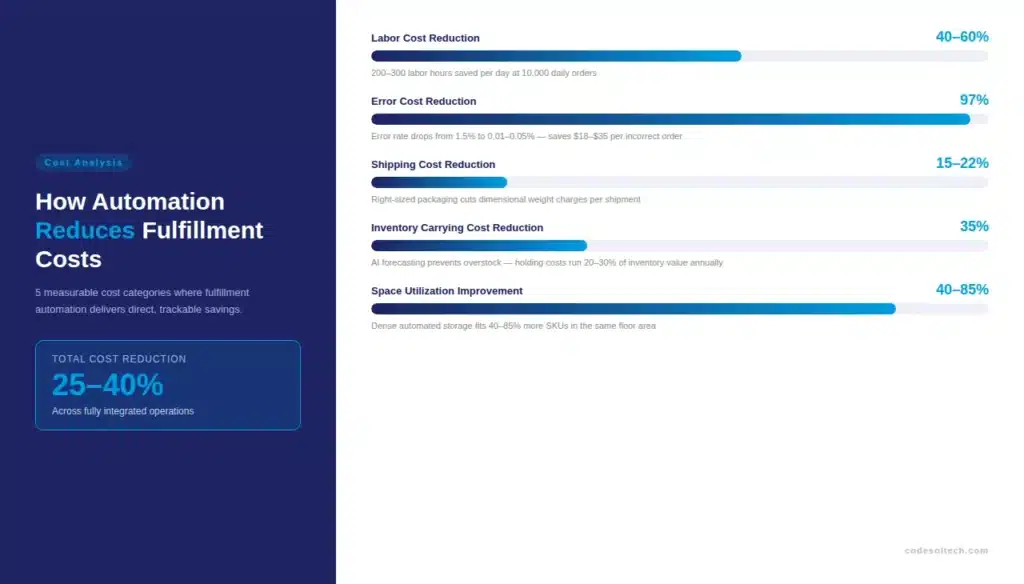
- Labor cost reduction: Automated picking and sorting cuts direct labor hours per order by 40–60%. A fulfillment center processing 10,000 daily orders saves 200–300 labor hours per day after full automation deployment.
- Error cost reduction: Manual picking produces error rates of 0.5–1.5%. Automated systems reduce errors to 0.01–0.05%, eliminating return processing costs that average $18–$35 per incorrect order.
- Shipping cost reduction: Right-sized automated packaging reduces average parcel dimensional weight by 15–22%, directly lowering per-shipment carrier fees.
- Inventory carrying cost reduction: AI forecasting prevents overstocking. Holding costs for excess inventory typically run 20–30% of inventory value annually; accurate forecasting reduces this by up to 35%.
- Space utilization improvement: Automated dense storage systems (like vertical lift modules) store 40–85% more SKUs in the same floor area, reducing warehouse lease requirements per unit of throughput.
The combined effect puts total fulfillment cost reduction at 25–40% for operations that fully integrate software and physical automation layers.
Types of Fulfillment Automation by Business Size
Fulfillment automation is not one-size-fits-all. There are 3 deployment tiers based on order volume and capital budget:
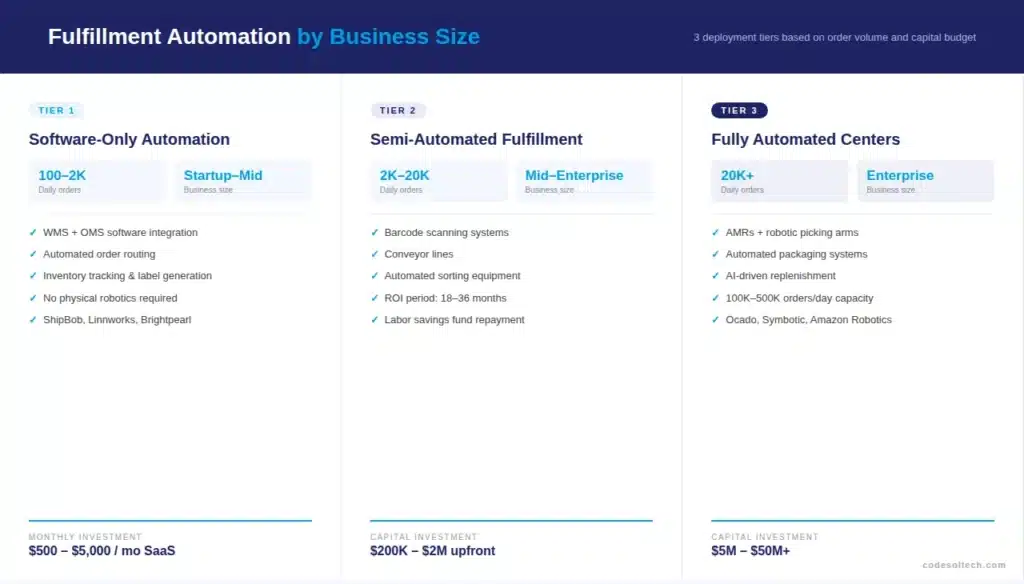
Tier 1: Software-Only Automation (Startups to Mid-Market)
Businesses processing 100–2,000 daily orders typically start with WMS and OMS software integrations. These platforms automate order routing, inventory tracking, and label generation without any physical robotics investment.
ShipBob, Linnworks, and Brightpearl serve this tier, with implementation costs between $500 and $5,000 per month in SaaS fees.
Tier 2: Semi-Automated Fulfillment (Mid-Market to Enterprise)
Operations handling 2,000–20,000 daily orders deploy barcode scanning systems, conveyor lines, and automated sorting. Capital investment runs from $200,000 to $2 million. ROI periods for this tier average 18–36 months based on labor savings.
Tier 3: Fully Automated Fulfillment Centers (Enterprise)
High-volume operations processing 20,000+ daily orders deploy AMRs, robotic picking arms, automated packaging, and AI-driven replenishment systems.
Capital investment starts at $5 million and scales to $50 million for hyperscale facilities. Ocado Technology, Symbotic, and Amazon Robotics operate at this level.
These systems achieve throughput rates of 100,000–500,000 orders per day.
What Is the Role of WMS Integration in Fulfillment Automation?
A WMS connects every component of the fulfillment operation into a single data environment. Without WMS integration, automated machines operate in isolation and create bottlenecks at handoff points between processes.
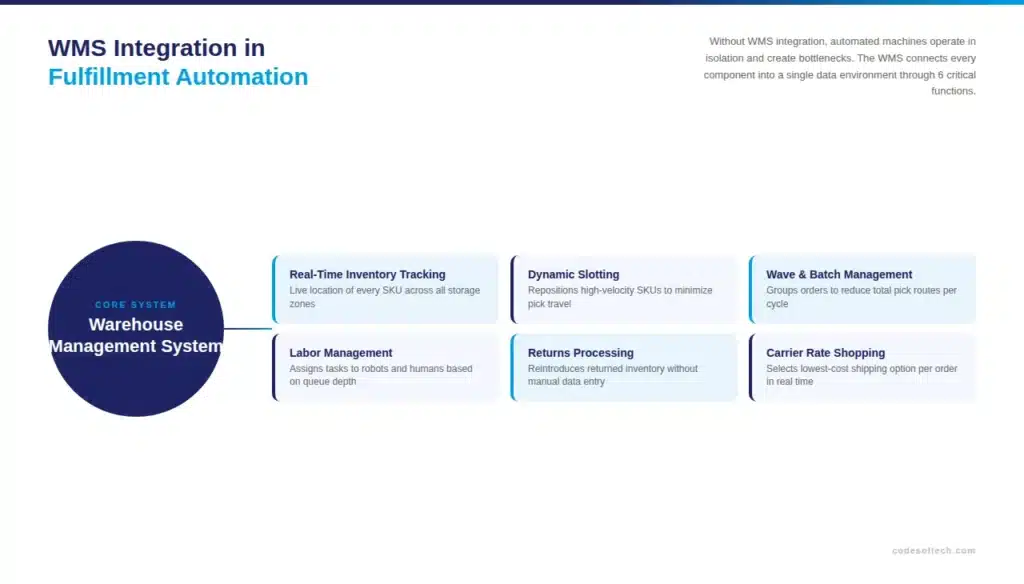
The WMS handles 6 critical functions that make automation coherent:
- Real-time inventory location tracking across all storage zones
- Dynamic slotting that repositions high-velocity SKUs to minimize pick travel
- Wave and batch order management that groups orders to reduce total pick routes
- Labor management that assigns tasks to robots and human workers based on current queue depth
- Returns processing workflows that reintroduce returned inventory without manual data entry
- Carrier rate shopping that selects the lowest-cost shipping option per order in real time
For ecommerce businesses running custom storefronts, custom web development creates direct API connections between the storefront’s order management layer and the WMS, removing manual export/import steps that delay order processing by 15–90 minutes.
Fulfillment Automation vs. Traditional Fulfillment: Key Differences
| Metric | Traditional Fulfillment | Automated Fulfillment |
|---|---|---|
| Pick accuracy rate | 98.5–99.5% | 99.9–99.99% |
| Picks per hour (per station) | 80–120 | 300–1,200 |
| Order processing time | 45–120 minutes | 5–20 minutes |
| Labor cost per order | $2.50–$5.00 | $0.50–$1.50 |
| Scalability during peak | Requires 2–3x staff | Software configuration only |
| Inventory accuracy | 95–98% | 99.5–99.9% |
How Fulfillment Automation Connects to Ecommerce Platform Architecture
Fulfillment automation delivers maximum ROI when the ecommerce platform communicates directly with the fulfillment system through structured APIs. 3 integration points define this architecture:
- Order API: Sends confirmed orders from the storefront to the WMS within 1–3 seconds of customer payment, triggering the pick workflow before the customer closes the confirmation screen.
- Inventory API: Pushes real-time stock levels from the WMS back to the storefront, preventing overselling of out-of-stock items and dynamically displaying lead times for low-stock SKUs.
- Shipping API: Returns tracking numbers and carrier labels from the fulfillment system to the storefront, triggering automated shipping confirmation emails without manual entry.
Businesses that use proprietary platforms or legacy systems often face integration friction at these 3 points. A web application development engagement builds custom middleware that connects non-standard ecommerce stacks to WMS platforms without requiring platform replacements.
Challenges in Deploying Fulfillment Automation
Fulfillment automation produces clear ROI, but 4 deployment challenges consistently delay or reduce returns:
- SKU variability: Robotics systems perform best with uniform product dimensions. Operations with high SKU variability (apparel, fragile goods, irregular shapes) require advanced vision AI and specialized end-of-arm tooling, increasing per-robot costs by 30–60%.
- Legacy WMS integration: Older WMS platforms lack the API structure needed to communicate with modern robotic systems in real time. Migration to a compatible WMS is often a prerequisite, adding 3–9 months to deployment timelines.
- Capital expenditure requirements: Physical automation systems require significant upfront investment. Many mid-market businesses fund automation through robotics-as-a-service (RaaS) models, paying per-pick fees rather than purchasing equipment outright.
- Change management: Workforce retraining and process redesign consume 20–30% of implementation timelines. Automation shifts labor from picking to robot supervision, maintenance, and exception handling roles.
Fulfillment Automation Trends for 2026 and Beyond
4 technologies are reshaping fulfillment automation at the enterprise level through 2025–2027:
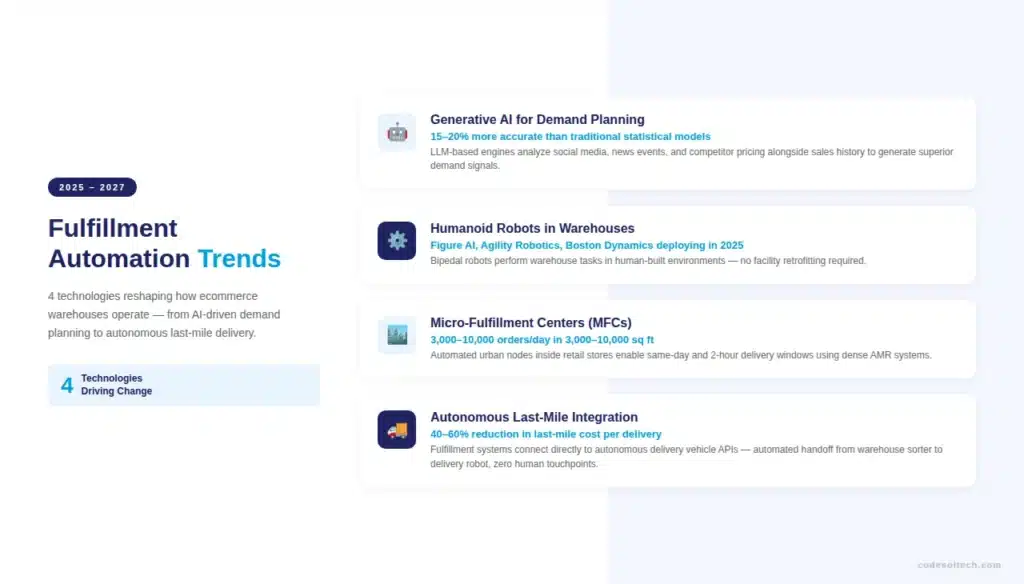
- Generative AI for demand planning: LLM-based forecasting tools analyze unstructured data sources (social media, news events, competitor pricing) alongside historical sales data to generate demand signals with 15–20% greater accuracy than traditional statistical models.
- Humanoid robots: Companies including Figure AI, Agility Robotics, and Boston Dynamics are deploying bipedal robots that perform warehouse tasks in environments built for humans, removing the need to retrofit facilities for conventional automation.
- Micro-fulfillment centers (MFCs): Retailers deploy small automated nodes inside urban locations—often within existing retail stores—to enable same-day and 2-hour delivery windows. MFCs process 3,000–10,000 orders per day in 3,000–10,000 sq ft of floor space using dense AMR systems.
- Autonomous last-mile integration: Fulfillment systems now connect to autonomous delivery vehicle APIs, enabling automated handoff from warehouse sorter to delivery robot without human touchpoints, reducing last-mile cost per delivery by 40–60%.
Final Words
Fulfillment automation is no longer a competitive advantage; it’s a baseline requirement for ecommerce operations that compete on delivery speed and order accuracy.
Businesses that delay automation face rising labor costs, growing customer return rates, and a widening gap against competitors who process orders in minutes rather than hours.
The entry point is lower than most assume. Software-layer automation through WMS and OMS integration delivers measurable ROI before any robotics investment. The path scales from there.
Ready to Connect Your Ecommerce Store to Fulfillment Automation?
CodeSol Technologies builds API integrations between ecommerce platforms and WMS, OMS, and robotics systems.
We design the middleware layer that makes your storefront and fulfillment center operate as one system, reducing order delays, eliminating manual data entry, and scaling with your order volume.