
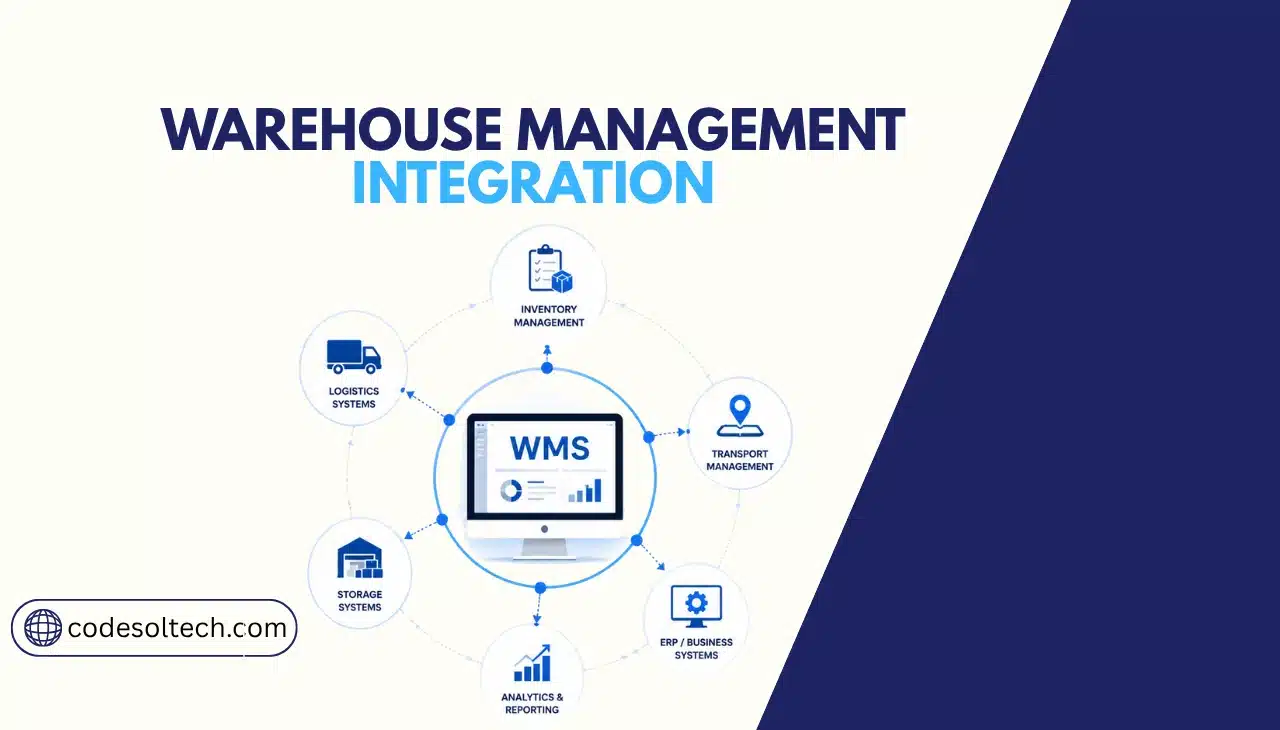
Warehouse management integration connects a Warehouse Management System (WMS) with logistics platforms, storage systems, ERP software, and order management tools into a single, automated data ecosystem. Businesses that integrate these systems reduce manual data entry, eliminate inventory discrepancies, and fulfil orders faster.
The global WMS market was valued at USD 2.91 billion in 2024 and is projected to reach USD 10.02 billion by 2032, growing at a CAGR of 16.70%.
What Is Warehouse Management Integration?
Warehouse management integration is the process of synchronising a WMS with external business systems so that data flows automatically between inventory, orders, shipping, and finance without human intervention.
It eliminates data silos that cause stockouts, duplicate records, and delayed shipments.
The 3 core layers of warehouse management integration are:
- System layer — WMS, ERP, and Order Management System (OMS) share real-time inventory and order data.
- Logistics layer — Transportation Management Systems (TMS) and carrier APIs receive pick-and-pack data to generate shipping labels and route assignments.
- Storage layer — Automated Storage and Retrieval Systems (AS/RS), conveyor controls, and IoT sensors report bin-level stock counts back to the WMS.
Integration is executed through 4 primary methods: RESTful APIs, EDI (Electronic Data Interchange), middleware platforms such as MuleSoft or Dell Boomi, and native connectors built into cloud WMS solutions like Manhattan Active WM or Oracle Warehouse Management Cloud.
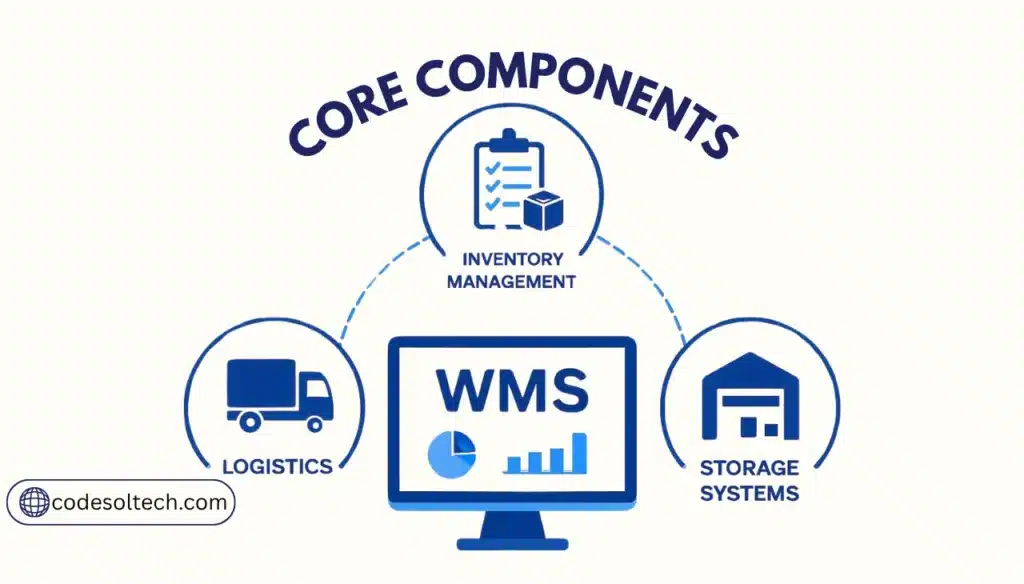
Core Components: WMS, Logistics, and Storage Systems
Warehouse Management System (WMS)
A WMS controls 5 core warehouse functions: receiving, putaway, picking, packing, and shipping. Cloud-based WMS solutions held a 55% market share in 2023 because they offer scalability, lower IT overhead, and remote accessibility.
Leading vendors include Manhattan Associates, Blue Yonder, Oracle, and SAP.
A WMS captures the following data in real time:
- Stock-keeping unit (SKU) location at bin, aisle, or zone level
- Inventory ageing and expiry dates (critical for food, beverage, and pharmaceutical sectors)
- Labour productivity metrics per warehouse associate
- Inbound purchase orders and outbound sales orders
- Carrier performance data and shipping costs per order
Logistics Systems
Logistics systems connected to a WMS include a Transportation Management System (TMS), last-mile delivery platforms, and third-party logistics (3PL) portals.
The 3PL segment held the largest WMS market share in 2024 because 3PL providers manage multi-client warehouses that require highly flexible, integrated systems.
A WMS-TMS integration automatically selects the lowest-cost carrier, generates compliant shipping labels, and pushes tracking numbers to the OMS in under 2 seconds per shipment.
Storage Systems
Storage systems include 4 primary types that integrate with a WMS:
- Automated Storage and Retrieval Systems (AS/RS) — robotic cranes or shuttles that retrieve totes and pallets, reporting exact stock positions to the WMS.
- Conveyor and sortation systems — route totes to packing stations based on WMS wave-pick sequences.
- Goods-to-person (GTP) systems — bring products to a static operator workstation, increasing pick rates by up to 300% versus manual picking.
- IoT-enabled shelving and RFID systems — broadcast bin-level inventory changes to the WMS without manual scans.
How Does WMS Integration Work with E-Commerce?
WMS integration with e-commerce platforms Shopify, WooCommerce, Magento, or custom-built storefronts creates a closed-loop order fulfilment cycle. When a customer places an order, the e-commerce platform pushes the order to the WMS via API in real time.
The WMS allocates inventory, assigns a pick task to a warehouse associate or robot, generates a packing slip, and pushes shipment confirmation and tracking data back to the storefront automatically.
The 5-step integration flow between an e-commerce platform and a WMS:
- Customer places order → OMS receives order and sends it to WMS via REST API.
- WMS confirms inventory availability and reserves the SKU against the order.
- WMS generates a pick task and routes the operator or robot to the correct bin location.
- After packing, WMS calls the carrier API to purchase a shipping label and assigns a tracking number.
- WMS sends shipment confirmation with tracking data back to the OMS, which updates the customer-facing order status.
A properly integrated WMS eliminates overselling by updating storefront inventory counts within seconds of a pick confirmation.
Without integration, inventory updates rely on manual batch exports that run every 15–60 minutes, producing a window of oversell risk on high-velocity SKUs.
If you are building a custom e-commerce platform that needs deep WMS integration, a custom web development solution ensures the API architecture supports real-time webhook events rather than scheduled polling, which reduces latency from minutes to milliseconds.
Key Benefits of Warehouse Management Integration
Warehouse management integration produces 6 measurable operational benefits:
- Inventory accuracy — Integrated WMS systems achieve 99.9% inventory accuracy versus 80–85% accuracy in manual or disconnected environments.
- Order cycle time reduction — WMS integration with AS/RS and GTP systems reduces order cycle time from hours to under 30 minutes for standard B2C shipments.
- Labour cost reduction — Automation triggered by WMS integration reduces picking labour costs by 20–40% in facilities that deploy conveyor or GTP systems.
- Shipping error reduction — Barcode scan verification enforced by the WMS at packing reduces mis-ships to below 0.1% of total orders.
- Supplier lead time visibility — ERP–WMS integration exposes purchase order ETAs so the WMS can reserve putaway locations before inbound trucks arrive.
- Returns processing speed — WMS integration with the OMS automates returns authorisation, restocking decisions, and refund triggers, cutting returns processing time by 50%.
WMS Integration Methods: API vs. EDI vs. Middleware
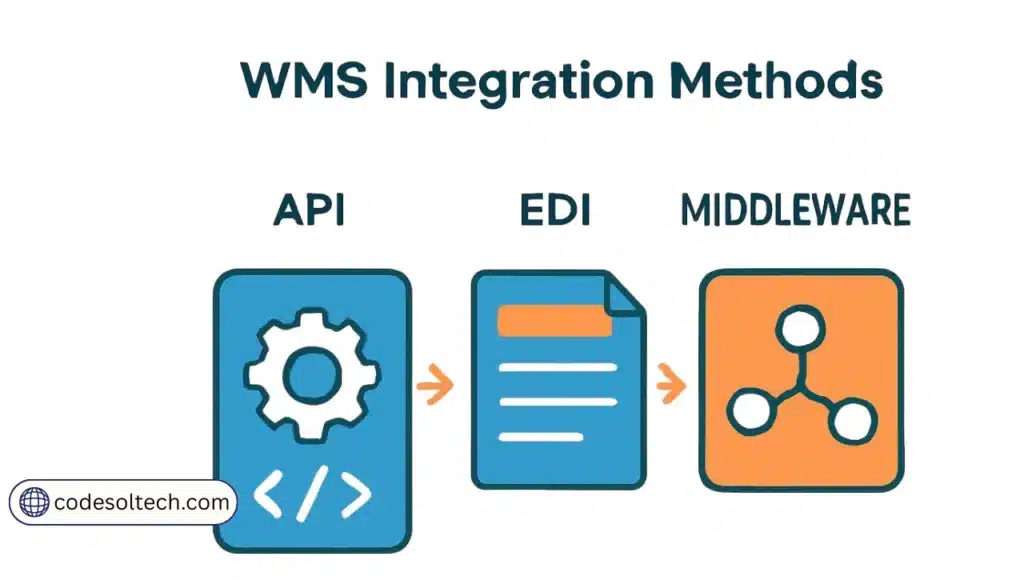
The 3 most common WMS integration methods are RESTful APIs, EDI, and middleware platforms. Each method suits a different technical context.
RESTful API Integration
RESTful API integration is the current standard for WMS connections with e-commerce platforms, OMS tools, and last-mile delivery apps. APIs send JSON or XML payloads over HTTPS in real time, enabling sub-second data exchange between systems.
Cloud WMS vendors like Manhattan Active WM and Blue Yonder publish documented API endpoints for order creation, inventory queries, shipment confirmation, and returns processing.
EDI Integration
EDI (Electronic Data Interchange) transmits structured business documents, purchase orders (EDI 850), advance ship notices (EDI 856), and invoices (EDI 810) between a WMS and trading partners. EDI remains dominant in retail and grocery supply chains where large retailers mandate specific transaction sets.
EDI integration processes documents in near-real-time or on scheduled cycles of 5–15 minutes, depending on the VAN (Value-Added Network) or AS2 connection used.
Middleware Platform Integration
Middleware platforms MuleSoft, Dell Boomi, Celigo, and similar iPaaS tools act as integration hubs that connect the WMS to 10 or more business systems through pre-built connectors.
A middleware layer is appropriate when a business operates multiple WMS instances across different sites, multiple ERP systems after a merger or acquisition, or a custom-built tech stack without native connectors.
Middleware platforms support data transformation, error handling, and retry logic that reduce integration failure rates below 0.01% per transaction.
What Are the Most Common WMS Integration Challenges?
The 4 most common WMS integration challenges are data format mismatches, latency under peak load, master data governance failures, and change management resistance.
- Data format mismatches — Different systems store product identifiers as GTIN, SKU, UPC, or internal codes. An integration layer must map all identifiers to a single canonical ID before routing data between systems.
- Latency under peak load — During Black Friday or flash-sale events, API call volumes spike 10–50× above baseline. A WMS integration without rate-limiting controls and queue management causes order processing delays or dropped transactions.
- Master data governance — A WMS integration fails when the product master in the ERP contains different dimensions, weights, or UOM (Unit of Measure) values from the WMS. A single item master governance policy must be established before integration goes live.
- Change management — Warehouse staff accustomed to manual processes or legacy systems resist new WMS workflows. Structured training programs that cover the 5 core WMS functions for each warehouse role reduce adoption friction and post-go-live error rates.
WMS Integration for 3PL and Multi-Site Logistics
Third-party logistics providers require multi-tenant WMS integration architectures that isolate client data while sharing physical warehouse infrastructure. A multi-tenant WMS assigns a unique billing entity, inventory namespace, and reporting dashboard to each client.
The WMS integration layer then connects each client’s OMS or ERP to their isolated data partition without exposing data from other tenants.
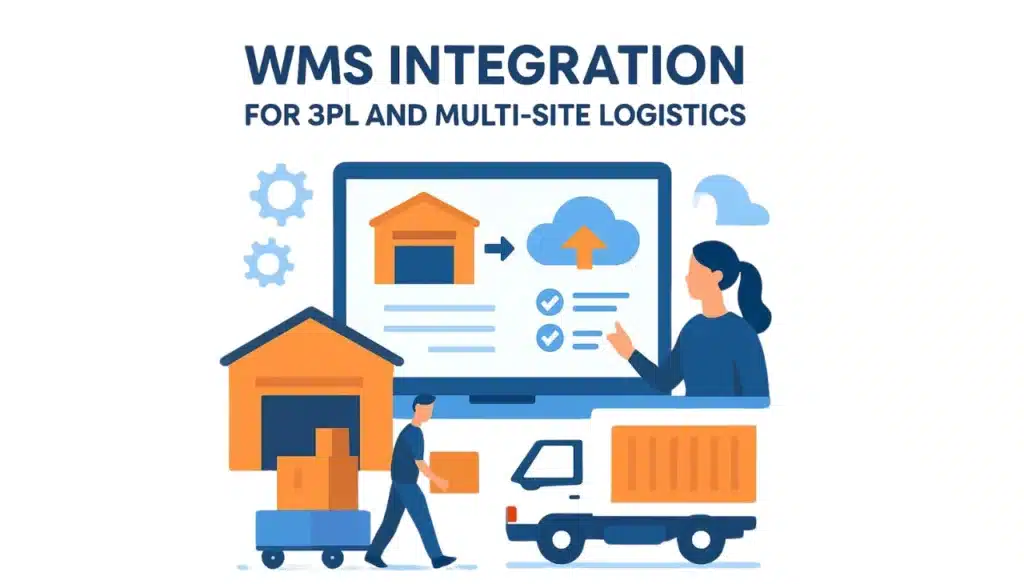
Multi-site WMS integration connects 2 or more physical warehouse locations under a single inventory visibility layer. A centralised inventory layer allows the OMS to route each order to the optimal fulfilment site based on 4 variables: stock availability, shipping zone proximity, carrier service level, and site throughput capacity.
This routing logic reduces average shipping distance, which directly lowers carrier costs and last-mile delivery time.
For businesses scaling their logistics technology stack, a well-structured web application development approach to the WMS integration layer ensures the architecture supports multi-site data federation without performance bottlenecks.
Technologies Powering Modern WMS Integration
6 technologies accelerate and enhance WMS integration in modern warehouses:
- IoT sensors and RFID — Broadcast real-time location and condition data (temperature, humidity) directly to the WMS without manual intervention.
- AI and machine learning — Demand forecasting models inside the WMS analyse 24–36 months of sales history to generate replenishment recommendations, reducing stockouts by up to 35%.
- Robotics and AMRs (Autonomous Mobile Robots) — Receive pick task assignments from the WMS via a robot management API and return pick confirmations upon task completion.
- Blockchain — Provides an immutable audit trail for inventory ownership transfers between trading partners, increasing supply chain transparency.
- Cloud computing — Cloud WMS deployments held a 55% market share in 2023 and eliminate the need for on-premise server infrastructure, reducing integration maintenance overhead.
- Digital twins — 3D virtual models of warehouse layouts connected to the WMS allow operators to simulate slotting changes and throughput scenarios before executing physical reorganisation.
How to Choose the Right WMS Integration Approach
The correct WMS integration approach depends on 4 decision factors: transaction volume, number of connected systems, real-time data requirements, and internal IT capability.
- Low volume (<500 orders/day), 2–3 systems — Native connectors or a lightweight iPaaS tool (Zapier, Make) handle the integration without custom development.
- Medium volume (500–5,000 orders/day), 4–8 systems — A dedicated middleware platform (Celigo, Boomi) with pre-built WMS connectors provides reliability and visibility at a manageable cost.
- High volume (>5,000 orders/day), 8+ systems — A custom-built integration layer with an event-driven architecture (Apache Kafka or AWS EventBridge) handles the throughput and supports real-time event streaming at scale.
- 3PL and multi-tenant environments — A multi-tenant WMS with a dedicated API gateway and client-level authentication manages data isolation and scales to hundreds of client connections.
Final Words
Warehouse management integration is not optional for businesses competing on fulfilment speed and inventory accuracy. A connected WMS reduces errors, cuts labour costs, and enables real-time decisions across logistics and storage systems.
The businesses that win in logistics are those that treat integration as infrastructure, not an afterthought. Build it right the first time.
Ready to Build a WMS-Integrated E-Commerce Platform?
CodeSol Technologies designs and develops custom web applications with WMS API integration built into the architecture from day one, no bolt-on workarounds.