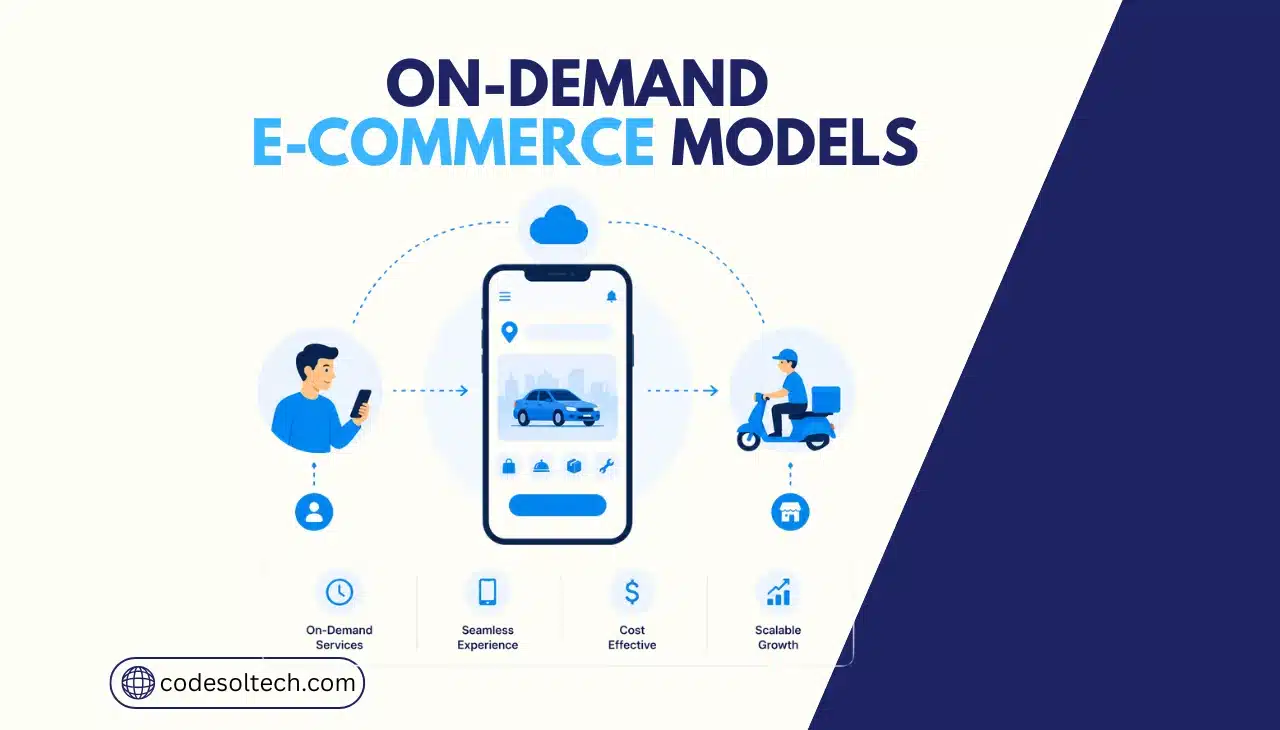
An on-demand ecommerce model connects a customer request to instant fulfillment through a digital platform. Three types exist: product-based, service-based, and logistics-based. Each runs on real-time inventory sync, GPS-based dispatch, and dynamic pricing.
The online on-demand home services segment alone grows from $3.71 billion (2021) to $14.7 billion by 2030, a 16.7% CAGR, per Grand View Research.
What Is an On-Demand Ecommerce Model?
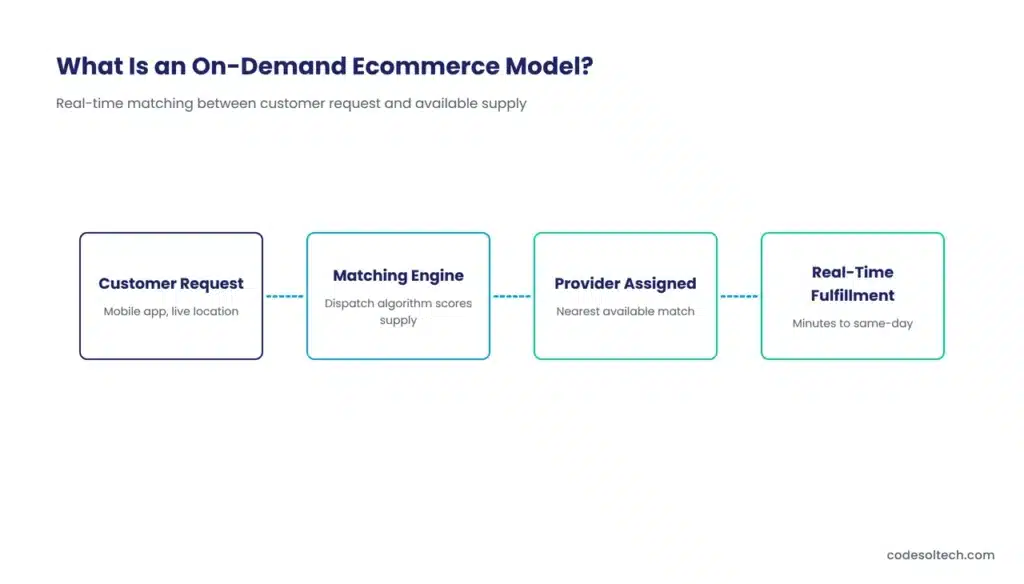
Ita model is a digital commerce structure where a platform matches a customer request with available supply in real time, rather than processing it on a delayed or fixed cycle. The customer requests a product or service through a mobile app or web platform.
The platform’s matching engine assigns the nearest available provider or inventory source. Fulfillment happens in minutes to same-day, not days.
This differs from traditional ecommerce, where inventory ships from a warehouse on a multi-day schedule. It also differs from subscription ecommerce, which delivers on a recurring schedule rather than in response to an immediate request. On-demand platforms depend on a large, flexible supply pool to work.
Up to 162 million people across the United States and the EU-15 countries engage in independent work, according to research by the McKinsey Global Institute. This is the labor pool that on-demand platforms draw on for last-mile fulfillment and service delivery.
Every on-demand ecommerce model shares 5 structural characteristics:
- Real-time demand-supply matching through a dispatch algorithm
- Mobile-first ordering interface with GPS-based location detection
- Dynamic or surge pricing engine tied to live demand data
- Provider-side app or dashboard for accepting and tracking requests
- Transaction-based revenue model commission, delivery fee, or markup
3 Types of On-Demand Ecommerce Models
On-demand ecommerce splits into 3 core types based on what moves through the platform: physical products, human services, or freight. Each type requires a different backend architecture.
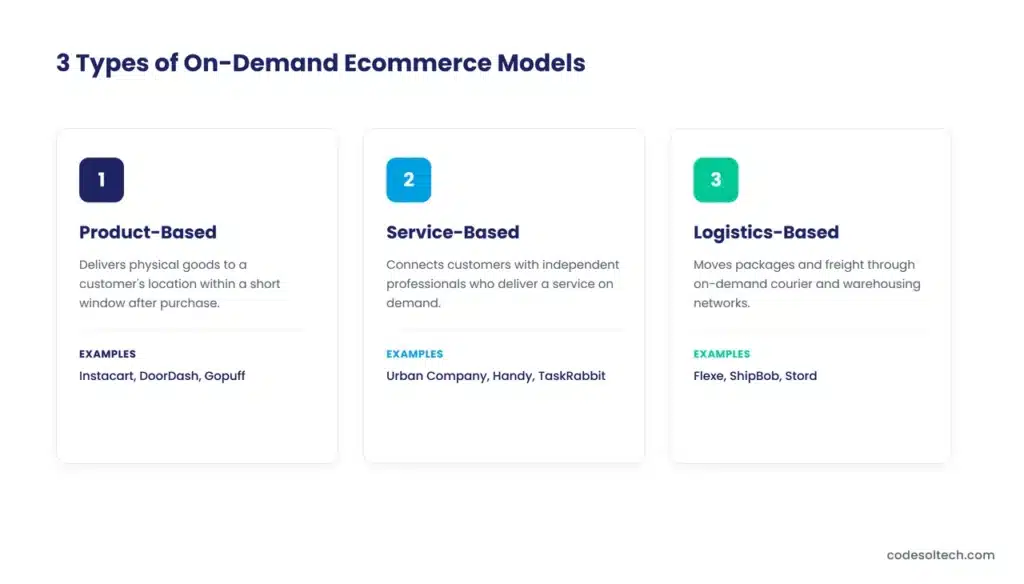
1. Product-Based On-Demand Ecommerce
Product-based on-demand ecommerce delivers physical goods groceries, meals, retail items, or pharmacy orders — to a customer’s location within a short window after purchase.
Instacart, DoorDash, and Gopuff operate this model. The platform connects to a merchant’s live inventory feed, processes the order, and routes it to a delivery provider.
- Requires real-time inventory sync with the merchant’s point-of-sale or ERP system
- Depends on dynamic delivery-radius logic based on driver availability
- Uses substitution rules for out-of-stock items during picking
2. Service-Based On-Demand Ecommerce
Service-based on-demand ecommerce connects customers with independent professionals, cleaners, technicians, tutors, or freelancers who deliver a service at the customer’s location or remotely.
Urban Company, Handy, and TaskRabbit run this model. The platform manages provider vetting, scheduling, and in-app payment.
- Requires a provider-rating and background-verification system
- Uses calendar-based slot booking alongside instant-request dispatch
- Depends on in-app messaging for pre-service coordination
3. Logistics-Based On-Demand Ecommerce
Logistics-based on-demand ecommerce moves packages, pallets, or freight between businesses and customers through on-demand courier, warehousing, or last-mile networks.
Flexe, ShipBob, and Stord operate this model. The platform exposes shipping and warehousing capacity through an API that other ecommerce businesses plug into.
- Requires multi-carrier API integration for rate shopping and label generation
- Uses warehouse-management system (WMS) data to allocate storage on demand
- Depends on route-optimization algorithms for last-mile delivery
How Does an On-Demand Ecommerce Platform Work?
An on-demand ecommerce platform works through 4 integrated layers: a customer-facing app, a provider or supply-side dashboard, a matching-and-dispatch engine, and a payment-settlement backend.
Each layer communicates through APIs in real time, so a single order triggers inventory checks, provider assignment, and payment authorization within seconds.
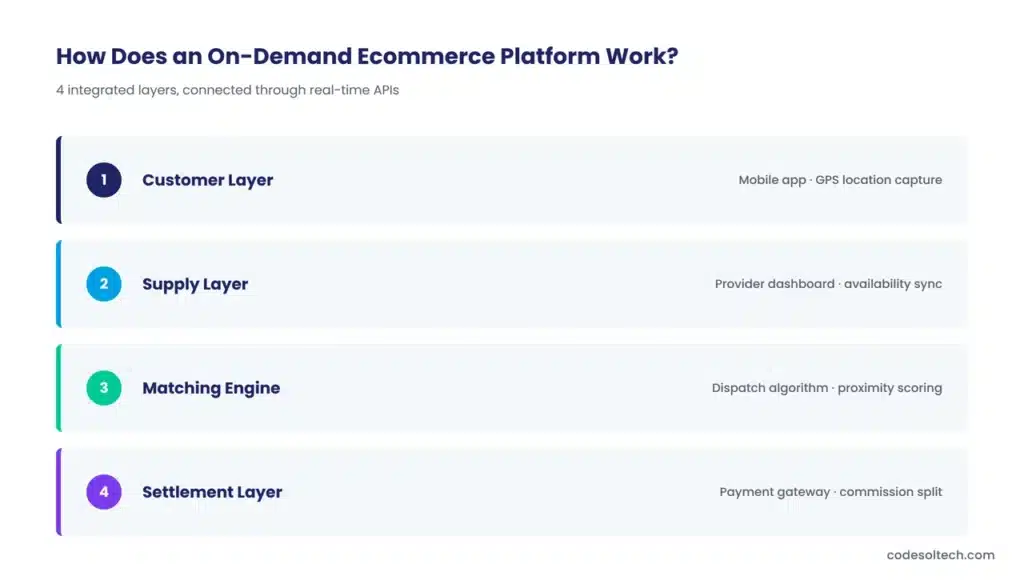
- Customer layer: The mobile app or web storefront captures the request, location, and payment method.
- Supply layer: The provider app or merchant dashboard receives the order and confirms availability.
- Matching engine: A dispatch algorithm scores available providers by proximity, rating, and current load, then assigns the order.
- Settlement layer: The payment gateway authorizes the charge, splits the commission, and releases the payout to the provider.
Custom-built platforms configure this stack around specific business rules, commission tiers, service-area boundaries, and surge conditions.
Off-the-shelf scripts hard-code these rules, which limits how the business can evolve pricing or expansion strategy later.
On-Demand vs Traditional vs Subscription Ecommerce
| Factor | On-Demand Ecommerce | Traditional Ecommerce | Subscription Ecommerce |
|---|---|---|---|
| Fulfillment speed | Minutes to same-day | 2–7 days | Fixed recurring cycle |
| Revenue model | Commission or per-order fee | Per-unit sale margin | Recurring subscription fee |
| Inventory ownership | Often third-party (merchant/provider) | Typically owned by the seller | Owned, pre-committed stock |
| Core technical dependency | Real-time dispatch and GPS | Warehouse and shipping integration | Recurring billing engine |
| Customer expectation | Immediate access | Reliable delivery window | Consistent, predictable delivery |
| Examples | Instacart, Urban Company, Flexe | Shopify DTC stores, Amazon retail | Dollar Shave Club, meal-kit brands |
Why Custom Development Outperforms Off-the-Shelf On-Demand Platforms
Off-the-shelf on-demand scripts run on shared, vendor-controlled codebases with fixed commission logic and generic dispatch rules.
This works for a single-city pilot. It fails once a business needs custom pricing tiers, a specific ERP integration, or dispatch logic tuned to its own service radius.
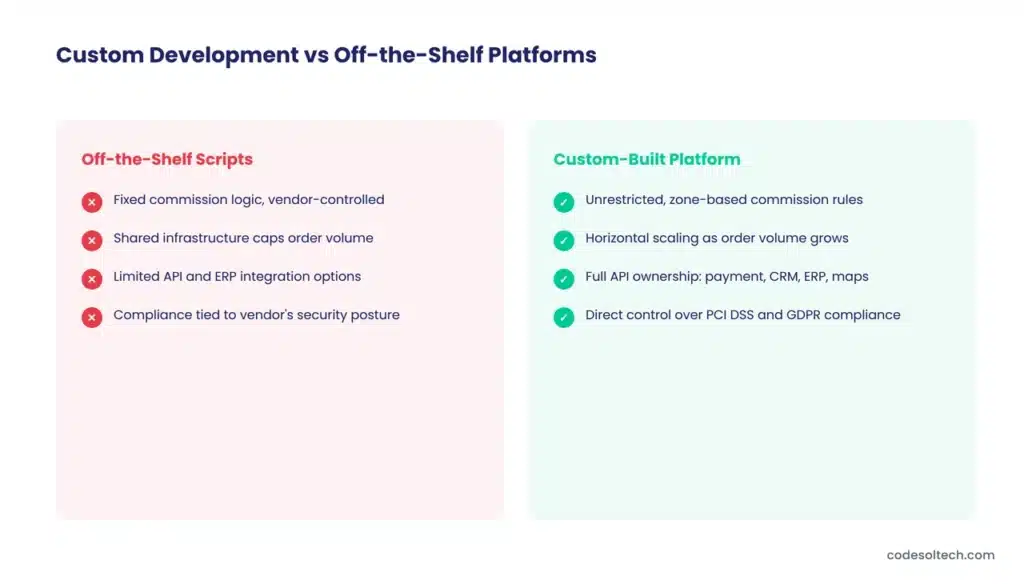
Custom development gives the business 4 structural advantages that off-the-shelf platforms cannot match:
- API ownership: The business controls every integration point, payment gateway, CRM, ERP, and mapping provider — instead of working within a vendor’s fixed plugin list.
- Unrestricted commission logic: Custom platforms configure tiered, zone-based, or provider-specific commission rules without a vendor’s licensing cap.
- Data ownership and compliance control: Custom-built platforms manage their own data infrastructure, which simplifies PCI DSS and GDPR compliance instead of depending on a third-party vendor’s security posture.
- Scalability past fixed vendor limits: A custom-built dispatch engine scales horizontally as order volume grows; off-the-shelf scripts hit performance ceilings tied to the vendor’s shared infrastructure.
This is the same reason businesses running subscription ecommerce models eventually move off template platforms once recurring billing logic gets complex the underlying pattern is identical: rigid templates work for MVPs, not for scaled operations.
What Does It Cost to Build a Custom On-Demand Ecommerce Platform?
Custom on-demand ecommerce platform development falls into 3 cost tiers based on scope: MVP, mid-market, and enterprise.
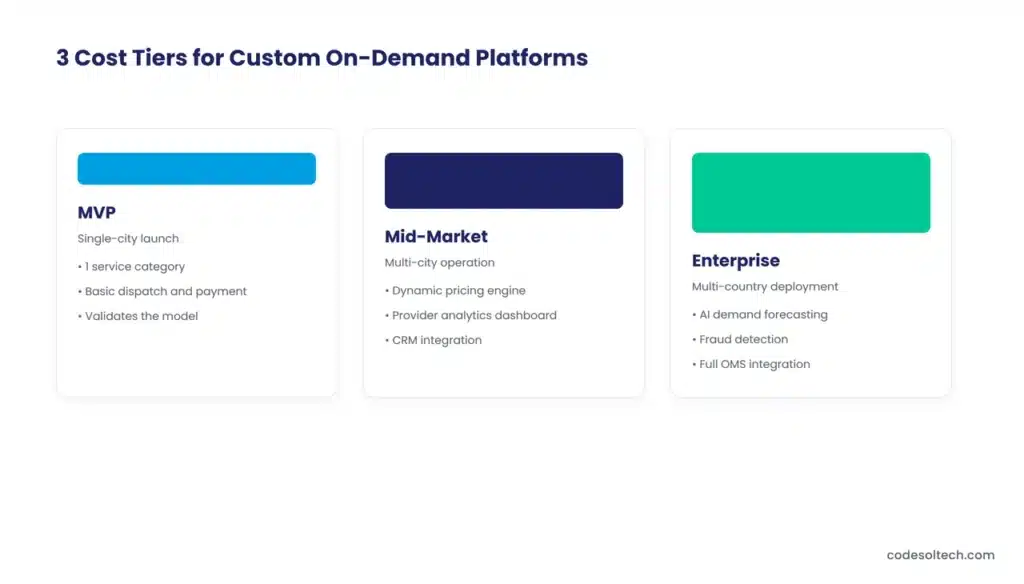
The determining factors are the number of user roles (customer, provider, admin), the complexity of the dispatch algorithm, and the depth of third-party integrations required.
- MVP tier: Single-city launch, 1 service category, basic dispatch and payment validates the model before regional expansion.
- Mid-market tier: Multi-city operation, dynamic pricing engine, provider analytics dashboard, and CRM integration for retention marketing.
- Enterprise tier: Multi-country deployment, AI-based demand forecasting, fraud detection, and full order management system integration across regions.
The cost gap between tiers comes almost entirely from integration depth, not screen count. A platform with 20 screens and 3 deep API integrations (payment, mapping, ERP) costs more to build correctly than a 40-screen platform with no external dependencies.
Final Words
On-demand ecommerce models win or fail on architecture, not idea quality. Product-based, service-based, and logistics-based models each demand a different dispatch and integration stack.
Off-the-shelf scripts get a pilot live fast, then block growth. Custom development costs more upfront and removes the ceiling entirely.
Building an on-demand ecommerce platform that needs to survive its first traffic spike, not just its demo?

![4 Quiet Cloud Security Gaps Attackers Love [Fix Them Now]](https://www.codesoltech.com/wp-content/uploads/2026/10/Cloud-Security-Gaps-.webp)