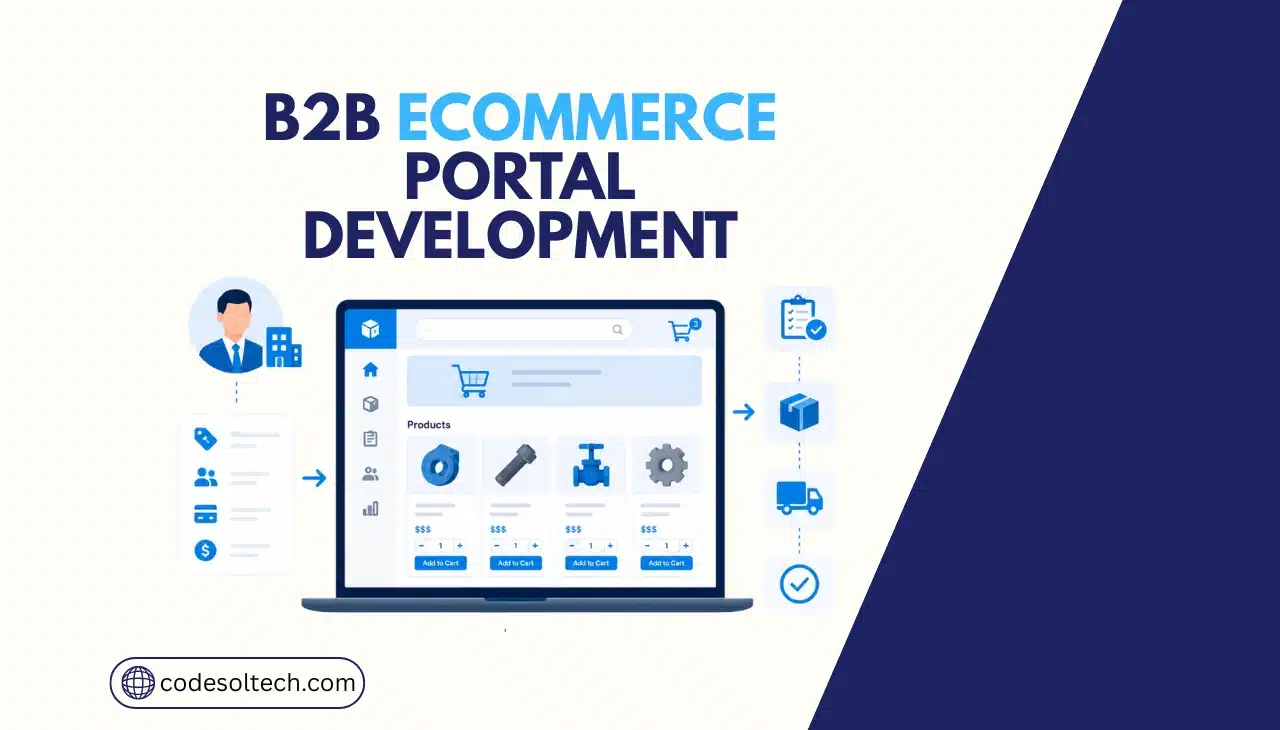
B2B ecommerce portal development builds a self-service digital storefront that lets business buyers browse custom catalogs, request quotes, and reorder products without contacting a sales rep. The portal integrates directly with ERP, CRM, and inventory systems to synchronize pricing, stock, and order data in real time.
The global B2B ecommerce market reached $24.1 trillion in 2025 and is projected to grow to $28.0 trillion in 2026, expanding to $105.9 trillion by 2033 at a 20.9% compound annual growth rate.
This growth confirms that buyers now expect digital self-service as the default purchasing channel, not an alternative to phone or email ordering.
Why B2B Companies Need a Dedicated Ecommerce Portal
Manual order processing through phone, email, and fax generates data entry errors, delays fulfillment, and limits order visibility for the buyer.
A B2B ecommerce portal removes these bottlenecks by centralizing catalog data, pricing logic, and order history in one system. This structure benefits three groups directly:
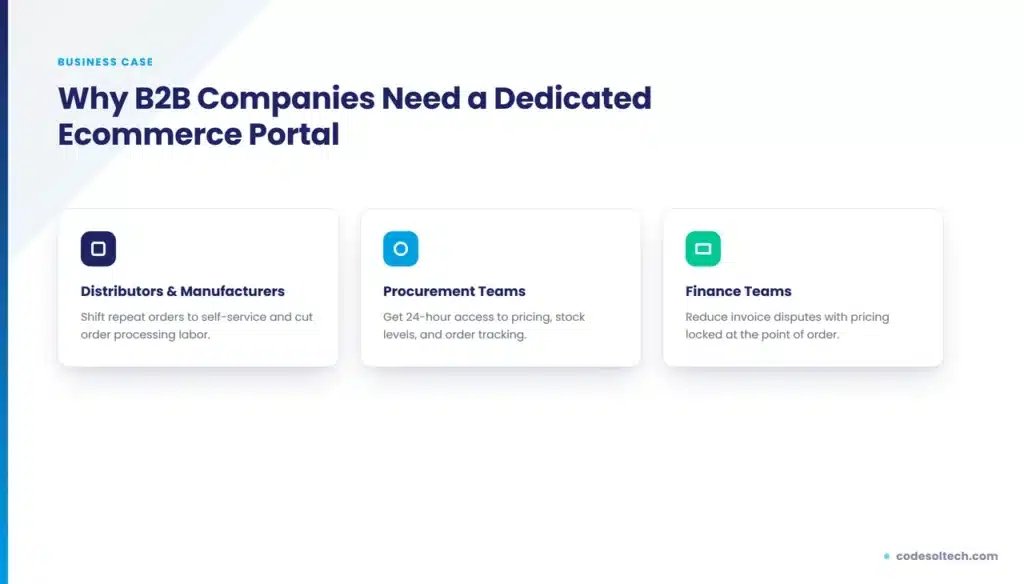
- Distributors and manufacturers reduce order processing labor by shifting repeat orders to self-service.
- Procurement teams at buyer organizations gain 24-hour access to pricing, stock levels, and order tracking.
- Finance teams reduce invoice disputes because pricing and quantities are locked at the point of order, not re-keyed manually.
Gartner’s research on B2B buying journeys shows that purchase decisions increasingly involve multiple stakeholders across procurement, finance, and operations.
A portal that supports layered approval workflows reduces the internal friction this creates, because each stakeholder can review and approve within the same system instead of over email threads.
Core Architecture of a B2B Ecommerce Portal
A B2B ecommerce portal architecture consists of four layers: the storefront layer, the business logic layer, the integration layer, and the data layer.
Each layer performs a distinct function and connects to the next through defined APIs. Development teams configure these layers separately, which allows the agency to scale or replace individual components without rebuilding the full platform.
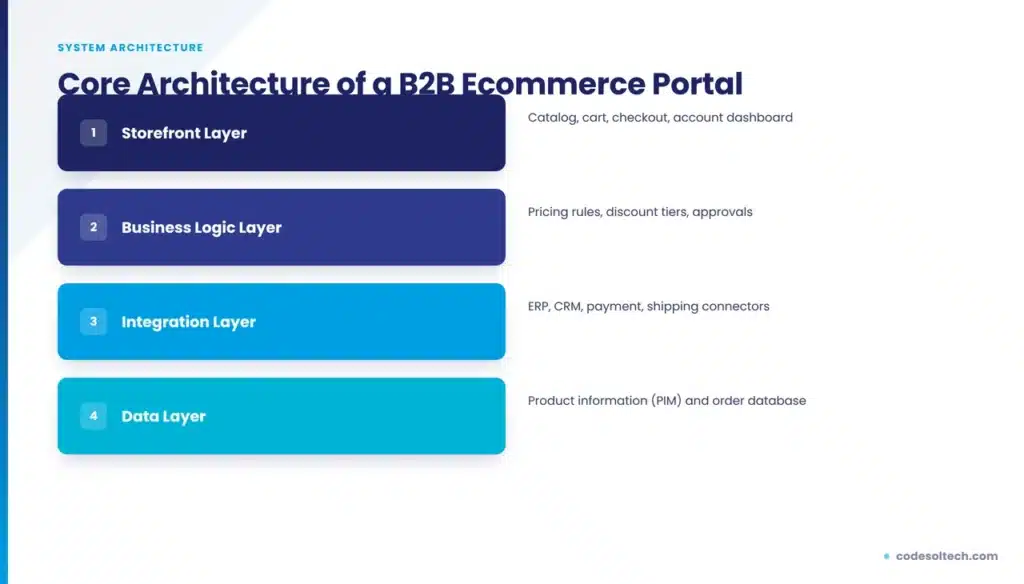
- Storefront layer: the buyer-facing interface, including catalog browsing, cart, checkout, and account dashboard.
- Business logic layer: pricing rules, discount tiers, approval workflows, and order validation.
- Integration layer: connectors to ERP, CRM, payment gateways, and shipping carriers.
- Data layer: the product information management (PIM) system and order database that store catalog, pricing, and transaction records.
Most agencies build B2B portals on a headless commerce architecture, which separates the frontend storefront from the backend commerce engine through an API.
Headless architecture lets a company update the buyer interface without touching order processing logic, and it lets the platform serve multiple frontends, such as a web portal and a mobile app, from one backend.
This structure supports the custom ecommerce development work required for complex B2B catalogs.
9 Essential Features of a B2B Ecommerce Portal
A functional B2B ecommerce portal requires nine core features. Missing any one of these features forces the buyer back to phone or email ordering, which defeats the purpose of the portal.
- Account-based pricing: each buyer account sees only its negotiated price list, not a public catalog price.
- Bulk and quick-order tools: buyers add products by SKU or upload a CSV order file instead of clicking through pages.
- Real-time inventory visibility: the portal displays live stock counts pulled from the warehouse management system.
- Quote-to-order workflow: buyers request a quote, negotiate terms, and convert the approved quote directly into an order.
- Multi-level approval routing: purchase requests route to a manager or finance approver before the order submits.
- Punchout catalog support: buyers access the supplier catalog directly from their own procurement system.
- Reorder and subscription tools: buyers repeat a past order in one click or schedule recurring shipments.
- Multi-currency and tax logic: the portal calculates tax and displays pricing based on the buyer’s region.
- Order tracking dashboard: buyers view shipment status, invoices, and order history without contacting support.
ERP, CRM, and Punchout (cXML/OCI) Integration
ERP integration synchronizes inventory, pricing, and order data between the ecommerce portal and the company’s core operations system. Without this integration, staff must manually update stock levels and pricing across two systems, which introduces delay and error.
ERP integration connects systems such as SAP, NetSuite, or Microsoft Dynamics to the portal through middleware or a direct API, so that an order placed on the portal deducts inventory in the ERP in real time.
CRM integration gives the sales team visibility into portal activity, including quote requests, cart abandonment, and reorder frequency, inside the same CRM record they already use for that account.
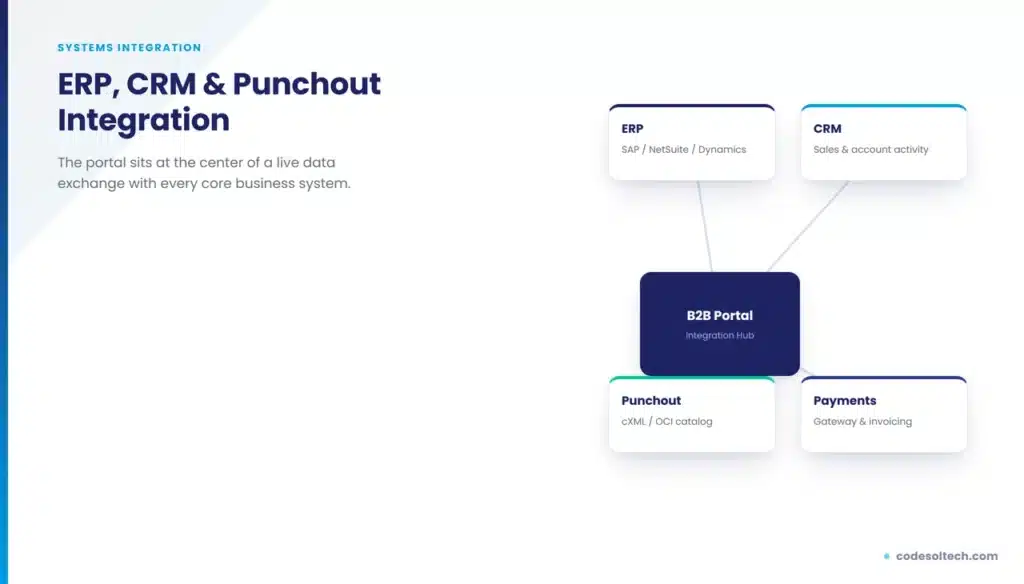
This integration lets account managers intervene on stalled quotes without asking the buyer to repeat information already entered in the portal.
Punchout integration lets enterprise buyers access a supplier’s catalog directly from their own procurement software, such as Ariba, Coupa, or Oracle Procurement Cloud. The portal exchanges catalog and order data with the buyer’s system using the cXML or OCI protocol.
This integration is a requirement, not an option, for suppliers targeting enterprise accounts that mandate punchout as a condition of doing business.
Multi-Entity Account Hierarchies and Role-Based Access Control
A multi-entity account hierarchy lets one parent organization manage multiple sub-accounts, such as regional branches or franchise locations, under a single portal login.
The parent account sets pricing rules, credit limits, and catalog access for each sub-account, and can view consolidated order history across every location.
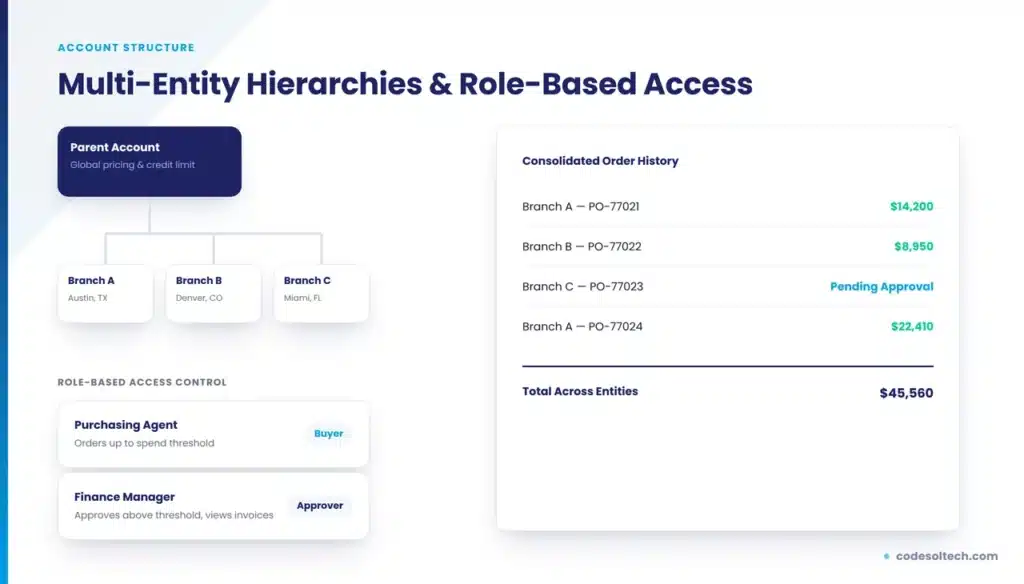
Role-based access control (RBAC) restricts what each user within an account can do inside the portal. A purchasing agent can place orders up to a set dollar threshold, while a finance manager approves orders above that threshold and views invoice history.
This structure prevents unauthorized spending and gives the buyer organization the internal controls their finance department requires.
Custom Pricing, Quoting, and Contract Management
Custom pricing engines calculate the correct price for each buyer based on contract terms, order volume, and product category, rather than applying one price list to every account.
A pricing engine evaluates rules in a fixed order: contract price first, then volume-tier discount, then any active promotion. This calculation happens at checkout, in real time, so the buyer never sees a price that does not match their contract.
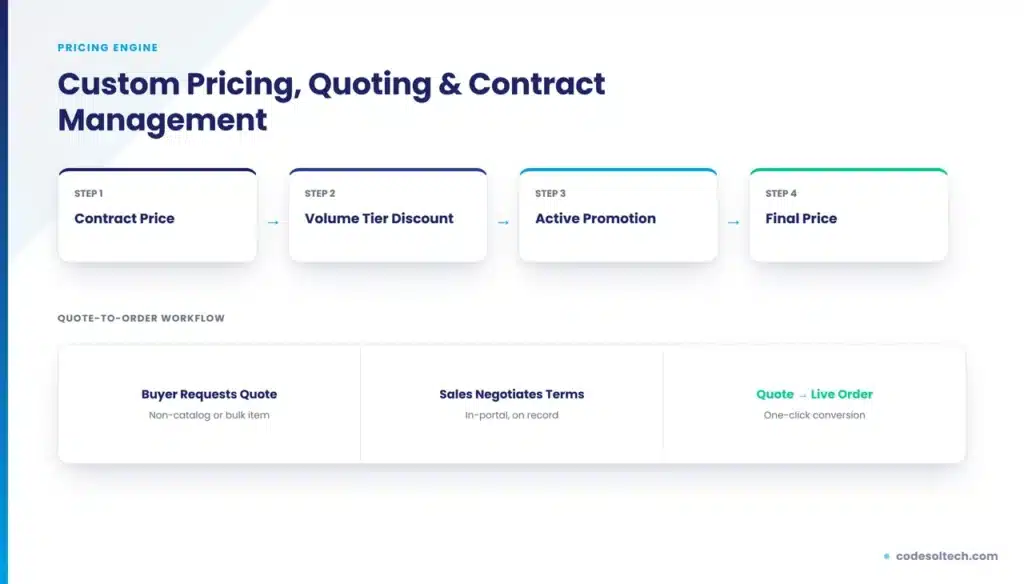
Quote management tools let a buyer request a custom quote for non-catalog items or large volume orders, negotiate terms with the sales team inside the portal, and convert the accepted quote into a live order with one action.
This workflow keeps the entire negotiation on record, which reduces disputes over agreed pricing at invoicing.
B2B Ecommerce Portal vs Traditional Order Channels
A B2B ecommerce portal replaces the manual steps required by phone, email, and EDI ordering with a self-service workflow. The table below compares the three channels across the factors that affect order accuracy and buyer experience.
| Factor | Phone / Email Ordering | EDI | B2B Ecommerce Portal |
|---|---|---|---|
| Buyer self-service | None | None | Full |
| Real-time inventory visibility | No | Limited | Yes |
| Setup complexity for new buyers | Low | High | Medium |
| Order error risk | High (manual entry) | Low | Low |
| Best fit | Small, irregular buyers | Large enterprise, fixed catalogs | Mid-market to enterprise, all order sizes |
Does a B2B Portal Replace the Sales Team?
A B2B ecommerce portal does not replace the sales team; it removes repeat, low-value order processing from the sales team’s workload.
Sales reps shift their time toward new account acquisition and complex quote negotiation, while the portal handles reorders, catalog browsing, and standard order submission.
This division of labor is why order management systems and portal platforms are typically implemented together, not as competing tools.
How Much Does B2B Ecommerce Portal Development Cost?
B2B ecommerce portal development cost depends on three variables: the number of system integrations required, the complexity of the pricing and approval logic, and the size of the product catalog. Agencies typically scope B2B portal projects into three tiers based on these variables.
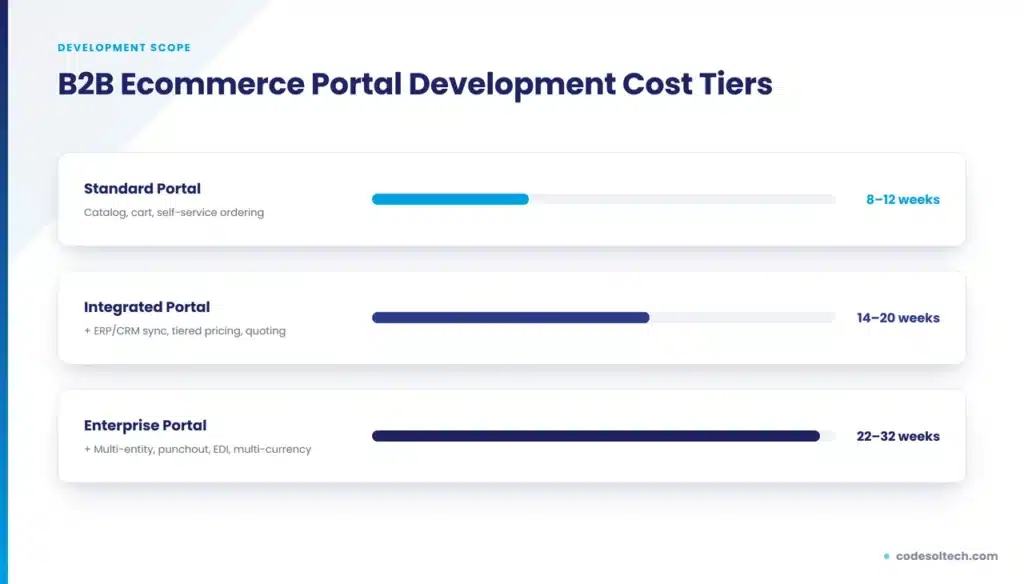
- Standard portal: catalog browsing, cart, self-service ordering, and basic account pricing. Development timeline runs 8 to 12 weeks.
- Integrated portal: adds ERP and CRM synchronization, tiered pricing, and quote-to-order workflow. Development timeline runs 14 to 20 weeks.
- Enterprise portal: adds multi-entity account hierarchies, punchout catalog support, EDI, and multi-currency logic. The development timeline runs 22 to 32 weeks.
Final cost varies by integration scope, catalog size, and existing system compatibility. Request a project scope to get an accurate estimate based on your current ERP, CRM, and catalog structure.
B2B Ecommerce Portal Development Process: 6-Phase Timeline
B2B ecommerce portal development follows six phases from discovery to launch. Each phase produces a deliverable that the next phase depends on, so skipping a phase increases rework later in the build.
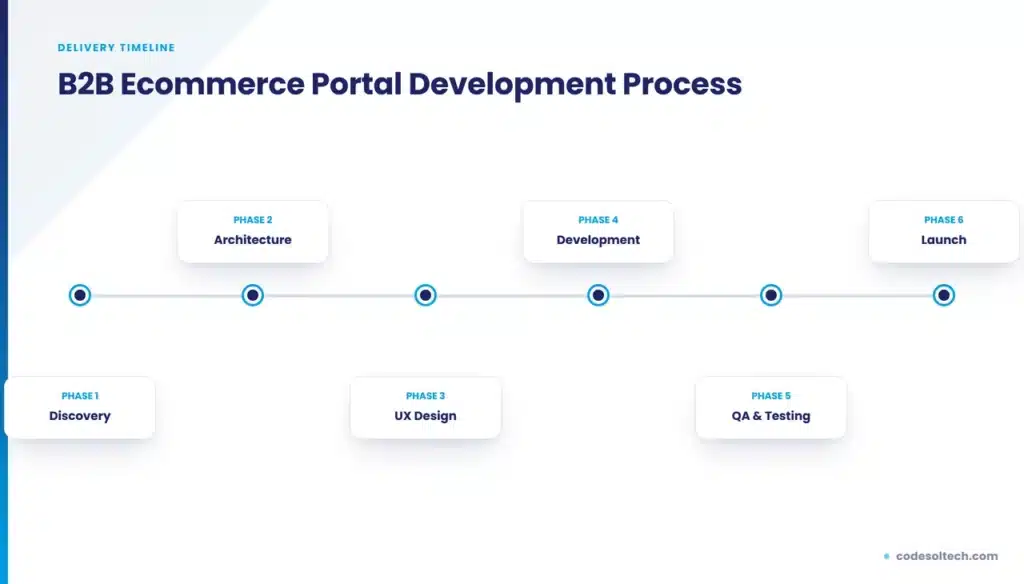
- Phase 1 — Discovery and requirements mapping: the agency audits existing ERP, CRM, and catalog data structures.
- Phase 2 — Architecture and integration planning: the team defines the API connections between the portal, ERP, and payment gateway.
- Phase 3 — Storefront and UX design: designers build the catalog browsing, cart, and account dashboard interfaces.
- Phase 4 — Backend development and integration build: developers connect the pricing engine, inventory sync, and approval workflows.
- Phase 5 — Quality assurance and load testing: the team tests order accuracy, pricing logic, and system performance under peak load.
- Phase 6 — Launch and post-launch monitoring: the portal goes live, with order and integration monitoring for the first 30 to 60 days.
Post-launch, most companies extend the portal with additional capabilities, including fulfillment automation, multi-store backend management for companies operating separate regional storefronts, and fraud detection for portals processing high-value B2B transactions.
Final Words
B2B ecommerce portal development turns a manual, phone-driven sales process into a self-service revenue channel. A well-architected portal reduces order errors, cuts processing time, and gives buyers direct access to pricing, inventory, and order history.
Companies that integrate ERP and CRM into the portal from day one convert faster and retain more accounts than those relying on legacy order channels.
Build a B2B Portal That Scales With Your Account Base
CodeSol Technologies designs and develops custom B2B ecommerce portals with ERP, CRM, and punchout integration built in from day one.

![Electrician CRM: Win More Jobs [Faster Estimates Guide]](https://www.codesoltech.com/wp-content/uploads/2026/10/Crm-for-an-electricians-business.webp)