

An ecommerce fraud detection system identifies and blocks unauthorized or deceptive transactions before they generate financial loss.
Global ecommerce fraud losses reached $48 billion in 2023, making automated fraud detection a mandatory component of any online retail infrastructure.
These systems combine rule-based filters, machine learning models, and behavioral analytics to evaluate every transaction in real time typically returning a decision in under 300 milliseconds.
This article covers how fraud detection systems work, what risk scoring calculates, how AI models outperform static rules, and which prevention practices reduce chargeback rates to below the critical 1% threshold.
What Is an Ecommerce Fraud Detection System?
An ecommerce fraud detection system is a software layer that analyzes transaction data, user behavior, and device signals to assign a fraud probability to each order or payment event.
The system executes this analysis at checkout, account login, or payment processing then blocks, flags, or approves the transaction based on a predefined risk threshold.
These systems operate through 3 primary mechanisms:
- Rule-based filters — Static logical conditions that trigger alerts automatically (e.g., orders over $500 from a newly created account with a mismatched billing address)
- Machine learning models — Algorithms trained on historical fraud data that detect anomalous patterns invisible to static rules
- Behavioral analytics — Real-time monitoring of user actions including typing speed, mouse movement, and session navigation sequences
Ecommerce platforms integrate fraud detection via APIs from providers such as Stripe Radar, SEON, Signifyd, or Kount. These tools connect directly to the payment gateway layer and process signals without interrupting the customer checkout experience.
The full fraud decision pipeline from data collection to approve/decline action completes within a single transaction authorization call.
7 Types of Ecommerce Fraud That Directly Cost Merchants Revenue
Ecommerce fraud takes 7 distinct forms. Each form targets a different stage of the transaction lifecycle and requires a dedicated detection strategy.
Merchants who deploy only a single detection layer fail to cover the full attack surface.
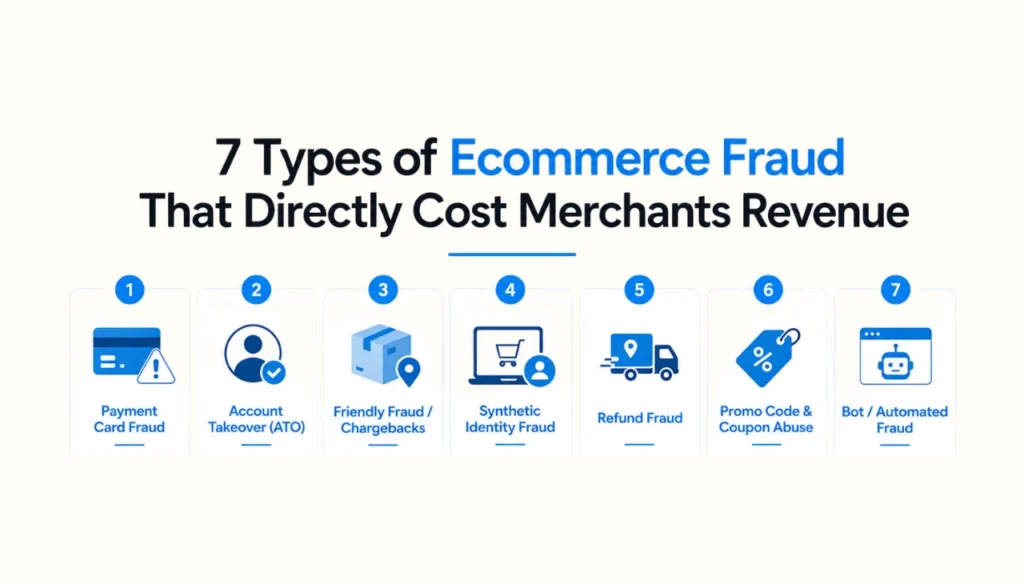
- Card-not-present (CNP) fraud — A fraudster uses stolen card credentials to complete online purchases without possessing the physical card. CNP fraud accounts for 73% of all card fraud losses globally.
- Account takeover (ATO) — An attacker gains unauthorized access to a legitimate customer account through credential stuffing or phishing, then places fraudulent orders using stored payment methods.
- Chargeback fraud (friendly fraud) — A customer completes a legitimate purchase, then disputes the transaction with their issuing bank to receive a refund while keeping the product or service.
- Triangulation fraud — A fraudster creates a fake storefront, collects real customer payment data at checkout, fulfills those orders using stolen cards from a separate source, and disappears with the harvested credentials.
- Refund fraud — A bad actor exploits return and refund policies to receive money back for items never purchased, never shipped, or never returned.
- Promo abuse — Fraudsters create multiple fake accounts to repeatedly redeem single-use discount codes, referral bonuses, or new-customer promotions meant for unique users.
- Synthetic identity fraud — A fraudster constructs a fake identity by combining real and fabricated personal data to open merchant accounts and execute purchases that are difficult to trace.
Each fraud type maps to a specific weakness in the ecommerce transaction flow from account creation through post-purchase dispute resolution.
A layered fraud detection architecture addresses all 7 vectors simultaneously rather than patching vulnerabilities one at a time.
How Does Risk Scoring Work in Ecommerce Fraud Detection?
Risk scoring assigns a numerical fraud probability on a scale of 0 to 100 to each transaction or user session. A score of 0 signals a clean transaction; a score of 100 signals confirmed fraud.
Merchants configure 3 action thresholds: transactions scoring above 75 are blocked automatically, those scoring between 50 and 75 are routed to a manual review queue, and those scoring below 50 are approved without friction.
The risk score aggregates signals across 5 data categories:
- Transaction data — Order value, product category, billing-to-shipping address match status, and payment method type
- Device signals — IP address geolocation, device fingerprint hash, browser configuration, and VPN or proxy detection status
- User behavior — Time spent on the checkout page, keystroke dynamics, and page navigation sequence
- Identity signals — Email domain age, phone number carrier verification, and social media profile existence linked to the email
- Historical data — Previous transaction records, chargeback rate associated with the card BIN, and account age at time of purchase
Advanced fraud platforms such as SEON analyze over 200 data points per transaction to compute the final risk score.
The scoring model continuously using confirmed fraud outcomes and chargeback report data, which prevents score drift as fraud patterns evolve.
Static risk models that do not retrain become ineffective within 3 to 6 months of deployment as attackers adapt their methods.
What Is a Velocity Check in Fraud Detection?
A velocity check is a rule that flags or blocks activity when a specific action exceeds a defined frequency within a set time window.
For example, a velocity check triggers an alert when 5 or more orders originate from the same IP address within 10 minutes.
This rule directly targets automated fraud attacks, card testing operations, and promo abuse campaigns that execute high transaction volumes in rapid succession.
Velocity checks apply across 4 dimensions: IP address, email domain, card BIN, and device fingerprint.
AI and Machine Learning Fraud Detection: How the Technology Works
AI fraud detection uses supervised and unsupervised machine learning models to identify fraudulent transactions based on patterns learned from historical data. Supervised models train on labeled datasets of confirmed fraud and legitimate transactions.
Unsupervised models detect behavioral anomalies without requiring pre-labeled fraud examples, making them effective against new, previously unseen fraud patterns.

Machine learning fraud detection systems deploy 4 model architectures:
- Logistic regression — Calculates the probability of fraud based on weighted input variables; fast to execute and interpretable by fraud analysts
- Random forest — Combines hundreds of decision trees to classify transactions; handles high-dimensional, imbalanced datasets without overfitting
- Gradient boosting (XGBoost) — Builds sequential decision trees where each tree corrects errors from the previous iteration; achieves the highest accuracy on skewed fraud datasets
- Neural networks — Detects complex non-linear fraud patterns across large transaction volumes; deployed by enterprise systems processing millions of daily transactions
AI models reduce false positive rates legitimate transactions incorrectly flagged as fraud by learning the behavioral baseline of each customer.
A false positive rate above 3% causes measurable revenue loss and increases customer churn. This is the primary commercial advantage of AI-based detection over static rule systems: fewer blocked legitimate orders without increasing fraud exposure.
See how AI integrations function across ecommerce infrastructure.
Rule-Based Systems vs. Machine Learning: 4 Key Differences
Rule-based fraud systems apply fixed logical conditions defined by human analysts. Machine learning systems derive detection logic automatically from transaction data. These 2 approaches differ across 4 critical operational dimensions:
- Adaptability — Rule-based systems require manual updates when new fraud patterns emerge. ML systems retrain automatically as new confirmed fraud data flows into the feedback loop.
- Accuracy — Rule-based systems generate higher false positive rates because they cannot account for individual customer context. ML systems reduce false positives by modeling customer-specific purchase behavior.
- Scalability — Rule-based systems degrade in detection performance as transaction volume and data complexity grow. ML systems scale proportionally with data volume and maintain accuracy at high throughput.
- Transparency — Rule-based decisions are fully auditable at every step. Neural network decisions require explainability tools — such as SHAP (SHapley Additive exPlanations) values — to interpret why a transaction was flagged.
Production fraud detection architectures deploy both systems in parallel. Rule-based filters handle obvious, high-confidence fraud signals instantly.
ML models process ambiguous cases and refine risk scores using complex pattern combinations. This hybrid approach reduces both fraud losses and false positive rates below what either system achieves independently.
5 Core Components of a Production Fraud Detection System
A production-grade ecommerce fraud detection system contains 5 functional components that operate as a sequential data pipeline:

- Data ingestion layer — Collects transaction, device, and behavioral data from checkout pages, payment APIs, and account management systems in real time
- Feature engineering module — Transforms raw data into structured variables used as model inputs, such as “days since account creation,” “number of distinct cards used in the last 24 hours,” or “distance between billing and shipping geolocation”
- Scoring engine — Executes the risk scoring model against the engineered features and returns a fraud probability score within milliseconds
- Decision engine — Applies merchant-configured business rules to the risk score to produce a final approve, manual review, or decline action
- Case management interface — Provides a dashboard for fraud analysts to review flagged transactions, confirm or clear fraud decisions, and feed confirmed outcomes back into the ML training pipeline
The feedback loop between the case management interface and the scoring engine is the critical mechanism that prevents model decay. Without confirmed fraud labels flowing back into the model, detection accuracy degrades as fraud patterns shift.
How Does Chargeback Fraud Affect Ecommerce Merchants?
Chargeback fraud also called friendly fraud occurs when a customer disputes a legitimate transaction with their issuing bank by claiming the purchase was unauthorized.
The merchant loses the transaction amount, pays a chargeback processing fee between $15 and $100 per incident, and absorbs the cost of any fulfilled product or service.
Visa and Mastercard impose penalty programs on merchants whose chargeback rate exceeds 1% of monthly transaction volume, triggering higher processing fees or account termination.
Fraud detection systems reduce chargeback exposure through 3 specific mechanisms:
- Address Verification Service (AVS) — Matches the billing address submitted at checkout against the address registered with the card issuer; mismatches elevate the transaction risk score
- Order velocity monitoring — Detects repeat purchases by the same customer that deviate from their established buying pattern, flagging potential unauthorized card use
- 3D Secure 2.0 (3DS2) — Transfers liability for card-not-present fraud chargebacks from the merchant to the card issuer when the authentication protocol is applied successfully to the transaction
Implementing 3DS2 across all card-not-present transactions eliminates merchant chargeback liability on authenticated orders. This single protocol change reduces chargeback-related losses without requiring manual review overhead.
Explore how ecommerce security configurations embed 3DS2 and AVS at the payment processing layer.
Device Fingerprinting and Behavioral Analytics
Device fingerprinting collects and hashes 50 or more browser and hardware attributes, including screen resolution, installed fonts, GPU renderer string, timezone offset, and user agent to generate a unique device identifier.
This identifier persists across browser sessions and incognito mode, enabling fraud systems to link multiple accounts or transactions to the same physical device even when the user changes email addresses or IP addresses.

Behavioral analytics monitors 4 categories of user interaction during the checkout session:
- Biometric patterns — Typing speed, keystroke timing intervals, and mouse movement trajectories that distinguish human users from automated bot scripts
- Navigation flow — Page visit sequence and time-on-page ratios that reveal whether a user follows a normal purchase decision path or jumps directly to checkout
- Form interaction — Auto-fill detection, copy-paste events in card number fields, and field completion order that indicate script-driven versus manually typed entry
- Session anomalies — Simultaneous active sessions from the same account, geographic location changes mid-session, or transaction attempts executed within seconds of account creation
Combining device fingerprinting with behavioral analytics creates a fraud signal that resists identity spoofing.
A fraudster using a stolen card cannot replicate the behavioral interaction profile of the legitimate cardholder causing the behavioral analytics module to flag the session regardless of how accurately the stolen credentials match the card issuer’s records.
8 Ecommerce Fraud Prevention Best Practices
Fraud prevention requires a layered defense strategy that addresses detection, authentication, and post-purchase monitoring as a single architecture rather than isolated tools.
These 8 practices form the operational baseline for any ecommerce fraud program:
- Deploy a hybrid fraud detection system that combines rule-based filters and machine learning models in parallel
- Implement 3D Secure 2.0 across all card-not-present transactions to transfer chargeback liability to the card issuer
- Configure velocity checks on IP addresses, email domains, card BINs, and device fingerprints
- Enable device fingerprinting on account creation pages, login events, and checkout flows
- Integrate real-time email and phone number validation at registration to block synthetic identity account creation
- Build a chargeback dispute workflow with automated evidence collection, including delivery confirmation, IP session logs, and device fingerprint records
- Retrain fraud scoring models monthly using confirmed fraud cases and chargeback outcome data
- Apply AVS and CVV verification at the payment gateway level for all card transactions, regardless of order value
Final Words
Ecommerce fraud detection is an engineering decision, not just a security policy. The wrong system blocks legitimate customers; the absent system funds fraudsters.
Combining AI risk scoring, device fingerprinting, 3DS2, and velocity checks creates a defense architecture that scales with transaction volume and adapts to new attack patterns without manual intervention.
The merchants who lose the most to fraud are those treating detection as a one-time configuration rather than a continuously maintained system.
Build a Secure Ecommerce Platform with Built-In Fraud Detection
We develop custom ecommerce systems with production-grade fraud detection, payment gateway integration, and AI-powered risk scoring architected from day one not bolted on after launch.