
Subscription ecommerce works by charging customers recurring monthly or annual fees for ongoing products or services, creating predictable revenue and 3–5x higher customer lifetime value than one-time buyers.
In 2026, the biggest opportunities are AI-driven replenishment, B2B consumables, and personalized wellness subscriptions, while the main reasons subscription businesses fail are high churn, weak retention, and poor unit economics.
The subscription model is not a new idea. The Book-of-the-Month Club launched it in 1926. Columbia House ran it for 60 years.
But the internet turned it into a multi-hundred-billion-dollar industry, one that has reshaped how consumers shop, how businesses get funded, and how brands think about customer relationships.
Today, subscription businesses span everything from razor blades to pet food to cloud software. The rules are the same as always: charge periodically, deliver value consistently, and keep customers from leaving.
The execution, however, is harder than it looks.
Key Numbers at a Glance
- $492 billion — Global subscription economy size in 2024
- 435% — Growth in subscription businesses over the last decade
- 3–5x — Higher lifetime value of subscription customers vs. one-time buyers
- 38% — North America’s share of global subscription revenue
What a Subscription Model Actually Is
A subscription ecommerce business charges customers a recurring fee, usually monthly or annually in exchange for regular product delivery or ongoing access to services.
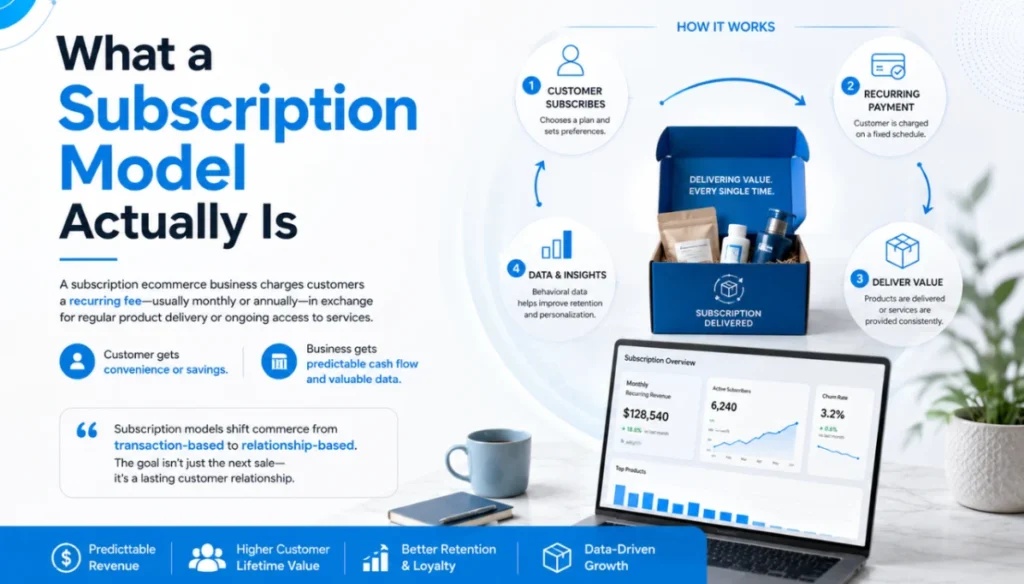
The customer gets convenience or savings. The business gets predictable, recurring cash flow and valuable behavioural data.
What makes this model strategically powerful is the shift from transaction-based to relationship-based commerce. Traditional retail lives and dies on acquisition.
Subscription businesses, in theory, only need to acquire a customer once and then focus on keeping them. The math rewards retention: a customer who stays for 24 months is far more valuable than two customers who each stay for 12.
“Subscription customers generate 3 to 5 times more revenue over their lifetime compared to transactional buyers.” Swell Subscription Commerce Report, 2024
The broader subscription economy, including SaaS, media, and physical goods, reached $492.34 billion in 2024 and is projected to triple to over $1.5 trillion by 2033. The e-commerce-specific segment is growing at a 9.36% CAGR through 2034.
The Three Core Models
Subscription ecommerce is not one thing. There are three structurally different models, each with its own economics, churn profile, and customer psychology.
1. Replenishment Subscriptions
Automates regular delivery of consumable products. The customer sets it up once and stops thinking about it. This is the most defensible model because it solves a real, recurring need.
Examples: Dollar Shave Club, Amazon Subscribe & Save, Chewy AutoShip
Monthly churn rate: Below 4% the lowest of any model
2. Curation Subscriptions
Surprise boxes of themed or personalized products. Sells novelty, discovery, and the unboxing experience. High consumer appeal, but structurally weak retention because novelty fades.
Examples: Birchbox, BarkBox, Stitch Fix, Blue Apron
Monthly churn rate: 10–12% the highest of any model
3. Access / Membership Subscriptions
Members pay a recurring fee for exclusive pricing, early access, or members-only perks not a physical box. The most scalable model but requires a large, loyal customer base.
Examples: Amazon Prime, Costco, Thrive Market
Monthly churn rate: Moderate, varies by category
Curation subscriptions, despite their high churn, account for 55% of all subscription types, reflecting strong consumer appetite for personalized experiences.
Replenishment holds the most defensible economics, capturing over 45% of the subscription-based ecommerce market share.
The Business Case: Why Companies Pursue This Model
The appeal is not just philosophical. Subscription businesses have outperformed the S&P 500 by 4.6 times over the past decade 17.5% vs 3.8% annual growth.
The financial advantages are structural:
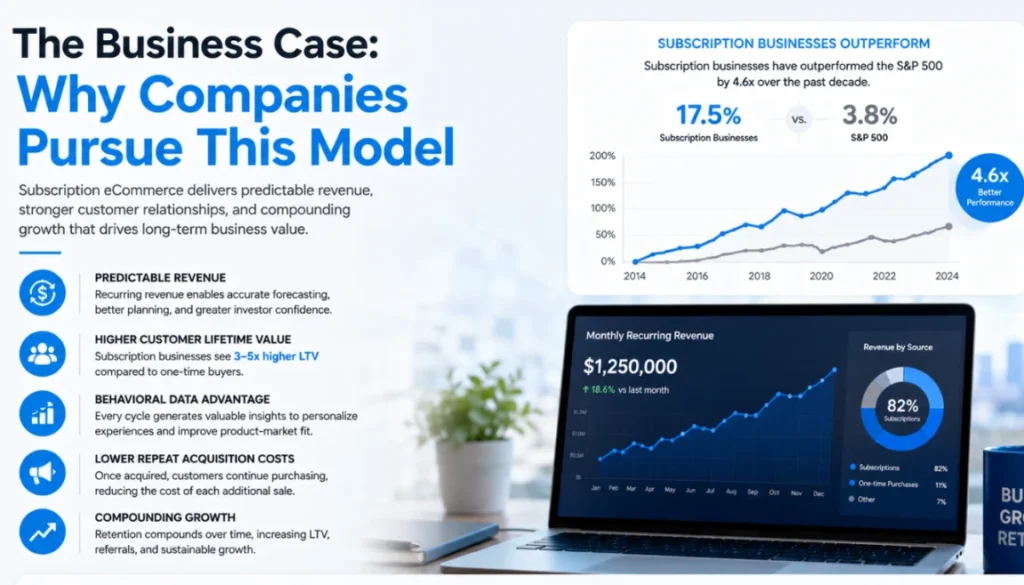
- Predictable revenue. Monthly recurring revenue allows accurate financial forecasting, which improves everything from inventory planning to investor confidence.
- Higher customer lifetime value. Subscription ecommerce businesses see an average retention rate of 67% compared to 30% for standard ecommerce.
- Behavioural data. Every cycle generates data on what customers use, ignore, or cancel, enabling better personalization and inventory decisions.
- Lower repeat acquisition cost. Once a subscriber is locked in, the marginal cost of the next order drops sharply.
- Compounding LTV. Subscription businesses have a 70% higher customer lifetime value than transactional businesses.
Case Study: Chewy AutoShip
Chewy’s AutoShip program demonstrates what replenishment looks like when it works. AutoShip customers generate approximately 82% of Chewy’s net sales an extraordinary concentration of revenue from a single loyalty mechanism.
The reason is structural: pet owners have a consistent, non-negotiable need for food and supplies. The emotional connection to their pets means they are unusually price-insensitive and unlikely to churn.
Chewy reinforced this with exceptional customer service, creating a moat that Amazon despite enormous advantages, has struggled to break through.
The Real Risks: What Kills Subscription Businesses
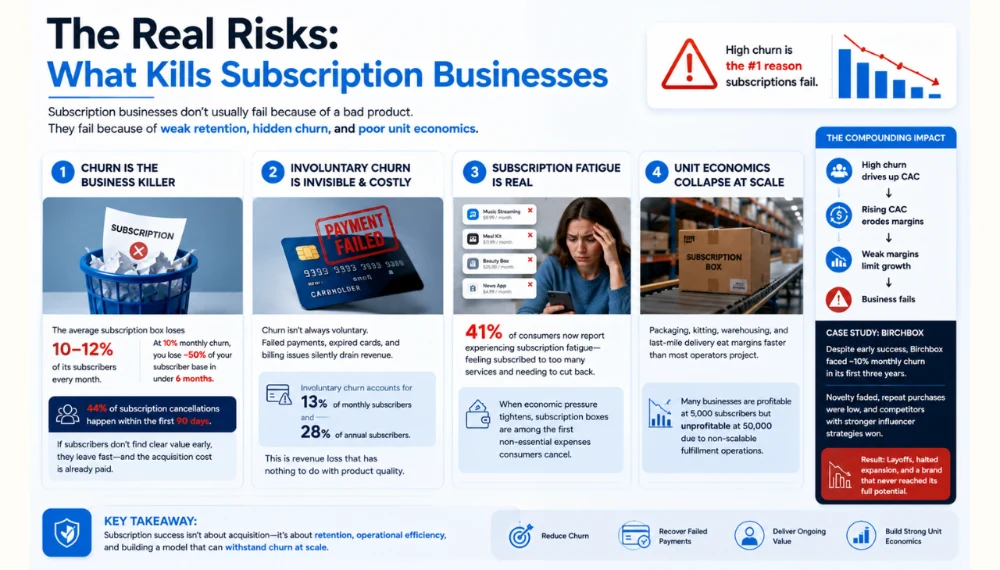
The failure rate in subscription ecommerce is high, and it is rarely because the product is bad. It is almost always because the economics were not stress-tested before scaling.
1. Churn Is the Business Killer
The average subscription box loses 10 to 12% of its subscribers every month. At 10% monthly churn, a business loses roughly half its subscriber base in under six months, meaning it must replace nearly its entire customer base each year just to stay flat.
This is not a growth problem. It is a hole in the bucket.
Critical stat: 44% of subscription cancellations happen within the first 90 days. If a subscriber does not find clear value early, they leave fast and the cost of acquiring them was already paid.
2. Involuntary Churn Is Invisible and Costly
Not all churn is voluntary. A significant share happens because credit cards expire, billing fails, or payment details change.
One DTC brand told Shopify that involuntary churn accounted for 13% of monthly subscribers and 28% of annual ones. This is revenue loss that has nothing to do with product quality.
3. Subscription Fatigue Is Real
41% of consumers now report experiencing subscription fatigue the feeling that they are subscribed to too many services and need to cut back.
When economic pressure tightens, subscription boxes are among the first non-essential expenses consumers cancel.
4. Unit Economics Collapse at Scale
Physical subscription boxes have fixed costs that do not scale gracefully. Packaging, kitting, warehousing, and last-mile delivery eat margins faster than most operators project.
Many subscription box businesses discover they are operationally profitable at 5,000 subscribers but structurally unprofitable at 50,000 because they built fulfillment on manual processes.
Case Study: Birchbox — The Cost of Ignoring Churn
Birchbox practically invented the modern beauty subscription box in 2010. By 2016, it was laying off 25% of its workforce and halting retail expansion. Its churn rate in the first three years of operation was around 10% a number that compounded into an existential problem.
The core issue: Birchbox sent sample-sized products hoping subscribers would buy full-size versions through its online store. Most did not.
Meanwhile, competitors like Ipsy aggressively built influencer networks that Birchbox was slow to recognize as a threat.
Birchbox’s mistake was treating the subscription as the product, rather than as the front door to a larger purchase relationship.
What Actually Makes Subscription Ecommerce Work
The businesses that survive and scale share a consistent set of structural characteristics. These are not nice-to-haves. They are preconditions.
- High purchase frequency. If your product is bought once a year, subscriptions do not fit. The math only works when the natural replenishment cycle is monthly or faster.
- Genuine consumer pain solved. Convenience for its own sake is a weak retention hook. The best subscription products eliminate a specific friction running out of something, making repetitive decisions, or accessing something hard to find elsewhere.
- Flexibility as a retention tool. 65% of consumers say the ability to pause or cancel anytime is the number one reason they subscribe. Businesses that offer pause, skip, and flexible frequency options reduce churn by 11 to 20%.
- Strong onboarding in the first 90 days. Since nearly half of cancellations happen before the 90-day mark, the onboarding experience is a direct churn lever. Automated post-purchase emails alone reduce 90-day churn by 14%.
- Dunning management. Businesses using advanced tools to recover failed payments reduced involuntary churn by up to 15%. This is free revenue recovery that most operators ignore.
- Data-led personalization. Subscribers who use a product weekly show 85% higher retention. Every behavioral signal is an input for personalization that compounds loyalty over time.
“Reducing churn by just 1% can increase company valuation by 12% or more for subscription businesses.” Modeled SaaS Investor Benchmarks
Where the Real Opportunities Are
The market is large and growing, but the obvious plays, beauty boxes, meal kits, and lifestyle curation are crowded and operationally brutal. The better opportunities are in less glamorous categories with stronger unit economics.
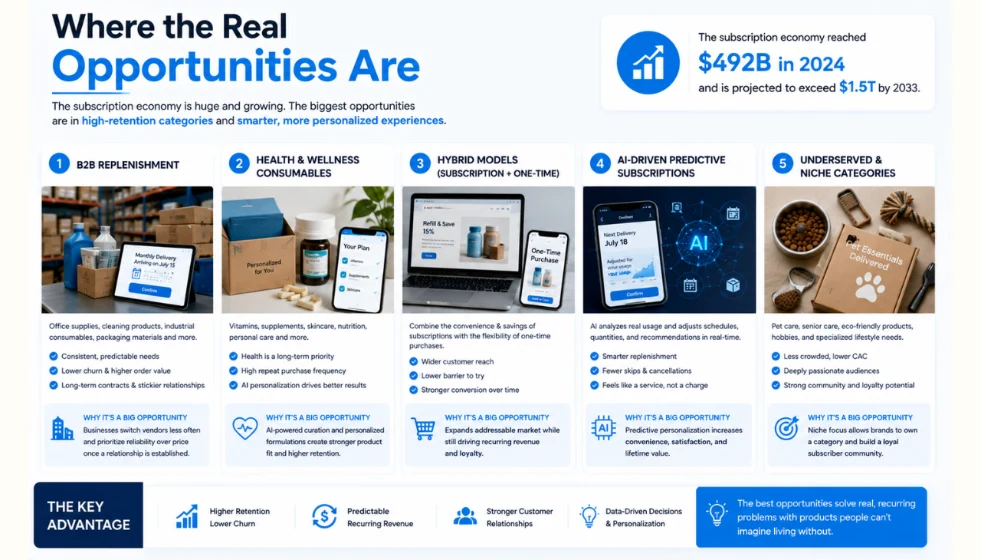
B2B Replenishment
Office supplies, cleaning products, industrial consumables, and packaging materials. Businesses have consistent, predictable needs and switch vendors far less frequently than consumers.
Churn is structurally lower, and price sensitivity once a contract is in place is reduced. Less marketing buzz means less competition.
Health and Wellness Consumables
The beauty subscription segment is growing faster than most other categories in 2026, driven by AI-powered curation and personalization.
The key differentiator is moving beyond generic product assortments into genuinely personalized formulations where the subscription relationship generates data that improves the product itself, not just the packaging.
Hybrid Models
Pure subscription-only models are giving way to hybrid approaches that combine subscriptions with one-time purchases.
A subscriber gets a lower price and convenience; a non-subscriber can still buy at full price. This broadens the addressable market while preserving the subscription revenue base.
AI-Driven Predictive Subscriptions
In early 2025, Amazon launched an AI-driven predictive subscription model that analyzes individual consumption patterns and adjusts delivery schedules dynamically based on real-time usage data.
This is the direction the entire category is moving from fixed schedules to intelligent replenishment that feels like a service rather than a recurring charge.
Key Metrics Every Subscription Operator Must Track
- 5.3% — Average monthly churn rate across subscription businesses
- Below 3% — Monthly churn rate for top-performing subscription companies
- 72% — Average annual customer retention rate
- 11% — Average subscriber reactivation rate after cancellation
The metrics to watch closely:
- MRR (Monthly Recurring Revenue) — the baseline health metric of the business.
- Churn rate (voluntary and involuntary separately) — tracked separately because they have different fixes.
- LTV:CAC ratio — if the ratio is below 3:1, fix the model before scaling.
- Time to first value — how quickly does a new subscriber understand why they subscribed?
- Cohort retention — how does Month 3 retention compare across different acquisition channels? Mismatched channels produce high-volume, low-retention subscribers.
The Bottom Line
Subscription ecommerce is one of the most durable and financially attractive business models available. The data on customer lifetime value, revenue predictability, and market growth is genuinely compelling.
But the model punishes operators who treat it as a feature bolted onto a transactional business.
The companies that thrive, such as Chewy, Amazon, and Ipsy, built their entire operating model around retention from day one. They treated churn as an engineering problem, not a marketing problem.
They invested in data before packaging. And they picked product categories where the natural replenishment cycle aligned with monthly billing.
The companies that struggled, such as Birchbox, several meal kit brands, were building subscription businesses on top of novelty. Novelty fades. Genuine utility does not.
The question for any operator entering this space is not “can we build a subscription offering?” The question is “what is the real reason a customer would still be subscribing in month 18?”
If you cannot answer that clearly, the model will answer it for you in churn numbers.
Sources
- Swell. “40 Subscription Commerce Statistics for 2025.” swell.is
- Precedence Research. “Subscription E-Commerce Market Size.” 2025. precedenceresearch.com
- Marketing LTB. “Subscription Statistics 2026: 92+ Stats & Insights.” marketingltb.com
- Market.us. “Subscription-Based E-Commerce Market Report.” 2024. market.us
- Marketing LTB. “Customer Retention Statistics 2026.” marketingltb.com
- Envive AI / MobiLoud. “Customer Retention in Ecommerce Statistics.” 2025. envive.ai
- Shopify. “How to Improve Ecommerce Customer Retention.” 2025. shopify.com
- ScienceDirect. “Riding the subscription box wave.” Business Horizons, 2021. sciencedirect.com
- Technavio. “Subscription E-Commerce Platform Market.” 2025. technavio.com
- Market.us. “Subscription E-Commerce Market Size.” 2024. market.us