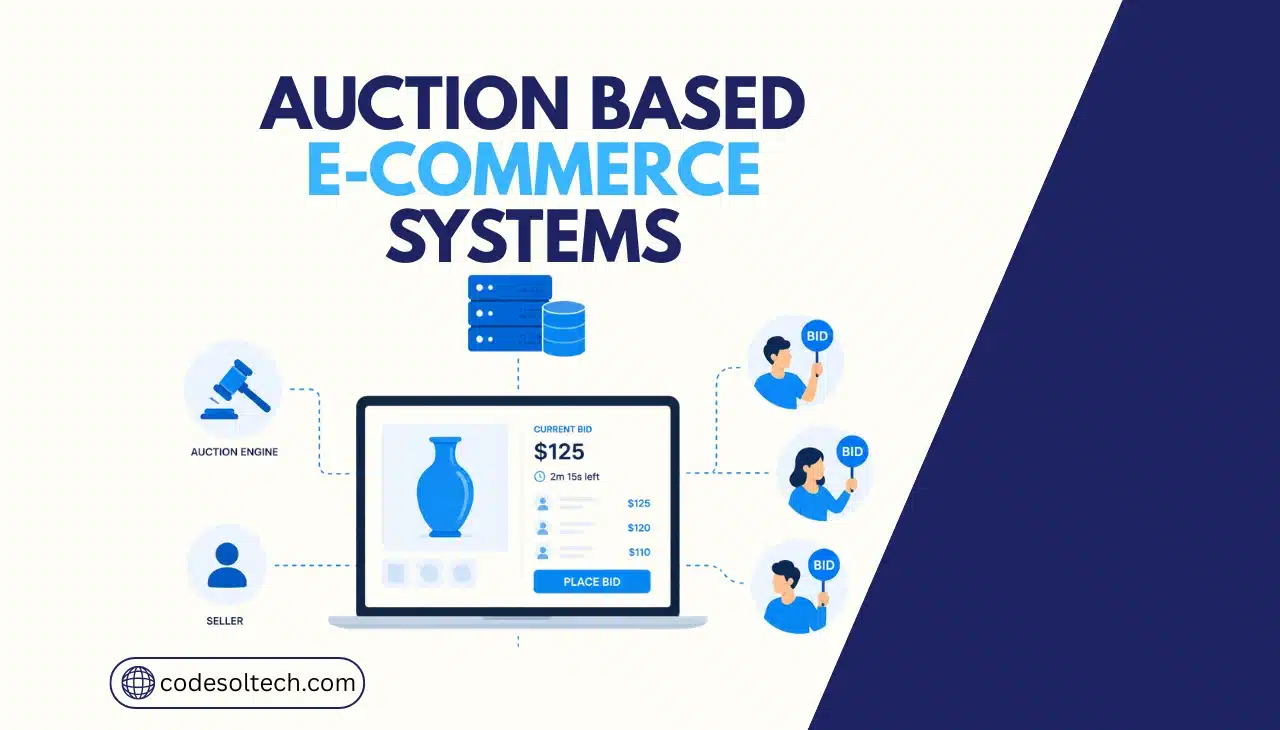
An auction-based ecommerce system is a platform where buyers compete for products through live bidding instead of fixed prices. It combines a real-time bidding engine, proxy bidding logic, payment authorization holds, and fraud detection to close each sale at the highest price a market will bear.
Building this system correctly requires more engineering discipline than a standard storefront. A regular ecommerce checkout processes one transaction per session.
An auction listing processes hundreds of competing write operations against a single record in the final seconds before close.
That difference in concurrency is the core technical challenge covered in this guide.
What Is an Auction-Based Ecommerce System?
The software that manages the full bidding lifecycle: listing creation, bid submission, price updates, auction closure, and payment collection from the winning bidder.
It replaces static pricing with a dynamic price that moves in response to competing bids.
Every auction-based ecommerce platform needs five core modules working together:
- Listing management — sellers define starting price, reserve price, bid increment, and auction duration.
- Bidding engine — validates, ranks, and processes bids in real time.
- Notification system — alerts bidders instantly when they are outbid.
- Payment and escrow layer — authorizes funds on bid, captures payment only from the winner.
- Fraud and compliance layer — detects shill bidding and enforces auction law.
These modules must stay synchronized under load. A delay of even two seconds in bid confirmation during the closing minute of a high-value auction directly changes who wins the item.
This is why the bidding engine’s architecture matters more than its visual design.
Auction Models Used in Ecommerce Platforms
Ecommerce platforms implement four auction formats, each suited to a different sales objective. Choosing the wrong format for a product category reduces final sale prices and bidder participation.
| Auction Model | Price Direction | Bid Visibility | Best Use Case |
|---|---|---|---|
| English Auction | Rises from a low starting bid | Public — bidders see the current highest bid | Collectibles, art, general consumer auctions |
| Dutch Auction | Falls from a high starting price | Public — price drops until a buyer accepts it | Liquidating large inventory quickly |
| Sealed-Bid Auction | Single hidden bid per participant | Private — bids revealed only at close | B2B procurement, government contracts, real estate |
| Vickrey (Second-Price) Auction | Winner pays the second-highest bid | Hidden maximum bid, visible current price | Proxy bidding systems (the model eBay uses) |
Most consumer auction platforms run a hybrid: an English auction on the surface, powered underneath by Vickrey-style proxy bidding.
eBay’s proxy bidding system confirms this directly the platform bids on a buyer’s behalf in small increments, only enough to keep them in the lead, while their true maximum bid stays hidden from every other participant.
How Does Real-Time Bidding Work in an Auction Platform?
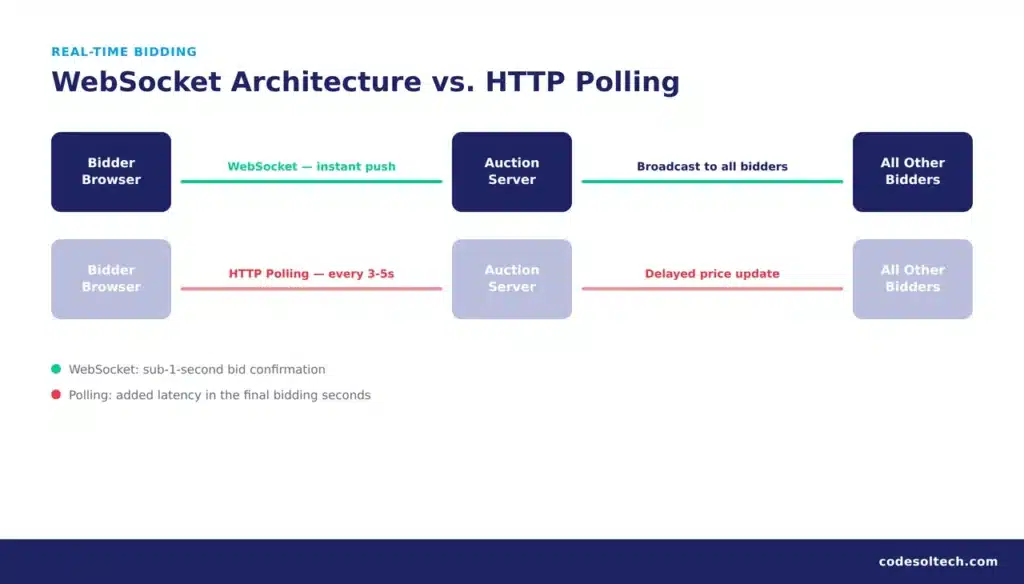
Real-time bidding works through a persistent connection between the buyer’s browser and the auction server that pushes price updates instantly, instead of the browser repeatedly asking the server for updates.
The platform validates each bid against the current price and increment rule in under one second, then broadcasts the new price to every connected bidder simultaneously.
Proxy Bidding Logic
Proxy bidding lets a buyer enter one maximum bid instead of manually re-bidding every time they’re outbid. The engine automatically raises the buyer’s visible bid by one increment whenever a competing bid comes in, stopping once the buyer’s hidden maximum is reached.
The final price equals the second-highest maximum bid plus one increment, never the winner’s full ceiling. This logic protects buyers from overpaying and is the same mechanism eBay documents in its own bidding rules.
WebSocket Architecture vs. HTTP Polling
Auction platforms transmit bid updates through WebSocket connections rather than repeated HTTP polling. A WebSocket connection stays open between client and server, pushing new prices the instant a bid is accepted.
HTTP polling instead forces the browser to ask the server “any updates?” every few seconds, which adds latency and server load that becomes visible exactly when it matters most, the final seconds of a contested auction.
Development teams typically pair a WebSocket layer (Socket.IO, native WebSocket API, or a managed service such as Pusher or Ably) with a message broker to fan updates out to thousands of simultaneous bidders on a single listing.
Concurrency Control for Simultaneous Bids
When two bidders submit bids within milliseconds of each other, the database must decide which bid arrived first without corrupting the auction record. Auction platforms solve this with one of two concurrency models:
- Pessimistic locking — the database locks the auction row the instant a bid transaction starts, forcing competing bids to queue and process sequentially.
- Optimistic concurrency control — each bid carries a version number; if two bids reference the same version, the database rejects the second and forces a re-check against the current price.
High-traffic platforms favor optimistic concurrency because it avoids the throughput bottleneck that row-locking creates during a bidding surge in the closing minute.
Anti-Sniping and Soft-Close Mechanisms
Bid sniping placing a winning bid in the final seconds to deny others a chance to respond is a structural weakness of any fixed-end-time auction.
Platforms counter it with a soft-close rule: any bid placed inside a defined window before the scheduled end time (commonly two to five minutes) automatically extends the auction by that same window.
This single mechanism does more to raise final sale prices than any UI change, because it restores the ability of a second bidder to respond.
Legal Rules Every Auction Platform Must Follow
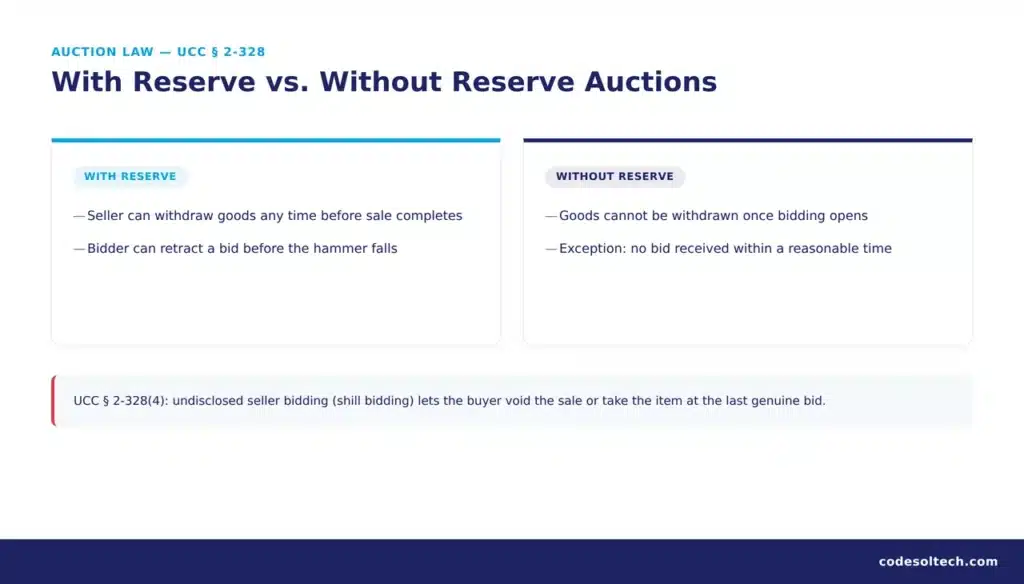
Uniform Commercial Code § 2-328 governs auction sales in nearly every U.S. state and defines two distinct auction types with different legal consequences. In a “with reserve” auction, the seller can withdraw the goods at any point until the sale is announced complete.
In a “without reserve” auction, once bidding opens on a lot, it cannot be withdrawn unless no bid arrives within a reasonable time.
Auction platforms must encode this distinction into the listing schema, not just the marketing copy, because it determines whether a seller is legally permitted to cancel a live auction.
UCC § 2-328(4) also defines the legal remedy for shill bidding: if a seller (or someone bidding on the seller’s behalf) places bids without disclosing that right in advance, the winning buyer can void the sale entirely or take the item at the last genuine bid before the manipulation occurred.
This is why shill-bidding detection isn’t just a trust feature, it’s a compliance requirement.
How Do Auction Platforms Prevent Fraud and Shill Bidding?
Auction platforms prevent fraud by cross-referencing bidder identity signals IP address, payment method, device fingerprint, and account creation date against the seller’s own account and listing history, then flagging or blocking bids that show a pattern of coordination.
Online auction fraud has been tracked as a distinct complaint category by the FBI’s Internet Crime Complaint Center since the center’s founding in 2000, making it one of the oldest recognized categories of ecommerce fraud.
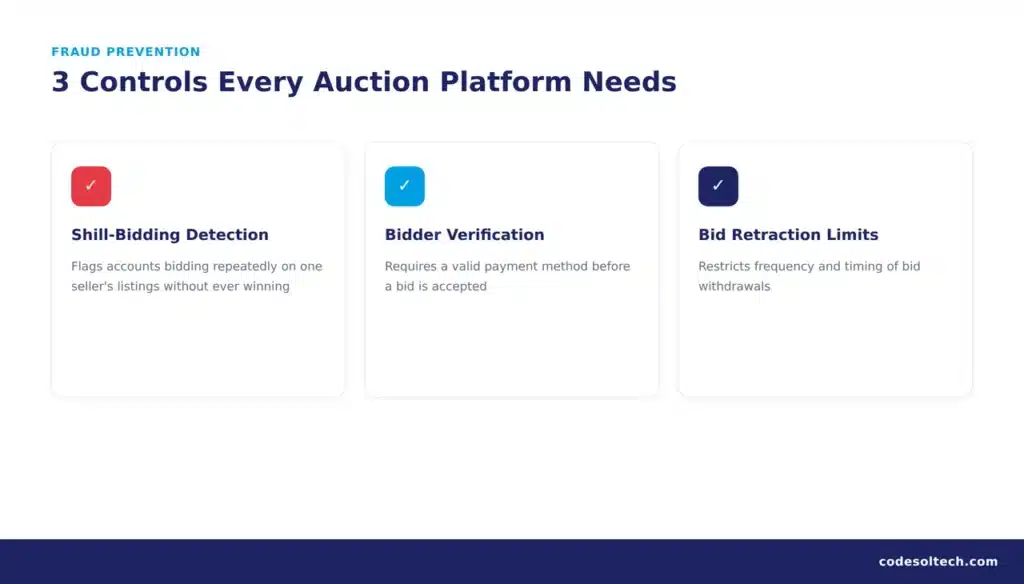
Three fraud controls form the baseline for any production auction system:
- Shill-bidding detection — flags accounts that repeatedly bid on the same seller’s listings without ever winning, or that share a device fingerprint or payment method with the seller account.
- Bidder verification — requires a valid payment method on file before a bid is accepted, not just before checkout.
- Bid retraction limits — restricts how often and how late a bidder can withdraw a bid, consistent with the UCC § 2-328(3) retraction rule described above.
Payment Processing and Escrow Workflow for Auctions
Auction platforms cannot charge a buyer’s card the moment they place a bid, because most bids never win.
Instead, the payment gateway places an authorization hold, a temporary reservation of funds against each active bid, then releases the holds for every losing bidder the moment the auction closes and captures payment only from the winner.
Three payment states occur in sequence during every auction transaction:
- Authorization — funds are reserved but not moved, confirming the bidder can pay if they win.
- Release — holds on losing bids are cancelled automatically at auction close.
- Capture — the winning bidder’s authorized amount is charged and moved to the seller’s account, often through an escrow period for high-value goods.
For high-value categories vehicles, real estate, industrial equipment platforms add a manual escrow step: funds sit with a third-party escrow agent until the buyer confirms receipt and condition, then the agent releases payment to the seller.
This protects both parties in a transaction where the item can’t be inspected before the bid is placed.
Market Growth and Adoption of Auction-Based Ecommerce
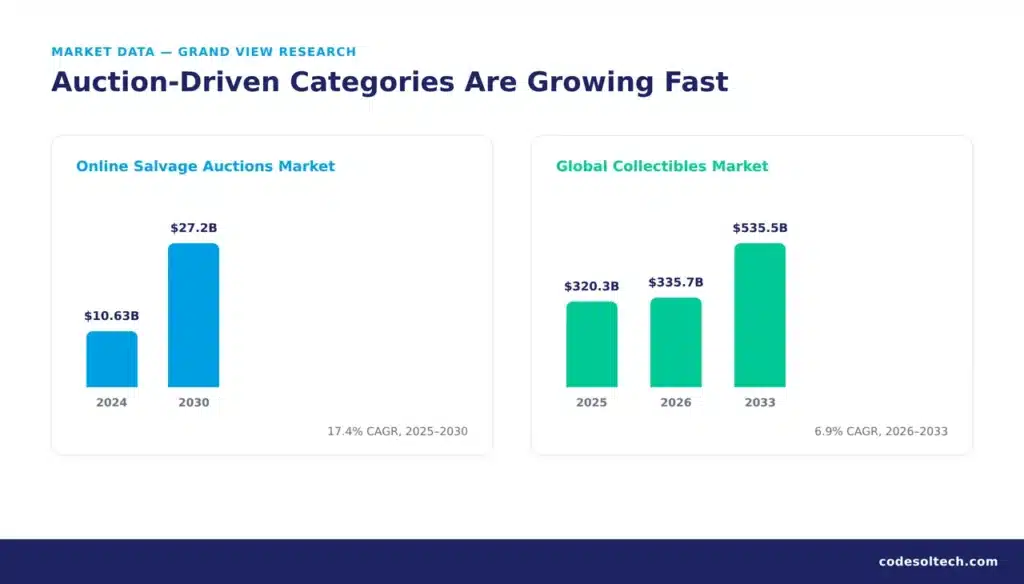
Auction-based ecommerce is expanding fastest in categories where price discovery matters more than fixed retail pricing. The online salvage auctions market was valued at $10.63 billion in 2024 and is projected to reach $27.2 billion by 2030, growing at a compound annual rate of 17.4%.
The collectibles category shows a similar pattern: Grand View Research values the global collectibles market at $320.3 billion in 2025, rising to $335.7 billion in 2026 and $535.5 billion by 2033.
Three factors explain this growth:
- Price discovery — sellers of unique or rare items capture true market value instead of guessing at a fixed price.
- Engagement mechanics — competitive bidding produces longer session times and higher return-visit rates than static product pages.
- Inventory liquidation speed — Dutch auction formats clear large or damaged goods inventory faster than fixed-price listings.
Technology Stack for Building an Auction-Based Ecommerce Platform
An auction-based ecommerce platform needs a technology stack built for real-time, high-concurrency writes not the read-heavy stack that powers a standard product catalog. The core components are:
- Backend runtime — Node.js or Python (Django/FastAPI) for handling concurrent bid requests with non-blocking I/O.
- Real-time layer — WebSocket server (Socket.IO, native WebSocket) or a managed pub-sub service for instant price broadcasts.
- Message broker — RabbitMQ or Kafka to queue bid events and decouple the bidding engine from payment and notification services.
- Database — PostgreSQL or MySQL with row-versioning support for optimistic concurrency control on bid records.
- Cache layer — Redis for storing the current highest bid and serving it to thousands of concurrent viewers without hitting the primary database.
- Payment gateway — a processor supporting authorization holds and delayed capture (not simple charge-on-purchase).
Development effort scales with the concurrency requirements of the auction categories supported, not with the number of product pages. A single-category auction site with modest concurrent bidder counts sits at the MVP tier.
A multi-category platform supporting simultaneous high-traffic auctions, live video bidding, and escrow-managed high-value categories sits at the enterprise tier.
Most agencies, including our own development process, scope this work by concurrency and compliance requirements rather than a flat per-page estimate.
Request a custom ecommerce development consultation for a tier-specific estimate.
Frequently Confused: Auction Ecommerce vs. Fixed-Price Ecommerce
| Factor | Auction-Based Ecommerce | Fixed-Price Ecommerce |
|---|---|---|
| Price determination | Set by competing bids at close | Set by the seller before listing |
| Payment timing | Authorization hold, then capture only from the winner | Immediate charge at checkout |
| Core infrastructure demand | Real-time, high-concurrency writes | Read-heavy catalog browsing |
| Fraud surface | Shill bidding, bid retraction abuse | Card fraud, chargeback abuse |
| Legal framework (U.S.) | UCC § 2-328 | General UCC Article 2 sales provisions |
Auction platforms typically integrate with the same back-office systems as fixed-price stores. Once a sale closes, ERP and CRM integration, order management, and fraud detection pipelines all connect the same way regardless of how the price was set.
Final Words
Auction-based ecommerce rewards platforms that treat bidding as a real-time system problem, not a checkout feature.
Proxy bidding, soft-close timing, authorization holds, and shill-bidding detection are not optional add-ons — they are the difference between a trustworthy marketplace and a legal liability.
Get the architecture right before the first auction goes live.
Ready to build a real-time auction platform that scales?
CodeSol Technologies designs and develops custom auction-based ecommerce systems from proxy bidding engines to escrow-managed payment workflows.


![Electrician CRM: Win More Jobs [Faster Estimates Guide]](https://www.codesoltech.com/wp-content/uploads/2026/10/Crm-for-an-electricians-business.webp)