
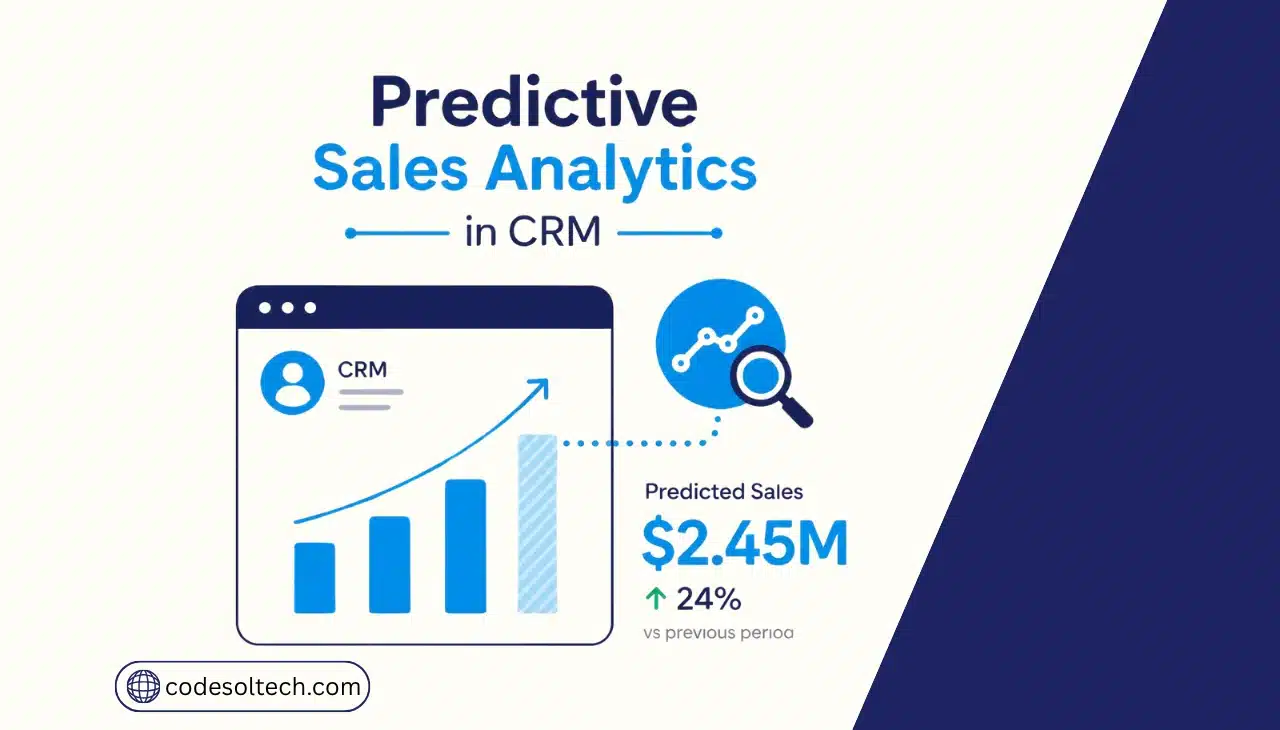
Predictive sales analytics uses machine learning to analyze historical deal data, customer behavior, and pipeline activity inside a CRM. The system forecasts revenue, scores lead quality, and flags at-risk deals. Platforms like Salesforce Einstein and HubSpot generate these scores automatically from existing CRM records.
Predictive sales analytics converts raw CRM data into a revenue forecast. The system applies machine learning algorithms to closed-won deals, pipeline stages, and engagement signals.
Sales teams use the output to prioritize leads and predict quarterly revenue within a defined accuracy range, not a guess.
The technology is not new machine learning theory. It is an application layer built on top of a CRM database that already stores every deal, contact, and touchpoint a company has recorded.
What changed is accessibility. Predictive scoring used to require a dedicated data science team; now it ships as a native feature in most enterprise CRM platforms.
How Does Predictive Sales Analytics Work in a CRM
Predictive sales analytics runs on four sequential components inside a CRM: data ingestion, feature engineering, model training, and scoring. Each component processes deal records automatically once configured.
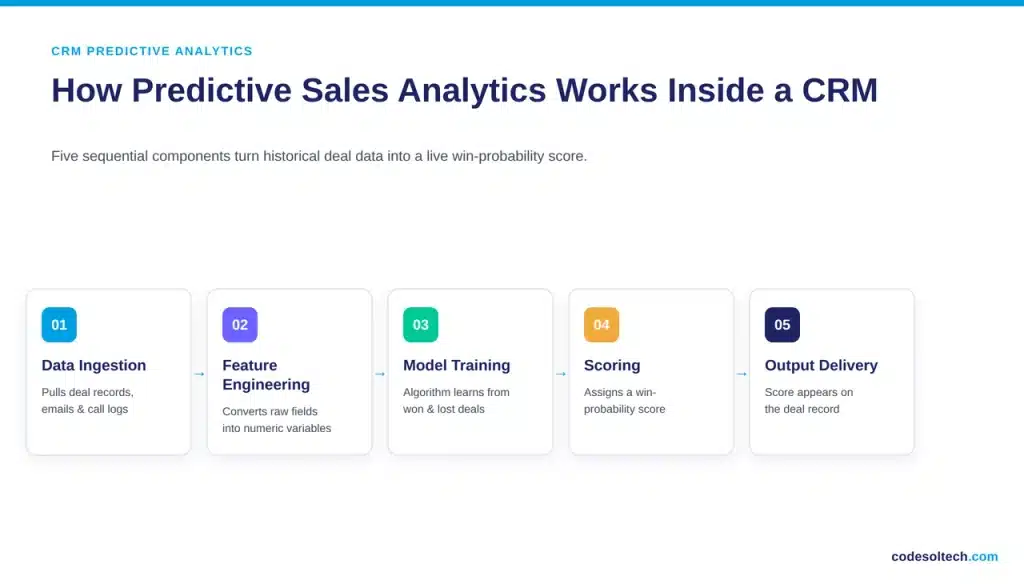
- Data ingestion: The CRM pulls historical deal records, email activity, and call logs into a training dataset.
- Feature engineering: The system converts raw fields — deal size, industry, sales cycle length — into numeric variables a model can process.
- Model training: Algorithms such as logistic regression or gradient boosting learn patterns from closed-won and closed-lost deals.
- Scoring: The trained model assigns a win-probability score to every open opportunity.
- Output delivery: The CRM displays the score on the deal record and updates it as new activity occurs.
87% of sales organizations already use AI for prospecting, forecasting, or lead scoring, according to Salesforce’s 2026 State of Sales Report. Predictive scoring is the most common entry point into that adoption.
The model does not stop learning after the first training run. Every new closed-won or closed-lost deal feeds back into the dataset, and the CRM retrains the model on a scheduled interval — typically weekly or monthly.
This retraining cycle is what separates predictive analytics from a static lead-scoring rulebook. A rulebook stays fixed until a human edits it; a predictive model adjusts itself as market conditions shift.
How Accurate Is AI-Driven Sales Forecasting
AI-driven forecasting outperforms manual forecasting because it processes more variables per deal than a sales manager can track by hand. 98% of sales leaders report that AI improves their forecasting accuracy, per Salesforce’s forecasting research.
Companies that pair predictive analytics with a data-driven sales engine report EBITDA growth of 15% to 25% above market average, according to McKinsey’s commercial growth research.
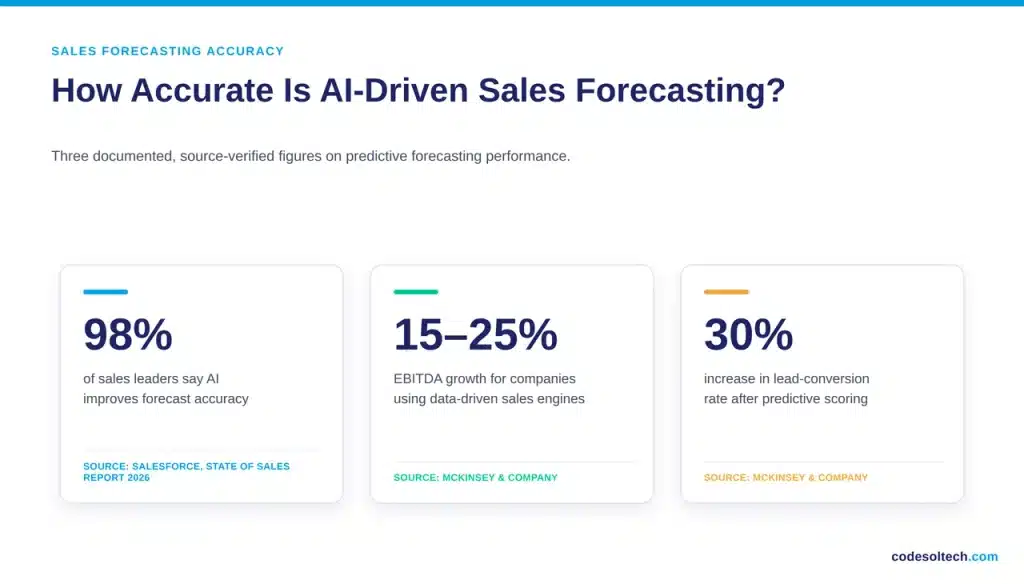
One documented case is direct: an IT services company applied predictive lead-scoring, redirected outreach toward established accounts over startups, and raised its lead-conversion rate by 30%, per McKinsey’s B2B sales analytics report.
Accuracy is not uniform across every CRM instance. It scales with the volume of historical data, the cleanliness of the records, and how frequently the sales team logs activity against each deal.
A CRM with two years of consistent deal history produces a materially more reliable score than one with six months of sparse logging, regardless of which algorithm powers the model.
Predictive vs. Descriptive vs. Prescriptive Analytics in CRM
CRM analytics splits into four distinct types. Each type answers a different question and produces a different output format.
Most CRM dashboards ship with descriptive and diagnostic reporting by default. Predictive and prescriptive layers require either a native AI add-on or a custom model connected through the CRM’s API.
| Analytics Type | Question It Answers | CRM Example | Output Format |
|---|---|---|---|
| Descriptive | What happened? | Closed-won report by quarter | Historical dashboard |
| Diagnostic | Why did it happen? | Win/loss reason breakdown | Root-cause report |
| Predictive | What will happen? | Deal win-probability score | Numeric probability (0–100%) |
| Prescriptive | What should we do? | Next-best-action recommendation | Ranked task list |
Core Algorithms Powering Predictive Sales Models
Predictive sales engines run on five algorithm types. Each type suits a different data structure and prediction target.
- Logistic regression: Calculates a binary win/loss probability from historical deal features. It is the fastest model to train and the easiest to audit.
- Random forest: Combines multiple decision trees to rank lead quality with lower variance than a single model. It handles missing CRM fields better than regression alone.
- Gradient boosting (XGBoost): Corrects prediction errors sequentially to increase forecast precision. It is the standard engine behind most enterprise CRM forecasting tools.
- Time-series models (ARIMA, Prophet): Project revenue trends from historical pipeline velocity rather than individual deal features.
- Neural networks: Process unstructured data email text, call transcripts for sentiment and intent scoring. They require the largest training dataset of the five.
CRM vendors rarely disclose which algorithm powers their scoring feature. The output a probability score on the deal record stays consistent across vendors even when the underlying model differs.
How to Implement Predictive Analytics in an Existing CRM
Implementation follows five stages regardless of the CRM platform. Skipping a stage produces an unreliable model.
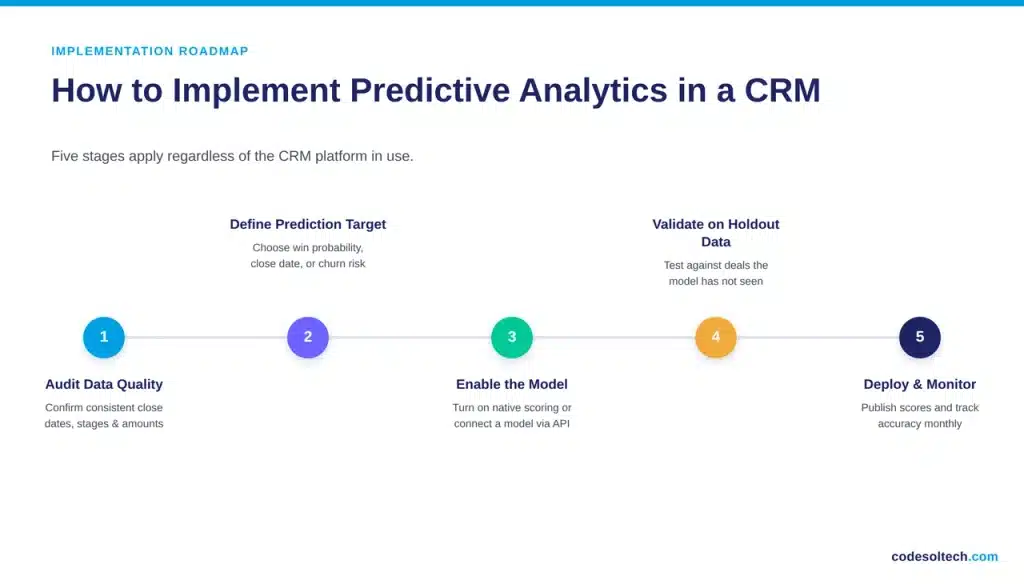
- Audit data quality: Confirm deal records carry consistent close dates, stages, and amounts before training starts.
- Define the prediction target: Choose one outcome to predict first — win probability, deal-close date, or churn risk.
- Select or enable the model: Turn on the CRM’s native predictive feature, or connect a custom model through the CRM’s API.
- Validate against holdout data: Test the model against deals it has not seen to confirm accuracy before rollout.
- Deploy and monitor: Publish the score to rep-facing views and track accuracy monthly against actual outcomes.
Business Benefits of Predictive Sales Analytics
Predictive analytics changes four measurable outcomes inside a sales organization. Each outcome is tied to a documented data point, not an estimate.
- Revenue growth: 83% of AI-using sales teams saw revenue growth versus 66% of non-AI teams, per Salesforce’s State of Sales data.
- Deal risk detection: Models flag stalled deals once they exceed the historical average deal-cycle length for their segment.
- Lead prioritization: Reps work leads ranked by win-probability score instead of building prospect lists manually.
- Customer understanding: 89% of sellers using AI say it deepens their understanding of customer needs, per Salesforce’s 2026 report.
None of these outcomes activate automatically. Each depends on the CRM holding clean, complete records before the model ever runs which is where most predictive analytics projects actually fail.
Data Requirements and Common Failure Points
Predictive models fail without clean, structured input. CRM data quality is a prerequisite, not an optional step.
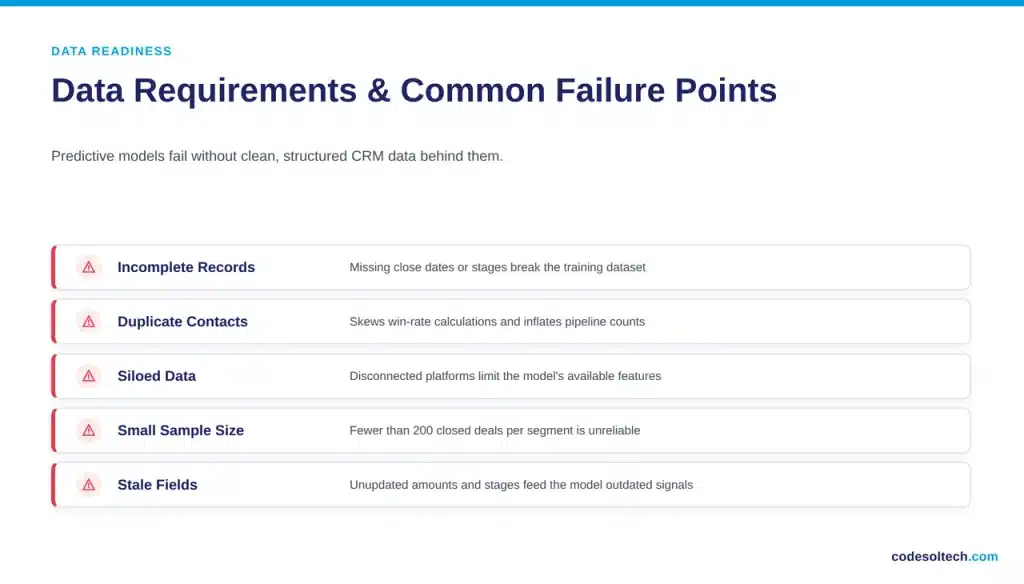
- Incomplete records: Missing close dates or deal stages break the training dataset before a model runs.
- Duplicate contacts: Duplicate records skew win-rate calculations and inflate pipeline counts. See CRM data quality standards.
- Siloed data: Disconnected marketing and sales platforms limit the feature set available to the model. See CRM integration architecture.
- Small sample size: Segments with fewer than 200 closed deals produce statistically unreliable predictions.
- Stale fields: Deal amounts and stages that reps forget to update feed the model outdated signals, which lowers score accuracy over time.
A CRM migration or integration project is often the fastest route to fixing these gaps, because it forces a full data audit before any predictive feature goes live.
Which CRM Platforms Support Predictive Analytics
Five CRM categories currently support native or configurable predictive analytics. Each one attaches a different engine to the same core function.
- Salesforce: Einstein Forecasting and Einstein Lead Scoring.
- HubSpot: Predictive Lead Scoring, available on the Enterprise tier.
- Microsoft Dynamics 365: AI Builder combined with Sales Insights.
- Zoho CRM: Zia, Zoho’s built-in predictive sales engine.
- Custom CRM builds: A predictive layer configured on top of a company’s own data warehouse. See custom CRM development for build requirements.
Platform choice depends on data volume and internal technical capacity. A native tool like Zia or Einstein fits a team with no data science resources; a custom build fits a company with data volume too specific for a generic vendor model.
FAQs
Does predictive sales analytics replace sales reps?
No. Predictive sales analytics scores and ranks deals; reps still execute outreach, negotiation, and closing. The model removes manual data analysis, not selling activity.
How much historical data does a CRM need to train a predictive model?
Most predictive sales models need a minimum of 12 months and 200+ closed deals per segment to produce a statistically reliable win-probability score.
Can small businesses use predictive sales analytics?
Yes. Native scoring in CRMs like HubSpot and Zoho requires no in-house data science team, though accuracy scales with data volume. See CRM sales forecasting for setup steps.
How often should a predictive sales model retrain?
Most CRMs retrain predictive models weekly or monthly. A faster sales cycle with high deal volume supports weekly retraining; a long enterprise sales cycle typically retrains monthly.
Final Words
Predictive sales analytics turns CRM history into a working forecast. The output is only as reliable as the data feeding it.
Clean records, integrated platforms, and sufficient data volume determine whether the score is useful or noise.
Ready to add predictive analytics to your CRM? Request a consultation and get a data-readiness assessment before you turn on a single model.
You May Like
AI Lead Scoring in CRM: 5-Stage Work Breakdown
![Conversational AI in CRM: Stop Typing, Start Talking [2026]](https://www.codesoltech.com/wp-content/uploads/2026/10/Conversational-AI-in-CRM-Stop-Typing-Start-Talking-2026.webp)
![AI Customer Segmentation in CRM [Proven Data + 6-Step Setup]](https://www.codesoltech.com/wp-content/uploads/2026/09/AI-Customer-Segmentation.webp)