
![AI CRM vs Traditional CRM [2026 Reality Check]](https://www.codesoltech.com/wp-content/uploads/2026/09/AI-CRM-vs-Traditional-CRM.webp)
Traditional CRM stores customer data and waits for a human to act on it while AI CRM analyzes that same data and takes action on its own, such as scoring leads, drafting follow-ups, or flagging at-risk deals. Salesforce reports that 87% of sales organizations now use AI somewhere in their CRM workflow.
Traditional CRM software records customer interactions in a database. AI CRM software reads that database and executes decisions without waiting for a person.
The difference is not cosmetic. It changes how a sales or support team spends its working hours every day.
Traditional CRM software performs five core functions:
- Contact and account record-keeping
- Deal or opportunity pipeline tracking
- Manual task and follow-up reminders
- Static, backward-looking reporting dashboards
- Email and calendar synchronization
Base-tier platforms like classic Salesforce Sales Cloud, HubSpot CRM Free, and Zoho CRM’s entry plan operate this way. The system responds to human input. It does not generate new input on its own.
This model works well when deal volume stays low and every rep can track their own accounts. It breaks down once lead volume grows faster than headcount.
Every new lead still requires a human to log, score, and follow up on it manually. Nothing in the system does that step on its own.
AI CRM System: Definition and Core Capabilities
An AI CRM system adds machine learning models, and increasingly autonomous agents, on top of the same customer database. It processes incoming data continuously and executes predefined actions without a human triggering each step.
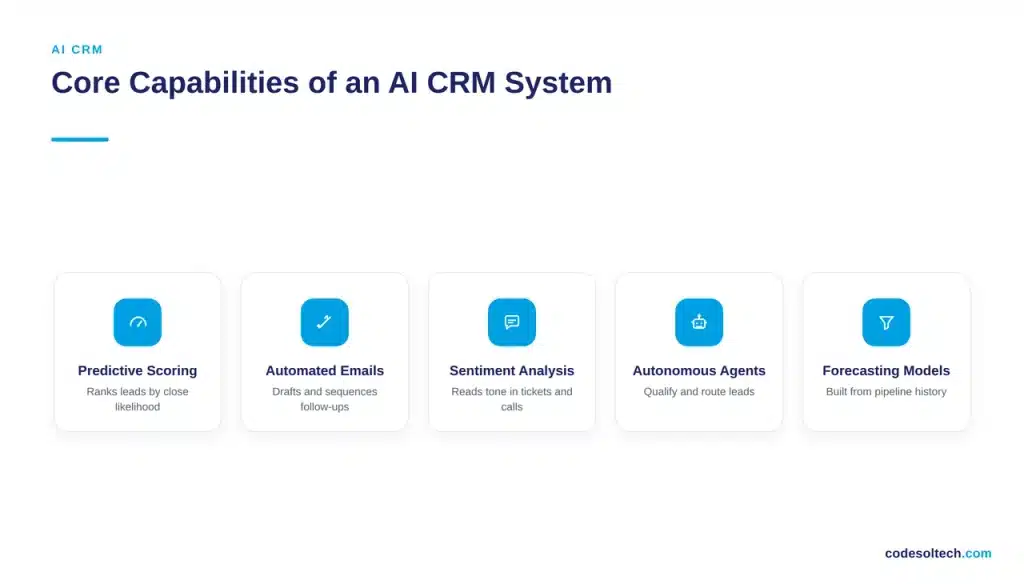
AI CRM software adds five capabilities a traditional system does not have:
- Predictive lead scoring based on behavior signals
- Automated email drafting and follow-up sequencing
- Sentiment analysis on support tickets and sales calls
- Autonomous agents that qualify or route leads
- Forecasting models built from historical pipeline data
Salesforce’s 2026 State of Sales report surveyed 4,050 sales professionals between August and September 2025. It found that 87% of sales organizations now use AI for prospecting, forecasting, lead scoring, or email drafting.
How Does AI CRM Differ From Traditional CRM
Traditional CRM requires a human to interpret data and decide the next step. AI CRM interprets the data itself and either recommends or executes that step. The core difference is decision-making, not data storage.
| Capability | Traditional CRM | AI CRM |
|---|---|---|
| Data entry | Manual, rep-driven | Automated from calls, emails, and forms |
| Lead scoring | Fixed rules set by admin | Dynamic, model-based on conversion history |
| Follow-up emails | Rep writes and sends | Agent drafts, sequences, and sends |
| Forecasting | Based on rep-entered close dates | Based on historical pattern modeling |
| Reporting | Static dashboards | Natural-language queries on live data |
| Setup complexity | Low | Higher, requires clean data first |
Capabilities AI Adds to a CRM
AI does not add one feature. It adds a layer of automation across five separate functions, each backed by a specific technical mechanism.
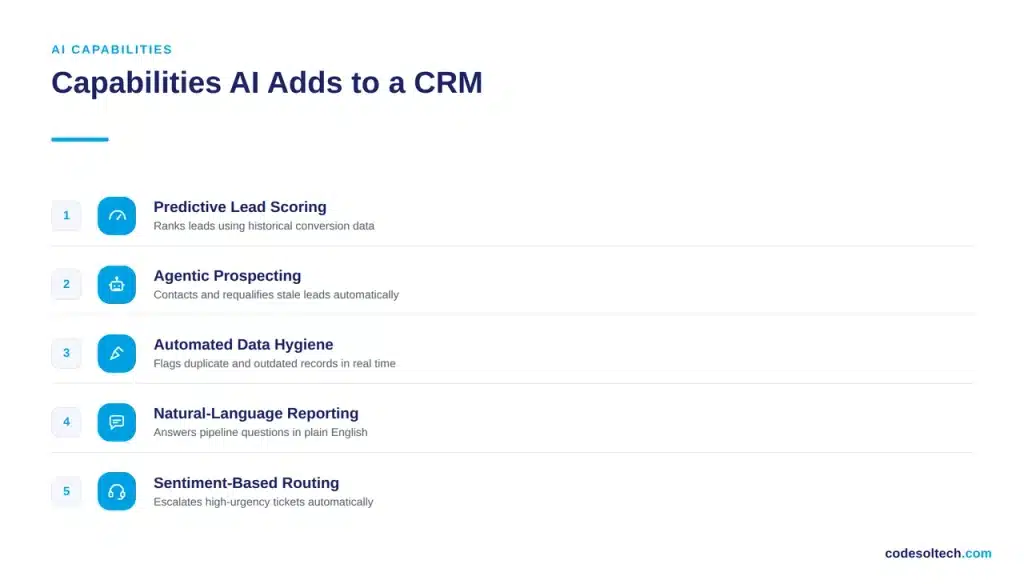
1. Predictive lead scoring
Machine learning models rank leads by likelihood to close, using historical conversion data instead of a static point system.
The model retrains itself as deals close or die, so scores shift as conditions change.
2. Agentic prospecting
AI agents contact and requalify stale leads without rep involvement. Salesforce reports its own agents contacted 130,000 leads and created 3,200 new opportunities in four months.
These are leads a rep would otherwise never revisit once they went cold.
3. Automated data hygiene
AI CRM platforms flag duplicate, outdated, or conflicting records in real time. This depends on the underlying CRM data quality process already being in place.
A model trained on duplicate or stale records inherits those errors in every prediction it makes.
4. Natural-language reporting
Reps query pipeline data in plain English instead of building a dashboard. The system converts the question into a database query, executes it against live CRM data, and returns the result in seconds.
5. Sentiment-based routing
Support tickets route based on detected urgency and tone, not just keyword tags or manual triage. A ticket flagged as high-frustration escalates automatically, before a human agent even opens it.
AI CRM Cost vs Traditional CRM Cost
Traditional CRM licenses are priced per seat, per month, with a flat feature set. AI CRM adds a second cost layer on top of that seat price.
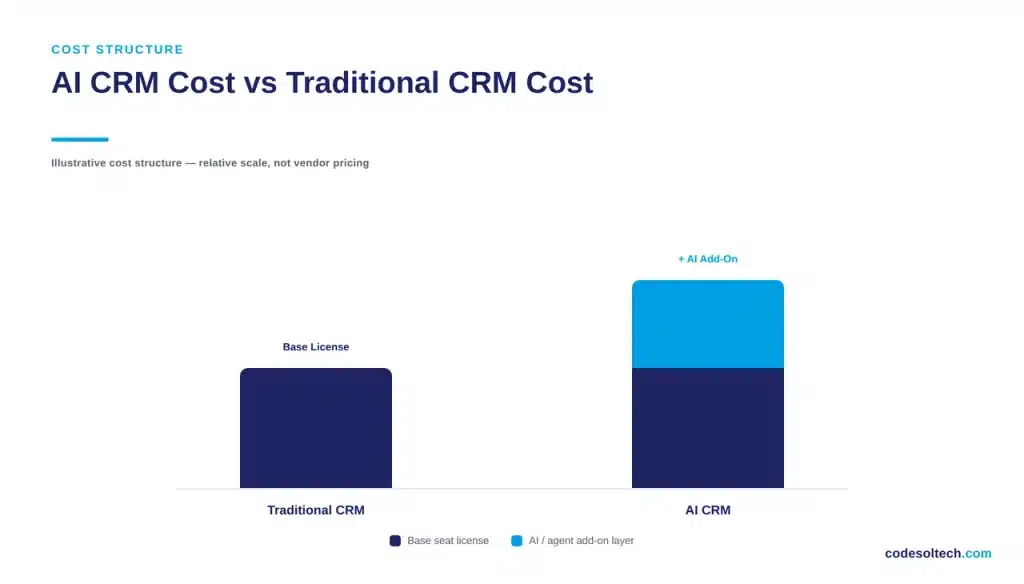
Three pricing models dominate AI CRM billing:
- Flat AI add-on fee per seat, regardless of usage
- Usage-based credits, billed per AI action or agent task completed
- Bundled AI features locked to the highest-tier plan only
Usage-based pricing creates budget uncertainty. An agent that contacts 10,000 leads in a slow month and 100,000 in a busy quarter produces a bill that swings just as widely.
Does AI CRM Replace Traditional CRM
No. AI CRM extends a traditional CRM’s database. It does not replace it. Every AI CRM platform still stores contact records, deal stages, and communication history the same way a traditional CRM does.
The AI layer sits on top of that database. If the underlying CRM integration architecture is weak or the data is inconsistent, the AI layer produces unreliable predictions regardless of how advanced the model is.
Where AI CRM Projects Fail
Gartner projects that more than 40% of agentic AI initiatives will be canceled, restructured, or abandoned by the end of 2027, citing escalating costs, unclear business value, and inadequate risk controls.
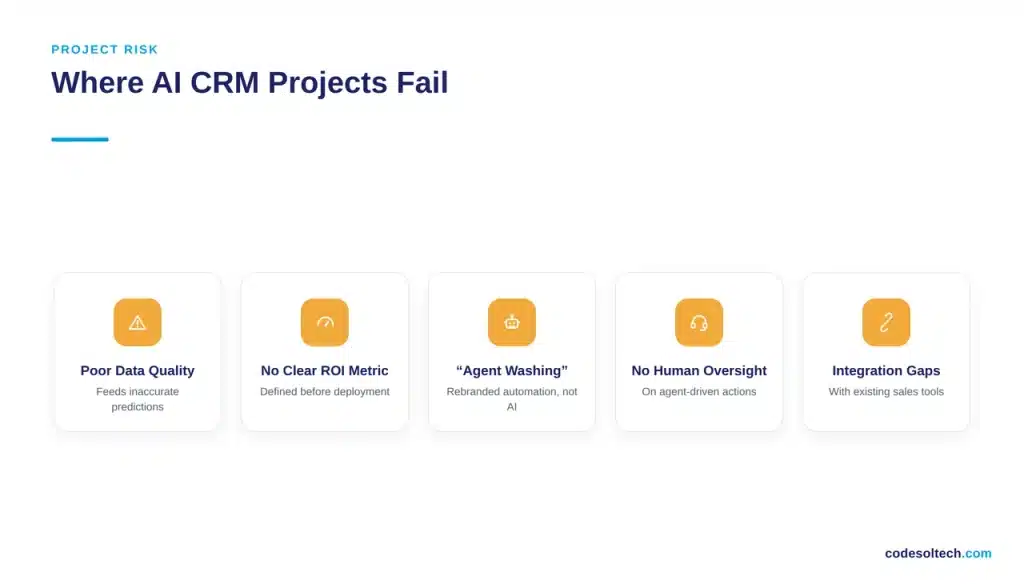
Five factors drive most AI CRM project failures:
- Poor data quality feeding inaccurate predictions
- No clear ROI metric defined before deployment
- Vendors rebranding existing automation as “agentic AI” without real autonomy
- No human oversight built into agent-driven actions
- Integration gaps with existing sales and support tools
Most of these failures trace back to one root cause: the business deployed AI before fixing its data quality and integration architecture.
Gartner’s research also flags “agent washing,” where vendors rebrand existing chatbots or robotic process automation as agentic AI without adding real autonomy. Only a fraction of agentic AI vendors on the market deliver genuine autonomous decision-making, according to the same report.
How to Move From Traditional CRM to AI CRM Without Losing Data
A CRM upgrade fails most often at the data migration step, not at the AI configuration step. Records get duplicated, custom fields get dropped, and historical notes get flattened into plain text.
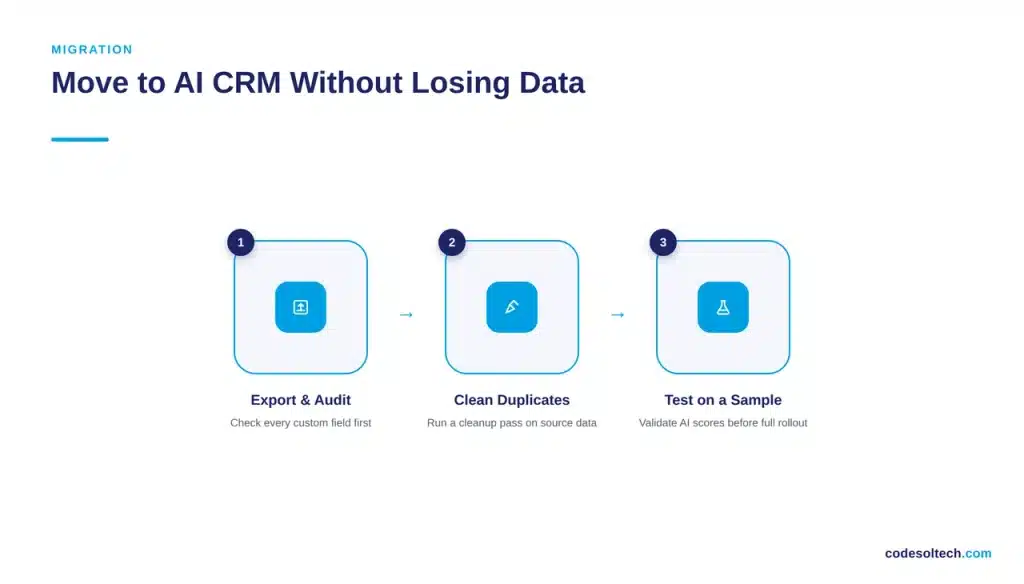
Three checks reduce that risk before switching platforms:
- Export and audit every custom field before migration starts
- Run a duplicate-record cleanup pass on the source system first
- Test AI scoring on a small data sample before full rollout
A full CRM migration checklist walks through each of these steps in order, including how to validate that AI-generated scores match expected outcomes before going live.
When Should a Business Choose AI CRM Over Traditional CRM
A business should adopt AI CRM once lead or ticket volume exceeds what a team can manually track and score. Below that volume, a traditional CRM handles the workload without added AI cost or complexity.
Four signals indicate it is time to upgrade:
- Lead volume outpaces a rep’s manual scoring capacity
- Reps lose multiple hours weekly to manual data entry instead of selling
- Support tickets require round-the-clock triage
- Forecast accuracy directly affects board or investor reporting
Salesforce’s 2026 data shows the average seller already spends only 40% of their time selling, with Gen Z reps at 35% due to manual data entry. That gap is the clearest sign a workflow automation layer is overdue.
A business below that threshold gains little from AI CRM beyond a higher bill. The models need volume to learn from.
A team logging 20 deals a month does not generate enough data for a scoring model to outperform a rep’s own judgment.
FAQs
Is AI CRM more expensive than traditional CRM?
Yes, in most cases. AI CRM tiers charge extra for predictive scoring, agent seats, or usage-based AI credits on top of the base CRM license.
Can a small business use AI CRM?
Yes, but only after core contact and pipeline data is clean. AI models trained on messy data produce unreliable scores and forecasts.
What is agentic CRM?
Agentic CRM is a subset of AI CRM where autonomous agents complete multi-step tasks, such as qualifying a lead and scheduling a call, without a human approving each action.
Does switching to AI CRM require migrating all historical data?
Yes, in most cases. Predictive models need historical deal and interaction data to generate accurate scores, so incomplete migration produces weaker predictions in the first several months.
Final Words
AI CRM does not replace traditional CRM. It automates decisions on top of the same customer data traditional CRM already stores.
The businesses getting real ROI fixed their data quality and integration first, then layered AI on top, not the other way around.
Ready to see whether your CRM setup is AI-ready?
Talk to CodeSol Technologies about a CRM data and integration audit before you invest in AI features you can’t yet use.
You May Like
AI CRM Explained: How AI Is Changing Customer Management
Customer Lifecycle Management in CRM: 6 Stages Explained
CRM Knowledge Base Integration: [Types + 5-Step Setup]
Stay Connected With Us 🙂
![Conversational AI in CRM: Stop Typing, Start Talking [2026]](https://www.codesoltech.com/wp-content/uploads/2026/10/Conversational-AI-in-CRM-Stop-Typing-Start-Talking-2026.webp)
![AI Customer Segmentation in CRM [Proven Data + 6-Step Setup]](https://www.codesoltech.com/wp-content/uploads/2026/09/AI-Customer-Segmentation.webp)