![AI Customer Segmentation in CRM [Proven Data + 6-Step Setup]](https://www.codesoltech.com/wp-content/uploads/2026/09/AI-Customer-Segmentation.webp)
AI customer segmentation in CRM groups customers automatically by behavior, value, and intent. Machine learning models read purchase history, engagement, and support data, then assign each contact to a segment. Teams use those segments to target offers, rank leads, and reduce churn.
What Is AI Customer Segmentation in a CRM
AI customer segmentation is the use of machine learning to divide CRM contacts into groups with shared behaviors. The model discovers the groups from data instead of from rules a marketer writes by hand.
Traditional segmentation relies on fixed fields such as industry, location, and company size. AI segmentation adds behavioral signals and updates group membership every time new data arrives.
The approach builds on market segmentation, the marketing practice of dividing a market into subsets of consumers with common needs.
Data Types That Feed an AI Segmentation Model
A CRM segmentation model learns from 5 data types:
- Firmographic and demographic data: industry, company size, job title, and location.
- Transactional data: order value, purchase frequency, and payment history.
- Behavioral data: email opens, website visits, and product usage events.
- Support data: ticket volume, resolution time, and sentiment scores.
- Communication data: preferred channel, response time, and call outcomes.
How Does AI Customer Segmentation Work
AI customer segmentation turns customer data into meaningful groups based on behaviors, preferences, and business activity. Instead of manually sorting customers, AI analyzes large amounts of CRM data and identifies patterns that may be difficult to spot manually.

The process generally involves four stages: collecting data, creating useful customer attributes, training AI models, and applying the resulting segments.
1. Collect Customer Data
The process starts by bringing customer information together from different sources. A CRM may combine data from sales, marketing campaigns, customer support, purchases, and billing records.
This creates a more complete customer profile and gives the AI enough information to identify meaningful patterns.
2. Create Useful Customer Attributes
Raw customer data is converted into measurable attributes that an AI model can understand. These attributes can include purchase frequency, average order value, last purchase date, support activity, or email engagement.
For example, instead of simply recording a customer’s purchase history, the system can calculate how many days have passed since their last purchase.
3. Train the AI Model
The AI model analyzes customer attributes to find similarities and differences between customers. It can group customers with similar behaviors or predict specific outcomes, such as the likelihood of churn or another purchase.
Depending on the business goal, the system may use clustering, predictive models, or other machine learning techniques.
4. Activate Customer Segments
Once the segments are created, they can be connected to everyday business workflows. A CRM can use these groups to personalize marketing campaigns, prioritize sales opportunities, trigger customer service actions, or create retention workflows.
For example, customers showing signs of inactivity could automatically enter a re-engagement campaign, while highly engaged customers could receive relevant upsell offers.
Models retrain on a schedule, usually weekly or monthly. Retraining moves customers between segments as their behavior changes.
Algorithms That Power AI Segmentation
CRM platforms rely on 4 core techniques:
- K-means clustering partitions customers into k groups by minimizing the distance to each group’s center.
- Hierarchical clustering builds a tree of nested groups and exposes sub-segments inside large audiences.
- RFM scoring ranks customers by recency, frequency, and monetary value.
- Predictive models such as logistic regression and gradient boosting score each contact’s probability of churn or purchase.
K-means and hierarchical clustering are unsupervised methods. They find groups without labeled outcomes.
AI Segmentation vs. Manual Segmentation
AI segmentation outperforms manual segmentation on speed, scale, and depth. Manual rules still suit small lists with simple criteria.
| Factor | Manual Segmentation | AI Segmentation |
|---|---|---|
| Segment creation | Marketer defines rules | Algorithm discovers groups |
| Update frequency | Quarterly or ad hoc | Continuous or scheduled retraining |
| Data signals | 3 to 5 static fields | Dozens of behavioral variables |
| Scale | Hundreds of contacts | Millions of records |
| Personalization depth | Segment-level | Segment-level and individual-level |
Business Benefits of AI Segmentation
AI segmentation delivers higher revenue, lower acquisition costs, and stronger retention. The benefits trace back to better personalization.
McKinsey reports that 71 percent of consumers expect personalized interactions, and 76 percent feel frustrated when they do not receive them. McKinsey also reports these business outcomes from personalization:
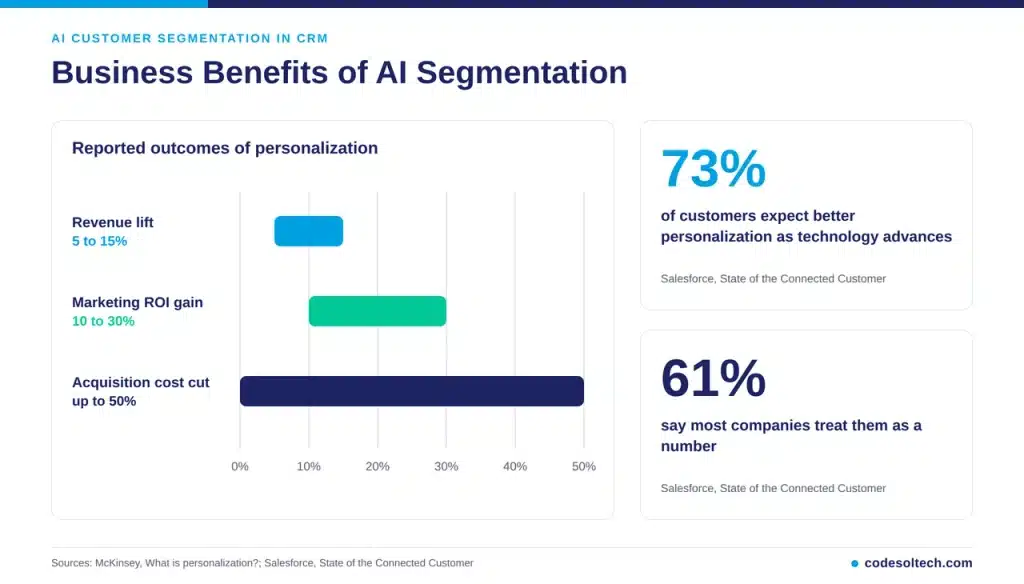
- Revenue lifts of 5 to 15 percent.
- Marketing ROI gains of 10 to 30 percent.
- Customer acquisition cost reductions of up to 50 percent.
Salesforce’s State of the Connected Customer survey of 14,300 consumers and business buyers adds 2 more data points.
It finds that 73 percent of customers expect better personalization as technology advances, and 61 percent say most companies treat them as a number.
Segment Applications Inside the CRM
Sales, marketing, and service teams apply segments in 5 workflows:
- Lead prioritization: Predictive scores rank new leads by conversion probability.
- Churn prevention: At-risk segments trigger retention offers and account manager alerts.
- Upsell targeting: High-value segments receive product recommendations based on purchase patterns.
- Campaign personalization: Email and SMS content changes by segment.
- Service routing: Premium segments reach senior agents first.
Customer Segments AI Typically Produces
AI clustering on CRM data produces 5 segment types in most B2B and B2C datasets. Each type calls for a different action.
- High-value loyalists: Customers with recent, frequent, and large purchases who receive loyalty and referral offers.
- At-risk customers: Formerly active buyers whose engagement dropped, who receive retention outreach.
- New high-potential buyers: Recent customers with fast early engagement, who receive onboarding and cross-sell content.
- Discount-driven buyers: Customers who purchase only during promotions, who receive limited-time offers.
- Dormant accounts: Customers with no activity for 6 or more months, who receive reactivation campaigns.
Segment names come from the marketer. The algorithm only assigns numbered clusters, and the team labels each cluster after reviewing its average behavior.
Data Quality Requirements for AI Segmentation
AI segmentation requires complete, deduplicated, and consistently formatted records. A model trained on duplicate contacts splits one customer into 2 profiles and distorts every segment.

Teams fix this before training by running a CRM data quality audit. The audit checks 4 conditions:
- Duplicate contact and account records.
- Empty fields in key variables such as last purchase date.
- Inconsistent formats for phone numbers, dates, and addresses.
- Stale records with no activity in 12 or more months.
A unified data layer also matters.
A well-planned CRM integration architecture connects billing, support, and marketing tools so the model sees the full customer. Teams moving from an older platform complete a CRM data migration first.
How Do You Implement AI Customer Segmentation in a CRM
You implement AI segmentation in 6 steps, from defining a business goal to monitoring model drift. A narrow first goal, such as churn reduction, delivers results fastest.
- Define the goal: Choose one measurable outcome, such as reducing 90-day churn.
- Audit the data: Clean duplicates and fill gaps in the variables the model needs.
- Select the method: Use clustering for discovery and predictive scoring for ranked outcomes.
- Train and validate: Test segments against a holdout sample of historical customers.
- Activate in workflows: Connect each segment to a campaign, pipeline stage, or service rule.
- Monitor drift: Track segment stability monthly and retrain when membership shifts.
Businesses that need models embedded in their own data layer choose custom CRM development. Custom builds expose raw data to the model and avoid the field limits of off-the-shelf tools.
How to Measure AI Segmentation Success
You measure success with 2 metric groups: model quality and business impact. Model quality confirms the clusters are distinct, and business impact confirms they earn revenue.
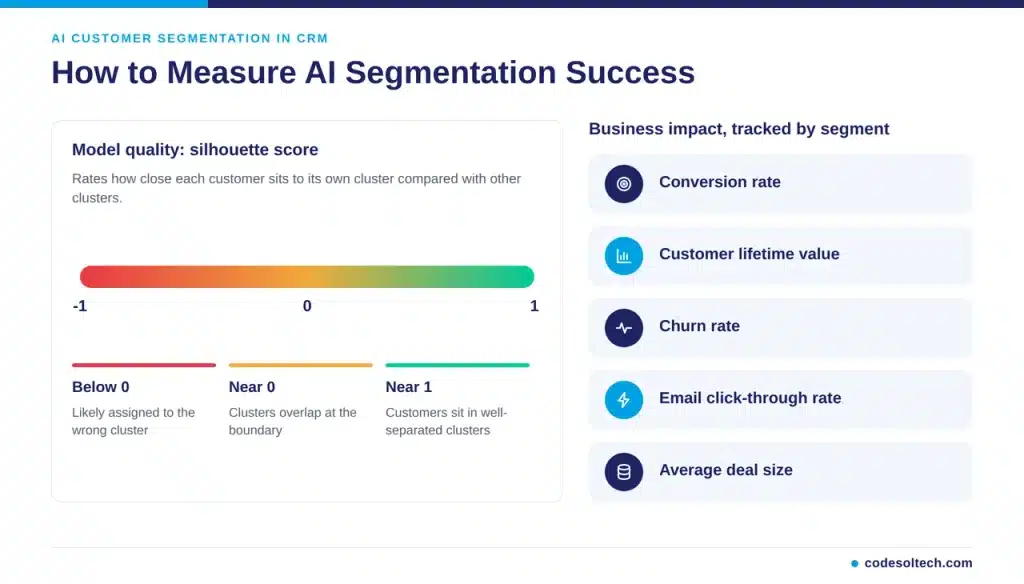
The silhouette score measures cluster quality on a scale from -1 to 1. Scores closer to 1 indicate customers sit close to their own cluster and far from others.
Business impact metrics track 5 outcomes:
- Conversion rate by segment.
- Customer lifetime value by segment.
- Churn rate by segment.
- Email click-through rate by segment.
- Average deal size by segment.
Mistakes That Break AI Segmentation
5 mistakes cause most segmentation failures. Each one has a direct fix.
- Training on dirty data: Duplicates and empty fields distort clusters. Clean the data first.
- Choosing too large a segment count: Teams cannot run 20 different campaigns. Limit the output to 5 to 8 segments.
- Ignoring behavioral data: Static fields miss intent. Add product usage and engagement events.
- Skipping retraining: Customer behavior shifts, and stale segments lose accuracy. Retrain monthly or quarterly.
- Leaving segments unused: A segment delivers value only after it triggers a workflow. Connect every segment to an action.
Built-In CRM AI vs. Custom Models
Built-in CRM AI fits teams that need fast setup. Custom models fit teams with unique data or strict performance targets.
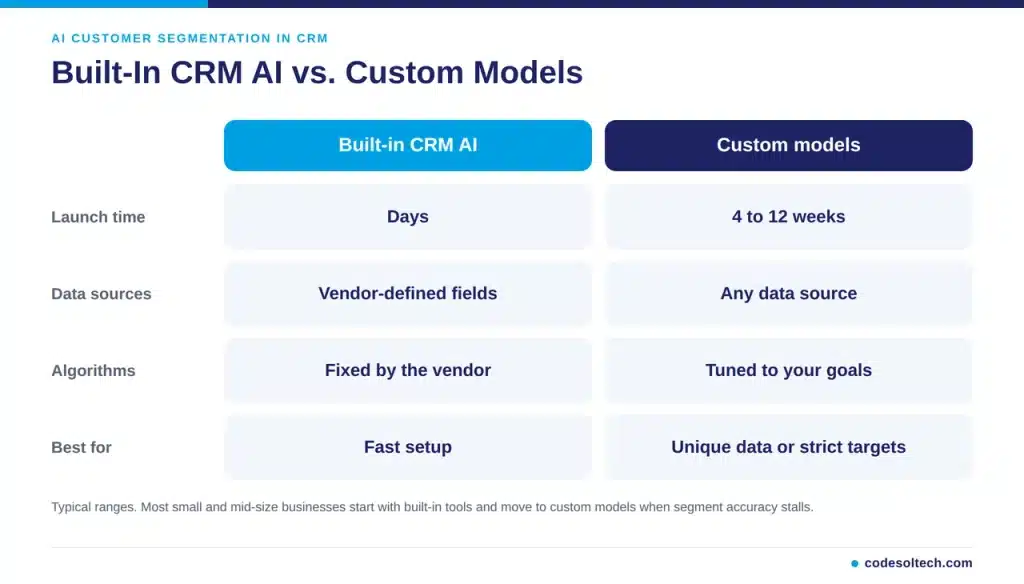
- Built-in CRM AI: Launches in days, uses vendor-defined fields, and runs fixed algorithms.
- Custom models: Use any data source, tune algorithms to your goals, and require a development phase of 4 to 12 weeks.
Most small and mid-size businesses start with built-in tools and move to custom models when segment accuracy stalls.
Privacy and Compliance Rules for AI Segmentation
AI segmentation processes personal data, so privacy law governs it. Consumers also expect transparency about how companies use AI.
The same Salesforce survey reports 74 percent of customers are concerned about the unethical use of AI.
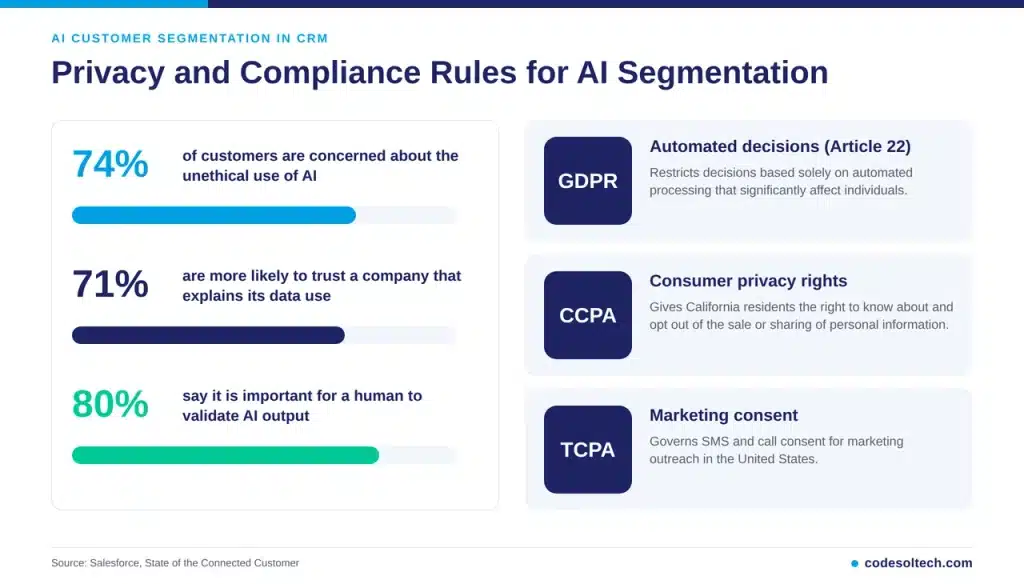
It also reports that 71 percent are more likely to trust a company with personal data when the company explains its use.
Three regulations apply most often:
- GDPR Article 22 restricts decisions based solely on automated processing that significantly affect individuals.
- CCPA gives California residents the right to know about and opt out of the sale or sharing of their personal information.
- TCPA governs SMS and call consent for marketing outreach in the United States.
Compliant teams document model inputs, honor opt-outs, and keep a human reviewer on high-impact decisions.
Final Words
AI customer segmentation turns static CRM lists into living audiences.
Clean data, a narrow first goal, and monthly monitoring produce reliable segments. Clear labels turn each cluster into a concrete action.
Start with one use case, measure the lift, then expand to every team that touches the customer, with each segment tied to an action.
Ready to build AI segmentation into your CRM? Talk to CodeSolTech and get a custom segmentation plan for your data.
You May Like
AI Email Generation in CRM: Save 12 Hrs/Week
AI Sales Assistants for Small Business: What They Actually Do
AI Meeting Notes & Call Summaries in CRM [6-Step Plan]
Thanks for Reading 🙂
![AI Meeting Notes & Call Summaries in CRM [6-Step Plan]](https://www.codesoltech.com/wp-content/uploads/2026/09/AI-Meeting-Notes-.webp)