A CRM for mortgage brokers is software that captures loan leads, tracks each file through pipeline stages, and automates follow-up until the loan closes. It replaces spreadsheets and scattered emails with one system that shows every borrower’s stage, every referral partner’s activity, and every overdue task.
Mortgage-specific CRMs add loan origination system (LOS) integration, compliance tracking, and rate-change alerts that generic sales CRMs do not include.
Mortgage brokers manage three types of relationships inside a CRM: borrowers, referral partners, and internal team members.
Referral partners include real estate agents, financial advisors, and builders who send repeat business. A CRM tracks the referral source on every lead, letting a broker calculate which partner produces the highest closing rate.
The financial stakes behind this organization are measurable. Independent mortgage banks spent an average of $12,579 in total production costs per loan in the first quarter of 2025, with personnel expenses alone reaching $7,598 per loan, according to the Mortgage Bankers Association’s Quarterly Mortgage Bankers Performance Report.
Net production income was negative $28 per loan that quarter. A lead lost to poor follow-up is not a missed opportunity in the abstract it is a direct loss against a cost structure that is already thin.
Why Mortgage Brokers Lose Deals Without a Dedicated CRM
Borrowers rarely wait for a broker to catch up. The Consumer Financial Protection Bureau found that nearly half of borrowers seriously consider only one lender or broker before applying, and roughly 77% submit an application to only one lender.
This narrow window means the first broker to respond with a credible rate and a clear next step usually keeps the deal. A CRM shortens that response time by routing new leads to a loan officer immediately and logging a required first-contact deadline.
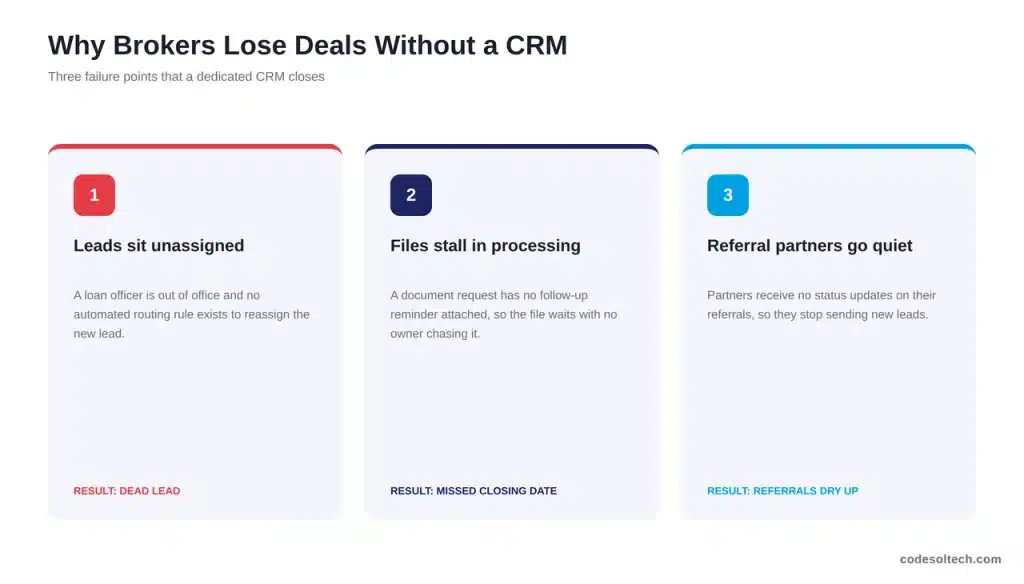
Spreadsheets and shared inboxes create three specific failure points:
- Leads sit unassigned when a loan officer is out of office, because no automated routing rule exists.
- Files stall in processing when a required document request has no follow-up reminder attached.
- Referral partners stop sending leads when they receive no status updates on their prior referrals.
Wholesale and broker-channel lending continues to expand its share of total originations, with United Wholesale Mortgage originating 422,120 loans through independent brokers in 2025, the highest loan count of any lender in the country. Broker volume at this scale cannot run on manual tracking.
A CRM is the operational layer that lets a small brokerage compete for the same borrower attention as a large retail lender.
Core Features Mortgage Broker CRMs Must Have
A CRM built for mortgage brokers configures five capabilities that a generic sales CRM does not include by default:
- LOS integration — the CRM syncs with loan origination systems such as Encompass or Calyx Point so loan status updates automatically instead of requiring manual re-entry.
- Pipeline stage automation — the system moves a file through defined stages (Lead, Pre-Qualification, Application, Processing, Underwriting, Clear to Close, Funded) and triggers the next task at each transition.
- Compliance and audit tracking — the CRM timestamps borrower communications and disclosure delivery to support TRID (TILA-RESPA Integrated Disclosure) recordkeeping requirements.
- Rate-change alerts — the system flags borrowers in a “nurture” or “not ready” stage when market rates move, prompting a re-engagement call.
- Referral partner dashboards — real estate agents and other partners access a limited view of their referred borrowers’ status without full CRM access.
Loan officer capacity data supports why automation on these five points matters. The mortgage industry recorded 221,161 active producing loan officers in 2025, a workforce that has stabilized well below its pandemic-era peak of roughly 290,000.
Fewer loan officers must manage the same borrower demand, which makes automated task routing a capacity multiplier rather than a convenience feature.
How to Organize Loan Pipelines Inside a CRM
A mortgage broker organizes a loan pipeline by mapping every file to a fixed sequence of stages and assigning an owner and a deadline to each stage. The CRM displays this sequence as a visual board, so a broker sees the entire active pipeline at a glance instead of opening individual files.
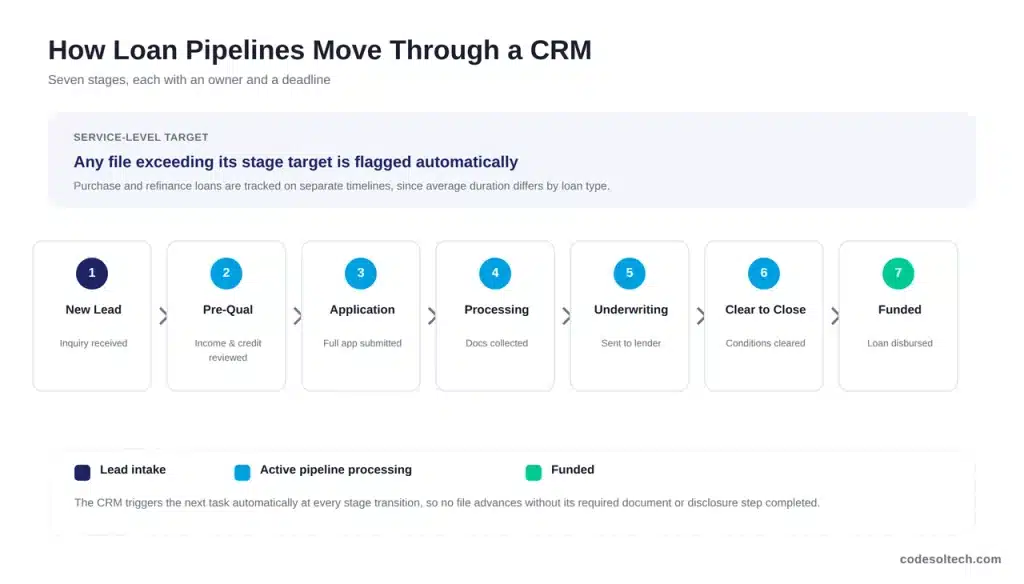
A standard mortgage pipeline configuration includes seven stages:
- New Lead — borrower has inquired but has not submitted an application.
- Pre-Qualification — broker has reviewed income, credit, and debt-to-income ratio.
- Application Submitted — borrower has completed a full loan application.
- Processing — documents are collected and verified.
- Underwriting — the file is submitted to the lender for approval.
- Clear to Close — all conditions are satisfied and closing is scheduled.
- Funded — the loan has closed and disbursed.
Each stage carries a service-level target. A broker configures the CRM to flag any file that exceeds its target time in a single stage, which surfaces bottlenecks before they delay closing.
Pipeline reporting also separates purchase loans from refinance loans, since the two loan types carry different average timelines and different referral sources.
Mortgage CRM vs. Generic Sales CRM: Key Differences
| Capability | Mortgage Broker CRM | Generic Sales CRM |
|---|---|---|
| LOS integration (Encompass, Calyx Point) | Native or direct API sync | Not available; requires custom build |
| TRID disclosure timestamp tracking | Built into pipeline stages | Absent |
| Loan-specific pipeline stages | Pre-configured (Underwriting, Clear to Close, etc.) | Generic sales stages (Prospect, Negotiation, Won) |
| Referral partner portal | Standard feature | Requires third-party add-on |
| Rate-change re-engagement triggers | Standard automation | Not applicable to the industry |
Compliance and Data Security Requirements
A mortgage CRM stores nonpublic personal information: Social Security numbers, income documentation, and credit reports. This data qualifies as sensitive under the Gramm-Leach-Bliley Act, which requires lenders and brokers to safeguard borrower financial information. The CRM must encrypt data at rest and in transit and restrict field-level access by user role.
A compliant mortgage CRM configuration includes the following controls:
- Role-based permissions that separate loan officer, processor, and referral partner access levels.
- Automatic audit logs that record who viewed or edited a borrower file and when.
- Retention rules that archive closed files according to state and federal recordkeeping requirements.
- Secure document portals that replace unencrypted email attachments for sensitive files.
A brokerage that develops a custom CRM can configure these controls to match its specific state licensing requirements, rather than adapting its workflow to a generic platform’s fixed permission structure.
Best Practices for Lead Organization and Follow-Up
Consistent lead handling produces more closed loans than any single feature inside the CRM. The following practices apply regardless of which CRM platform a brokerage deploys:
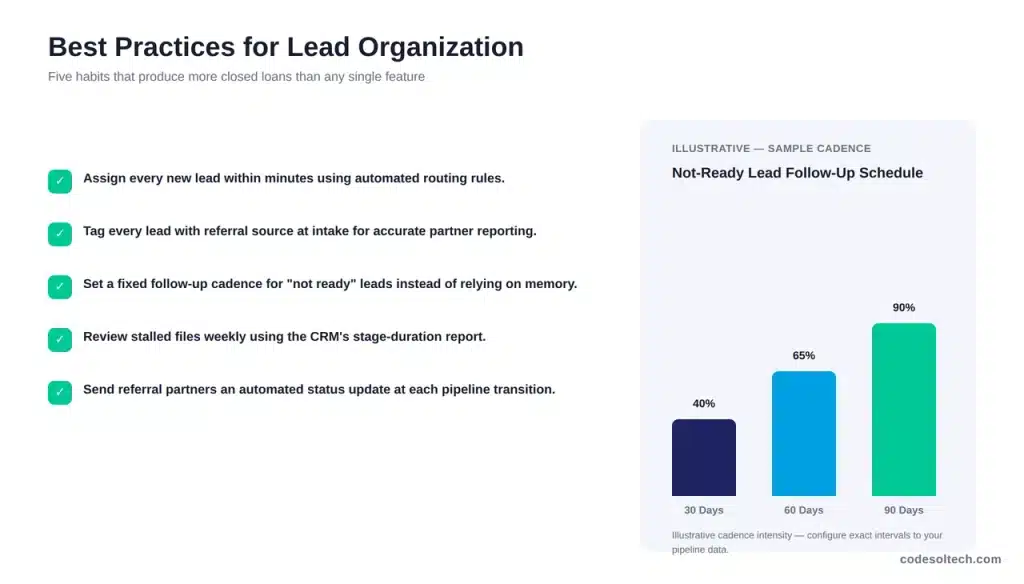
- Assign every new lead to a loan officer within minutes of capture, using automated routing rules rather than manual assignment.
- Tag every lead with its referral source at intake, so partner performance reporting stays accurate without manual reconciliation.
- Set a fixed follow-up cadence for “not ready” leads for example, contact at 30, 60, and 90 days instead of leaving re-engagement to memory.
- Review stalled files weekly using the CRM’s stage-duration report, and reassign or escalate any file that has exceeded its target time.
- Send referral partners an automated status update at each major pipeline transition, which sustains repeat referrals from real estate agents and other partners.
Brokerages that coordinate mortgage referrals with financial advisors or insurance agencies can extend the same CRM instance to manage those cross-referral relationships, rather than operating separate systems for each partner type.
FAQs
Does a mortgage broker need a CRM if the team is small?
Yes. Response speed determines which broker keeps a lead, and CFPB data shows most borrowers only seriously consider one lender before applying. A two-person brokerage without automated routing loses leads to slower response the same way a large team does.
Can a mortgage CRM integrate with an existing loan origination system?
Most mortgage-specific CRMs integrate with Encompass, Calyx Point, or similar loan origination systems through a direct API connection. Generic sales CRMs typically require a custom integration built separately.
What is the difference between a CRM and a loan origination system (LOS)?
A loan origination system processes the loan file through underwriting and closing. A CRM manages the relationship before, during, and after that process — lead capture, follow-up, referral tracking, and post-close communication. The two systems integrate; they do not replace each other.
How long does it take to deploy a mortgage broker CRM?
A configured, off-the-shelf mortgage CRM typically deploys in 2 to 4 weeks. A custom-built CRM with LOS integration and brokerage-specific compliance rules typically takes 6 to 12 weeks to develop and deploy.
Final Words
A mortgage broker CRM is not optional overhead; it is the system that determines whether a lead becomes a closed loan.
Pipeline visibility, automated follow-up, and LOS integration protect margin in an industry where production costs already outpace profit on many files. Brokers who organize leads manually compete against brokers who don’t have to.
CodeSoltech develops custom CRM systems for mortgage brokers, built around your loan pipeline, your LOS, and your compliance requirements.


![Electrician CRM: Win More Jobs [Faster Estimates Guide]](https://www.codesoltech.com/wp-content/uploads/2026/10/Crm-for-an-electricians-business.webp)