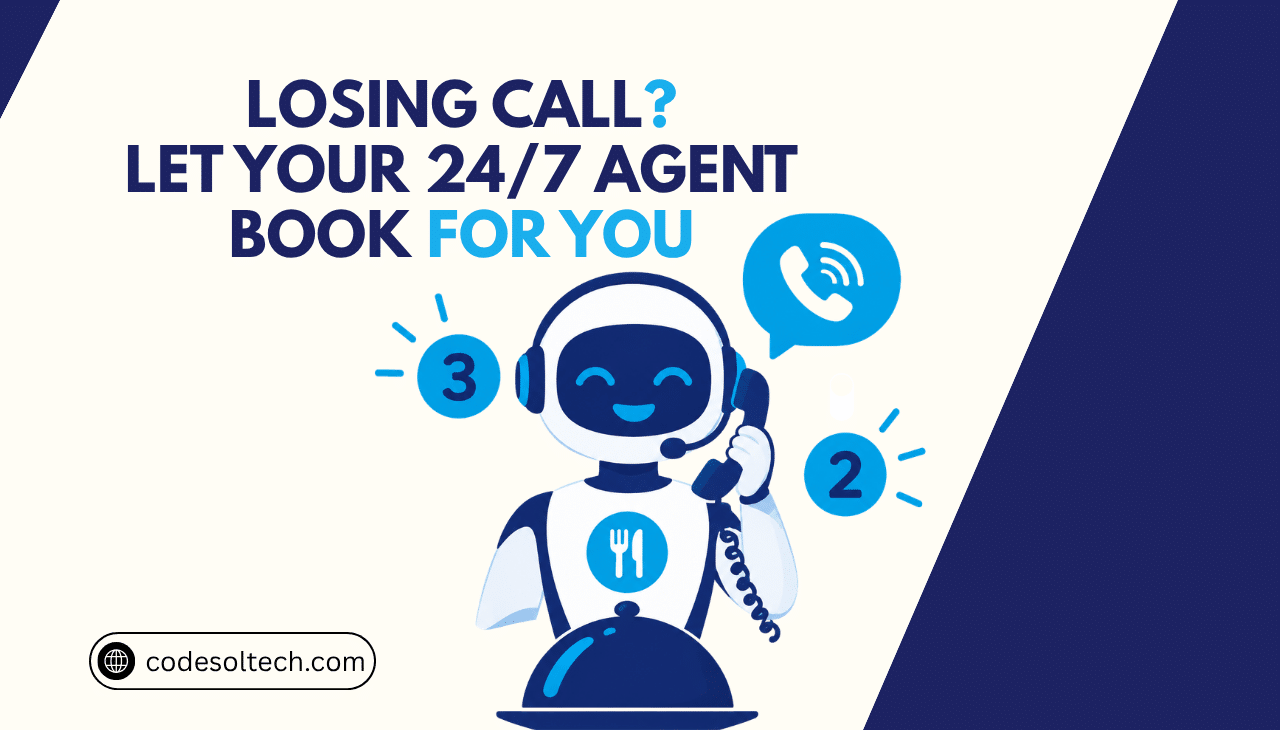
An AI phone agent answers every restaurant call on the first ring, day and night. It books tables, manages the waitlist, answers hours and menu questions, and takes takeout orders. For a restaurant, that means ringing phones turn into booked tables instead of lost revenue.
If you run a restaurant in Austin, you know the pattern well. Friday at 7 PM, the dining room is full and servers are moving fast. The host is juggling the waitlist at the door. Then the phone rings, and nobody can reach it.
Then it rings again. Each of those calls was someone ready to spend money with you tonight. This refresh keeps what worked in the original article and adds newer call data, a clearer buying checklist, and a rollout plan your team can follow.
Why restaurant phones go unanswered
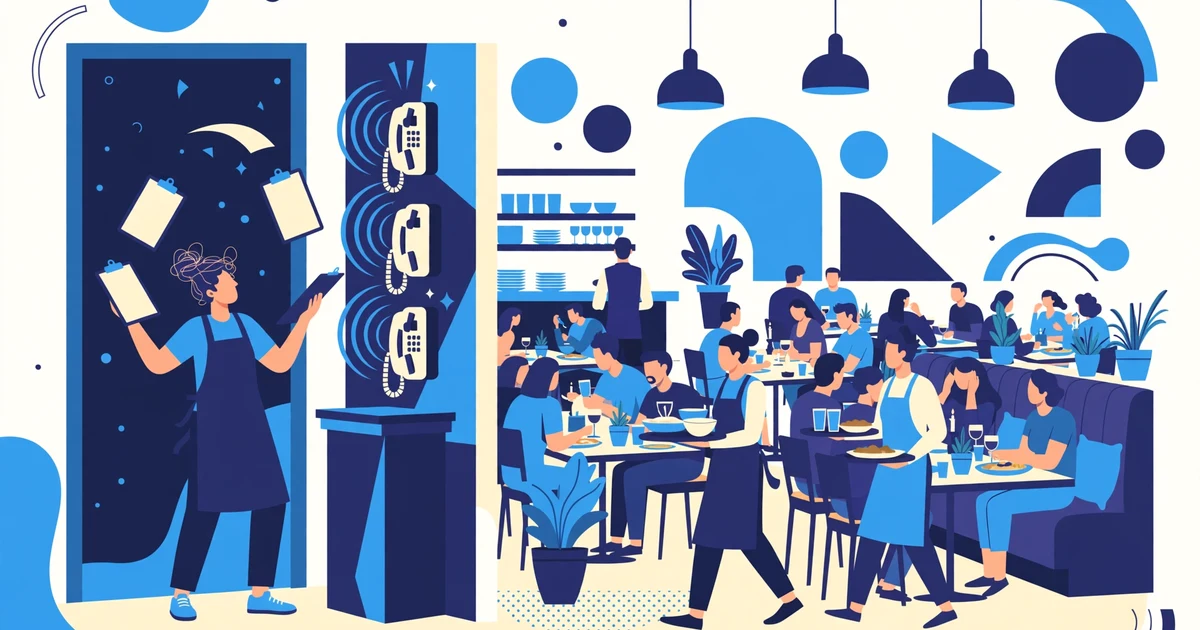
The problem is structural, not a staffing failure. Peak call times land exactly on peak service times. Guests want to call about dinner at the same moment your team is busiest serving guests already in the building.
The dinner rush collision
The host taking names at the door cannot answer line two at the same time. The server carrying plates to table twelve cannot pick up a reservation call. Every restaurant makes the same choice a dozen times per shift.
Serve the guest in front of you, or answer the phone. The guest in front of you wins, and the phone call becomes lost revenue. The data backs this up in a stark way.
According to the Slang AI State of the Restaurant Phone report, about 12 percent of calls arrive at the same time. A single host simply cannot catch them all. Slang puts average monthly volume at 1,220 calls per restaurant.
The Revmo State of Restaurant Calls 2026 report found the same pressure at dinner. Between 5 PM and 8 PM, the average restaurant leaves 32 percent of calls unanswered. That window brings in 47 percent of all daily phone orders.
After hours calls nobody staffs
Guests do not only call during dinner service. They call when they plan: mid-afternoon, late at night, Sunday morning. Slang found restaurants average about 168 after-hours calls a month, nearly 14 percent of all calls.
Slang also found that 20 percent of reservations happen outside business hours. That is demand your restaurant cannot capture with a closed phone line. Voicemail does not fix it, because most callers move on.
Revmo reported that 60 percent of callers will not try again after one unanswered attempt. Another 69 percent simply go somewhere else. The reservation goes to whoever answered first.
What an AI phone agent does for a restaurant

Think of an AI phone agent as a tireless host who only answers the phone. It picks up on the first ring, speaks naturally, and handles the full range of guest calls. It never gets pulled onto the floor mid-call.
The same technology already supports AI receptionist coverage for dental clinics. Restaurants are a natural next fit, because the calls follow predictable patterns. Most callers want one of a few things.
Reservations and waitlists
Over half of restaurant calls, about 57 percent according to Slang, are about reservations. The AI agent books tables directly into your reservation system. It adds parties to the waitlist and quotes realistic wait times.
That matters most at peak times. Slang estimates coinciding reservation calls alone could be worth about 83 missed bookings a month. At 100 dollars per reservation, that is 8,200 dollars a month left on the table.
Hours, directions, and menu questions
A big share of calls are simple questions. Are you open Sunday, do you have parking, is the patio dog-friendly. The agent answers instantly from your business profile. No hold music, no callback needed.
These calls look small, but they decide where a guest eats. A fast, correct answer keeps the guest moving toward a booking. A missed call sends that guest to the next restaurant on their list.
Takeout orders and event inquiries
The agent takes takeout orders straight into your POS flow. It routes private-event inquiries to the right person, with a written summary. Nothing sits in a voicemail inbox until Monday morning.
Takeout callers are high-intent buyers. They already chose your menu. Answering them fast protects an order you have effectively already won. Delay, and that order goes to a competitor.
The real cost of every missed call

The numbers make the business case on their own. QSR Magazine ran the math across the industry in its QSR Magazine analysis of 20 billion dollars in lost restaurant revenue. The average restaurant misses about 150 calls a month.
About 60 percent of those missed calls carry real customer intent. That leaves roughly 1,080 actionable calls unanswered per year. At a 70 percent conversion rate, that is 756 lost orders per restaurant per year.
At an average takeout order of 38 dollars, that is about 28,700 dollars in lost revenue per restaurant per year. Across the industry, that is over 20 billion dollars left on the table annually. Revmo puts the toll even higher for quick-service locations.
Revmo found quick-service restaurants miss 40.1 percent of calls. That works out to roughly 73,000 dollars lost per location per year. A single 50-location chain loses an estimated 3.65 million dollars annually from missed calls alone.
- A single missed 4-top at 40 to 55 dollars per person is 160 to 220 dollars gone.
- Callers who reach voicemail convert at a fraction of callers who speak to someone live.
- Busy nights hurt twice: your highest-revenue hours are also your highest-missed-call hours.
- Slang puts combined coinciding and after-hours missed revenue at up to 212,400 dollars per restaurant per year.
No marketing campaign can outperform simply answering the phone you already paid to ring. Marketing brings callers to your door. Answering turns them into seated guests.
AI answering compared with a human host

AI does not replace your host. It covers the calls your host cannot physically take. Here is where each one wins, side by side.
- Warmth and judgment: the human host wins. Greeting regulars, handling a delicate complaint, and reading the room stay human.
- Speed and availability: the AI wins. First-ring pickup, midnight coverage, and five simultaneous calls, with no bad days.
- Consistency: the AI never forgets to offer the waitlist or ask for the callback number.
- Cost per call: the AI costs a fraction of a dedicated phone staffer per shift.
The strongest setup is both. Your host owns the room, and the AI owns the ringing. Guests get the human touch where it matters, and instant answers where it does not.
This split also protects your team. Staff stop splitting attention between the floor and the phone. Service gets calmer, and the phone still gets answered every time.
How to choose an AI phone system for your restaurant
Not every system is built for restaurants. Phone trees that say press 1 are not AI answering. Look for a system trained for hospitality conversations, not generic call routing.
Test it the way a guest would. Call it during a pretend rush, ask about a party of six, and change the booking time mid-call. A good system handles all three without breaking character.
Features that matter
- Direct integration with your reservation platform and POS, not a separate dashboard your team must check.
- Natural conversation, not menus. Callers should just talk, the way they would to a host.
- Real-time waitlist management with honest wait-time quotes.
- Call transcripts and summaries, so your team sees every booking and question each morning.
- After-hours and overflow modes, so it only takes the calls your staff cannot.
Red flags to avoid
- No integration with your existing reservation tools. Double entry means double errors.
- No way to transfer to a human mid-call. Guests must always be able to reach a person.
- Generic voice models with no restaurant vocabulary. Party of six should not confuse it.
- No transcripts. If you cannot audit a call, you cannot trust the bookings it made.
Ask vendors for a live demo on your own menu and policies. A system that sounds great on a generic script can still fail on your patio rules, your private dining minimum, or your holiday hours.
Rolling it out in an Austin restaurant
Austin restaurants run on weekends, festivals, and patios. The phone problem gets worse at exactly those times. A rollout here does not need to be dramatic. Start small, prove it, then widen coverage.
Salons faced a similar booking problem and solved it with online booking systems that cut salon no-shows. Restaurants get the same lift by automating the phone instead. The pattern is the same: remove friction at booking time.
A simple week by week plan
Week 1: after-hours only. Let the AI cover nights, Sundays, and holidays. Read the transcripts each morning and confirm it sounds like your brand.
Week 2 to 3: add overflow during service. When the host line is busy, calls route to the AI instead of voicemail. Tell your team what is changing and why, so it feels like backup, not a replacement.
Week 4: review the data. Count recovered reservations, takeout orders, and event leads. That is your ROI, measured in booked tables.
Pair the phone agent with process workflow automation services across the business, from online reservations to staff scheduling. The phone then becomes part of one connected guest pipeline.
That wider view pays off in staff time too. See how workflow automation saves small businesses 20 hours a week for the kind of weekly hours automation can return. Phone coverage is one of the fastest wins inside that total.
For guest follow-up after the call, conversational AI inside a CRM keeps the conversation going without extra manual work. A booked table can trigger a reminder, and a missed detail can trigger a follow-up.
Common questions about restaurant AI answering
Does it sound like a robot?
Modern systems use natural voices tuned for conversation, not robotic text-to-speech. Most callers never realize they are not speaking to a person. Transcripts let you audit every call.
What if a caller wants a human?
The agent transfers to your team on request, any time. The rule is simple: the AI handles routine calls and hands off anything sensitive or unusual.
Can it take takeout orders?
Yes. It takes the order, confirms the total and pickup time, and pushes it into your POS flow, exactly like a counter staffer would.
Will it work for a small single-location restaurant?
Small restaurants benefit most. You have the fewest hands on the phones and the least margin to lose a Friday-night 4-top. After-hours coverage alone usually pays for the system.
What happens when the AI gets a question wrong?
A good system hands off instead of guessing. It transfers the call, or takes a message with the exact question. Your team then answers from a transcript, not from a guess.
Want an AI phone agent for your restaurant?