
The agentic AI platform market was valued at $5.6 billion in 2025 and is forecast to reach $52.3 billion by 2033.
Yet adoption and value are very different things. McKinsey found 88% of organizations use AI in at least one function, but only 7% have fully scaled it.
Below are 50 verified AI automation statistics for 2026, grouped by topic. Every number names its source, and every source link was checked to load.
At a glance: the numbers that frame this roundup
| Headline figure | Value | Source |
|---|---|---|
| Agentic AI platform market, 2033 forecast | $52.3 billion | Grand View Research |
| AI infrastructure spending, 2025 | $318 billion, more than double 2024 | IDC |
| Organizations regularly using AI, 2025 | 88% | McKinsey, via AI Workforce |
| Organizations with AI fully scaled | 7% | McKinsey, via IDM |
| AI contribution to the global economy, 2030 | Up to $15.7 trillion | PwC, via AmCham |
| Sales organizations using some form of AI | 87% | Salesforce State of Sales 2026 |
| Agentic projects cancelled by end 2027 (forecast) | Over 40% | Gartner |
| Small businesses investing in AI | 75% | Salesforce SMB Trends |
Read the scope note on each row before comparing figures from two firms.
Different firms measure different slices of AI, so their totals are not interchangeable.
AI Automation Market Size and Spending
Spending on AI is growing on every measure, from infrastructure to niche software markets.
The fastest growth sits in agentic platforms, the tools that let AI act across systems.
| Market figure | Value | Source |
|---|---|---|
| Agentic AI development platforms, 2025 to 2033 | $5.6B in 2025, $7.4B in 2026, $52.3B by 2033, 32.3% CAGR | Grand View Research |
| AI in sales market, 2025 to 2033 | $29.2B in 2025, $34.8B in 2026, $145.1B by 2033, 22.6% CAGR | Grand View Research |
| AI infrastructure spending, 2025 and 2026 | $318B in 2025 (from $153B in 2024); $487B forecast for 2026; over $1T by 2029 | IDC |
| AI in software development, 2025 to 2033 | $933M in 2025 to $15.7B by 2033, 42.8% CAGR | Grand View Research |
| AI contribution to the global economy, 2030 | Up to $15.7 trillion, equal to up to 14% higher global GDP | PwC, via AmCham |
| Productivity vs consumption split of the $15.7T | $6.6 trillion from productivity, $9.1 trillion from consumption-side effects | PwC, via AmCham |
| Enterprise AI spending, 2026 | Nears $400 billion | FII Institute, via IDC estimates |
| Where generative AI value concentrates | 75% in four functions: customer operations, marketing and sales, software engineering, R&D | McKinsey, via CFTE |
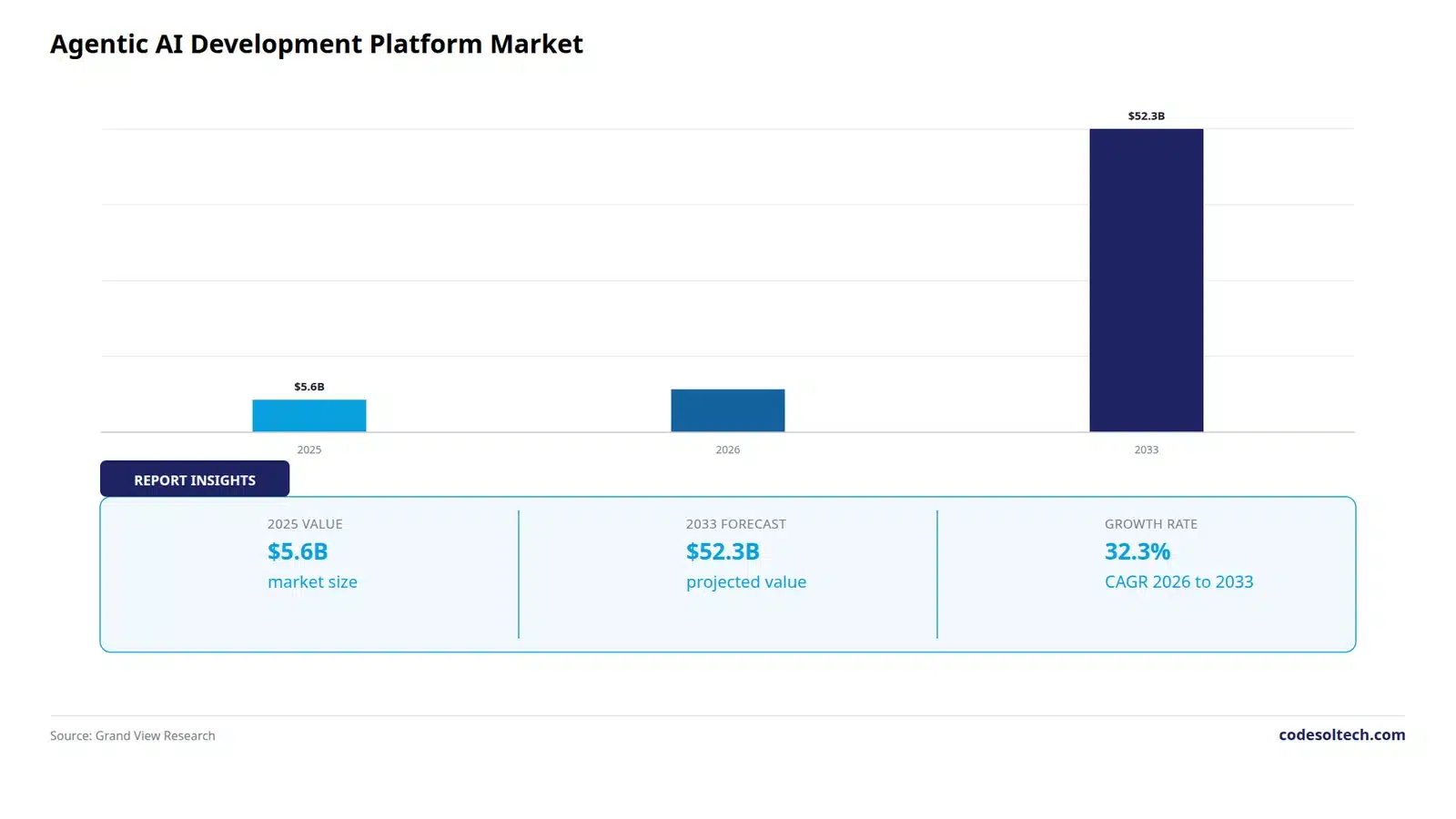
The agentic platform series is the cleanest growth story in this roundup.
It grows almost tenfold in eight years, which explains why vendors are racing to add agents.
IDC infrastructure spending tells the hardware side of the same story.
At $318 billion in 2025, it more than doubled in a single year, and servers dominate the total.
AI Adoption Statistics
AI use is now normal inside surveyed organizations. Scaling it is still rare.
That gap between use and scale is the single most important pattern in this roundup.
| Adoption figure | Value | Source |
|---|---|---|
| Organizations regularly using AI, 2025 | 88%, up from 78% in 2024 (1,993 respondents, 105 countries) | McKinsey, via AI Workforce |
| Regular generative AI use, 2025 | 79%, up from 33% in 2023 and 71% in 2024 | McKinsey |
| AI fully scaled across the organization | 7% of respondents | McKinsey, via IDM |
| In the scaling phase | 31%, while about two-thirds have not begun scaling enterprise-wide | McKinsey, via IDM |
| Any enterprise-level EBIT impact from AI | 39%, usually under 5% | McKinsey, via AI Workforce |
| AI high performers | 6%, with EBIT impact of 5% or more plus significant value attribution | McKinsey, via AI Workforce |
| Scaling agentic AI in at least one function | 23% of respondents | McKinsey, via AI Workforce |
| Experimenting with agentic AI | 39% of respondents | McKinsey, via AI Workforce |
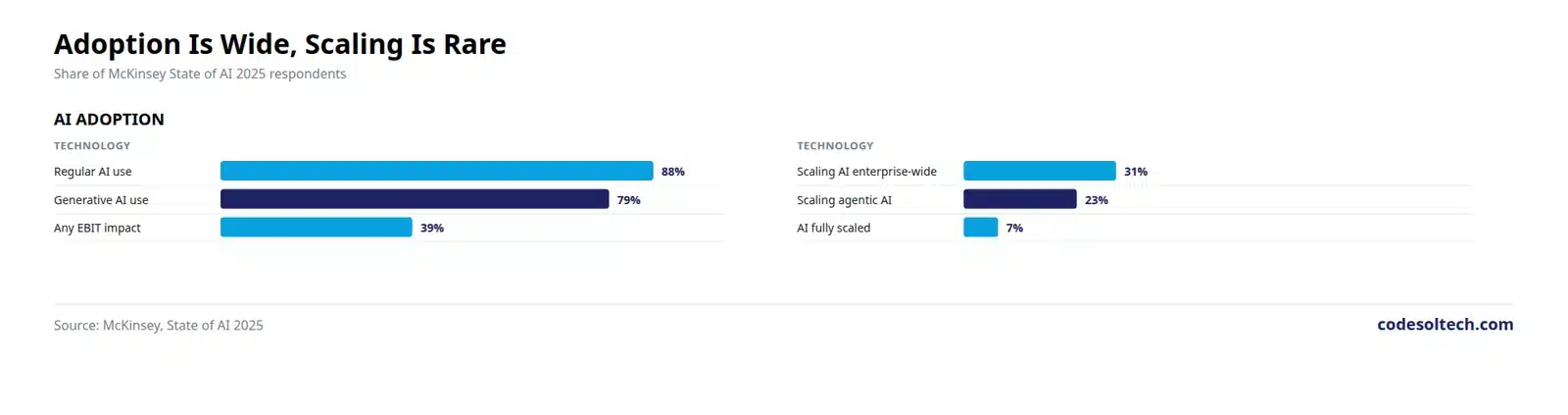
The chart makes the gap visual. Use sits at 88%, but full scale sits at just 7%.
Most organizations are therefore still in the pilot phase, even after years of AI spending.
The adoption trend over time
McKinsey tracked regular AI use from 20% in 2017 to 88% in 2025.
The definition of use changed over that period, so treat the early years as indicative.
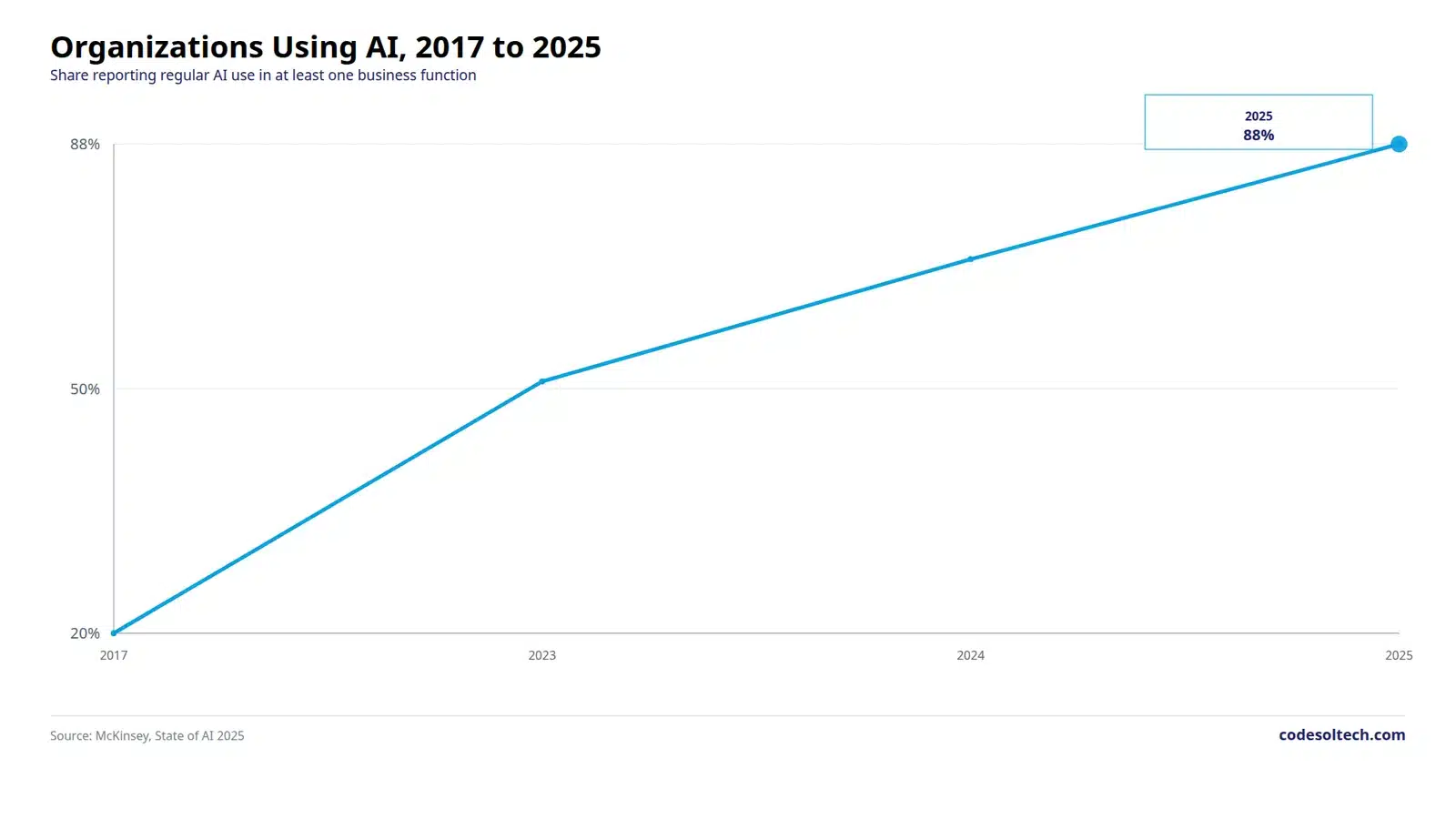
Generative AI drove the recent jump, rising from 33% in 2023 to 79% in 2025.
For a local comparison, see how Texas businesses compare AI automation agencies before shortlisting vendors.
AI ROI and Productivity Statistics
Productivity gains are widely reported. Bankable profit is much rarer.
That distinction matters when a vendor quotes a time saving as if it were a return.
| ROI and productivity figure | Value | Source |
|---|---|---|
| Work activities with automation potential | 60 to 70% of employee time, via generative AI plus other technologies | McKinsey, via CFTE |
| When half of work activities could be automated | Between 2030 and 2060, midpoint 2045, about a decade earlier than prior estimates | McKinsey, via CFTE |
| Gen AI experiments moved into production | Nearly 70% of respondents moved only 30% or fewer into production (Deloitte Q3 2024) | Deloitte |
| Organizations planning to boost AI investment | 78% plan to boost investment next year (Deloitte Q4 survey) | Deloitte |
| Time marketers save with AI | Average of one to two hours per work day | HubSpot, AI Trends for Marketers |
| Marketing leaders increasing AI investment | 65% plan to increase investment in AI and automation tools | HubSpot, AI Trends for Marketers |
| Generative AI pilots with no measurable P&L impact | 95% of the pilots studied (300 deployments across about 2,400 enterprises) | MIT NANDA, via The AI Tools |
| Companies achieving AI value at scale | 5% in BCG 2025 study | BCG 2025, via AICopse |
The MIT pilot figure needs its scope stated plainly. It covers pilots studied, not all AI work.
Even with that scope, it warns against judging an automation program by pilot enthusiasm alone.
Time saved only becomes profit when a workflow is redesigned around the saving.
That redesign step is exactly what most organizations have not yet done, per Deloitte.
Before buying tools, read the workflow automation myths that hold small teams back so the pilot is designed to scale.
Sales and Marketing Automation Statistics
Sales and marketing are where AI automation is most embedded today.
Agents now work leads and drafts, while humans keep the closing conversations.
| Sales and marketing figure | Value | Source |
|---|---|---|
| Sales organizations using some form of AI | 87%, for prospecting, forecasting, lead scoring or drafting emails (4,050 professionals, 22 countries) | Salesforce State of Sales 2026 |
| Sales leaders calling agents essential to growth | 94% of sales leaders who use agents | Salesforce, State of Sales takeaways |
| Sales leaders held back by tech silos | 51% say tech silos hinder their AI efforts | Salesforce, State of Sales takeaways |
| Email marketers reporting an ROI lift from AI | Four in ten report an 11 to 25% ROI increase since implementing AI tools | HubSpot, AI in Email Marketing |
| Weekly time email marketers save with AI | 54% save 1 to 5 hours per week; 31% save 6 to 10 hours per week | HubSpot, AI in Email Marketing |
| Share of marketing activities using AI, 2026 | 24.2%, up from 13.1% in 2024 (308 US marketing leaders) | The CMO Survey 2026, via FirstPromoter |
| Expected share of marketing activities using AI | 55.9% within three years, per marketing leaders | The CMO Survey 2026, via FirstPromoter |
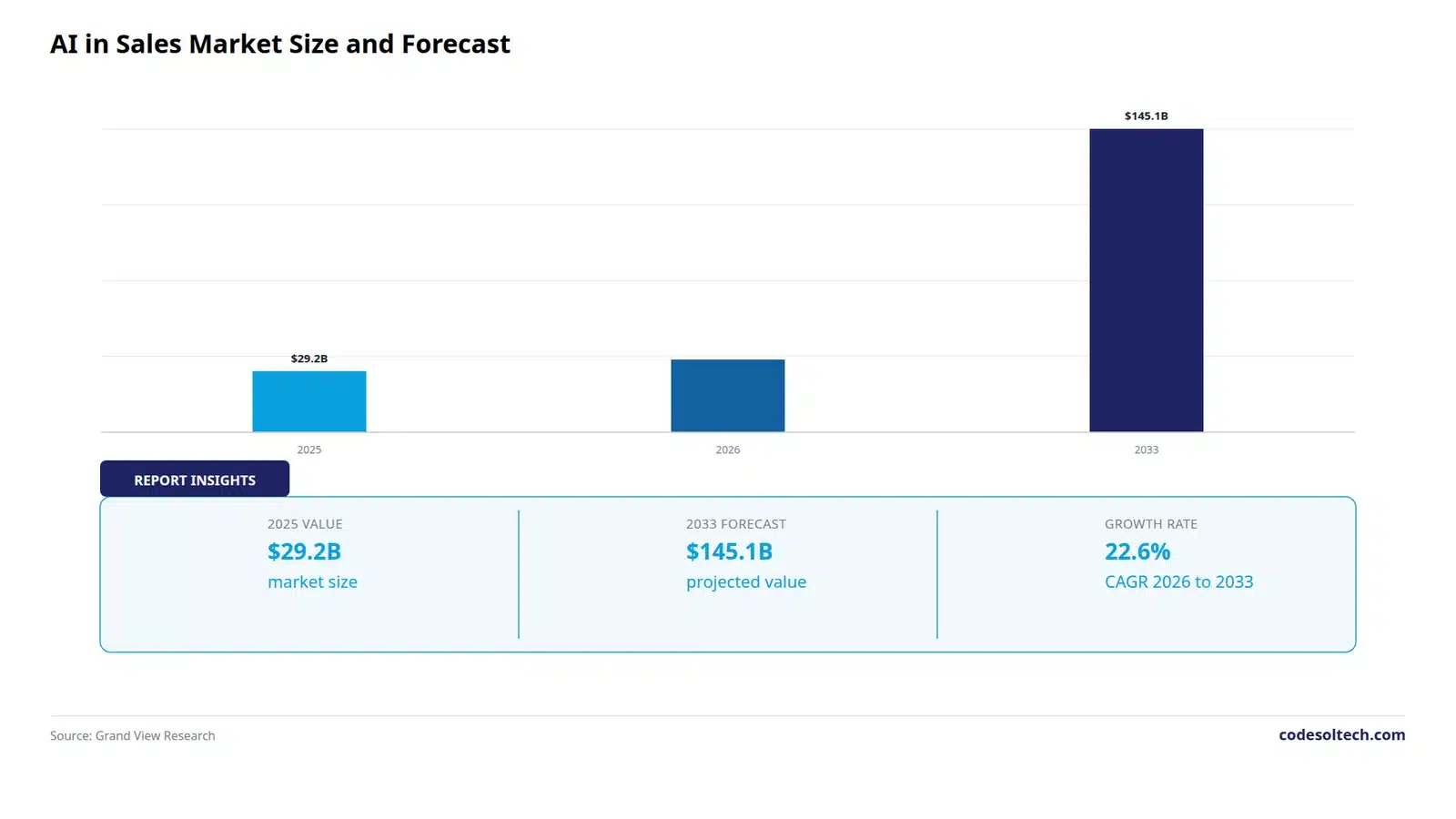
The AI in sales market grows from $29.2 billion in 2025 to $145.1 billion by 2033.
That growth matches the Salesforce finding that agents are now seen as essential, not optional.
Silos remain the brake. Half of sales leaders say disconnected tools hinder their AI efforts.
Customer Service and AI Agent Statistics
Support is the function where agents already resolve real work without a human.
Resolution rates vary widely by vendor, so averages hide the decision that matters.
| Service and agent figure | Value | Source |
|---|---|---|
| Enterprise software including agentic AI, 2028 forecast | 33%, up from less than 1% in 2024 | Gartner |
| Day-to-day work decisions made autonomously, 2028 forecast | At least 15%, up from 0% in 2024 | Gartner |
| Agentic AI projects cancelled by end 2027, forecast | Over 40%, on costs, unclear value or weak risk controls | Gartner |
| Organizations with significant agentic investment | 19% in a January 2025 Gartner poll of 3,412 attendees; 42% conservative, 31% waiting or unsure | Gartner poll, via TBN Grow |
| CX leaders using AI for ticket resolution | 71%, more than for any other task (606 leaders and practitioners, early 2026) | Zendesk, via eMarketer |
| Common service issues resolved by agentic AI, 2029 forecast | 80% without human intervention | Gartner, via Ringly |
| Independent agent resolution benchmark | Median vendor fully resolved 48% of conversations; top five averaged 70% (212 live stores, 13 vendors) | Gorgias benchmark, via SaaStr |

Vendor claims sit above independent benchmarks. Zendesk claims 80% autonomous resolution.
The independent Gorgias benchmark found a 48% median, with the best vendors near 70%.
Buyers should therefore ask for resolution rates on their own ticket types, not a headline.
A practical starting point is AI phone answering for restaurants, where missed calls map directly to lost bookings.
The same logic applies to home services in the AI automation guide for home service businesses.
AI Jobs and Workforce Statistics
Job forecasts describe churn, not a single net number that helps one worker.
New roles and displaced roles rarely sit in the same occupation or city.
| Workforce figure | Value | Source |
|---|---|---|
| New roles created globally by 2030 | 170 million, across all drivers (technology, demographics, green transition), not AI alone | World Economic Forum, via Turkiye Today |
| Roles displaced globally by 2030 | 92 million across all drivers; net effect plus 78 million | World Economic Forum, via Turkiye Today |
| Professions radically changing or vanishing | 22% of current professions by 2030 | World Economic Forum, via Turkiye Today |
| Respondents expecting AI workforce decreases | 32% expect decreases next year; 43% expect no change; 13% expect increases | McKinsey |
| Jobs that could be affected by AI | Around 40% globally, about 60% in advanced economies; affected means transformed, not necessarily eliminated | IMF, via DailyTouch |
| Workers in gen AI-exposed occupations | One in four workers worldwide; transformation is more likely than complete redundancy | ILO 2025, via DailyTouch |
The WEF net gain of 78 million hides the transition cost for displaced workers.
Reskilling speed, not the net figure, decides whether a worker lands in a new role.
Routine and clerical work faces the earliest pressure, while judgment work shifts more slowly.
Small Business Automation and the Execution Gap
Small businesses are investing in AI at enterprise-like rates, with smaller teams.
Their constraint is execution: redesign, data readiness and follow-through.
| Small business figure | Value | Source |
|---|---|---|
| Small businesses investing in AI | 75% (survey of over 3,350 SMB leaders worldwide) | Salesforce SMB Trends |
| SMBs with AI fully integrated daily | Over one-third say AI is fully integrated into daily operations | Salesforce SMB Trends |
| SMB leaders expecting efficiency gains | 90% believe AI will make operations more efficient | Salesforce SMB Trends |
| Organizations generating revenue from AI | 20%, even as 74% expect AI to drive revenue growth eventually (3,235 leaders, 24 countries) | Deloitte 2026, via Beri |
| Organizations that have not redesigned jobs for AI | 84% have not redesigned jobs around AI capabilities | Deloitte 2026, via Beri |
| Organizations moving 40% or more of pilots to production | 25% have moved 40% or more of AI pilots into production | Deloitte 2026, via Beri |

The Deloitte trio explains the McKinsey gap. Tools arrive faster than redesigned jobs.
Only one in four organizations moves most pilots into production, and revenue follows later.
Small teams can still win by automating one high-volume workflow completely, then repeating.
See how workflow automation saves small teams 20 hours a week for a worked example of that sequence.
How These Statistics Were Verified
Every figure above comes from a named source with a link in its table row.
No number was estimated, rounded into a new claim, or invented for this roundup.
Each source link was checked and returned HTTP 200 or was confirmed by page fetch.
Three links needed handling. PwC and WEF pages block automated checks, so their figures link to 200-verified summaries of the same reports.
Forecasts are labelled as forecasts. Vendor claims are labelled as claims, with independent benchmarks beside them.
Where firms measure different things, the article says so instead of presenting their totals as comparable.
Figures that describe pilots, surveys or polls carry their sample size or scope in the row.
FAQs
How big is the AI automation market in 2026?
Grand View Research values agentic AI platforms at $5.6 billion in 2025 and $52.3 billion by 2033, while IDC puts AI infrastructure spending at $318 billion in 2025.
How many organizations actually use AI?
McKinsey found 88% of surveyed organizations regularly use AI in at least one function in 2025, but only 7% have fully scaled AI across the organization.
Does AI automation deliver a return?
Returns are uneven. Deloitte found only 20% of organizations generate revenue from AI so far, while 74% expect it eventually, and MIT found 95% of studied pilots had no measurable P&L impact.
Will AI agents replace customer service teams?
Gartner forecasts agents resolving 80% of common service issues by 2029, but an independent benchmark found a 48% median resolution rate today, so teams should plan for hybrid coverage.
What should a small business automate first?
Start with one high-volume, repeatable workflow, such as missed-call answering or lead follow-up, redesign the job around it, and measure resolution before adding a second workflow.
Want automation built around numbers like these?