Speed decides who wins the lead. A prospect who fills in your form is shopping right now, and the company that answers first usually gets the conversation.
This roundup gathers 50 verified lead response-time statistics on the five-minute window, the first minute, how slow most companies are, what buyers expect, channel differences, follow-up persistence, automation, and the cost of a slow reply, each linked to its source.
The headline numbers: contacting a lead within 5 minutes instead of 30 makes you 21 times more likely to qualify it (Oldroyd and InsideSales, 2007), and calling within the first minute lifts conversion by 391% (Velocify, 2012). The rest of this page shows the data behind those claims.
| Section | Standout stat | Source |
|---|---|---|
| The 5-minute window | 21x higher qualification odds at 5 minutes vs 30 minutes | Oldroyd / InsideSales, 2007 |
| The first minute | 391% higher conversion when the first call lands in minute 1 | Velocify, 2012 |
| How slow companies are | 42-hour average first response; 23% never reply | Harvard Business Review, 2011 |
| What buyers expect | 82% rate an immediate response important for sales questions | HubSpot, 2018 |
| Channel differences | All 10 fastest responders in Drift’s test used live chat | Drift, 2017 |
| Follow-up persistence | 93% of converted leads reached by the 6th call | Velocify, 2012 |
| Automation and AI | 66.7% of qualified forms book with instant scheduling vs 30% average | Chili Piper, 2025 |
| Cost of slow response | 77% of leads got no response at all | XANT, 2021 |
The 5-Minute Window
The five-minute rule is the most cited finding in sales research. It comes from a 2007 study, and every later study has pointed the same way: the value of a lead decays in minutes, not days.
Contact and qualification odds collapse fast
- 100x contact odds. The odds of contacting a web lead drop 100 times when the first call happens at 30 minutes instead of within 5 minutes, in the Lead Response Management Study by James Oldroyd and InsideSales.com (2007), based on 3 years of data from 6 companies, 15,000 plus leads, and 100,000 plus call attempts. Source: Oldroyd / InsideSales, 2007
- 21x qualification odds. The odds of qualifying a lead drop 21 times over the same 5 to 30 minute gap, in the same study. Qualification means a real conversation that confirms fit, budget, and intent. Source: Oldroyd / InsideSales, 2007
- 6x drop within the first hour. The same study notes that the odds of qualifying a lead drop more than 6 times within just the first hour after it arrives. Source: Oldroyd / InsideSales, 2007
- 5x worse contact at 10 minutes. Calling at 10 minutes instead of 5 gives 5 times worse contact rates and 4 times worse qualification rates, in the same 2007 study. Source: Oldroyd / InsideSales, 2007, via ITBE
The finding still holds in newer data
- 8x higher conversion inside 5 minutes. Conversion rates are 8 times higher when the first call happens within 5 minutes versus 6 or more minutes, in the XANT and InsideSales Lead Response Management 2021 study, covering 5.7 million inbound leads, 55 million sales activities, and 400 plus companies from 2018 to 2020. Source: XANT / InsideSales, 2021
- 32% close rate under 5 minutes, 12% after 24 hours. Leads contacted within 5 minutes close at 32%, against 12% for leads contacted after 24 hours or more, in a 2025 to 2026 benchmark of 939 B2B SaaS companies and 253,817 submissions. Source: Optifai benchmark 2025-2026, via RankPlan
Five minutes is a goal, not a magic line. The curve falls steeply from minute one, so every minute you save is worth more than the last one.
The First Minute
If five minutes is the benchmark, the first minute is where the biggest lift lives. Velocify measured it across 3.5 million leads, and the drop from minute one to minute three is steep.
Minute one is worth far more than minute three
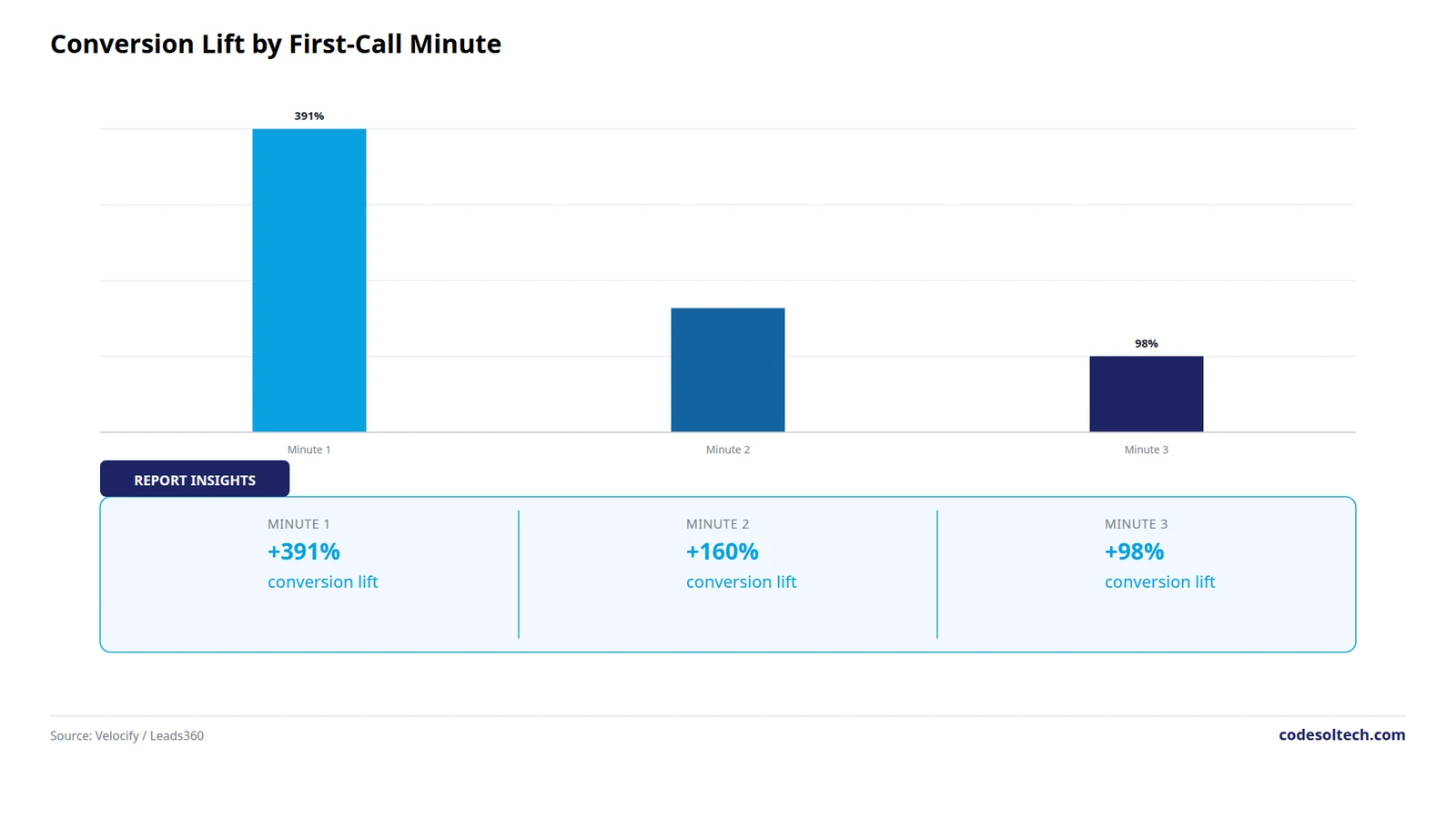
- 391% higher conversion in minute 1. Calling a lead within one minute of its inquiry increases conversion rates by 391% compared with calling later, in Velocify (Leads360) The Ultimate Contact Strategy (2012), a study of about 3.5 million leads across 400 plus companies. Source: Velocify / Leads360, 2012
- 160% lift in minute 2. The conversion lift falls to 160% when the first call happens in the second minute, in the same Velocify study. Source: Velocify / Leads360, 2012, via RevStrike
- 98% lift in minute 3. By the third minute, the lift is 98%, still large, but less than a quarter of the minute-one figure. Source: Velocify / Leads360, 2012, via RevStrike
Meetings follow the same curve
- 80% booking chance in the first minute, 40% by the next business day. The probability of booking a meeting is about 80% in the first minute and about 40% by the next business day, in RevenueHero B2B demo funnel data. Source: RevenueHero, via IntentSignal
- 17.2% reply within 2 minutes. In RevenueHero 2024 test of 1,000 B2B SaaS companies, 17.2% replied to a demo request within 2 minutes, automated replies included. Source: RevenueHero, 2024
A one-minute response is only possible with an always-on system. That is why the automation section of this roundup matters: humans alone cannot watch a form all day.
How Slow Companies Actually Are
The research says five minutes. The audits say most companies take hours or days, and a large share never reply at all. The gap has barely moved in fifteen years.
The 2011 Harvard Business Review audit
- 42-hour average first response. Among companies that replied within 30 days, the average time to first response was 42 hours, in Harvard Business Review, The Short Life of Online Sales Leads (Oldroyd, McElheran, and Elkington, March 2011), an audit of 2,241 US companies. Source: Harvard Business Review, 2011
- 23% never responded. Nearly one in four of the audited companies never responded to the web lead at all. Source: Harvard Business Review, 2011
- 37% responded within one hour. Only 37% of the audited companies responded within an hour of the enquiry. Source: Harvard Business Review, 2011
- 24% took more than 24 hours. A quarter of the audited companies took more than a day to respond, and 16% took between 1 and 24 hours. Source: Harvard Business Review, 2011
Later audits found the same pattern, or worse
- 47-hour average in 2017. Drift ran a secret-shopper test against 433 B2B companies in February 2017 and found an average first response of 47 hours. Source: Drift, 2017
- 7% replied within 5 minutes. Only 7% of the 433 B2B companies in Drift 2017 test responded to a demo or lead form within 5 minutes. Source: Drift, 2017
- 55% silent after five business days. More than half of the companies in Drift 2017 test had not responded within five business days. Source: Drift, 2017
- 3 hours 8 minutes median phone response. InsideSales.com 2014 Lead Response Report found a median first phone response of 3 hours 8 minutes, and a mean of 61 hours, across 9,538 companies that received a test lead. Source: InsideSales.com, 2014
- 47% never responded by any channel. In the same 2014 audit, 47% of companies that received a test web lead never responded by any channel. Source: InsideSales.com, 2014
- 57.1% wait more than a week. In the XANT 2021 study of 5.7 million inbound leads, 57.1% of first call attempts happened more than a week after the lead arrived. Source: XANT, 2021
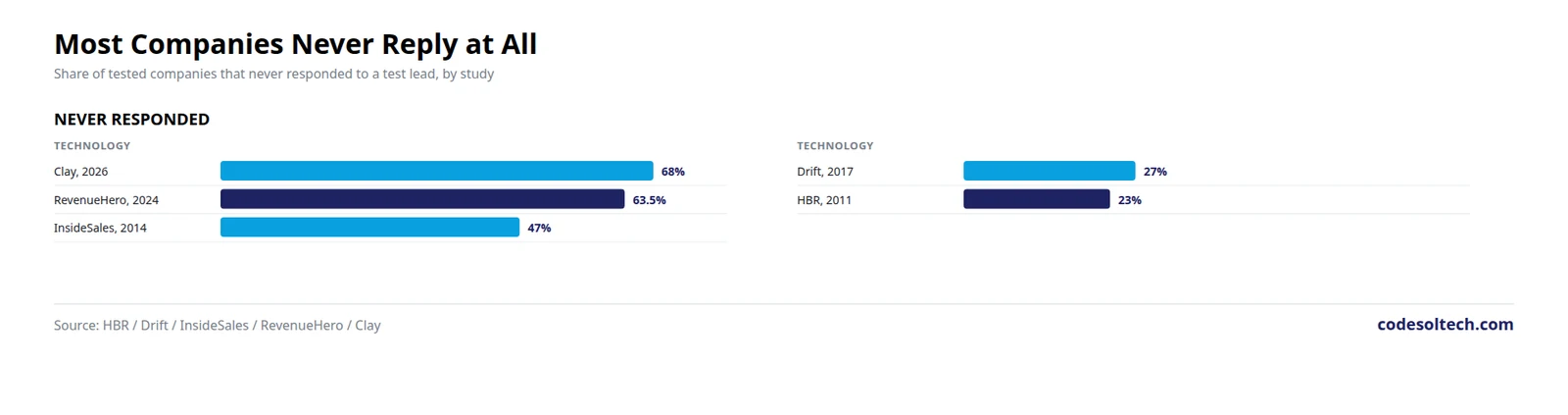
The average has barely moved since 2011. A five-minute reply today beats roughly 93% of the companies in Drift 2017 test, and the newer audits show no sign of the field catching up.
What Buyers Expect
Buyers do not compare your response time with your industry average. They compare it with what they consider immediate, and that bar is measured in minutes.
Immediate means minutes, not hours
- 82% rate an immediate response important for sales. HubSpot research found 82% of consumers rate an immediate response as important or very important when they have a sales or marketing question, and HubSpot reads immediate as 10 minutes or less. Source: HubSpot Research, 2018
- 90% rate an immediate response important for support. The same HubSpot survey puts the figure at 90% for a customer-service question. Source: HubSpot Research, 2018
- 83% expect to engage immediately. In Salesforce State of the Connected Customer, 4th edition (2020), 83% of customers expect to engage with someone immediately when contacting a company, up from 78% in 2019. The survey covered 15,000 plus consumers and business buyers. Source: Salesforce, 2020
- 71% expect real-time communication. In the 3rd edition of the same Salesforce report (2019), 71% of customers expect companies to communicate with them in real time. Source: Salesforce, 2019
The expectation keeps rising
- 88% expect faster digital service. In the Salesforce 4th edition (2020), 88% of customers expect companies to accelerate digital initiatives. Source: Salesforce, 2020
- 88% are satisfied by a one-hour reply. A Toister Performance Solutions survey of more than 3,200 people in the US, UK, and Canada (March 2020) found that a reply within one hour meets the expectations of 88% of consumers. Source: Toister, 2020
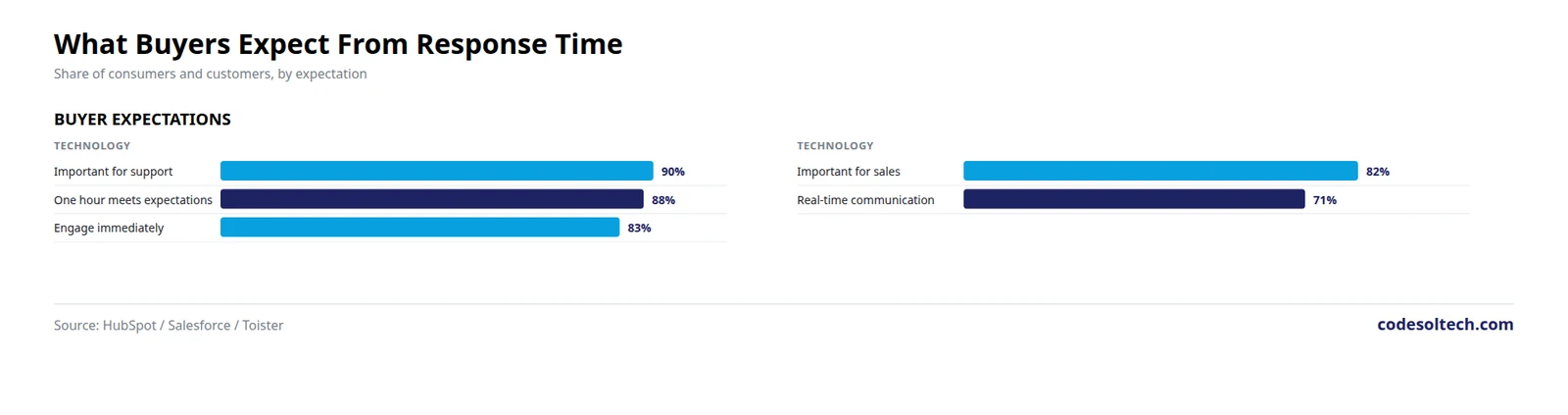
One hour is the floor buyers will accept. Five minutes is the level that wins. See our AI automation statistics for 2026 for the related automation numbers.
Channel Differences: Phone, Email, and Chat
Not all channels are equal. A phone call catches intent while it is live. Email waits in an inbox. Live chat sits between the two, and the fastest teams in the audits all used it.
Live chat is the fastest channel in the audits
- All 10 fastest responders used live chat. In Drift 2017 test of 433 B2B companies, all ten of the fastest-responding companies used live chat on their websites. Source: Drift, 2017
- Only 14% offered chat at all. Just 14% of the full 433-company sample in Drift 2017 test offered live chat, which makes the 10-of-10 result a striking correlation, not proof that chat alone causes speed. Source: Drift, 2017
- 31.5% moved into the 5-to-60-minute band. Chili Piper (2022) found that pairing a form with a chat option moved 31.5% of responses into the 5-to-60-minute band, and 10.5% became instant. Source: Chili Piper, 2022
Email is the slowest channel by a wide margin
- 12 hours 10 minutes average email reply. SuperOffice emailed 1,000 companies with two questions and found an average response time of 12 hours 10 minutes among the companies that replied. Source: SuperOffice, 2018
- 62% never reply to email at all. In the same SuperOffice test, 62% of the 1,000 companies never responded to the customer-service email. Source: SuperOffice, 2018
- 11 hours 54 minutes for a personalised email. Workato tested 114 B2B companies in 2024 and 2026 and found the average personalised email reply took 11 hours 54 minutes, while a phone call took 14 hours 29 minutes, and only 31% ever called at all. Source: Workato, 2024/2026
- 46 minutes 51 seconds median ticket response. Freshworks Customer Service Benchmark Report 2025, built from 32,000 plus companies and 1.2 billion tickets, puts the median software company first response to a support ticket at 46 minutes 51 seconds. The fastest fifth reply in 2 minutes 20 seconds, and the bottom tier takes 6 hours 10 minutes. Source: Freshworks, 2025
Channel choice is a speed choice. A form that ends in a thank-you page is the slowest option. A form that opens a chat or a call is the fastest. Compare AI sales assistants for small businesses to see how teams answer after hours.
Follow-Up Persistence
Speed gets the first conversation. Persistence gets the rest. Most leads are not reached on the first attempt, and most sellers stop trying far too early.
Six calls captures nearly all converted leads
- 93% reached by the sixth call. In the Velocify study of about 3.5 million leads, 93% of all converted leads were reached by the sixth call attempt, and only 7% converted after more than six calls. Source: Velocify, 2012
- 50% never get a second call. Half of all leads are never called a second time, in Velocify research. A one-attempt cadence is the cheapest fix in most inbound funnels. Source: Velocify, via Expertise.ai
- 81% stop at five or fewer attempts. In the XANT 2021 study, 81% of sellers make 5 or fewer follow-up attempts, yet making 7 or more attempts yields 15% more connections, based on about 30 million contact attempts by 10,000 plus North American reps. Source: XANT, 2021
Meetings take several touches
- 8 touches to book a meeting. RAIN Group Top Performance in Sales Prospecting research, based on 489 sellers, found it takes an average of 8 touches to book a first meeting with a new prospect. Source: RAIN Group
- 5 touches for top performers. Top performers in the same RAIN Group study book the meeting in 5 touches, and generate 2.7 times more meetings than everyone else. Source: RAIN Group
- 42% of replies come from follow-ups. Woodpecker 2026 analysis of more than 20 million emails found that 42% of all replies to a cold outreach sequence come from follow-up emails, not the initial message, yet 48% of reps never send a follow-up email at all. Source: Woodpecker, 2026
Persistence has a ceiling. After the sixth call, the return falls away, so cap the cadence and spend the dials on fresh leads. Plan the sequence with CRM email automation so no lead is ever left to a single attempt.
Automation and AI Impact
Almost nobody hits five minutes by hand. The teams that do it use automation for the first touch: instant qualification, instant scheduling, and routing that never sleeps.
Instant scheduling more than doubles bookings
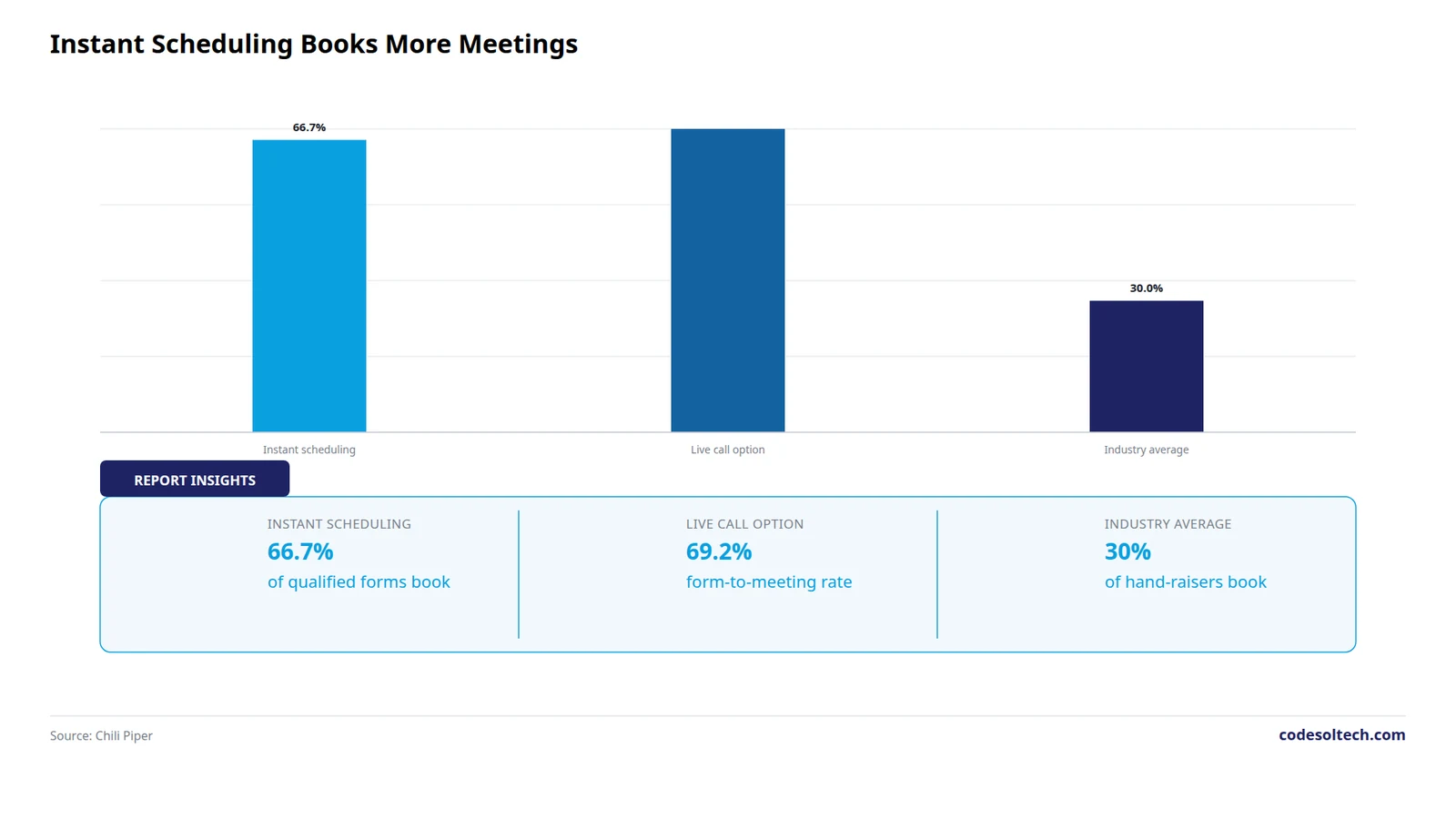
- 66.7% book with instant scheduling, vs 30% average. In Chili Piper 2025 Benchmark Report on Demo Form Conversion Rates, based on nearly 4 million form submissions in 2024, 66.7% of qualified form submissions book a meeting when buyers can schedule instantly, against an industry average of about 30%. Source: Chili Piper, 2025
- 69.2% with a live call option. Customers that provide a live call option on their booking form see a 69.2% form-to-meeting conversion rate, in the same Chili Piper 2025 report. Source: Chili Piper, 2025
- Only 11.3% offer a scheduler. In RevenueHero 2024 test of 1,000 B2B SaaS companies, only 11.3% offered a scheduler on the demo form, so instant booking is still a rare advantage. Source: RevenueHero, 2024
The gap automation fills
- Under 1% respond within 5 minutes. In the XANT 2021 study of 5.7 million inbound leads, under 1% of first call attempts happened within 5 minutes. A five-minute SLA beats nearly the whole field. Source: XANT, 2021
- 64% expect real-time responses. Salesforce State of Sales Report finds 64% of consumers now expect real-time responses when they reach out to a business, up from 58% in 2023. Source: Salesforce, State of Sales, via GreetNow
Automation does not replace the salesperson. It buys the salesperson the first five minutes, and the first five minutes are where the deal is usually decided. See AI CRM automation workflows for how the routing works.
The Cost of Slow Response
Slow response is not a politeness problem. It is a revenue leak: leads that are never answered, meetings that never get booked, and buyers who hire the faster competitor.
What slow response costs
- 128% net conversion gain from a full cadence. Combining the recommended 6-call and 5-email cadence yields a 128% net conversion gain, in the Velocify study, and the call timing alone adds an average 49% conversion gain. Source: Velocify, 2012
- 77% of leads got no response at all. In the XANT 2021 study of 5.7 million inbound leads, 77% of leads got no response at all. Source: XANT, 2021
- 35.4% of leaders call five minutes essential, and 38% fail their own standard. In the Blazeo lead response benchmark (2026, 573 companies), 35.4% of business leaders say a 5-minute response is essential, yet 38% of those same leaders fail their own stated standard. Source: Blazeo, 2026
- 82% hire within a week. In a Yelp consumer study, 82% of Yelp users hire or buy within a week of finding a business, and 57% contact a business within a day of researching it. Speed is the hiring decision. Source: Yelp consumer study, via LeadWinner
- 63.5% never replied to a demo request. In RevenueHero March 2024 test of 1,000 B2B SaaS companies, 63.5% never replied to a demo request at all. Source: RevenueHero, 2024
The cost is invisible because the lost leads never complain. They simply buy from the company that answered first. Score and prioritise the queue with AI lead scoring inside a CRM so the hottest leads never wait.
Methodology: How These Stats Were Verified
The canonical studies are old, and the page says so. Oldroyd dates to 2007, Harvard Business Review to 2011, Velocify to 2012, and Drift to 2017. Each stat carries its study year in the text, so a 2007 finding is never presented as a 2026 measurement.
Where the original report is paywalled, offline, or blocks automated checks, the figure is attributed to the original researcher and the working source is named. Examples: Oldroyd, Velocify, XANT, and Drift figures via Expertise.ai, and RAIN Group and Woodpecker figures via Gaidme.
Three famous claims were left out because no primary source could be traced: 78% of customers buy from the first responder, and 35 to 50% of sales go to the first vendor.
The 80% of sales require five or more follow-ups claim traces to a 1942 survey of fewer than 40 people. The page uses verified persistence figures from Velocify, XANT, RAIN Group, and Woodpecker instead.
Figures are quoted as published, including sample sizes and study dates where the source gives them. Where a source reports a range or an average across studies, the page says so.
Frequently Asked Questions
What is a good lead response time?
Under 5 minutes during staffed hours, and never later than an hour. Harvard Business Review (2011) found that firms contacting a lead within an hour were nearly 7 times more likely to qualify it than firms that waited even an hour longer.
The 2007 Oldroyd study adds the sharper edge: the odds of qualifying a lead are 21 times higher at 5 minutes than at 30 minutes. Treat 5 minutes as the goal and 1 hour as the hard limit.
How much does responding in 5 minutes help?
A lot, on every measure the studies track. Contact odds are 100 times higher and qualification odds 21 times higher at 5 minutes versus 30 minutes (Oldroyd and InsideSales, 2007).
On conversion, XANT (2021) measured 8 times higher conversion within 5 minutes versus 6 or more minutes, across 5.7 million inbound leads. The 100x figure is about contact, not closed sales, so use the 8x figure when you talk about revenue.
How fast do most companies respond to leads?
Slowly. Harvard Business Review (2011) measured a 42-hour average first response across 2,241 companies, and 23% never replied at all.
Newer audits are no better: Drift (2017) found a 47-hour average, and RevenueHero (2024) found 63.5% of 1,000 B2B SaaS companies never replied to a demo request. A five-minute reply beats roughly 93% of the field.
Do buyers really expect an immediate reply?
Yes. HubSpot research (2018) found 82% of consumers rate an immediate response as important or very important for a sales question, and 90% for a support question, with immediate defined as 10 minutes or less.
Salesforce (2020) found 83% of customers expect to engage with someone immediately when contacting a company. A reply within one hour meets the expectations of 88% of consumers (Toister, 2020).
How many follow-ups should a sales team send?
Six calls and a structured email sequence. Velocify (2012) found 93% of converted leads were reached by the sixth call, and only 7% converted after more than six calls.
RAIN Group research puts the average at 8 touches to book a first meeting, and 5 touches for top performers. Woodpecker (2026) found 42% of all replies come from follow-up emails, yet 48% of reps never send one.
Want a website that turns visitors into customers?