
Austin startups raised a record $7.19 billion in 2025, up 64.8% in one year. The city now ranks as the fifth strongest tech talent market in North America.
This roundup collects 48 verified Austin tech industry statistics for 2026, covering jobs, funding, salaries, major employers, AI and the cost of living.
Every number below names its source, and every source link was checked to load on November 7, 2026.
At a glance: the numbers that frame this roundup
| Headline figure | Value | Source |
|---|---|---|
| Venture funding to Austin startups, 2025 | $7.19 billion, an all-time high, up 64.8% year over year | Crunchbase News |
| Austin tech talent market rank, North America | #5 of the top 50 markets, behind only the Bay Area, Seattle, Toronto and New York Metro | CBRE Scoring Tech Talent 2025 |
| Austin tech talent workforce, 2025 | 103,210 workers, up 10.2% since 2023, 8% of the metro workforce | Realty News Report, reporting CBRE |
| Software developer median wage, Austin metro | $134,120 a year, May 2025 | O*NET, reporting BLS OEWS data |
| Austin tech GDP growth, 2024 | 7.79%, second-highest in the United States | Opportunity Austin |
| Samsung economic impact on Central Texas, 2024 | $19.8 billion from its Austin and Taylor campuses | Samsung Austin Semiconductor |
| Largest Austin funding round of 2025 | Base Power, $1 billion Series C at a $4 billion valuation | Crunchbase News |
| Austin metro job growth, 2019 to 2025 | 21.8%, adding over 242,000 jobs, fastest of any major U.S. metro | Real International, reporting Economic Leadership |
Read the scope note on each row before comparing figures from two firms.
Different firms measure different things, so their totals are not interchangeable.
Two employment counts in this article differ by design, and the methodology section explains why.
Tech Jobs and Employment in Austin
Austin held up better than most tech markets through the 2024 slowdown.
Software and IT services roles kept growing, and hiring forecasts for 2026 point up again.
| Jobs figure | Value | Source |
|---|---|---|
| Tech talent market rank, North America, 2025 | #5 of the top 50 markets, behind only the Bay Area, Seattle, Toronto and New York Metro | CBRE Scoring Tech Talent 2025 |
| Tech talent workforce, 2025 | 103,210 workers, up 10.2% since 2023, 8% of the metro workforce | Realty News Report, reporting CBRE |
| Software, IT services and systems design roles | Up 30,000 jobs since 2018, to nearly 95,000 workers, a 46% jump | Opportunity Austin |
| Austin tech employment change, 2024 | Down less than 1%, one of the smallest dips among major U.S. markets | Opportunity Austin |
| Metro job growth, 2019 to 2025 | Total employment up 21.8%, adding over 242,000 jobs, fastest of any major U.S. metro | Real International, reporting Economic Leadership |
| Projected new Austin tech jobs, 2026 | 5,676 additional jobs, one of the largest metro gains in the U.S. | CompTIA State of the Tech Workforce 2026 |
| Projected new Texas tech jobs, 2026 | 32,238 additional jobs, the most of any state in the U.S. | CompTIA State of the Tech Workforce 2026 |
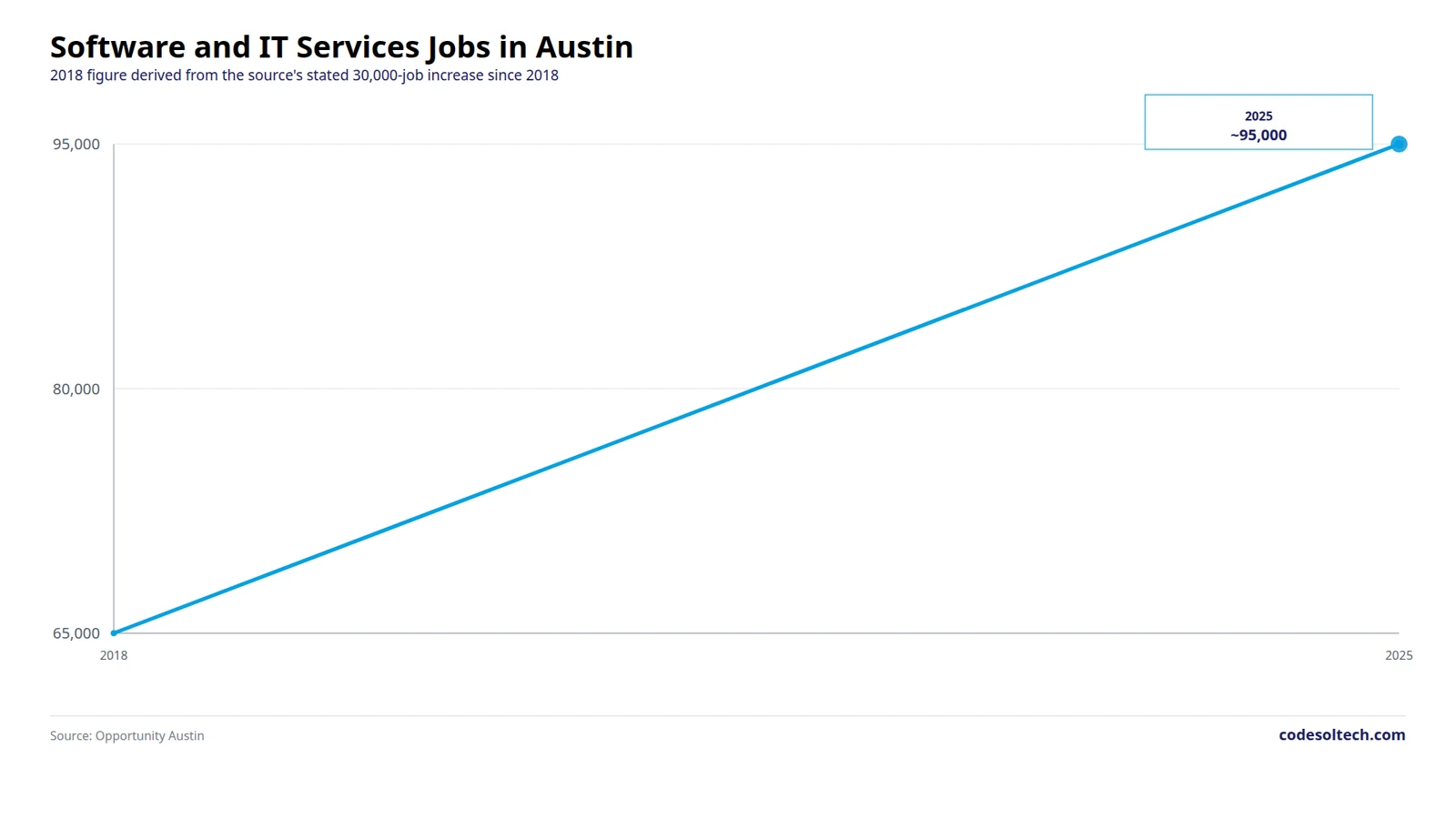
The 2018 point on the chart is a derived figure, not a published one.
Opportunity Austin states the 30,000-job increase and the near-95,000 total, so 2018 is about 65,000.
The CompTIA figures are projections for 2026, not measured results.
Treat them as a forecast of hiring intent, not as jobs already filled.
Startups and Venture Capital Funding
2025 was a record year for Austin venture funding, and it was driven by fewer, larger deals.
Energy, defense and robotics took the biggest checks, not consumer software.
| Funding figure | Value | Source |
|---|---|---|
| Venture funding to Austin startups, 2025 | $7.19 billion, an all-time high, up 64.8% year over year | Crunchbase News |
| Venture funding to Austin startups, 2024 | $4.37 billion, the base year for the 64.8% jump | Crunchbase News |
| Deal counts, 2024 to 2025 | Fell from 312 deals to 272, while $4 billion was late-stage | Crunchbase News |
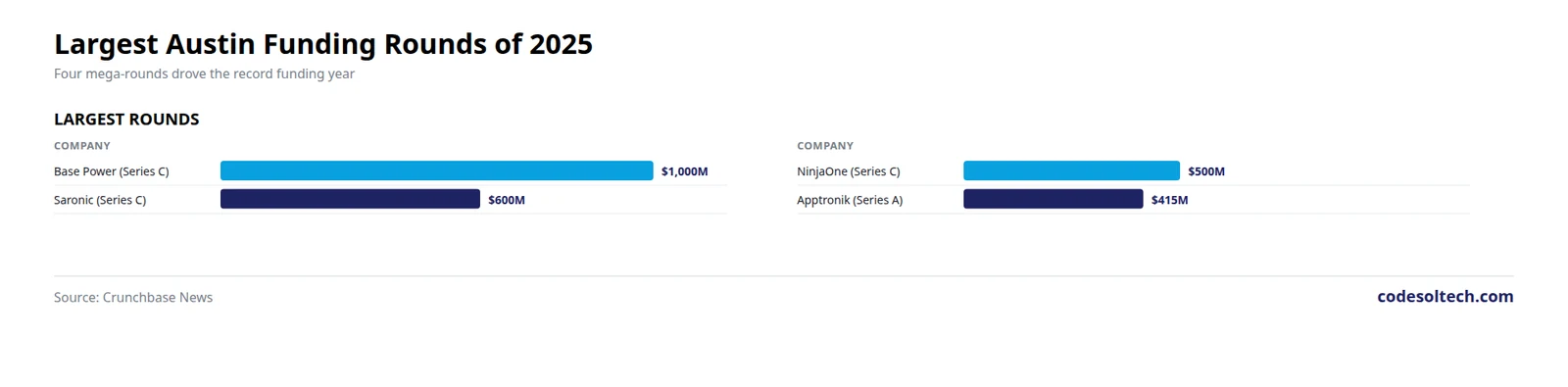
| Largest round of 2025 | Base Power, $1 billion Series C in October 2025, led by Addition, $4 billion valuation | Crunchbase News |
| Second-largest round of 2025 | Saronic, $600 million Series C in February 2025, $4 billion valuation, led by Elad Gil | Crunchbase News |
| Third-largest round of 2025 | NinjaOne, $500 million in Series C extensions in February 2025, $5 billion valuation | Crunchbase News |
| Fourth-largest round of 2025 | Apptronik, $415 million Series A in February 2025, plus a $520 million extension in February 2026 | Crunchbase News |
| Austin startup funding through Q3 2025 | $5.4 billion raised, including a record $4.5 billion in Series C and later rounds | Opportunity Austin, Q3 2025 newsletter |
| Texas venture funding, 2025 | About $8 billion, passing Massachusetts for the first time, with Austin taking $7.19 billion | Alpha Maven, reporting Crunchbase data |
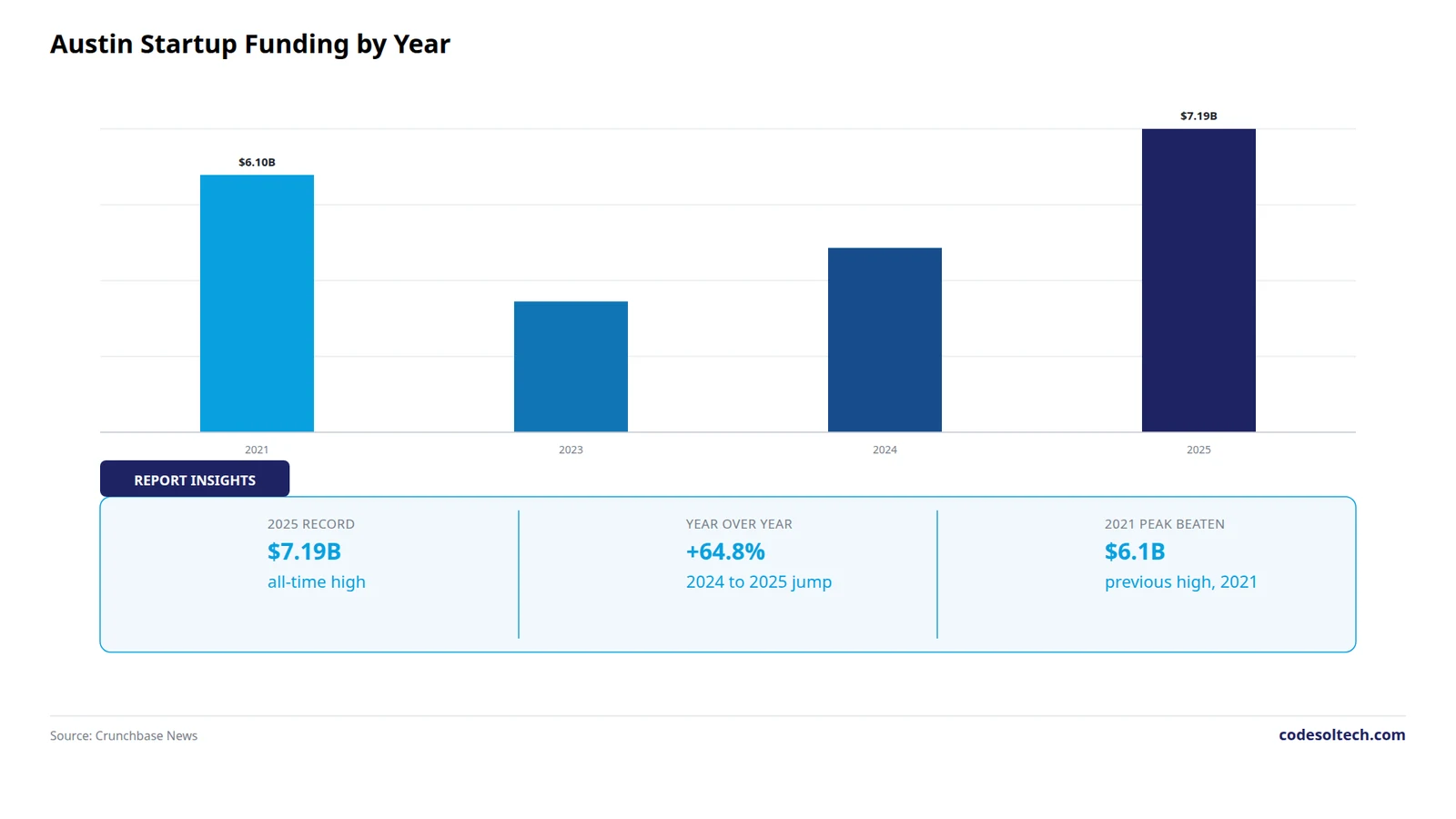
The 2025 total was more than double the $3.1 billion raised in 2023.
It also beat the $6.1 billion raised in 2021, the peak of the venture frenzy.

Roughly 38% of the 2025 capital went to the top five financings in Austin.
That concentration is the story: fewer deals, much larger checks.
For the local companies behind these numbers, see the 7 best custom software development companies in Austin list.
Austin Tech Salaries by Role
Austin tech pay sits close to national levels, with AI roles at the top.
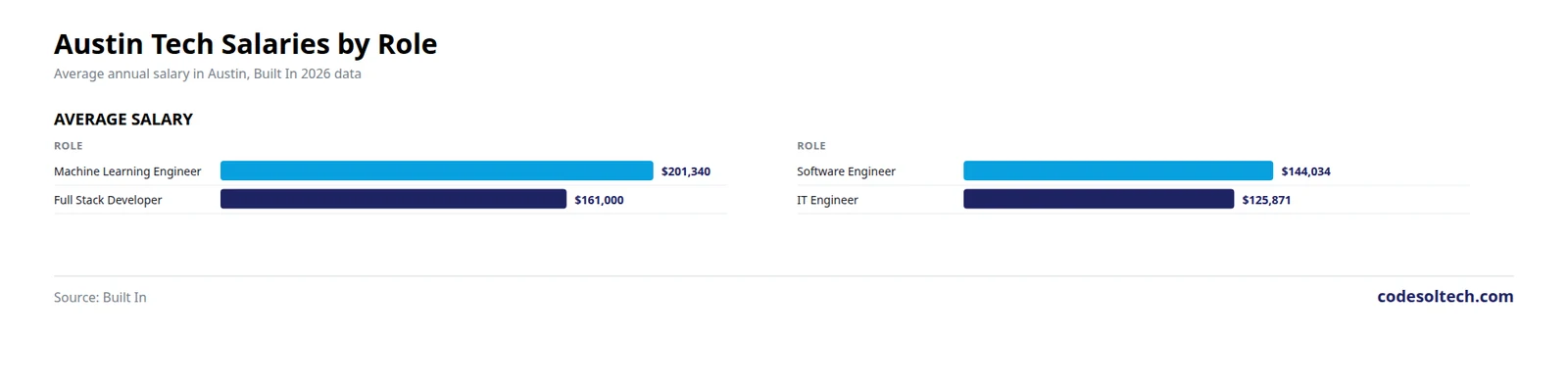
Machine learning engineers earn the most of any Austin engineering role tracked by Built In.
| Salary figure | Value | Source |
|---|---|---|
| Software developer median wage, Austin metro, May 2025 | $134,120 a year (10th percentile $96,110; 90th percentile $209,890) | O*NET, reporting BLS OEWS data |
| Software developer average wage, Austin metro, 2025 | $142,500 a year, with 26,970 people in the occupation | Workforce Solutions Capital Area, JobsEQ data |
| Average software engineer salary, Austin, 2026 | $144,034 (range $65,000 to $294,000) | Built In |
| Average full stack developer salary, Austin, 2026 | $161,000 (range $120,000 to $185,000) | Built In |
| Average machine learning engineer salary, Austin, 2026 | $201,340 (range $176,000 to $212,000), highest of the roles tracked | Built In |
| Average IT engineer salary, Austin, 2026 | $125,871 (range $105,000 to $162,000) | Built In |
| Computer and information systems manager median, Austin, 2024 | $173,300 a year, only 1% above the national median | Opportunity Austin, reporting BLS OEWS data |
Averages and medians are different measures, so do not compare them directly.
Built In averages come from self-reported salaries, while the BLS median comes from employer surveys.
For contrast, petroleum engineers in Austin earned a median of $184,250 in 2024, 30% above the national median.
That gap shows Austin pay premiums are strongest in energy, not in tech management.
Salary bands also shape hiring budgets, as shown in the website development costs in Austin guide.
Major Tech Employers and Companies
Three giant employers anchor the Austin story: Apple, Samsung and Tesla.
Samsung alone put more money into Central Texas in 2024 than most cities see in a decade.
| Employer figure | Value | Source |
|---|---|---|
| Apple new Austin campus, announced 2018 | $1 billion investment, 133-acre campus, 5,000 more staff at first, capacity for 15,000 | Apple Newsroom |
| Apple Austin headcount, 2019 | About 7,000 people, up more than 50% in the previous five years | Apple Newsroom |
| Samsung economic impact on Central Texas, 2024 | $19.8 billion from its Austin and Taylor campuses | Samsung Austin Semiconductor |
| Samsung investment in Austin since 1996 | $18 billion, plus at least $17 billion announced for the Taylor fab in 2021 | Samsung Austin Semiconductor |
| Samsung CHIPS Act funding and future plans | Up to $4.745 billion in direct funding, with over $37 billion more planned for Central Texas | Samsung Austin Semiconductor |
| Tesla Gigafactory Texas headcount, year-end 2025 | About 16,500 employees, down roughly 22% from about 21,200 the prior year | 360 Digital Transformation, reporting the Austin American-Statesman |
| Fortune 500 headquarters in the Austin metro, 2026 list | Three: Dell Technologies in Round Rock, plus Tesla and Oracle in Austin | RelocateMETX |
The Apple campus figures are from the 2018 announcement, not current headcount.
Apple has not published a newer Austin headcount since the 2019 figure above.
Oracle moved its world headquarters to Austin in 2020, then said in 2024 it intends to shift it to Nashville.
That move is announced, not complete, so Oracle still counts as an Austin headquarters for now.
Tesla headcount fell even as the company kept building in Austin.
The drop shows headcount and investment can move in opposite directions.
Austin Tech Ecosystem Size and Growth
Austin is small next to Silicon Valley, but it is the most tech-dense large metro in Texas.
Tech industries employ nearly twice the national share of workers here.
| Ecosystem figure | Value | Source |
|---|---|---|
| High-tech companies in Austin, 2021 | 9,565 companies, up nearly 15% in a single year | Silicon Hills News, reporting the Austin Chamber |
| People working in tech, Austin area, 2021 | 184,177 people, up 4% from 2020 | Silicon Hills News, reporting the Austin Chamber |
| Tech share of all Austin metro jobs, 2021 | Nearly 17%, against 9% nationally, a location quotient of 1.81 | Silicon Hills News, reporting the Austin Chamber |
| Tech industry job growth, Austin | Nearly 29% over five years to 2021 and 58% over the decade, against 19% nationally | Silicon Hills News, reporting the Austin Chamber |
| STEM jobs in the Austin metro, 2024 | 139,820 jobs, up 17% since 2019, 11.1% of all employment against 6.7% nationally | Opportunity Austin, reporting BLS OEWS data |
| Austin tech GDP growth, 2024 | Up 7.79%, second-highest in the country, and fastest since 2020 of any major metro | Opportunity Austin |
The 2021 Chamber figures are the latest published high-tech industry count.
Newer counts use different definitions, so do not mix them into one series.
The Chamber counts all jobs at tech-industry employers, while CBRE counts tech occupations only.
That is why the Chamber total of 184,177 is larger than the CBRE total of 103,210.
Austin is the sixth most STEM-concentrated large U.S. metro by the Chamber measure.
AI, Semiconductors and Innovation
AI and chips are where Austin is growing fastest now.
Humanoid robotics alone raised more venture money in 2025 than the whole Austin market raised in 2023.
| AI and innovation figure | Value | Source |
|---|---|---|
| U.S. tech workforce with AI skills, 2025 | Up over 50% year over year to 517,000 workers | CBRE Scoring Tech Talent 2025 |
| AI share of U.S. tech talent job postings, June 2025 | 20%, doubled from 11% at the mid-2022 peak | CBRE Scoring Tech Talent 2025 |
| Austin tech talent with AI-specialty skills, 2025 | 17% of the city tech talent workforce, among the highest shares in the U.S. | Realty News Report, reporting CBRE |
| AI companies in Austin, January 2026 | 204 companies, including 71 funded firms that raised $1.87 billion, with 3 unicorns | Tracxn |
| Austin AI cluster markers, 2025 | 216,000 STEM graduates, 11,800 job postings needing AI skills, 499 startups, 307 VC deals | Heartland Forward |
| Humanoid robotics venture funding, 2025 | $6.1 billion across 139 deals, up over 300% from $1.5 billion across 65 deals in 2024 | PitchBook |
| UT Austin founder ranking and Austin VC rank, 2025 | UT Austin is a top-ten university globally for startup founders, and Austin rose to the third-largest U.S. VC market | Opportunity Austin, Q3 2025 newsletter |

The humanoid robotics total is a global figure, not an Austin one.
Its Austin link is Apptronik, whose $520 million raise was a leading deal in the category.
The 499 startups in the Heartland Forward count use a different definition from the Chamber company count.
Do not compare the two totals directly.
For the wider AI picture, read the AI automation statistics roundup with 50 verified figures.
For how local startups turn this talent into products, see how tech startups near UT Austin scale with custom CRM.
Cost of Living, Talent and Office Market
Austin passed one million residents in 2025, and its workforce is unusually educated.
Office space is the weak spot: vacancy is high, even as office-using jobs grow faster than anywhere else.
| Cost and talent figure | Value | Source |
|---|---|---|
| City of Austin population, July 1, 2025 | 1,002,632 people, up 4.2% since the 2020 Census, passing one million for the first time | USAStateStats, reporting U.S. Census Bureau data |
| Austin metro population and growth | About 2.62 million people, up 2.1% from July 2024 to July 2025, fastest of the major Texas metros | Real International, reporting U.S. Census Bureau data |
| Median household income, Austin | $93,658, against $78,476 for Texas and $80,734 nationally | USAStateStats, reporting U.S. Census Bureau data |
| Austin adults with a bachelor degree or higher | 59.6% of adults 25 and older, against 35.7% nationally | USAStateStats, reporting U.S. Census Bureau data |
| Housing costs and cost of living, Austin, 2026 | Median home about $485,000, median two-bedroom rent $1,650 a month, cost of living index 112, no state income tax | Austin TX Homes, 2026 |
| Austin office vacancy and leasing, Q3 2025 | Vacancy 26.1%, up from 24.8% in Q2, while leasing topped 1 million sq. ft., up 76.2% on the quarter | CBRE Research, Austin Office Figures Q3 2025 |
| Office-using employment growth, 2019 to 2025 | Up roughly 34%, leading all U.S. cities, even with vacancy at 22.4% in Q1 2026 | Bisnow, reporting Avison Young, Colliers and CBRE |
The 108 tenants actively seeking space in Q3 2025 wanted over 3.52 million sq. ft. combined.
That demand came mostly from the technology sector, per CBRE.
High vacancy and fast job growth can both be true at once.
New towers delivered faster than tenants filled them, while hiring kept rising.
The population figures come from Census Bureau estimates republished by USAStateStats.
The Census QuickFacts page itself blocks automated checks, so the republished source is cited.
For what office and web presence costs a local firm, see the best web design companies in Austin list.
How These Statistics Were Verified
Every figure above comes from a named source with a link in its table row.
No number was estimated, rounded into a new claim, or invented for this roundup.
Two employment counts differ by definition, and the article says so where they appear.
The Austin Chamber counts high-tech industries, meaning all jobs at tech-industry employers.
CBRE counts tech talent occupations, meaning people in tech roles across all industries.
CompTIA counts net tech employment, a third definition again.
Never mix the three series in one chart or one comparison.
Three attributions need care when quoting them elsewhere.
Census figures come via USAStateStats, since Census QuickFacts blocks automated checks.
The Tesla headcount comes from a compliance report via the Austin American-Statesman, as reported by 360 Digital Transformation.
Forecasts are labelled as forecasts. Projections are labelled as projections.
Vendor claims and self-reported survey answers are labelled as such.
Where firms measure different things, the article says so instead of averaging them.
One chart point is derived, and the chart says so: the 2018 jobs figure comes from the stated 30,000-job increase.
If a source revises a figure, the table row should be updated to the revision.
Frequently Asked Questions
How big is the Austin tech industry in 2026?
Austin startups raised a record $7.19 billion in 2025, the city ranks fifth among North American tech talent markets, and its tech talent workforce reached 103,210 people.
How much do software developers earn in Austin?
The median wage for software developers in the Austin metro was $134,120 a year in May 2025, per BLS data via O*NET, while Built In puts the average software engineer salary at $144,034.
Who are the biggest tech employers in Austin?
Apple, Samsung and Tesla anchor the market, with Dell Technologies in nearby Round Rock and Oracle in Austin, giving the metro three Fortune 500 headquarters on the 2026 list.
How much venture funding did Austin startups raise in 2025?
Austin startups raised $7.19 billion in 2025, an all-time high and up 64.8% from $4.37 billion in 2024, with Base Power raising the largest single round at $1 billion.
Is Austin still growing as a tech hub?
Yes, on the growth measures: Austin tech GDP rose 7.79% in 2024, the second-highest rate in the U.S., and total metro employment grew 21.8% from 2019 to 2025.
What does it cost to live in Austin as a tech worker?
The median home costs about $485,000, a typical two-bedroom rents for $1,650 a month, and the cost of living index is 112, while Texas charges no state income tax.
Want to build in the Austin tech scene?