
AI sales forecasting in CRM uses machine learning models to predict future revenue from pipeline data, deal history, and customer activity. The CRM feeds records into the model, the model scores each open deal, and the system rolls those scores into a quarterly forecast.
AI Sales Forecasting in CRM: Definition and Scope
AI sales forecasting is a predictive analytics function inside a customer relationship management platform. It replaces manual revenue estimates with probability scores calculated from historical data.
The model learns which deal attributes lead to closed-won outcomes. It then applies those patterns to every open opportunity in the pipeline.
Forecasting itself is a mature discipline, defined as the use of past data to predict future values. The Wikipedia entry on forecasting documents the core methods that AI forecasting extends.
Platforms such as Salesforce and Microsoft Dynamics 365 Sales ship built-in predictive forecasting features. Custom-built models extend the same logic to business-specific data sources.
The 3 Traditional Forecasting Methods AI Replaces
Sales teams relied on three methods before machine learning entered the CRM:
- Rep-driven forecasting: each salesperson submits a number based on personal judgment.
- Stage-weighted forecasting: each pipeline stage carries a fixed win percentage, such as 20% for qualification.
- Run-rate forecasting: last quarter’s revenue projects forward with a flat growth factor.
Each method ignores deal-level signals such as email response time, meeting count, and stakeholder engagement. AI models read all of those signals at once.
Why Does Traditional Sales Forecasting Fail
Traditional sales forecasting fails because it depends on human opinion and static stage percentages instead of measured deal behavior. Both inputs carry bias and stay constant while the pipeline changes.
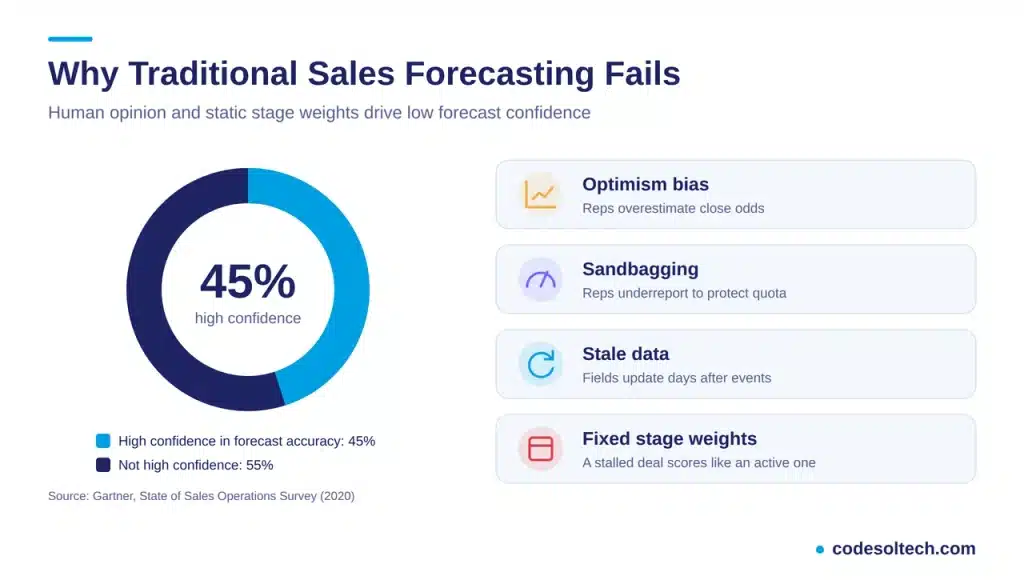
Gartner’s State of Sales Operations Survey found that only 45% of sales leaders and sellers have high confidence in their organization’s forecasting accuracy. Gartner published the finding in a 2020 press release.
Four root causes produce that low confidence:
- Optimism bias: reps overestimate close probability on deals they personally manage.
- Sandbagging: reps underreport deals to protect their quota position.
- Stale data: opportunity fields update days or weeks after the real event.
- Fixed stage weights: a 40% weight treats a stalled deal and an active deal identically.
How Does AI Sales Forecasting Work in a CRM
AI sales forecasting works in a CRM by training a model on closed deals, scoring open deals against learned patterns, and aggregating the scores into a forecast. The model retrains as new outcomes arrive.
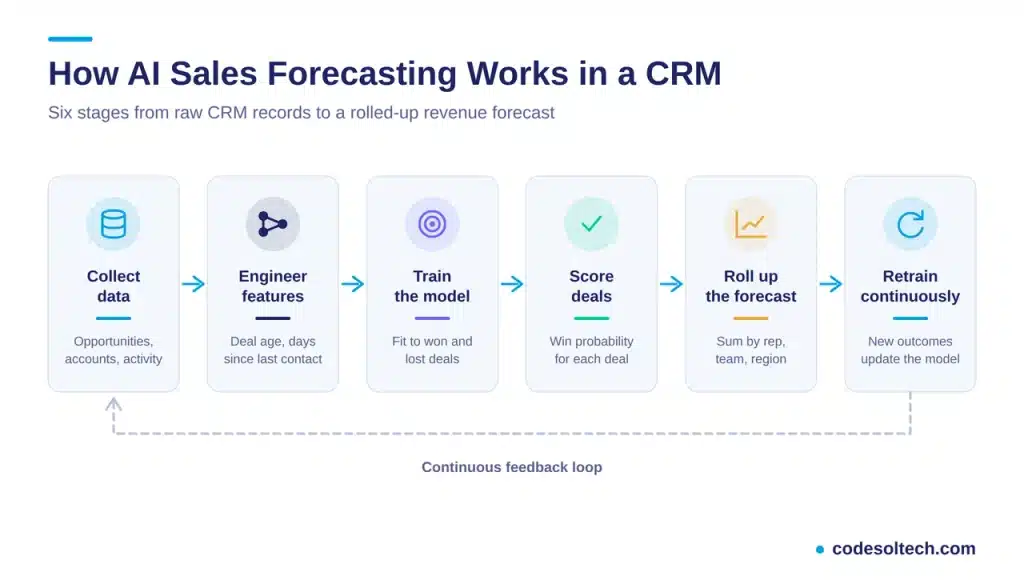
The process runs in 6 stages:
- Collect data: the platform extracts opportunity, account, contact, and activity records.
- Engineer features: the system converts raw fields into variables such as deal age and days since last contact.
- Train the model: the algorithm fits those variables to closed-won and closed-lost outcomes.
- Score deals: the model assigns each open opportunity a win probability.
- Roll up the forecast: the platform sums probability-weighted amounts by rep, team, and region.
- Retrain continuously: new outcomes update the model on a fixed schedule.
Data Inputs That Feed the Model
Model accuracy depends on input breadth. A CRM forecasting model draws from 6 data categories:
- Opportunity fields: amount, stage, close date, and product line.
- Stage history: timestamps for every stage change.
- Activity data: emails, calls, and meetings logged per deal.
- Account attributes: industry, company size, and prior purchases.
- Contact roles: the number of stakeholders engaged per deal.
- Seasonality: historical revenue patterns by month and quarter.
Machine Learning Models Behind Forecasts
CRM platforms apply 4 model families. Each family fits a different data profile.
| Model Family | Method Examples | Best Use |
|---|---|---|
| Time series | ARIMA, exponential smoothing | Revenue trends and seasonality |
| Regression | Linear, logistic regression | Win probability with few variables |
| Tree ensembles | Random forest, gradient boosting | Deal scoring with mixed data types |
| Neural networks | Deep learning, LSTM | Large datasets with complex patterns |
The time series family handles aggregate revenue. Tree ensembles handle individual deal scoring.
What Results Does AI Forecasting Deliver
AI forecasting delivers higher forecast confidence, earlier risk detection, and measurable revenue advantages for adopting teams. The strongest evidence comes from Salesforce research.
Salesforce’s State of Sales report surveyed 5,500 sales professionals. In the sixth edition, 83% of sales teams with AI grew revenue in the past year, compared with 66% of teams without AI.
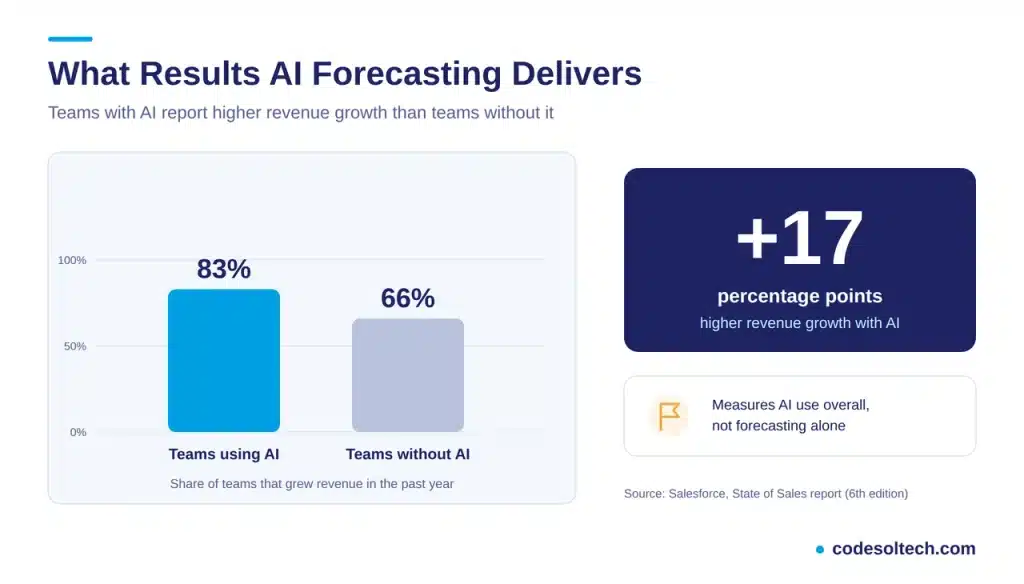
That 17-point gap measures AI adoption in general, not forecasting alone. The report also ranks sales forecasting accuracy among the top benefits teams attribute to AI.
AI forecasts also express uncertainty. Instead of one number, a probabilistic model outputs a range, such as $2.1M to $2.7M at 80% confidence, which gives leaders a planning band instead of a single guess.
Forecasting AI produces 5 operational gains:
- Deal-level risk flags: the model marks stalled opportunities before the quarter closes.
- Faster forecast calls: managers review exceptions instead of every deal.
- Consistent scoring: every rep’s pipeline uses the same probability logic.
- Range forecasts: the system outputs a best-case, likely, and worst-case number.
- Resource planning: finance and operations teams plan hiring and inventory against the likely case.
Data Quality Requirements for AI Forecasting
AI forecasting requires clean, complete, and consistent CRM records. A model trained on bad data produces confident but wrong scores.
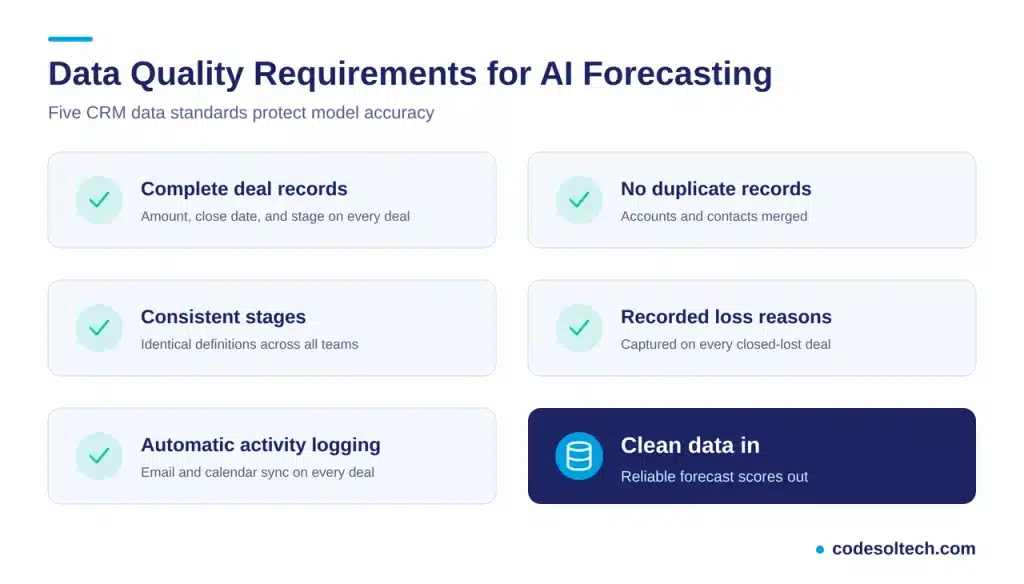
Five data standards protect model accuracy:
- Every opportunity carries an amount, close date, and stage.
- Stage definitions stay identical across all teams.
- Activity logging runs automatically through email and calendar sync.
- Duplicate accounts and contacts are merged.
- Closed-lost deals record a loss reason.
Teams that need a cleanup process start with a CRM data quality framework. Teams that move from an older system complete a CRM data migration first.
Native CRM Forecasting vs Custom AI Forecasting
Businesses choose between 2 deployment paths. Native forecasting uses the vendor’s built-in AI features, while custom forecasting uses a model built on your own data pipeline.
| Factor | Native CRM Forecasting | Custom AI Forecasting |
|---|---|---|
| Data scope | CRM records only | CRM plus ERP, billing, and support data |
| Model control | Vendor-defined | Business-defined |
| Deployment effort | Configuration | Development and integration |
| Best for | Standard sales processes | Complex or multi-product sales cycles |
Custom forecasting depends on a sound CRM integration architecture. A custom CRM development project builds the data pipeline and the scoring layer together.
How to Implement AI Sales Forecasting in 5 Steps
Implementation follows a fixed sequence. Each step produces an output the next step consumes.
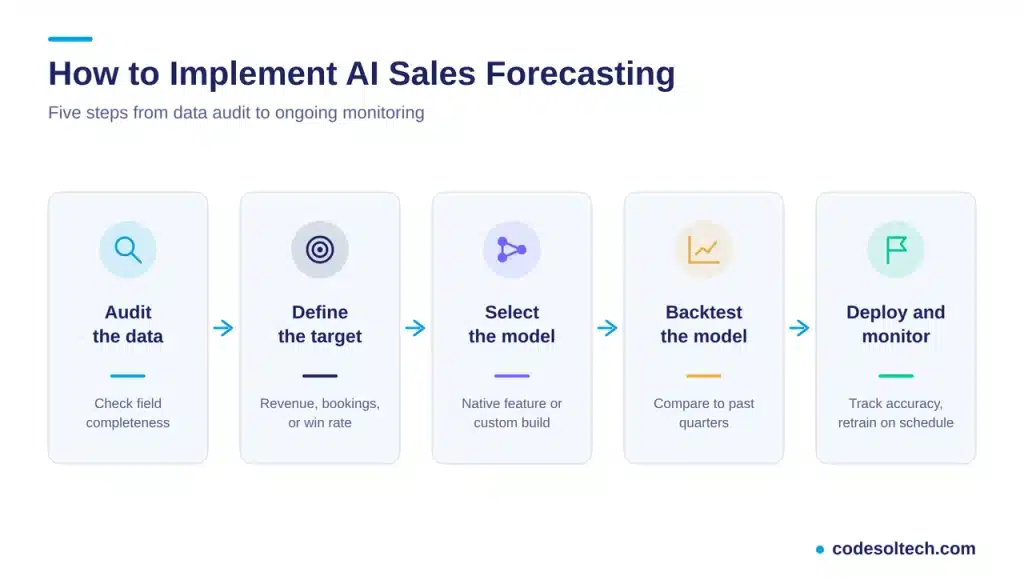
- Audit the data: measure field completeness on closed opportunities.
- Define the forecast target: choose quarterly revenue, monthly bookings, or deal win probability.
- Select the model path: deploy a native feature or develop a custom model.
- Backtest the model: run the model against 4 to 8 past quarters and compare predictions to actual results.
- Deploy and monitor: track accuracy weekly and retrain on a fixed schedule.
The business case for the project follows the same logic as other workflow automation ROI calculations: measure the baseline first, then compare.
Forecast Accuracy Metrics
Five metrics quantify forecast performance:
- MAPE (Mean Absolute Percentage Error): the average of |actual minus forecast| divided by actual.
- WAPE (Weighted Absolute Percentage Error): total absolute error divided by total actual revenue.
- Forecast bias: the average signed error, which shows consistent over-forecasting or under-forecasting.
- Commit accuracy: the share of committed revenue that closes.
- Slippage rate: the share of forecasted deals that move to a later period.
Business Roles That Use AI Forecasts
AI forecasts serve 4 roles, and each role reads a different output:
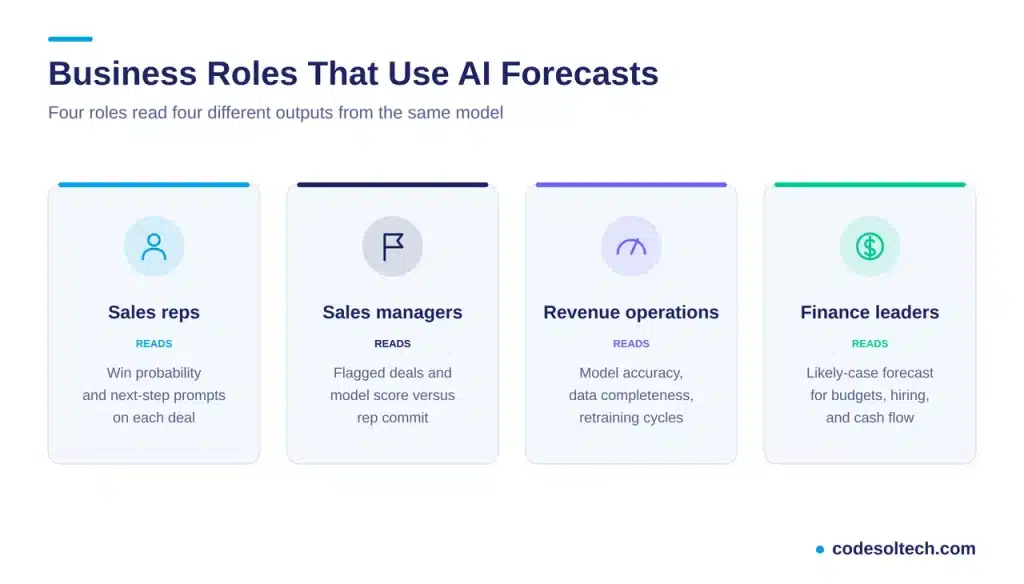
- Sales reps: view win probability and next-step prompts on each deal.
- Sales managers: inspect flagged deals and compare rep forecasts against model scores.
- Revenue operations: monitor model accuracy, data completeness, and retraining cycles.
- Finance leaders: use the likely-case forecast for budgets, hiring plans, and cash flow.
5 Common Mistakes in AI Forecasting Projects
Most failed projects trace back to process errors, not algorithm errors. Five mistakes appear repeatedly:
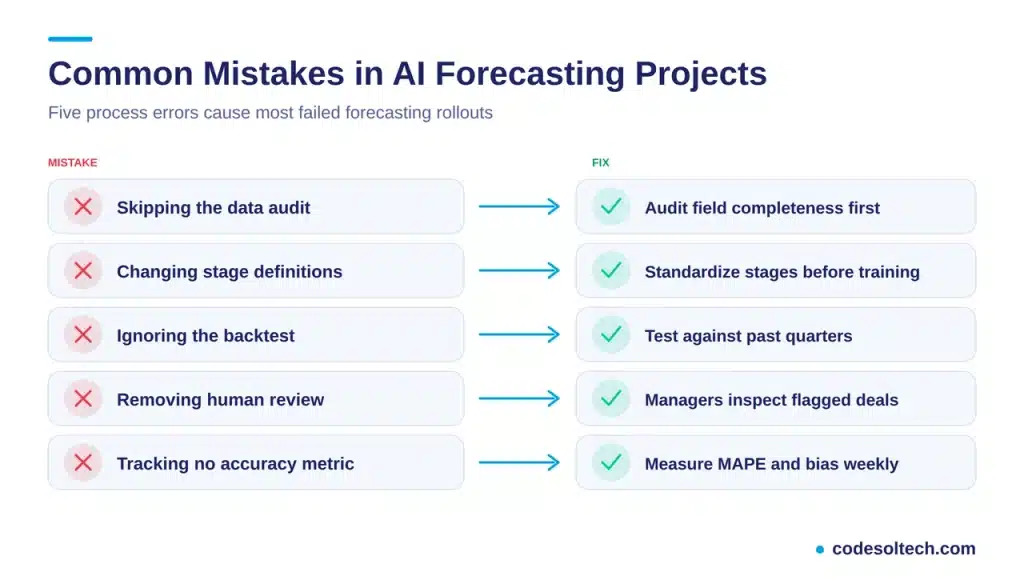
- Skipping the data audit: teams train models on incomplete opportunity records.
- Changing stage definitions mid-project: the model learns from inconsistent labels.
- Ignoring the backtest: teams deploy without comparing predictions to past results.
- Removing human review: managers stop inspecting flagged deals and lose context the model lacks.
- Tracking no accuracy metric: nobody measures MAPE or bias after launch.
Each mistake has a direct fix: audit, standardize, backtest, review, and measure.
Forecast Cadence After Launch
A production forecasting model runs on a schedule. Weekly scoring keeps deal probabilities current, and monthly retraining absorbs new closed-won and closed-lost outcomes.
Quarterly reviews compare forecast accuracy against the baseline set during backtesting. A drop in accuracy triggers a data audit, a feature review, or a model replacement.
Sales managers hold a weekly forecast call built on the model output. The call covers 3 items: flagged deals, forecast changes since the prior week, and the gap between rep commits and model scores.
Final Words
AI sales forecasting replaces opinion with probability. It scores every deal from real CRM data and updates the forecast as the pipeline changes.
Clean records decide the result. Fix data quality first, then deploy the model and measure accuracy every week.
Accurate forecasts turn revenue planning into a measurable, repeatable process.
Ready to build AI forecasting into your CRM? Talk to the CodeSolTech team and get a forecasting plan built around your pipeline data.
You May Like
AI Customer Segmentation in CRM [Proven Data + 6-Step Setup]
AI Meeting Notes & Call Summaries in CRM [6-Step Plan]
AI Email Generation in CRM: Save 12 Hrs/Week
Thanks for Reading 🙂
![Conversational AI in CRM: Stop Typing, Start Talking [2026]](https://www.codesoltech.com/wp-content/uploads/2026/10/Conversational-AI-in-CRM-Stop-Typing-Start-Talking-2026.webp)
![AI Customer Segmentation in CRM [Proven Data + 6-Step Setup]](https://www.codesoltech.com/wp-content/uploads/2026/09/AI-Customer-Segmentation.webp)