
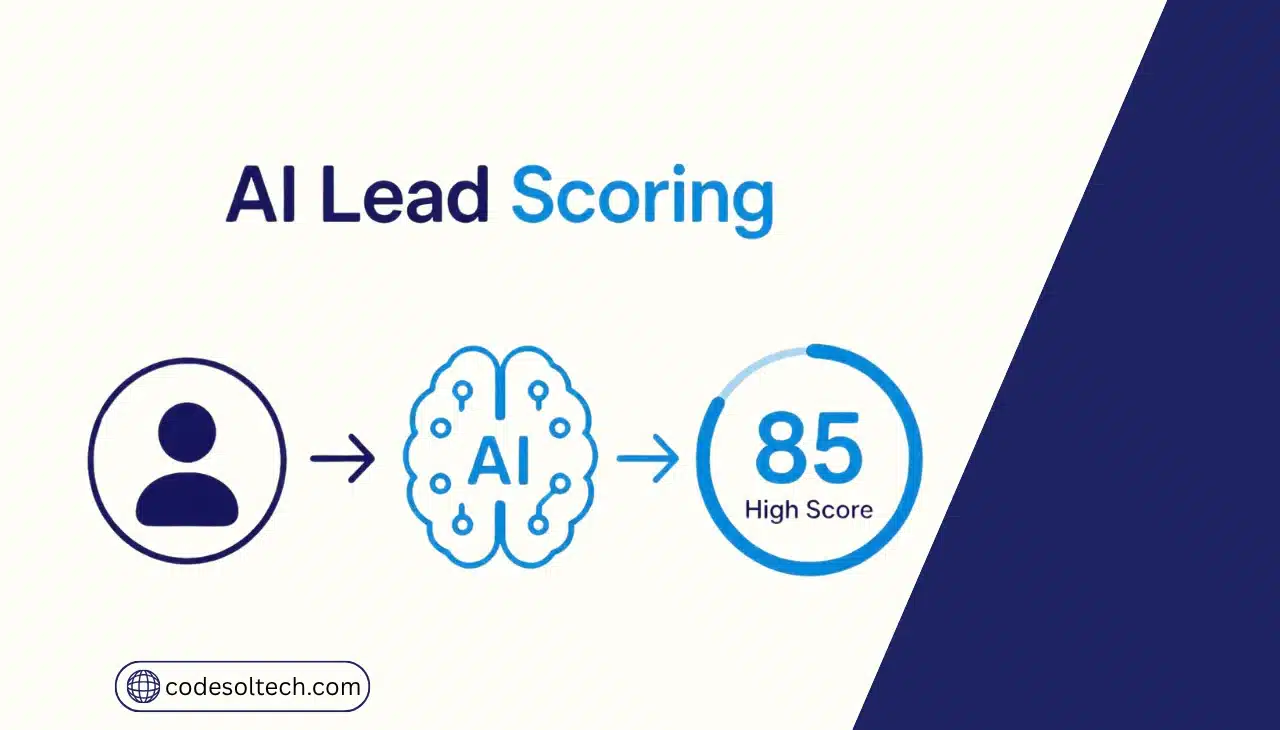
AI lead scoring in CRM uses machine learning to rank leads by conversion probability. The model studies demographic, behavioral, firmographic, and engagement data from past customers. It then assigns each new lead a numeric score, so sales teams contact the highest-probability leads first.
This differs from manual scoring. A human rep cannot process thousands of data points per lead. An AI model does this in milliseconds, across every lead in the pipeline, simultaneously.
Salesforce reports that 87% of sales organizations now use AI for prospecting, forecasting, lead scoring, or email drafting, based on a 2026 survey of more than 4,000 sales professionals. AI lead scoring has moved from experimental to a standard CRM function in three years.
The core output is a single number attached to each lead record. Sales reps see that number inside the CRM, next to the contact name, before they make the first call.
Why Traditional CRM Scoring Falls Short
Most CRMs ship with a basic point system. A form fill earns 10 points, an email open earns 2 points, and a job title match earns 5 points.
This system treats every lead the same way, regardless of context. A VP who opens one email gets the same weight logic as an intern who fills out three forms, unless a manager manually rewrites the rules.
Rule-based scoring also does not adjust when the market shifts. If buyer behavior changes after a product launch or a pricing update, the point values stay frozen until someone edits them by hand.
Sales and marketing teams often disagree on what a “qualified” lead even means under this system. One department trusts the score, the other overrides it manually, and leads fall through the gap between the two.
How Does AI Lead Scoring Work
AI lead scoring runs through five sequential stages inside a CRM. Each stage builds the accuracy of the final score.
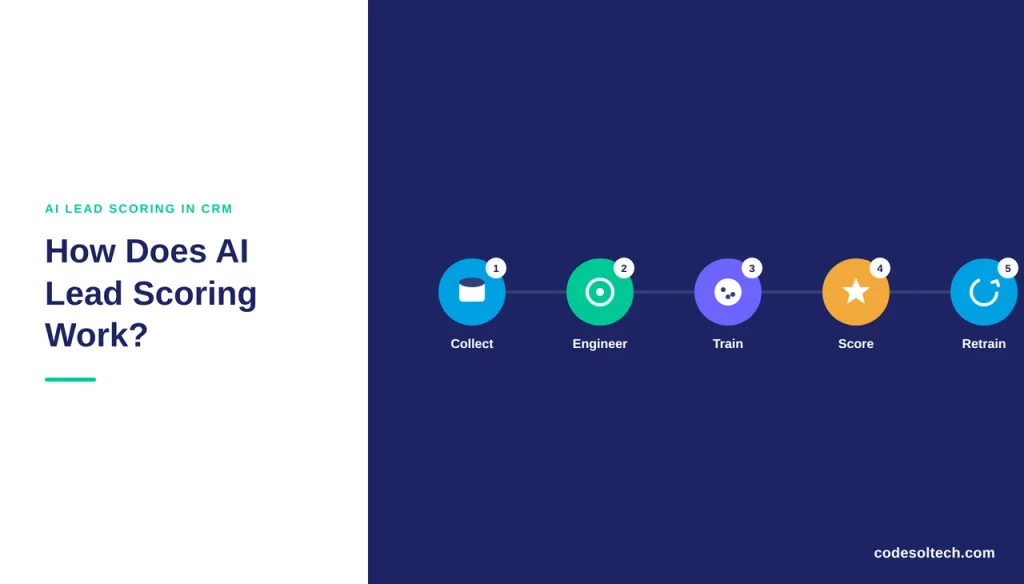
Stage 1: Data Collection
The CRM pulls data from four sources: demographic records, behavioral logs, firmographic details, and engagement history. These four categories form the model’s training set.
- Demographic data: job title, seniority, location
- Behavioral data: page visits, email opens, content downloads
- Firmographic data: company size, industry, annual revenue
- Engagement data: webinar attendance, demo requests, reply rate
Data quality determines model accuracy at this stage. A CRM with duplicate or outdated records produces unreliable scores. See our guide on CRM data quality and cleaning for the standard cleanup process.
Most CRM platforms require at least 100 closed deals before a scoring model can find statistically reliable patterns. Companies below that threshold should keep using rule-based scoring until enough deal history accumulates.
Stage 2: Feature Engineering
The system transforms raw fields into predictive signals. “Time on pricing page” becomes “purchase intent score.” Raw data alone rarely predicts conversion; engineered features do.
Stage 3: Model Training
The algorithm studies closed-won and closed-lost deals from CRM history. It identifies which combinations of attributes correlate with a sale.
The model then assigns statistical weight to each attribute. A lead visiting the pricing page three times carries more weight than a lead who only opened one email.
Stage 4: Score Assignment
Every new lead receives a numeric score, typically 0 to 100. Most CRM platforms group scores into three tiers.
- 90 to 100: sales-ready, route to a rep within 1 hour
- 50 to 89: marketing-qualified, enter a nurture sequence
- 0 to 49: unqualified, hold for re-engagement
Stage 5: Continuous Retraining
The model retrains as new conversion outcomes enter the CRM. This keeps the score accurate as buyer behavior shifts.
Example: a mid-size software company feeds 18 months of CRM history into its AI scoring model. The model learns that leads who request a demo within 7 days of first contact convert at a far higher rate than leads who only download a whitepaper.
The CRM then scores every new demo request higher than every new whitepaper download, without a manager writing that rule manually. Sales reps see the shift the same week it happens.
AI Lead Scoring vs. Traditional Lead Scoring
Traditional lead scoring assigns fixed points to fixed actions. A CRM manager sets these point values manually, and they do not adjust on their own.
AI lead scoring calculates weight dynamically from live conversion data. The table below compares both methods directly.
| Factor | Traditional Lead Scoring | AI Lead Scoring |
|---|---|---|
| Scoring method | Fixed point values set by a manager | Statistical weights calculated by an algorithm |
| Data volume | Handles 5 to 10 manual criteria | Processes hundreds of data points per lead |
| Update frequency | Manual review, typically quarterly | Continuous retraining as new data arrives |
| Accuracy over time | Static, degrades as buyer behavior shifts | Improves with each new closed deal |
| Setup effort | Low, spreadsheet-level rules | Higher, requires clean historical CRM data |
What Are the Benefits of AI Lead Scoring in CRM
AI lead scoring produces four measurable business outcomes. Each outcome ties directly to CRM performance metrics that sales leaders already track.
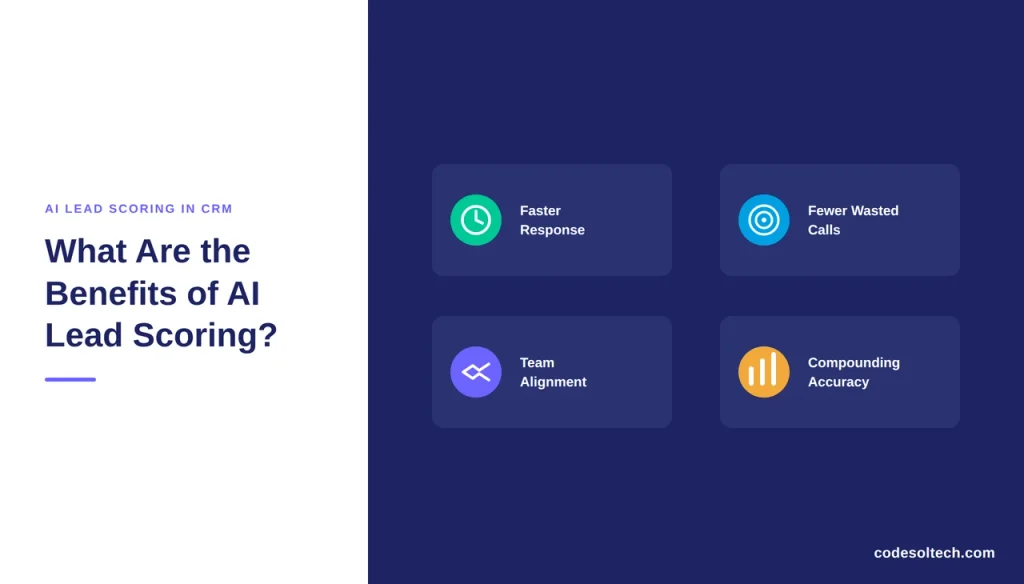
- Faster rep response time: reps contact sales-ready leads within the hour instead of scanning a full pipeline manually
- Fewer wasted calls: reps stop dialing leads that show no purchase intent signals
- Tighter sales and marketing alignment: both teams work from one shared score instead of separate definitions of “qualified”
- Compounding accuracy: the model improves every time a deal closes or a lead goes cold
McKinsey’s research with Salesforce found that AI-driven sales tools can drive a 3 to 5 percent increase in sales productivity, alongside a 5 to 15 percent lift in marketing spend effectiveness. Lead scoring is one of the primary drivers behind that productivity gain, since it removes manual triage from the rep’s daily workflow.
Each benefit compounds over a full sales cycle, not just a single quarter. A rep who saves 20 minutes per lead on triage recovers hours every week, and that time goes directly into selling activity.
Common Mistakes When Setting Up AI Lead Scoring
Three mistakes undermine most AI lead scoring rollouts. Each one is preventable before training starts.
- Training on too little data: models built on fewer than 12 months of deals lack enough closed-won examples to find reliable patterns
- Skipping data cleanup: duplicate contacts and outdated fields teach the model the wrong correlations
- Ignoring rep feedback: a score that contradicts what reps see in real conversations needs review, not blind trust
Sales leaders who skip cleanup see this problem first. The model scores a lead high, the rep calls, and the contact left the company eight months ago.
How to Set Up AI Lead Scoring in Your CRM
Five steps take a CRM from manual scoring to AI-driven scoring. Skipping any step produces an inaccurate model.
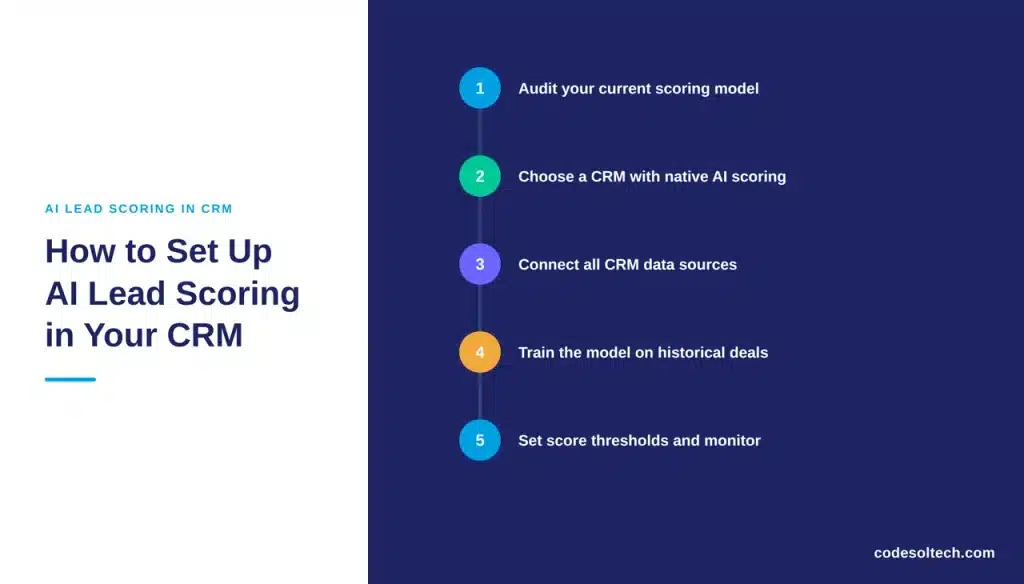
- Audit the current scoring model. Document which criteria your team scores today and where those scores fail to predict real conversions.
- Choose a CRM with native AI scoring. Confirm the platform supports explainable AI, so reps can see why a lead received its score.
- Connect all data sources. Sync the CRM with your CRM integration architecture so email, web, and marketing automation data flow into one model.
- Train the model on historical deals. Feed the system at least 12 months of closed-won and closed-lost records for reliable pattern detection.
- Set score thresholds and monitor results. Define the point at which a lead routes to sales, then track conversion rate by tier monthly.
Teams moving from a legacy CRM should complete CRM data migration and data cleanup before training any model. A model trained on incomplete records produces unreliable scores regardless of the algorithm used.
FAQs
How accurate is AI lead scoring?
Accuracy depends on data volume and quality. A CRM with 12+ months of clean historical deal data typically produces scores that outperform manual rules within the first two retraining cycles, and accuracy keeps climbing as more deals close.
Does AI lead scoring replace sales reps?
No. AI lead scoring ranks leads; it does not close deals. Reps still handle every conversation, negotiation, and relationship step, and the score only tells them where to start.
How long does setup take?
Most CRM platforms activate native AI scoring within 24 hours of connecting data sources. Full model accuracy typically stabilizes after 60 to 90 days of new conversion data flowing through the system.
What’s a good lead score threshold?
Most teams route leads scoring 85 or higher directly to sales. Thresholds should adjust after the first quarter based on actual conversion data, not fixed rules set at launch.
Can small businesses use AI lead scoring?
Yes, if the CRM supports it natively. A small business with fewer historical deals should expect a longer training period before scores reach full accuracy.
Final Words
AI lead scoring turns CRM data into a ranked action list. It removes guesswork from prioritization and gives sales reps a clear starting point every morning.
The model only works as well as the data behind it, so clean, connected CRM data comes first.
Ready to build AI lead scoring into your CRM?
Talk to CodeSol Technologies about a CRM built for AI-driven lead scoring from day one.
![Conversational AI in CRM: Stop Typing, Start Talking [2026]](https://www.codesoltech.com/wp-content/uploads/2026/10/Conversational-AI-in-CRM-Stop-Typing-Start-Talking-2026.webp)
![AI Customer Segmentation in CRM [Proven Data + 6-Step Setup]](https://www.codesoltech.com/wp-content/uploads/2026/09/AI-Customer-Segmentation.webp)