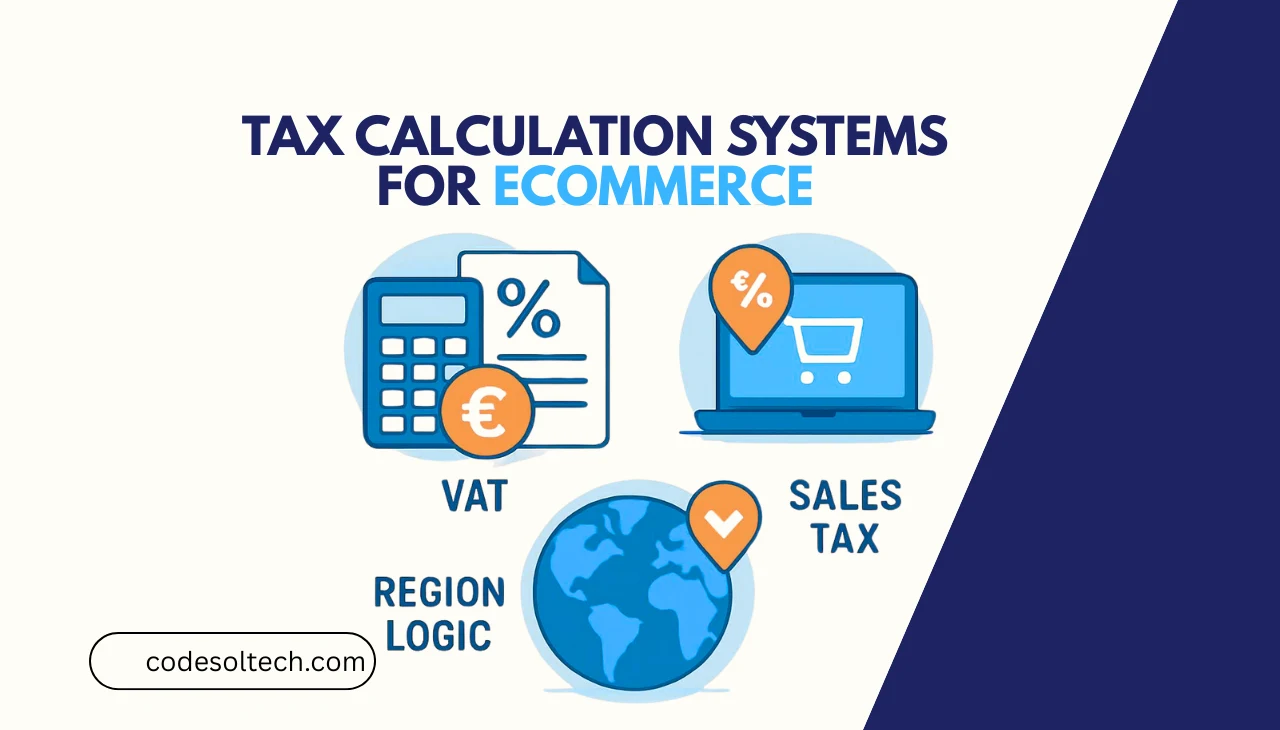
A tax calculation system for ecommerce is a software layer that automatically determines, applies, and records the correct tax obligation on every transaction based on the buyer’s jurisdiction, the product’s tax classification, and the seller’s nexus status.
Without an automated tax engine, a store operating across 3 or more tax jurisdictions accumulates compliance errors at a rate that triggers audits and financial penalties.
This guide covers the 4 core components of an ecommerce tax system: tax jurisdiction mapping, VAT computation, sales tax nexus logic, and real-time rate synchronization. Each component is a requirement for cross-border and multi-state ecommerce operations.
What Is a Tax Calculation Engine in Ecommerce?
A tax calculation engine is a deterministic rule processor that accepts 4 inputs: seller location, buyer location, product type, and transaction date and outputs the legally correct tax rate, tax amount, and tax code for that transaction.
The engine runs at checkout, before payment authorization, and generates a tax line item that appears on the customer’s invoice.
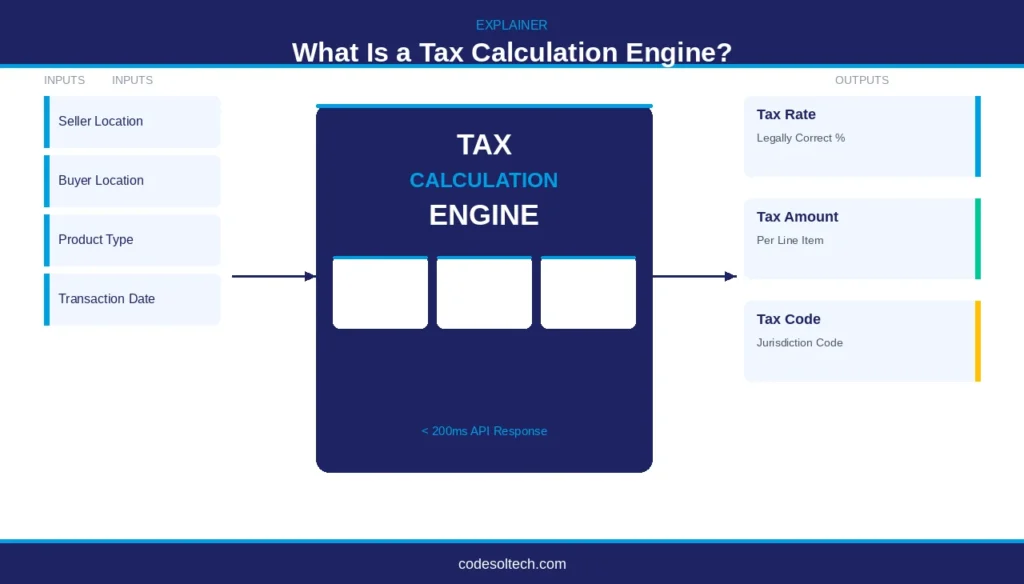
Modern ecommerce platforms integrate tax engines via API. The checkout service sends a tax calculation request payload containing the ship-from address, ship-to address, and line-item product codes.
The tax engine returns the applicable rates in under 200 milliseconds, keeping the checkout experience uninterrupted.
The checkout flow architecture directly determines how and when the tax API call is triggered within the order pipeline.
There are 2 deployment models for a tax engine:
- Hosted SaaS tax APIs — Services like Avalara AvaTax or TaxJar connect via REST API and maintain jurisdiction databases independently.
- Self-hosted rule engines — The store maintains its own rate tables, requiring a dedicated compliance team to update rates across all active jurisdictions.
VAT (Value-Added Tax): Structure, Rates, and Ecommerce Application
VAT is an indirect consumption tax collected at each stage of the supply chain, where only the value added at each stage is taxed. In ecommerce, VAT applies at the point of sale to the end consumer, and the merchant acts as the tax collector on behalf of the government.
The European Commission’s VAT rules for ecommerce mandate that all B2C digital goods sold to EU buyers are subject to VAT in the buyer’s member state, regardless of the seller’s location.
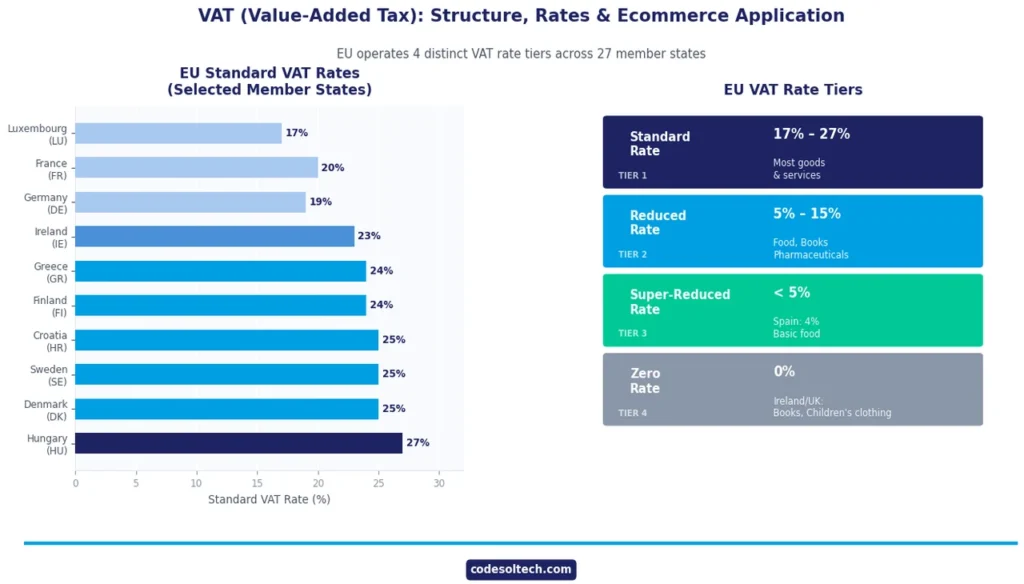
The EU operates 4 distinct VAT rate tiers across its 27 member states:
- Standard rate — Ranges from 17% (Luxembourg) to 27% (Hungary); applies to most goods and services.
- Reduced rate — Between 5% and 15%; applies to food, books, and pharmaceuticals in most member states.
- Super-reduced rate — Below 5%; permitted only for specific goods in specific member states (e.g., Spain applies 4% to basic food).
- Zero rate — 0%; applies in countries like Ireland and the UK for children’s clothing and printed books.
An ecommerce tax system resolves VAT by performing 3 sequential checks: (1) confirm the buyer’s country, (2) identify the product’s VAT commodity code, and (3) query the applicable rate for that commodity code in that country.
The One Stop Shop (OSS) scheme, launched by the EU on 1 July 2021, allows merchants to file a single VAT return covering all EU member states, replacing the previous obligation to register in each country individually.
How Does VAT Registration Threshold Work for Ecommerce?
The EU OSS threshold is €10,000 per calendar year in cross-border B2C sales. Below this threshold, a seller applies the VAT rate of their own member state. Above €10,000, the seller applies the VAT rate of each buyer’s member state and reports via OSS.
The UK maintains a separate VAT registration threshold of £90,000 (as of April 2024) for domestic turnover, with no minimum threshold for non-UK sellers supplying digital services to UK consumers.
The tax system tracks cumulative cross-border revenue in real time and triggers a threshold alert when the seller approaches the OSS registration limit.
This alert integrates with the store’s SKU management system to tag each product with the correct commodity code, ensuring the right VAT rate is applied from the first transaction after threshold crossing.
Sales Tax in the United States: Nexus, Economic Thresholds, and Jurisdiction Complexity
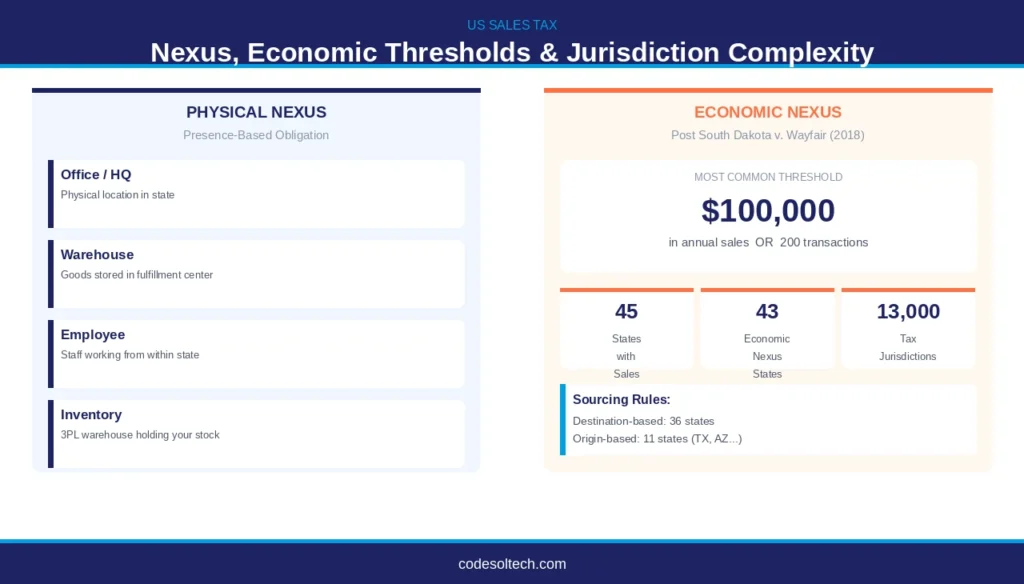
Sales tax in the United States is a state-administered consumption tax with no federal-level uniformity. 45 states plus the District of Columbia levy a sales tax. The 5 states with no general sales tax are Alaska, Delaware, Montana, New Hampshire, and Oregon. The IRS confirms that sales tax administration is entirely a state and local government responsibility, meaning an ecommerce seller faces up to 13,000 distinct sales tax jurisdictions across the country.
A sales tax obligation activates when a seller establishes nexus in a state. There are 2 types of nexus:
- Physical nexus — Triggered by a physical presence: an office, warehouse, employee, or inventory stored in a fulfillment center within the state.
- Economic nexus — Triggered by surpassing a state’s revenue or transaction threshold. Post South Dakota v. Wayfair (2018), 43 states adopted economic nexus laws. The most common threshold is $100,000 in annual sales or 200 separate transactions in the state.
How Does a Tax Engine Determine Nexus Automatically?
A nexus determination module within the tax engine continuously aggregates sales data by state. When a seller’s cumulative revenue or transaction count reaches 80% of a state’s economic nexus threshold, the system issues a compliance alert.
At 100%, the engine activates automatic sales tax collection for all future transactions destined for that state. This automation eliminates the manual monitoring burden that causes nexus compliance failures in scaling stores.
The engine then applies the correct sourcing rule either destination-based (tax charged at the buyer’s rate, used by 36 states) or origin-based (tax charged at the seller’s rate, used by 11 states, including Texas and Arizona for intrastate sales).
Misapplying sourcing rules is the leading cause of sales tax audit adjustments for ecommerce businesses.
Product taxability adds a third layer of complexity. The following product categories have non-standard sales tax treatment across states:
- Groceries and food — Exempt in 32 states; taxable in 18 states, sometimes at a reduced rate.
- Clothing and apparel — Exempt in states including Pennsylvania, New Jersey, and Minnesota.
- Digital goods and SaaS — Taxable in 28 states; the definition of “digital goods” varies by state statute.
- Prescription drugs — Universally exempt in all 45 sales-tax states.
- Medical devices — Exempt in most states; taxable in a minority, with exemption criteria varying by device classification.
Region-Based Tax Logic: How Geolocation Determines Tax Rate Assignment
Region-based tax logic is the process by which a tax engine resolves a buyer’s delivery address to a specific tax jurisdiction using geospatial mapping.
The engine converts the postal address to geographic coordinates, then cross-references those coordinates against a boundary database containing the exact polygon boundaries of every tax jurisdiction, including state, county, city, and special taxing district levels.
Address-based geolocation is more precise than ZIP-code-based tax lookup. A single ZIP code can span 3 or more tax jurisdictions with different combined rates.
For example, ZIP code 10001 (New York City) includes areas with the standard 8.875% combined rate, but adjacent ZIP codes crossing district boundaries produce rates between 8% and 8.875%.
A precise geolocation engine eliminates this ambiguity.
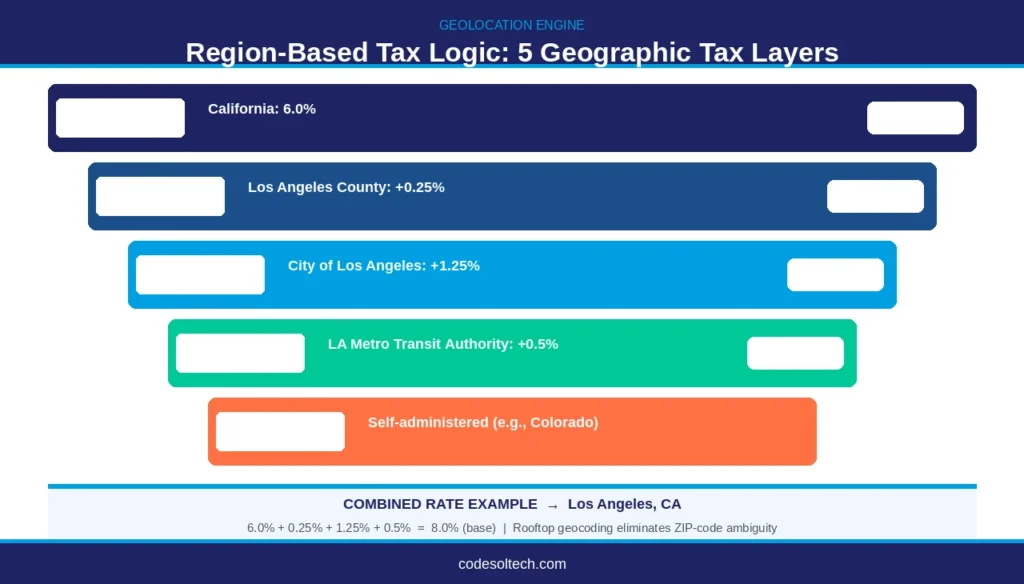
The region logic module processes 5 geographic layers to calculate the final combined tax rate:
- State rate — The base rate set by state legislation (e.g., California: 6%).
- County rate — An additive county-level rate (e.g., Los Angeles County: +0.25%).
- City/municipal rate — An additive city rate (e.g., Los Angeles city: +1.25%).
- Special district rate — Transportation, tourism, or improvement districts levying additional fractions (e.g., Los Angeles Metro Transportation Authority: +0.5%).
- Home rule jurisdiction rate — Self-administered cities (notably in Colorado) that set their own rates and administer their own returns independently from the state.
Technical Architecture of an Ecommerce Tax Calculation System
A production-grade tax calculation system consists of 5 interconnected components that operate in a defined sequence during the transaction lifecycle.
Understanding the architecture is essential for developers integrating a tax engine into a custom ecommerce stack.
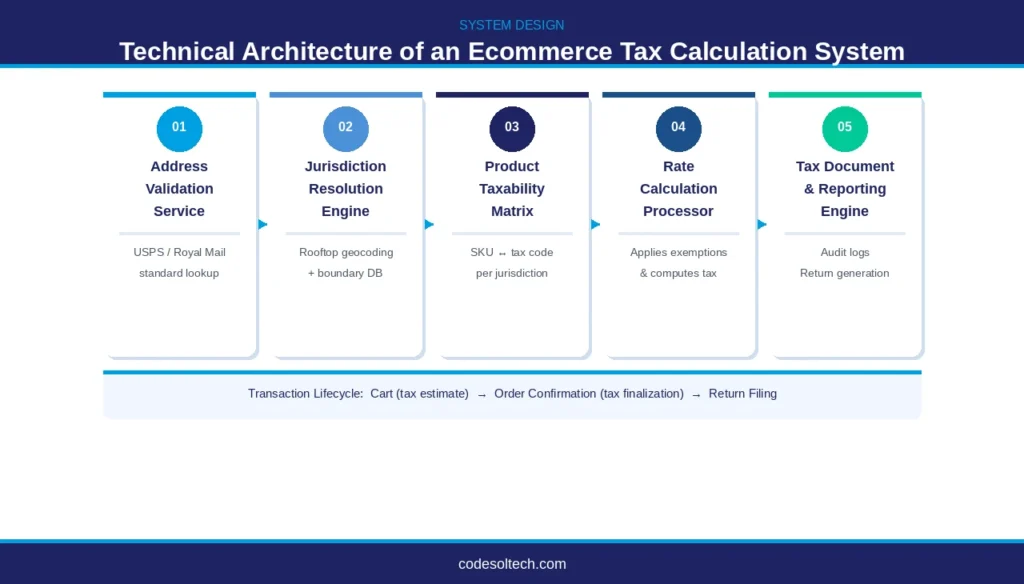
- Address validation service — Standardizes and verifies the buyer’s address against postal authority databases (USPS, Royal Mail, etc.) before passing it to the tax engine. Invalid addresses produce incorrect jurisdiction assignments.
- Jurisdiction resolution engine — Maps the validated address to the precise tax jurisdiction using rooftop-level geocoding. This component maintains a jurisdiction database updated with each legislative rate change.
- Product taxability matrix — Stores the taxability status of each SKU per jurisdiction. The matrix maps each product’s tax category code (e.g., Streamlined Sales Tax codes or Avalara tax codes) to its applicable rate or exemption in each active jurisdiction.
- Rate calculation processor — Combines the jurisdiction rate, the product taxability status, and any applicable exemptions (reseller certificates, nonprofit status) to produce the final tax amount for each line item.
- Tax document and reporting engine — Stores every calculated tax record with its jurisdiction, rate, and amount. It generates jurisdiction-specific returns, reconciliation reports, and audit-ready transaction logs.
The API call sequence integrates directly into the checkout flow at the tax estimation stage (cart page) and the tax finalization stage (order confirmation). Estimation uses an approximated ship-to address to display a tax preview.
Finalization uses the confirmed, validated delivery address to record the binding tax liability. Avalara’s AvaTax API documentation provides the complete REST endpoint specification for this two-stage integration pattern.
Exemption Certificate Management in Ecommerce Tax Systems
An exemption certificate is a legal document that a buyer provides to a seller to certify that a transaction is not subject to sales tax.
Accepting and validating exemption certificates is a legal requirement for merchants selling to wholesale customers, nonprofits, and government entities. Failure to retain valid certificates exposes the seller to liability for the uncollected tax during an audit.
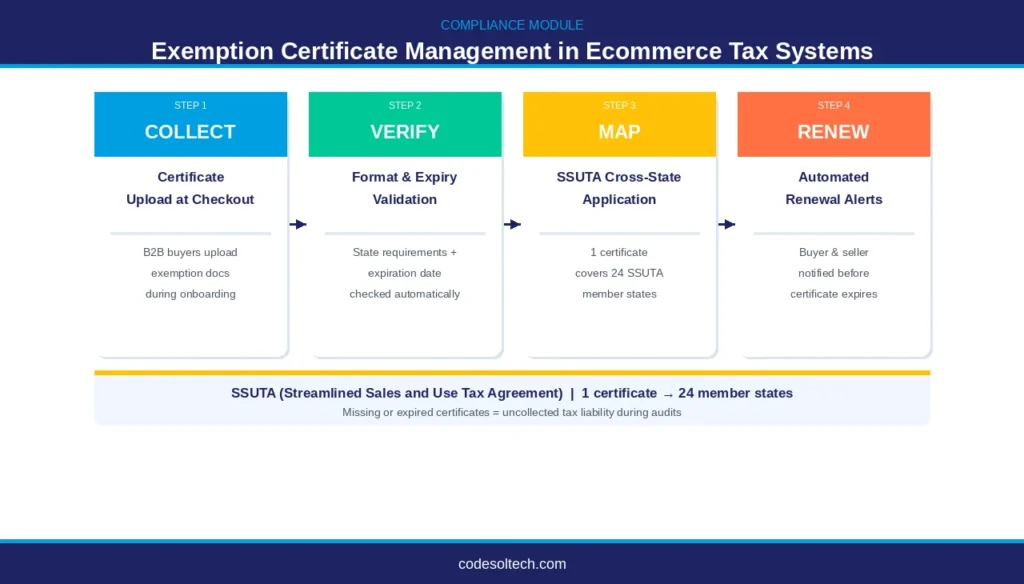
An automated exemption certificate management (ECM) module performs 4 functions:
- Certificate collection — Prompts B2B buyers to upload their exemption certificate during account creation or at checkout.
- Validity verification — Validates the certificate’s format, the issuing state’s requirements, and the expiration date.
- Jurisdiction cross-mapping — Applies a single Streamlined Sales and Use Tax (SSUTA) certificate to all 24 SSUTA member states, reducing the administrative burden of managing state-specific certificates.
- Automated renewal alerts — Notifies the buyer and seller when a certificate approaches its expiration date, maintaining continuous compliance.
The Streamlined Sales Tax Governing Board administers the multi-state certificate framework that simplifies exemption management for ecommerce sellers operating across SSUTA member states.
Real-Time Tax Rate Updates and Compliance Automation
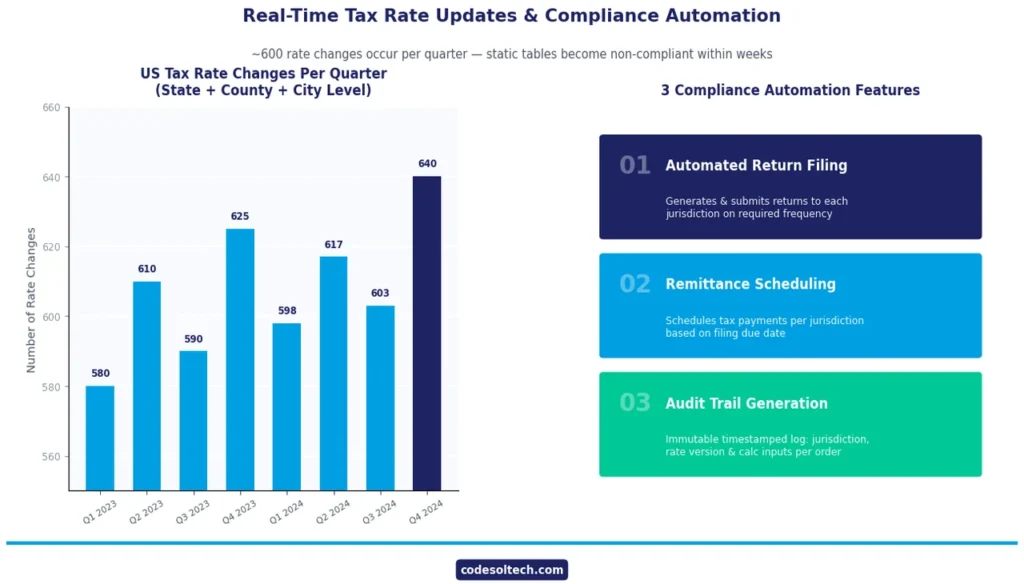
Tax rates change at the jurisdiction level continuously. In the United States alone, approximately 600 rate changes occur across state, county, and city jurisdictions each quarter. A tax system that relies on static rate tables becomes non-compliant within weeks of deployment.
A production tax engine subscribes to a real-time rate update feed that pushes legislative changes to the jurisdiction database on their effective date, not their announcement date.
Rate update automation integrates with the store’s SKU and product management layer to retest product taxability whenever a jurisdiction updates its commodity tax code definitions.
TaxJar’s SmartCalcs API maintains a database of over 14,000 US tax jurisdictions with daily rate synchronization, providing a benchmark for what a production-grade rate management system delivers.
The 3 compliance automation features that a mature tax system implements are:
- Automated return filing — Generates and submits sales tax returns to each jurisdiction’s portal on the required filing frequency (monthly, quarterly, or annually).
- Remittance scheduling — Schedules tax payment transfers to each jurisdiction based on the filing due date, preventing late payment penalties.
- Audit trail generation — Maintains an immutable, timestamped transaction log with the jurisdiction, rate version, and calculation inputs for every order, enabling rapid response to audit inquiries.
Cross-Border Tax Compliance: Duties, GST, and Import VAT
Cross-border ecommerce transactions generate 3 distinct tax obligations beyond standard domestic sales tax or VAT: import duties, import VAT, and Goods and Services Tax (GST) in destination countries.
A cross-border tax engine calculates all 3 at checkout using the product’s Harmonized System (HS) code, the declared customs value, and the destination country’s tariff schedule.
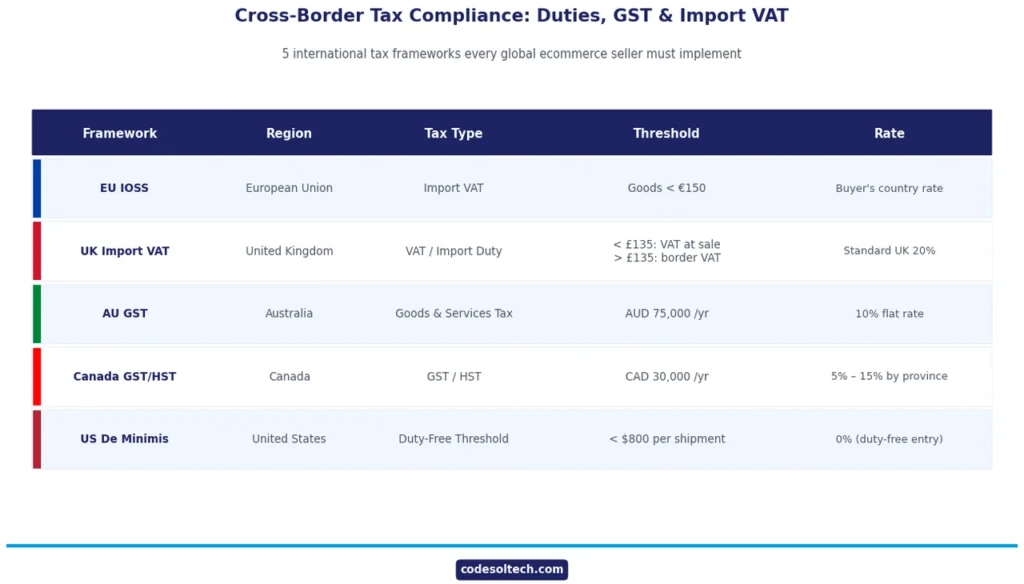
The key cross-border tax frameworks that affect global ecommerce sellers are:
- EU Import VAT (IOSS) — The Import One Stop Shop scheme covers goods with an intrinsic value below €150 shipped into the EU. The seller collects and remits import VAT at checkout, enabling customs clearance without additional charges to the buyer.
- UK Low Value Import Relief — Goods with a customs value below £135 are subject to UK VAT at the point of sale, collected by the seller. Goods above £135 are subject to import duty and VAT at the UK border.
- Australian GST (10%) — Applies to all goods and services sold to Australian consumers by overseas sellers with annual Australian sales exceeding AUD 75,000.
- Canada GST/HST — Non-resident suppliers of digital services to Canadian consumers must register for GST/HST once annual Canadian sales exceed CAD 30,000.
- US de minimis threshold — Goods with a declared customs value below $800 enter the US duty-free under Section 321. This threshold directly affects landed cost calculations for cross-border sellers shipping to US consumers.
The World Customs Organization’s Harmonized System provides the 6-digit commodity classification codes that the cross-border tax engine uses to determine the applicable duty rate in each destination country. Accurate HS code assignment at the product catalog level is a prerequisite for correct cross-border tax calculation.
How to Select the Right Tax Calculation System for Your Ecommerce Store
The correct tax system for an ecommerce store is determined by 4 operational variables: the number of active tax jurisdictions, the transaction volume per month, the product catalog’s taxability complexity, and the requirement for cross-border compliance.
A store selling only within one US state requires a different system than a store selling physical and digital goods across 30 countries.
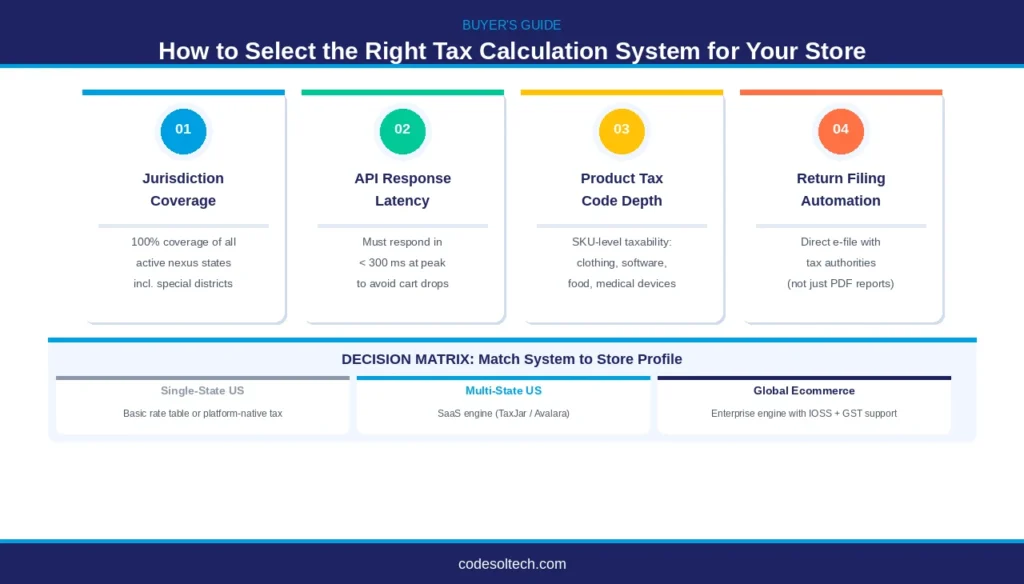
The 4 evaluation criteria for selecting a tax engine are:
- Jurisdiction coverage — Confirm the engine covers 100% of the jurisdictions where the store has active nexus, including special taxing districts.
- API response latency — The tax calculation API must respond in under 300 milliseconds at peak load to avoid checkout abandonment caused by page load delays.
- Product tax code library depth — The engine must support the specific tax categories relevant to the product catalog (e.g., clothing, software, food, medical devices) with jurisdiction-level granularity.
- Return filing automation — Verify whether the system files returns directly with tax authorities or only generates return-ready reports requiring manual submission.
For ecommerce platforms built on custom architectures, the tax engine integrates as a microservice within the checkout pipeline, alongside payment processing and shipping rate calculation.
This microservice pattern keeps the tax logic independently deployable and testable, matching the architectural standards described in the ecommerce checkout flow architecture guide.
Final Words
Tax calculation is not optional for ecommerce it is a legal obligation that scales in complexity with every new market entered.
An automated tax engine, built on accurate jurisdiction mapping, real-time rate synchronization, and VAT/sales tax logic, protects the business from audit exposure and removes compliance as a growth barrier.
Select a system that matches your jurisdiction footprint today and scales to your cross-border roadmap tomorrow.
Need a tax-ready ecommerce system built for global scale?
CodeSolTech engineers custom ecommerce architectures with integrated tax calculation, multi-jurisdiction compliance, and automated filing so your store stays compliant as it grows.