Guest checkout lets customers buy without creating an account, eliminating the registration barrier that causes 24% of all checkout abandonments. Account-based checkout stores customer data for repeat purchases, loyalty programs, and behavioral marketing.
Ecommerce stores that combine both through a hybrid checkout system maximize first-purchase conversion and long-term customer lifetime value simultaneously.
Guest vs Account-Based Checkout Systems in Ecommerce
Guest checkout and account-based checkout are the 2 primary purchase flow architectures in ecommerce. These systems directly determine a store’s cart abandonment rate, checkout conversion rate, and customer lifetime value (CLV).
The Baymard Institute identifies forced account creation as the second-largest cause of checkout abandonment, responsible for 24% of all abandoned purchases in US ecommerce stores.
Ecommerce platforms including Shopify, WooCommerce, BigCommerce, and Magento support both checkout models natively. Selecting the wrong system for your store’s traffic profile and revenue model costs revenue at every stage of the customer journey, from first visit to repeat purchase.
What Is Guest Checkout in Ecommerce?
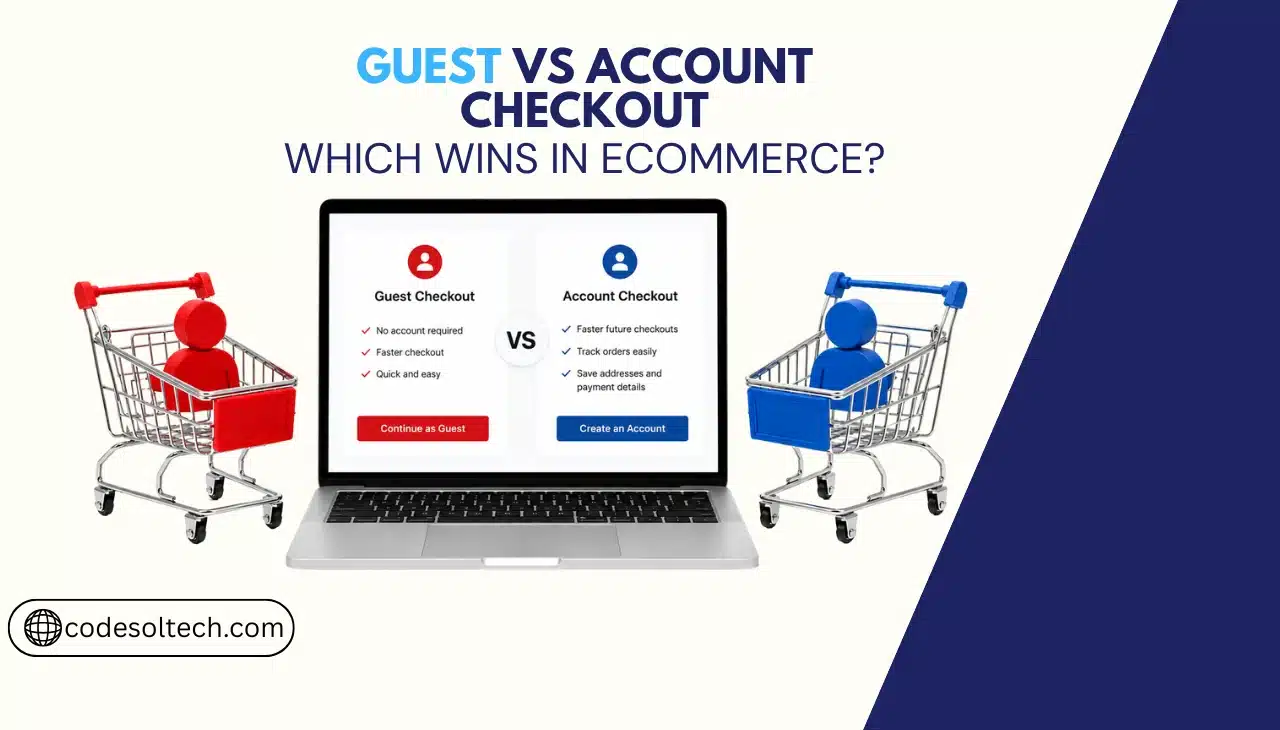
Guest checkout is a purchase flow that completes a transaction without requiring the customer to create a registered user account. The system collects an email address, shipping information, and payment details, processes the order, and delivers a confirmation — without storing a persistent customer profile in the merchant’s database.
Guest checkout eliminates 3 primary friction points from the purchase process:
- Password creation: Customers skip generating, entering, and confirming a unique account password.
- Email verification delay: The account activation email which interrupts the purchase flow is removed entirely.
- Profile completion burden: Customers fill in only the fields required to process the order, with no additional account preference inputs.
Retailers including Apple, Nike, Target, and ASOS, offer guest checkout as the default or as a prominently featured option alongside account sign-in.
This positions guest checkout as the standard practice for ecommerce checkout optimization, particularly for stores where the majority of traffic consists of first-time visitors.
What Is Account-Based Checkout?
Account-based checkout requires customers to create a registered profile before or during the purchase. The system stores order history, saved payment methods, delivery addresses, wishlist data, and behavioral tracking under a single customer profile.
This data infrastructure enables personalized marketing, loyalty program management, and streamlined re-ordering on every subsequent visit.
Account-based checkout delivers 4 measurable business advantages over guest checkout:
- Owned marketing channel: The registered email address creates a direct communication channel that is independent of paid advertising platforms like Meta or Google.
- Repeat purchase acceleration: Saved payment and delivery data eliminates the need to re-enter order details on return purchases, reducing checkout time significantly.
- Behavioral segmentation: Purchase history and on-site behavior feed product recommendation engines and automated email marketing sequences.
- Loyalty program integration: Points-based reward systems require a registered profile to track and apply rewards across multiple transactions.
The account-based model prioritizes long-term CLV over first-purchase conversion rate. Registered account holders consistently generate higher annual revenue per customer than one-time guest buyers across every major ecommerce product category.
Guest vs Account Checkout: Core Differences
The structural differences between guest and account-based checkout operate across 6 performance dimensions.
These dimensions determine which system produces better outcomes for a specific store’s traffic composition, product category, and growth strategy.
| Performance Factor | Guest Checkout | Account-Based Checkout |
|---|---|---|
| First-Purchase Conversion | Higher (no registration barrier) | Lower (registration friction) |
| Cart Abandonment Risk | Low | High when mandatory (causes 24% abandonment) |
| Repeat Purchase Rate | Low (no saved order data) | High (saved payment and address) |
| Customer Data Collected | Email and shipping address only | Full profile, behavior, and purchase history |
| Post-Purchase Marketing | Transactional email only | Full segmentation, automation, and loyalty |
| CLV Optimization | Low | High |
Does Guest Checkout Reduce Cart Abandonment?
Yes. Guest checkout directly reduces cart abandonment by removing mandatory account creation, the friction point that the Baymard Institute identifies as responsible for 24% of all US ecommerce checkout abandonments.
Stores that implement guest checkout as the default option record immediate reductions in checkout drop-off, with documented cases showing 35–50% decreases in abandonment within the first 30 days of implementation.
Forced account creation introduces 3 specific abandonment triggers that guest checkout eliminates:
- Password friction: Baymard’s usability research identifies forgotten or unwanted password creation as a top-3 reason customers exit checkout pages before completing a purchase.
- Trust barrier on first visit: First-time visitors with no prior brand relationship are reluctant to commit personal data to a new account before evaluating product quality through a first purchase.
- Perceived time cost: Customers overestimate how long account creation takes, increasing the perceived effort of the purchase and reducing purchase intent.
ASOS documented this directly: removing mandatory account creation from its checkout produced a 50% increase in completed transactions.
This result established guest checkout as a proven conversion rate optimization (CRO) intervention.
The abandonment reduction effect is strongest in high-competition product categories, such as fashion, electronics, and home goods, where customers compare multiple retailers before committing to a purchase.
How Account-Based Checkout Affects Customer Lifetime Value
Account-based checkout increases customer lifetime value by enabling the 4 post-purchase mechanisms that generate revenue beyond the initial transaction: email marketing automation, loyalty program participation, behavioral personalization, and subscription enrollment.
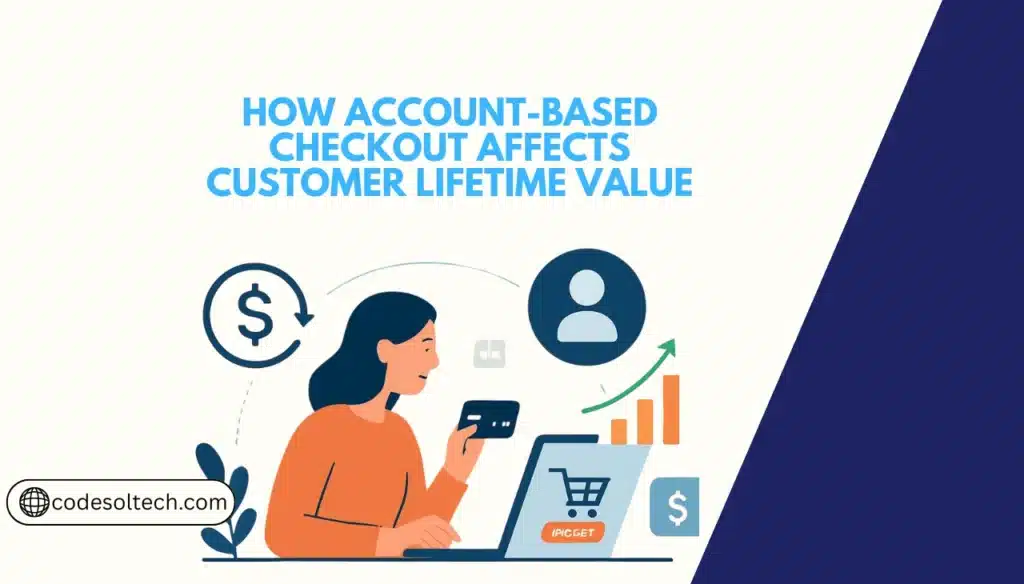
Each mechanism requires a registered account profile to function at scale.
- Abandoned cart recovery: Automated email sequences targeting registered users who exit checkout without purchasing recover an average of 5–15% of abandoned cart revenue per campaign.
- Product recommendation sequences: Purchase history data feeds recommendation algorithms that increase average order value (AOV) on return visits through cross-sell and upsell triggers.
- Win-back campaigns: Defined purchase recency data from registered profiles enables targeted re-engagement campaigns for lapsed buyers, restoring a revenue stream that guest checkout cannot capture.
- Subscription and auto-replenishment: Recurring order models require a stored account for repeating payment authorization and delivery scheduling. Guest checkout structurally cannot support subscription commerce.
The CLV trade-off is measurable: account-based checkout reduces first-purchase conversion rate but increases total revenue generated per customer over 12 months.
This model delivers the highest return in product categories with high repurchase frequency, such as consumables, personal care, pet supplies, and B2B procurement platforms.
Post-Purchase Account Creation: The Bridge Between Both Systems
Post-purchase account creation presents the registration option after the transaction completes, not before or during it.
The customer completes a guest purchase, then receives a single-step prompt on the order confirmation page to create an account using data already submitted during checkout.
This strategy eliminates pre-purchase friction while still converting guest buyers into registered accounts. The mechanism executes in 3 stages:
- Stage 1 — Guest transaction: The customer completes checkout without account creation. The system captures email, shipping address, and payment method.
- Stage 2 — Order confirmation prompt: The confirmation page displays a “Save your information” or “Create your account” prompt with all fields pre-populated from the completed transaction.
- Stage 3 — One-click registration: The customer sets only a password. The account activates instantly without requiring any data re-entry.
This implementation converts 25–45% of guest buyers into registered accounts, based on published ecommerce industry benchmarks. Shopify’s native checkout supports this model through its post-purchase account prompt.
This is the primary mechanism that established ecommerce stores use to build registered user databases without sacrificing first-purchase conversion rates.
Which Checkout System Is Right for Your Ecommerce Store?
The correct checkout system depends on 3 factors: your store’s traffic composition (first-time vs. returning), your product category’s repurchase frequency, and your revenue model (transactional vs. subscription).
New stores with predominantly first-time traffic implement guest checkout. Subscription and high-frequency repurchase stores require account-based checkout.
All established ecommerce stores with growth targets implement a hybrid system with post-purchase registration.
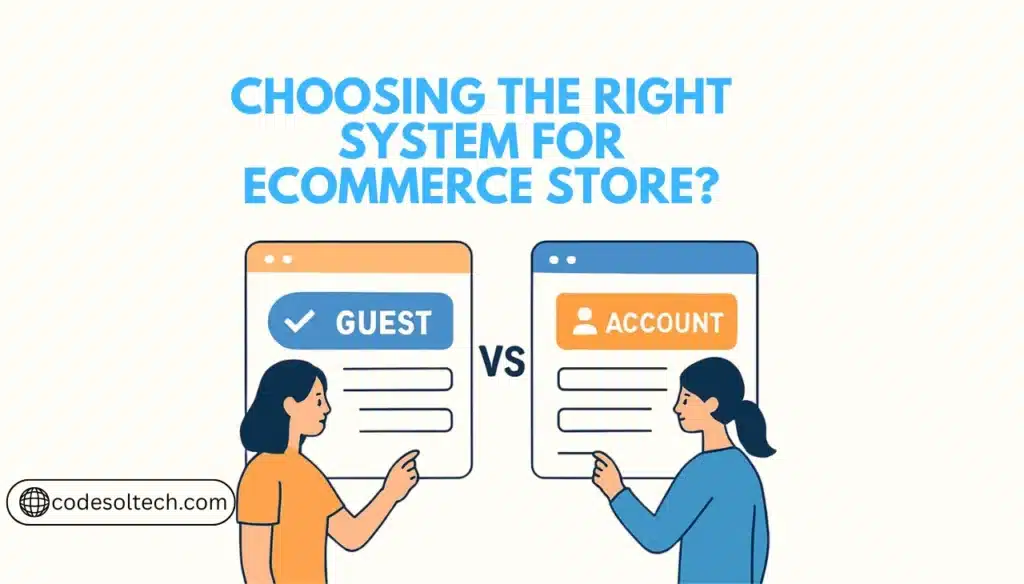
Use this 5-category decision framework to match your store profile to the correct model:
- New ecommerce store (under 12 months, under 10,000 monthly sessions): Implement guest checkout as the default. First-purchase conversion rate is the only metric that matters before a registered user base exists.
- Established store with broad product catalog: Implement hybrid checkout. Position guest checkout as the primary path with a post-purchase registration prompt on the order confirmation page.
- Subscription or consumable product store: Require account creation at checkout. Recurring billing cannot function without a registered account for payment authorization and delivery scheduling.
- B2B ecommerce platform: Require account creation. B2B buyers need purchase order history, invoice access, multi-user account management, and credit terms that only registered profiles support.
- High-ticket product store (AOV above $300): Incentivize account creation at checkout with a first-purchase discount or loyalty points to offset the registration friction at the moment of highest purchase intent.
The optimal checkout strategy shifts as a store matures. Early-stage stores maximize top-of-funnel conversion. Established stores maximize CLV through registered account data and post-purchase marketing systems.
The Hybrid Checkout Model: Current Best Practice
The hybrid checkout model presents guest and account options at checkout initiation and adds post-purchase registration to convert first-time buyers into registered accounts after the transaction completes.
This model captures the conversion rate advantage of guest checkout and the CLV advantage of account-based checkout without sacrificing either metric.
The hybrid model executes in 3 stages:
- Checkout entry: Display “Continue as Guest” and “Sign In” options with equal visual prominence. Do not default to the account path or use language that implies account creation is required to proceed.
- Transaction processing: Process the order through the guest flow. Collect email, shipping address, and payment method without profile creation.
- Post-purchase conversion: On the order confirmation page, display a one-click account creation prompt with all fields pre-populated from transaction data. This step converts 25–45% of guest buyers into registered accounts.
Shopify, BigCommerce, and WooCommerce support hybrid checkout configuration natively without custom development.
The hybrid model is the dominant implementation across high-revenue ecommerce stores and represents the current standard in checkout UX design.
Implementing it requires zero sacrifice to the first-purchase conversion rate while building the registered customer base that fuels CLV-driven revenue growth.
Final Words
Guest checkout maximizes first-purchase conversion by removing registration friction. Account checkout maximizes customer lifetime value by enabling post-purchase marketing and re-order acceleration.
The hybrid model captures both outcomes without compromising either metric.
No ecommerce store with a serious growth target runs a single checkout system. The post-purchase registration prompt bridges guest convenience with account-based retention and it is the most effective tool in checkout optimization.
Is Your Checkout Flow Losing You, Customers Right Now?
Your checkout system either converts customers or hands them over to a competitor. Audit your current flow and implement a hybrid checkout model that reduces abandonment and builds your registered user base simultaneously.