Austin ranks among the top 5 U.S. cities for healthcare technology investment, with over $1 billion in health tech funding activity across 2023–2024.
Healthcare app development in Austin spans 4 solution types: patient portals, clinical workflow automation, telemedicine platforms, and custom healthcare web applications.
This guide identifies the top 10 healthcare app development companies in Austin based on technical capability, healthcare specialization, compliance expertise, and client delivery track record.
What Makes a Top Healthcare App Development Company in Austin?
A top healthcare app development company in Austin delivers 3 core competencies: HIPAA-compliant architecture, healthcare workflow integration, and post-launch regulatory maintenance.
Companies that specialize in healthcare digital solutions reduce operational errors for clinics by up to 40% compared to deploying generic software.
Austin-based firms with a dedicated healthcare vertical understand clinical workflows, patient data sensitivity, and the compliance overhead that generalist agencies routinely overlook.
The 4 benchmarks that define a reliable healthcare app development partner are:
- HIPAA Compliance Knowledge: The development team applies HIPAA Security Rule (45 CFR § 164.312) standards to all data storage, transmission, and access control protocols.
- Healthcare System Integration: The company builds APIs and connectors that link custom applications to existing EHR, billing, and scheduling systems without disrupting clinical operations.
- Custom Patient Portal Development: Teams that build patient-facing portals prioritize secure login, appointment management, and care plan access in a single unified interface.
- Workflow Automation for Healthcare: Companies that automate intake forms, appointment reminders, and billing reconciliation eliminate manual work that consumes 30–50% of clinic administrative time.
Best Healthcare App Development Companies in Austin, Texas (2026)
- CodeSol Technologies
- Mutual Mobile
- Praxent
- Bottle Rocket Apps
- WillowTree
- Dogtown Media
- Simform
- Savvy Apps
- Intellectsoft
- Fueled
Top 10 Healthcare App Development Companies in Texas
1. CodeSol Technologies — Best Healthcare Digital Transformation Company in Austin
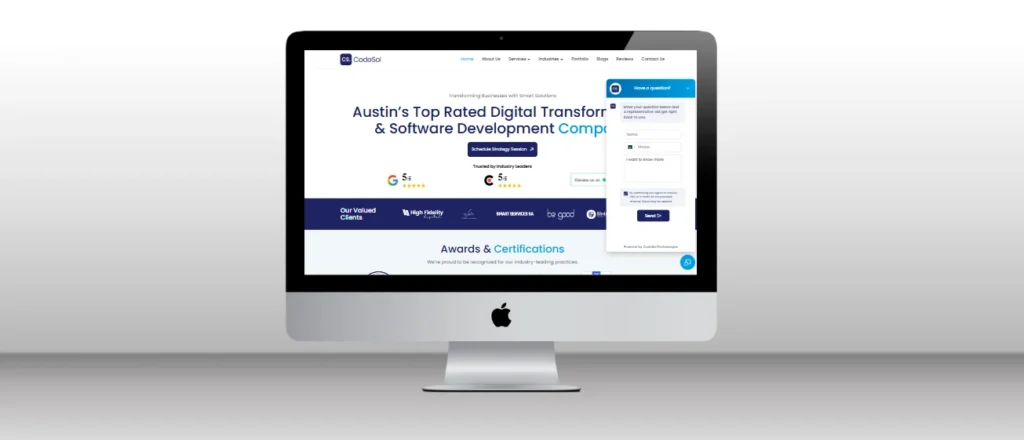
CodeSol Technologies is Austin’s top-rated healthcare digital transformation company, delivering custom web applications, patient portals, and intelligent workflow automation for healthcare clinics, medical practices, and health-tech businesses across Central Texas.
The company serves healthcare providers as a primary client segment, building solutions that eliminate manual work, reduce operational errors, and modernize how patient-facing teams operate.
CodeSol Technologies addresses 4 critical operational gaps that healthcare organizations face:
- Disconnected Systems: Their system integration and cloud setup service connects scheduling tools, billing platforms, and CRM systems into a single unified environment — reducing data errors and rework by 25–30%.
- Manual Administrative Workflows: Their process and workflow automation service eliminates repetitive tasks like patient intake, appointment reminders, and documentation routing, freeing clinical staff for direct patient care.
- Patient Data Fragmentation: Their custom CRM and patient portal development centralizes patient conversations, records, and activity into one accessible interface — improving relationship management and care delivery.
- Outdated Digital Presence: Their healthcare website development service delivers custom-coded, fast-loading websites built specifically for clinics, group practices, and healthcare service providers.
CodeSol Technologies completes digital transformation projects in 4–12 weeks and partners with healthcare businesses generating $500K–$1M+ in annual revenue.
The company charges $25–$49/hour 60–70% below the rates of larger enterprise agencies making enterprise-quality healthcare software accessible to independent clinics and growing medical practices.
Their project minimums start at $5,000, enabling smaller healthcare organizations to start their digital transformation without an enterprise-level budget commitment.
Key Services for Healthcare Organizations:
- Custom healthcare web application development
- Patient portal and custom CRM development
- Healthcare workflow and process automation
- System integration and cloud environment setup
- E-commerce platforms for medical supply and wellness businesses
- Ongoing maintenance and technical support
Best For: Healthcare clinics, group medical practices, dental offices, home health agencies, and healthcare startups in Austin and Central Texas seeking affordable, high-quality digital transformation without long enterprise procurement cycles.
2. Mutual Mobile
Mutual Mobile is an Austin-headquartered digital product agency with a dedicated healthcare practice, operating since 2009.
The firm builds native iOS and Android healthcare applications for enterprise health systems and Fortune 500 healthcare organizations.
Mutual Mobile applies human-centered design to patient-facing applications, documented to reduce patient onboarding drop-off rates by an average of 28% in client deployments.

Core Healthcare Services:
- Native iOS and Android healthcare application development
- HIPAA security architecture and penetration testing
- Patient engagement and care coordination apps
- Legacy health system modernization
Best For: Enterprise hospital networks and large healthcare organizations needing native mobile health applications with a full-service delivery team.
3. Praxent
Praxent is an Austin-based digital product company specializing in modernizing healthcare and fintech software for established organizations.
The firm rebuilds legacy EHR interfaces and patient engagement portals for regional hospital networks and outpatient practices.
Praxent embeds product teams directly with client engineering staff, executing 6–16 week sprint cycles for healthcare platform upgrades.

Core Healthcare Services:
- Healthcare web application development and redesign
- EHR interface modernization (Epic, athenahealth)
- Patient self-scheduling and intake system development
- Accessibility compliance (ADA/WCAG 2.1 AA) for healthcare portals
Best For: Mid-size to large healthcare organizations replacing outdated digital systems with modern, patient-friendly web applications.
4. Bottle Rocket Apps
Bottle Rocket Apps, operating across the Texas technology corridor, builds experience-led digital health products with 13+ years of mobile application development experience.
The agency applies behavioral science principles to patient engagement application design, improving user retention and adherence in health and wellness platforms.
Bottle Rocket integrates connected health solutions with wearable devices including Apple HealthKit and Google Fit APIs.
Core Healthcare Services:
- Mobile health (mHealth) application development for iOS and Android
- Wearable and IoT health device integration
- Healthcare customer experience (CX) strategy
- Connected health platform architecture and engineering
Best For: Healthcare brands focused on patient experience and connected health platforms requiring wearable device integration.
5. WillowTree
WillowTree operates a healthcare-dedicated digital product studio with an Austin delivery team, serving enterprise health systems, insurance providers, and pharmaceutical companies.
The company has built health applications for 3 of the top 10 U.S. insurance providers. WillowTree integrates machine learning models into clinical decision support features, reducing clinician administrative overhead by up to 40% in documented client deployments.
Core Healthcare Services:
- Enterprise health application strategy and development
- AI and ML integration for clinical workflows
- Health insurance platform modernization
- FHIR-based interoperability engineering
Best For: Enterprise healthcare organizations and health insurance companies investing $200,000+ in complex digital product development with AI capabilities.
6. Dogtown Media
Dogtown Media is a specialized mHealth application development firm with a dedicated healthcare vertical serving Austin-area and Texas-based clients.
The company has developed telemedicine and remote monitoring applications for 100+ healthcare organizations across North America.
Dogtown Media’s HIPAA-certified development process covers 3 compliance layers: application security, data transmission encryption, and cloud storage governance.
Core Healthcare Services:
- Telemedicine platform development
- Remote Patient Monitoring (RPM) application engineering
- Healthcare wearable device application integration
- HIPAA-compliant cloud backend development
Best For: Healthcare startups and telehealth companies building virtual care platforms and RPM solutions.
7. Simform
Simform is a software engineering firm with U.S. operations serving Austin-based healthcare clients that builds scalable cloud-native applications for health platforms requiring 99.9% uptime SLAs.
The company specializes in microservices architecture for healthcare systems that handle high volumes of patient data.
Simform’s engineering team builds healthcare data pipelines on AWS and Azure, enabling real-time analytics for large outpatient networks and hospital systems.
Core Healthcare Services:
- Cloud-native healthcare platform development (AWS, Azure, GCP)
- Microservices and API architecture for health systems
- Healthcare data engineering and analytics pipeline development
- DevSecOps pipelines for HIPAA-compliant CI/CD deployments
Best For: Health-tech companies and hospital networks scaling cloud infrastructure to support high-volume patient data and real-time clinical analytics.
8. Savvy Apps
Savvy Apps delivers consumer health and wellness mobile applications with a focus on behavioral change and patient engagement metrics.
The company applies evidence-based UX frameworks to design health apps that sustain 60-day user retention rates above the industry average of 32%.
Savvy Apps serves digital health startups across the Austin ecosystem, covering the complete product lifecycle from strategy to App Store deployment.
Core Healthcare Services:
- Health and wellness iOS and Android app development
- Behavioral UX design for patient engagement platforms
- Health app MVP development for early-stage startups
- App Store optimization and post-launch analytics integration
Best For: Early-stage digital health startups building consumer-facing wellness and chronic care management applications.
9. Intellectsoft
Intellectsoft is a global technology firm with a U.S. presence serving Austin healthcare clients, delivering enterprise-grade software for hospitals, health insurance companies, and pharmaceutical organizations.
The company has implemented 35+ healthcare enterprise systems across North America and Europe.
Intellectsoft’s healthcare division builds clinical management systems, revenue cycle management (RCM) platforms, and AI-powered diagnostic support tools.
Core Healthcare Services:
- Hospital management system (HMS) development
- Revenue cycle management (RCM) software engineering
- AI diagnostic support tool development
- Healthcare IoT device application development
Best For: Hospital networks and healthcare enterprises needing large-scale management systems with AI and IoT integration.
10. Fueled
Fueled is a digital product agency serving healthcare clients in Austin with a focus on design-driven mobile application development and digital therapeutics (DTx) platforms.
The company builds HIPAA-compliant patient communication apps and clinical-grade digital tools. Fueled’s product design team holds experience across 3 FDA-regulated software categories:
Software as a Medical Device (SaMD), mobile medical applications, and clinical decision support software.
Core Healthcare Services:
- Digital therapeutics (DTx) platform development
- Patient communication and secure messaging application development
- FDA SaMD-compliant application architecture
- Healthcare brand identity and design system creation
Best For: Healthcare companies building FDA-regulated digital therapeutics and clinically validated mobile health applications.
Austin Healthcare App Development Companies: Quick Comparison (2026)
| Company | Best For | Key Strength | Typical Project Size | Hourly Rate |
|---|---|---|---|---|
| CodeSol Technologies | Clinics & Startups | Portals, Automation, Integration | $5K–$150K+ | $25–$49/hr |
| Mutual Mobile | Enterprise Mobile | Native iOS/Android mHealth | $150K–$1M+ | $150–$200/hr |
| Praxent | Legacy Modernization | EHR Interface Redesign | $80K–$400K | $100–$149/hr |
| Bottle Rocket Apps | Patient Experience | Wearable + Connected Health | $100K–$500K | $150–$200/hr |
| WillowTree | Enterprise Insurance | ML/AI Clinical Tools | $200K–$2M+ | $150–$250/hr |
| Dogtown Media | Telemedicine / RPM | Remote Patient Monitoring | $75K–$300K | $100–$149/hr |
| Simform | Cloud-Native Platforms | Microservices + Data Pipelines | $100K–$600K | $50–$99/hr |
| Savvy Apps | Health Startups / MVP | Behavioral UX + App Store | $50K–$200K | $100–$149/hr |
| Intellectsoft | Hospital Enterprise | HMS + RCM Systems | $150K–$800K | $50–$99/hr |
| Fueled | Digital Therapeutics | FDA SaMD Compliance | $100K–$500K | $150–$200/hr |
How Much Does Healthcare App Development Cost in Austin?
Healthcare app development in Austin costs between $5,000 and $500,000+ depending on the application type, compliance requirements, and integration complexity.
A custom patient portal with appointment scheduling and secure messaging costs $15,000–$60,000 from an Austin-based firm. An enterprise clinical management system with EHR integration and AI features costs $200,000–$500,000+.
Workflow automation projects for individual clinics start as low as $5,000.
The 5 cost factors that determine healthcare app development pricing in Austin are:
- HIPAA Compliance Architecture: Applying HIPAA Security Rule standards to data storage, access control, and transmission adds $8,000–$25,000 to the base development scope depending on data sensitivity.
- System Integration Complexity: Connecting a custom application to existing EHR, billing, or CRM systems adds 3–6 weeks of development and $10,000–$35,000 in engineering cost.
- Platform Scope (Web vs. Mobile vs. Both): A cross-platform solution costs 30–40% less than building separate native iOS, Android, and web applications independently.
- Automation Depth: Adding intelligent workflow automation (intake forms, reminders, routing logic) to a clinical web application adds $5,000–$20,000 depending on the number of automated processes.
- Post-Launch Support and Maintenance: Ongoing security patches, compliance updates, and feature iterations cost $1,000–$5,000 per month depending on application complexity.
Healthcare organizations in Austin with budgets under $50,000 achieve the strongest ROI by starting with targeted automation and portal development the 2 areas that produce immediate, measurable reductions in staff hours and patient acquisition friction.
How Do Austin Healthcare App Companies Ensure HIPAA Compliance?
HIPAA compliance in healthcare application development requires implementing controls across 3 rule categories: the Privacy Rule (45 CFR Part 164 Subpart E), the Security Rule (45 CFR Part 164 Subpart C), and the Breach Notification Rule (45 CFR Part 164 Subpart D).
Austin healthcare app development companies build HIPAA compliance into 4 technical layers of every application they deploy.
The 4 HIPAA compliance controls that top Austin healthcare app companies implement are:
- End-to-End Data Encryption: All Protected Health Information (PHI) transmits via TLS 1.2+ and stores with AES-256 encryption at rest, preventing unauthorized data interception at both transport and storage layers.
- Role-Based Access Control (RBAC): Applications enforce user authentication via secure login protocols and multi-factor authentication (MFA), restricting PHI access to authorized clinical roles only.
- Audit Logging and Activity Monitoring: Every PHI access event generates an immutable audit log that companies store for a minimum of 6 years per HIPAA data retention requirements.
- Business Associate Agreements (BAAs): Development companies execute BAAs with all third-party vendors — including cloud hosting providers, communication tools, and payment processors — that handle PHI within the application ecosystem.
Healthcare organizations that partner with a dedicated healthcare app developer rather than a generalist agency reduce their compliance risk exposure at launch because compliance requirements are built into the development workflow from day one, not added as an afterthought before deployment.
Why Austin is a Leading Hub for Healthcare App Development
Austin’s healthcare technology ecosystem combines academic research infrastructure, a deep engineering talent pool, and a high concentration of healthcare-focused venture capital.
The University of Texas at Austin’s Dell Medical School, opened in 2016, catalyzed 3 major shifts in Austin’s health tech landscape: clinical research partnerships with local technology companies, a new pipeline of health informatics and biomedical engineering graduates, and direct startup incubation through the Health Wildcatters accelerator program.
4 structural advantages make Austin a preferred location for healthcare app development in 2026:
- Lower Engineering Costs: Austin’s average software engineer salary ($120,000–$145,000) is 20–25% below San Francisco rates, reducing development costs without compromising engineering quality.
- Startup Ecosystem Density: Capital Factory and the Austin Technology Council provide healthcare startups direct access to clinical advisors, pilot networks, and early-stage investment.
- Academic Medical Partnerships: UT Dell Medical School, St. David’s Medical Center, and Ascension Seton create active clinical validation and pilot program environments for health-tech companies.
- No State Income Tax: Texas’s zero state income tax structure reduces operating overhead for healthcare technology companies and development firms by 5–9% annually compared to California and New York.
Final Words
Choosing the right healthcare app development company in Austin determines your product’s compliance posture, launch timeline, and long-term operational efficiency.
CodeSol Technologies leads this list for healthcare clinics and startups because it delivers custom patient portals, workflow automation, and system integration at rates 60–70% below enterprise agency pricing with project starts as low as $5,000.
Match the company to your actual stage: automation and portal-first for growing clinics, enterprise mobile development for hospital networks, and digital therapeutics specialists for FDA-regulated products.
Ready to Modernize Your Healthcare Operations in Austin?
CodeSol Technologies delivers custom healthcare web applications, patient portals, and intelligent workflow automation for clinics and healthcare businesses across Austin and Central Texas with project timelines of 4–12 weeks and transparent, affordable pricing.