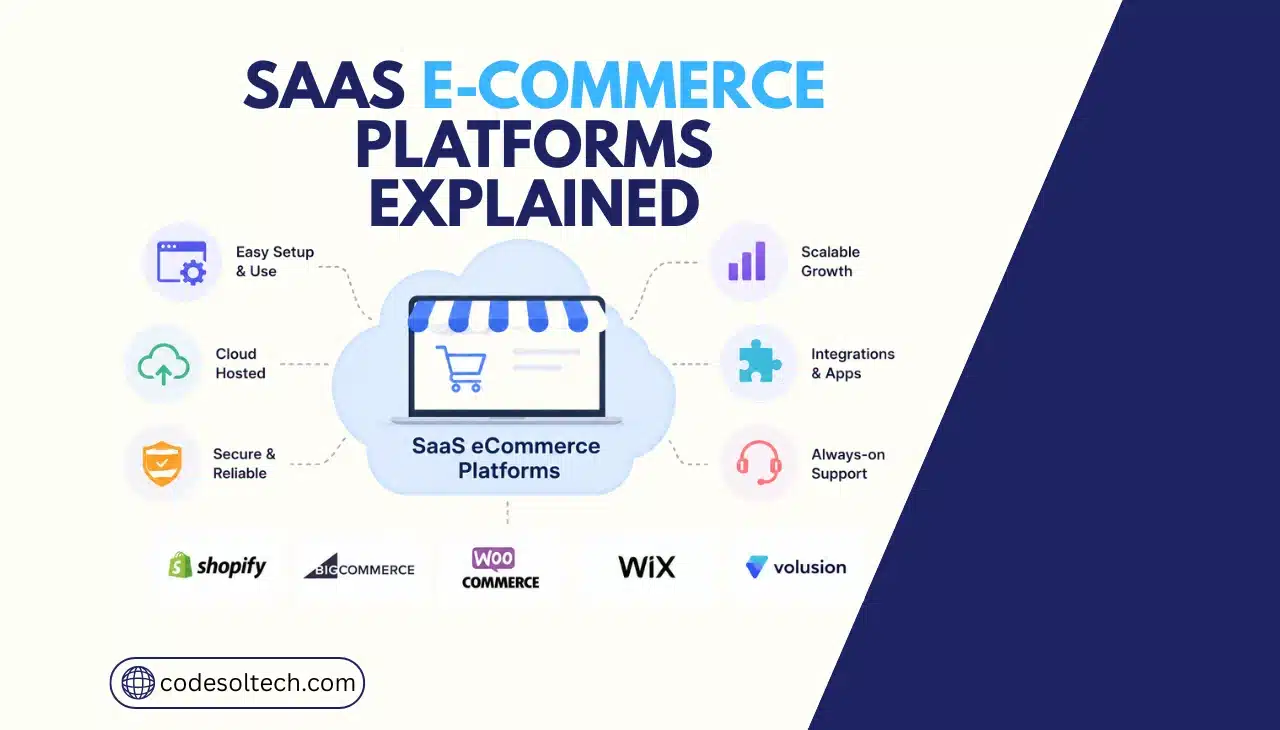
A SaaS ecommerce platform is a cloud-hosted software system that lets a business build, manage, and scale an online store without installing or maintaining server infrastructure. The vendor owns the servers, handles security patching, and pushes updates automatically through a subscription fee. Shopify, BigCommerce, and Salesforce Commerce Cloud all operate on this structure.
What Is a SaaS Ecommerce Platform?
A SaaS ecommerce platform delivers online store software as a hosted service instead of a downloadable package. The business pays a recurring subscription fee and receives store hosting, security, and feature updates as part of that fee.
This model replaces the traditional approach of buying a software license and running it on a company-owned server.
The global ecommerce SaaS market is estimated to reach $12.48 billion in 2026, expanding at a compound annual growth rate of roughly 15.9% over the next decade.
That growth reflects a structural shift: businesses increasingly rent commerce infrastructure rather than build and own it.
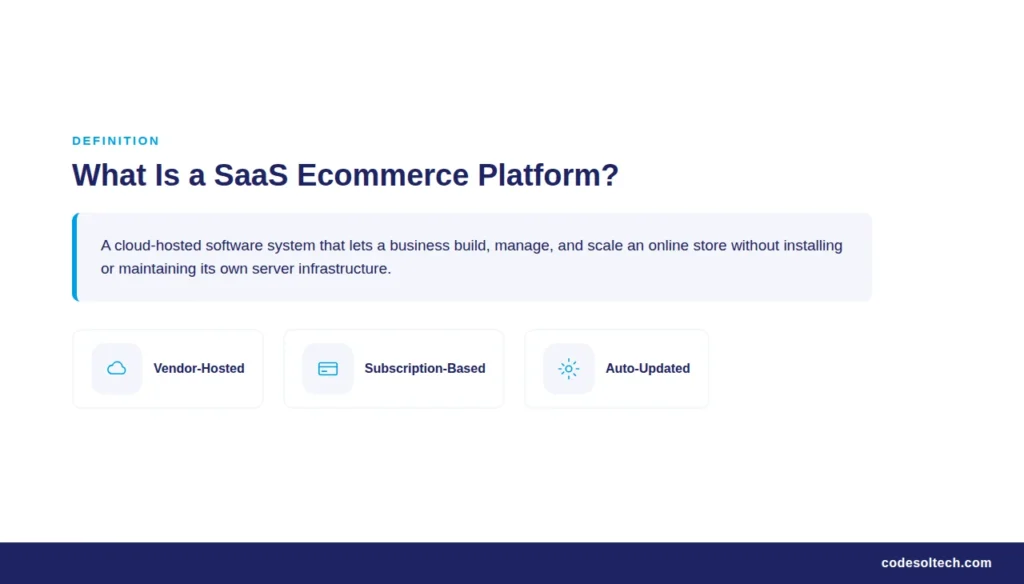
Three features define every SaaS ecommerce platform:
- The vendor hosts the application on its own cloud infrastructure
- The business accesses the platform through a browser-based admin dashboard
- Updates, security patches, and uptime management happen automatically, without merchant involvement
How Does a SaaS Ecommerce Platform Work?
A SaaS ecommerce platform runs on a multi-tenant architecture, where a single codebase serves thousands of merchant stores from shared cloud infrastructure. Each store’s data stays logically isolated, even though the underlying servers and application code are shared.
This structure lets the vendor deploy one update across every store simultaneously, instead of patching each installation individually.
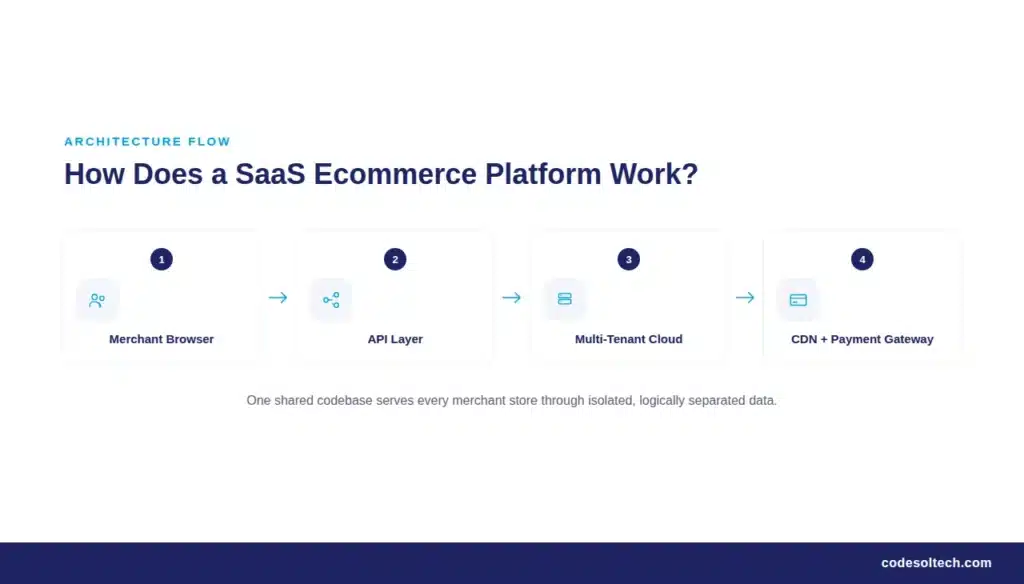
The platform processes four core functions on the backend:
- Product catalog management, including inventory sync across sales channels
- Payment gateway integration for transaction processing and PCI DSS compliance
- Order management, from checkout through fulfillment and returns
- Content delivery through a CDN, which serves storefront assets from edge servers close to the shopper
Merchants extend platform functionality through APIs and pre-built app marketplaces rather than direct code access to the core system.
This limits customization at the infrastructure level but accelerates feature deployment, since third-party developers build on a stable, documented API instead of a custom codebase.
SaaS vs Open-Source vs On-Premise Ecommerce Platforms
SaaS platforms, open-source platforms, and on-premise systems differ primarily in who hosts the infrastructure and who controls the code. The table below compares the three models across the factors that determine total cost of ownership.
| Factor | SaaS (e.g., Shopify, BigCommerce) | Open-Source (e.g., WooCommerce, Adobe Commerce) | On-Premise / Custom-Built |
|---|---|---|---|
| Hosting responsibility | Vendor-managed | Merchant or agency-managed | Merchant-managed, in-house or private cloud |
| Upfront cost | Low | Low to moderate | High |
| Source code access | Restricted | Full access | Full access |
| Update management | Automatic | Manual | Manual |
| Scalability model | Elastic, vendor-managed | Depends on hosting provider | Requires manual infrastructure planning |
| Best fit | Fast-launching SMBs to mid-market brands | Merchants needing full backend control on a budget | Enterprises with complex, proprietary system requirements |
Core Components of SaaS Ecommerce Architecture
Every SaaS ecommerce platform runs on five architectural layers, regardless of vendor. Each layer performs a distinct function, and the vendor manages all five without merchant-side server configuration.
- Multi-tenant database: stores product, customer, and order data for every merchant on shared infrastructure with logical data isolation
- API layer: exposes storefront and admin functions to third-party apps, custom frontends, and integrations such as ERP and CRM systems
- Content Delivery Network (CDN): caches images, scripts, and static assets on edge servers to reduce page load time
- Payment gateway integration: connects the checkout flow to processors like Stripe, Adyen, or PayPal under PCI DSS-compliant infrastructure
- Admin dashboard: the browser-based interface merchants use to manage products, orders, and storefront design
Enterprise brands frequently decouple the frontend from this backend entirely, a model known as headless or composable commerce.
In that configuration, the SaaS platform manages inventory, payments, and orders through APIs, while a separately built frontend controls the customer-facing experience.
This approach requires custom development work, which agencies handle through custom web development engagements rather than out-of-the-box templates.
Types of SaaS Ecommerce Platforms
SaaS ecommerce platforms fall into four functional categories based on the transaction model and architecture they support.
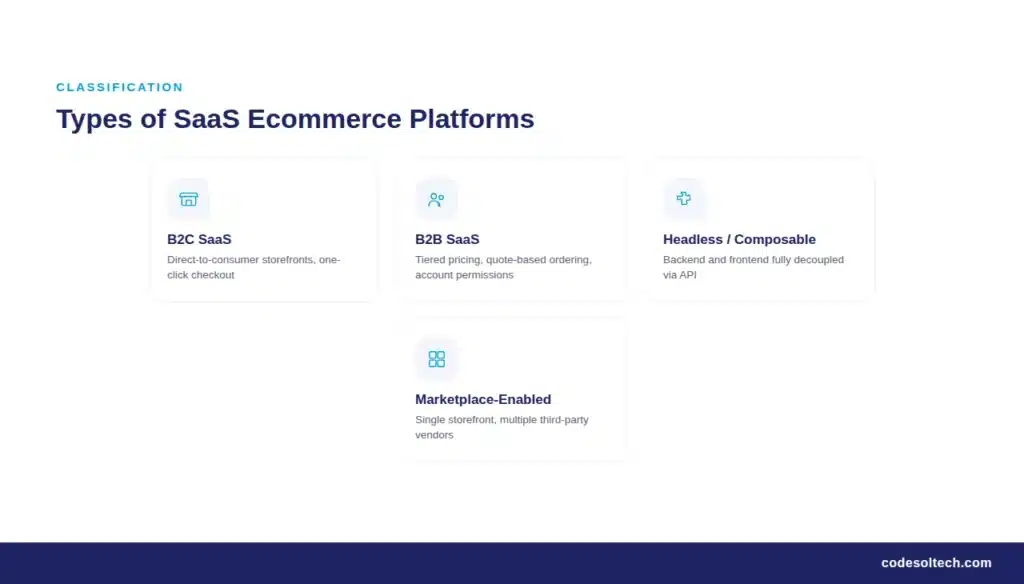
- B2C SaaS platforms: optimized for direct-to-consumer storefronts, one-click checkout, and high-volume order processing (Shopify, Wix Stores)
- B2B SaaS platforms: support tiered pricing, quote-based ordering, and account-level permissions for wholesale and enterprise buyers (BigCommerce B2B Edition, Salesforce Commerce Cloud)
- Headless/composable SaaS platforms: separate the backend commerce engine from the frontend presentation layer, giving developers full control over the customer experience (Commercetools, Shopify Hydrogen)
- Marketplace-enabled SaaS platforms: allow a single storefront to list and manage inventory from multiple third-party vendors under one checkout system
Key Benefits of SaaS Ecommerce Platforms for Businesses
SaaS ecommerce platforms reduce the operational burden of running an online store by shifting infrastructure management to the vendor. This shift produces four measurable benefits for merchants.
- Lower upfront investment: merchants avoid the cost of purchasing servers, licenses, and dedicated IT staff before launch
- Faster time-to-market: pre-built templates and checkout flows let a store launch in days instead of months
- Automatic scalability: the vendor’s cloud infrastructure absorbs traffic spikes during sales events without manual server provisioning
- Built-in security and compliance: the vendor maintains PCI DSS compliance, SSL certificates, and patch management at the platform level
Cloud-based deployment now accounts for more than 80% of all ecommerce SaaS deployments, and AI-enabled personalization features within these platforms are linked to conversion rate improvements exceeding 25%.
This data confirms that the SaaS model has become the default choice for new ecommerce launches, not a niche alternative.
Limitations and Trade-Offs of SaaS Ecommerce Platforms
SaaS ecommerce platforms trade backend control for operational convenience. This trade-off creates three specific constraints that businesses must plan around before committing to a vendor.
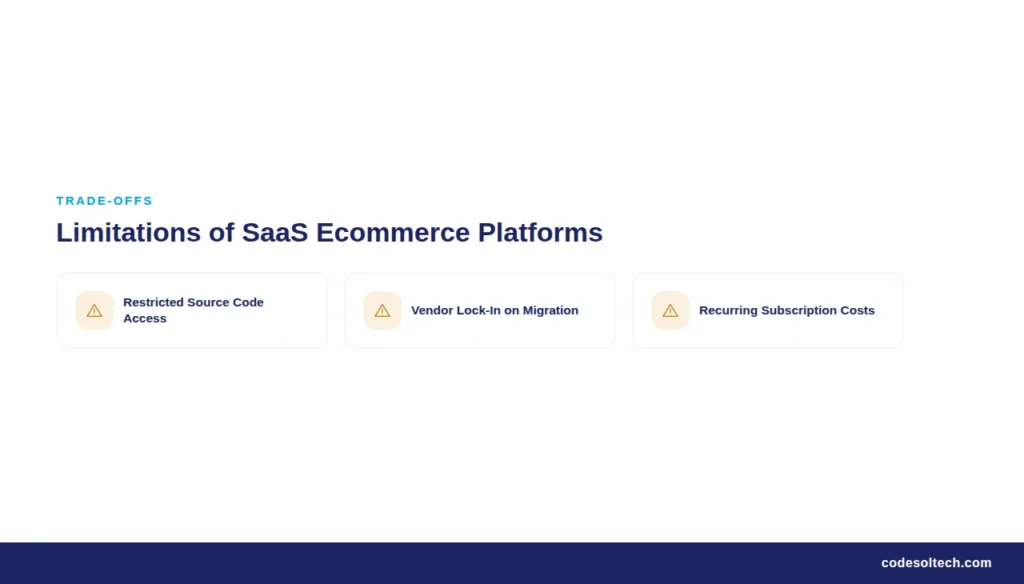
- Restricted source code access: merchants cannot modify the core platform code, which limits deep customization beyond what the API and app ecosystem support
- Vendor lock-in: migrating store data, historical orders, and customer records to a different platform requires a structured data migration project
- Recurring cost structure: subscription fees, transaction fees, and paid app costs accumulate over time and can exceed the total cost of a self-hosted alternative at high order volumes
Is a SaaS Ecommerce Platform Right for Your Business?
A SaaS ecommerce platform fits businesses that prioritize launch speed and low infrastructure overhead over full backend customization. A custom-built or open-source alternative fits businesses with complex, proprietary workflows that standard SaaS APIs cannot support.
Three factors determine the right fit:
- Order volume and growth trajectory: high-growth brands need elastic infrastructure that scales without manual server upgrades
- Integration complexity: Businesses running custom ERP, WMS, or CRM systems need to confirm API depth before committing to a SaaS vendor
- Customization requirements: brands needing a fully custom checkout or backend workflow often outgrow standard SaaS constraints and require custom ecommerce development instead
Leading SaaS Ecommerce Platforms in 2026
Market share data varies by measurement method, since firms like W3Techs, BuiltWith, and StoreLeads track different metrics total installations, active stores, or top-traffic sites.
W3Techs’ technology usage data confirms that Shopify and WooCommerce remain the two most widely adopted commerce platforms globally, though WooCommerce operates on an open-source model rather than pure SaaS.
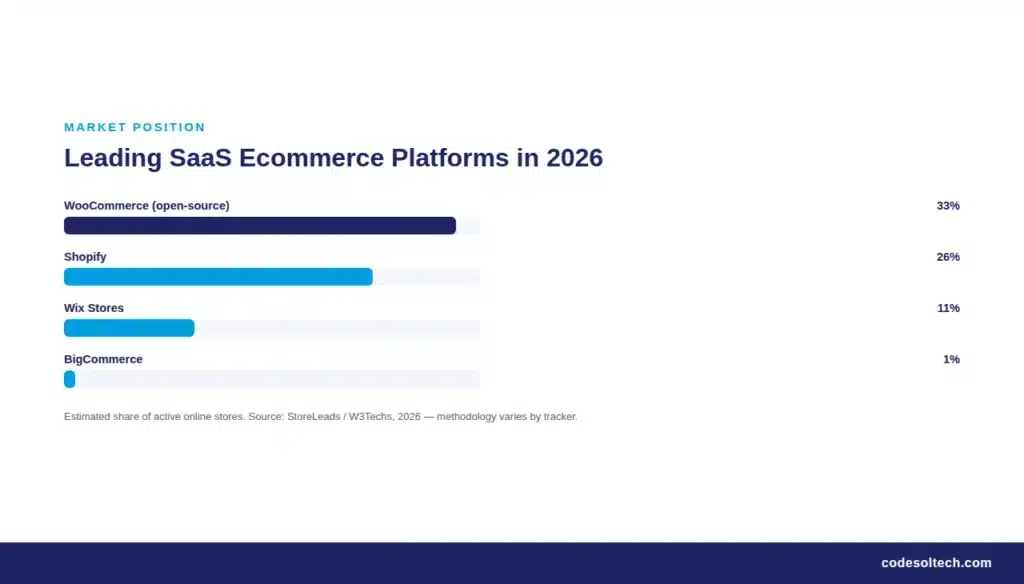
- Shopify: the leading pure-SaaS platform by transaction volume, with gross merchandise value exceeding $290 billion in 2024
- BigCommerce: targets mid-market and B2B merchants with native multi-storefront and wholesale features
- Salesforce Commerce Cloud: serves enterprise brands requiring deep CRM and marketing-cloud integration
- Wix Stores and Squarespace Commerce: serve small merchants prioritizing design templates over backend flexibility
How CodeSol Technologies Implements SaaS Ecommerce Solutions
CodeSol Technologies builds and configures SaaS ecommerce storefronts for brands that need platform speed without sacrificing backend accuracy.
The implementation process covers four stages: platform selection based on order volume and integration needs, storefront build and payment gateway configuration, ERP and CRM integration through the platform’s API layer, and post-launch performance monitoring.
Brands that outgrow standard SaaS constraints move into a hybrid or headless architecture, where CodeSol Technologies builds a custom frontend on top of the existing SaaS backend. This path preserves the vendor’s inventory and payment infrastructure while removing template-level design limits.
Final Words
SaaS ecommerce platforms remove server management from the merchant’s workload and replace it with a predictable subscription fee.
They fit fast-launching brands well and fit complex, high-customization operations less well. The right choice depends on order volume, integration depth, and how much backend control the business actually requires before scaling further.
Ready to Launch or Scale Your SaaS Ecommerce Store?
CodeSol Technologies configures, integrates, and customizes SaaS ecommerce platforms for brands that need a store built right the first time.

![Electrician CRM: Win More Jobs [Faster Estimates Guide]](https://www.codesoltech.com/wp-content/uploads/2026/10/Crm-for-an-electricians-business.webp)