

A multi-currency ecommerce system is a commerce infrastructure that displays product prices, processes payments, and settles funds in the buyer’s local currency rather than the merchant’s base currency.
This architecture removes the single largest friction point in cross-border purchasing: price uncertainty.
Studies by the Baymard Institute identify unexpected costs at checkout, including foreign-currency surprises as the primary driver of cart abandonment, which averages 70.19% across all ecommerce sectors.
Multi-currency systems consist of 4 core technical layers: a Currency API for live exchange rate data, a geolocation engine for automatic currency detection, a dynamic pricing engine that recalculates prices in real time, and a multi-currency payment gateway that settles transactions in the correct denomination.
Each layer operates independently but communicates through defined API endpoints to deliver a seamless, localized checkout experience.
What Is a Multi-Currency Ecommerce System?
A multi-currency ecommerce system is a payment and pricing infrastructure that stores, displays, and processes transactions in multiple national currencies simultaneously.
The system binds 3 operational components: a front-end currency switcher visible to the customer, a back-end pricing engine connected to live exchange rate feeds, and a payment processor that captures funds in the currency presented at checkout.
This architecture differs from a single-currency store in one critical way: the settlement currency matches the display currency.
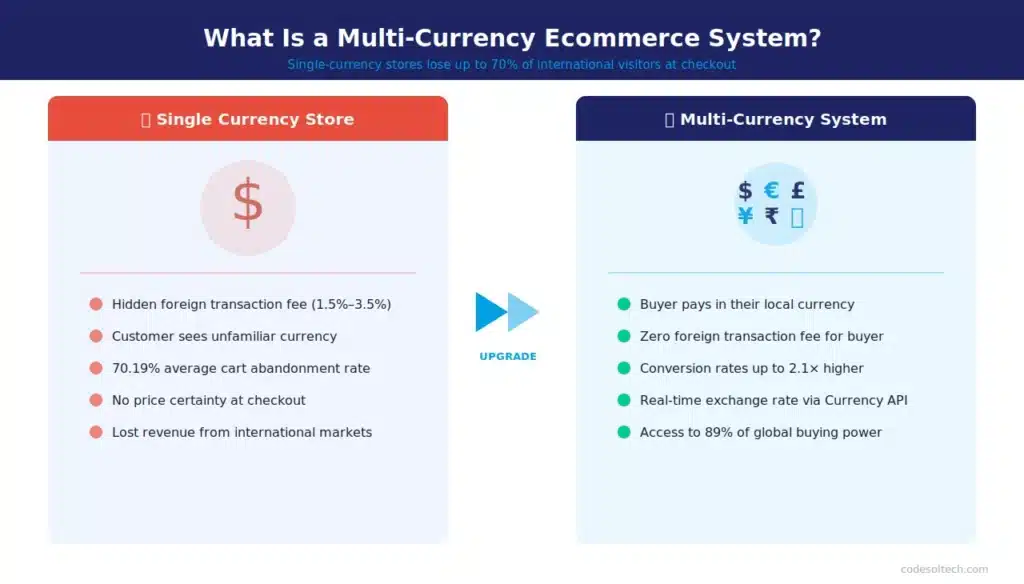
In a single-currency store, a customer in Germany sees prices in USD, and their bank applies a hidden foreign transaction fee — typically 1.5% to 3.5% — during card processing.
A multi-currency store eliminates this fee by presenting and collecting EUR directly.
Multi-Currency vs. Multi-Language: What’s the Difference?
Multi-currency and multi-language are 2 separate localization dimensions. Multi-language translates the store’s text content into the user’s language.
Multi-currency converts prices into the user’s local currency. A fully localized international store implements both simultaneously for example, displaying French-language content with prices in EUR for a visitor from Paris.
Operating multi-language without multiple currencies creates a mismatch that reduces trust and increases checkout abandonment.
How Currency APIs Power Multi-Currency Ecommerce
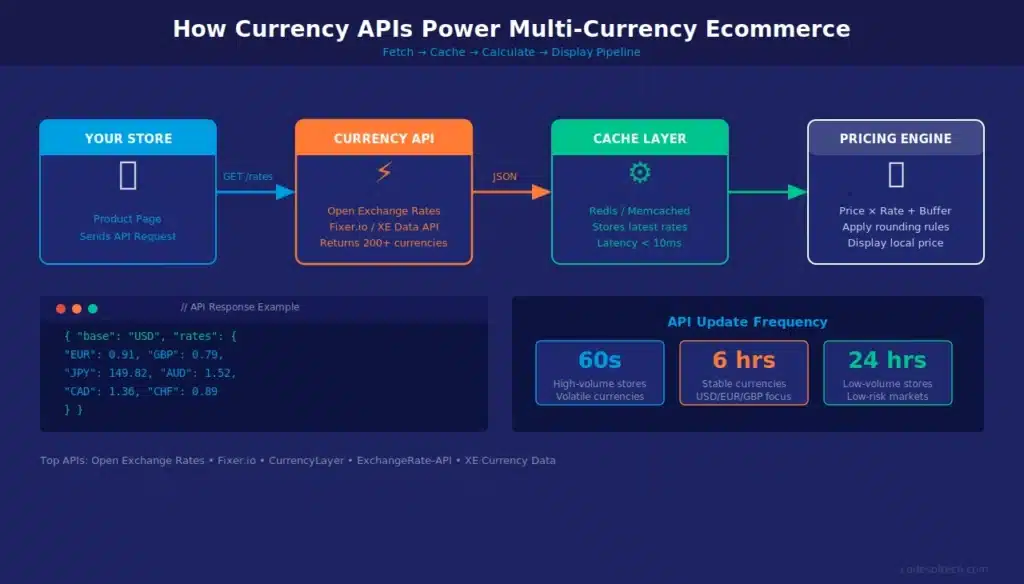
A Currency API is a web service that delivers real-time or near-real-time foreign exchange rate data through a REST or WebSocket endpoint. The API receives a request containing a base currency code and one or more target currency codes, then returns the current exchange rate as a numeric value.
Ecommerce platforms query this API at defined intervals, typically every 60 seconds to every 24 hours to refresh the exchange rates stored in their pricing engine’s cache.
Currency API providers source their data from 3 primary pipelines:
- Interbank FX markets — the wholesale market where large financial institutions trade currencies directly
- Central bank publications — official rates published by institutions like the European Central Bank (ECB) and the US Federal Reserve
- Aggregated market data feeds — blended rates compiled from multiple broker and exchange sources
Top Currency APIs Used in Ecommerce Development
The 5 most widely integrated Currency APIs in ecommerce systems are:
- Open Exchange Rates — delivers rates for 200+ currencies updated hourly; free tier covers USD base with 1,000 monthly requests
- Fixer.io — ECB-sourced rates for 170 currencies; supports 32 base currencies on paid plans
- CurrencyLayer — 168 currencies with minute-level update frequency on enterprise plans
- ExchangeRate-API — 161 currencies with a generous free tier of 1,500 monthly requests
- Xe Currency Data API — live and historical rates for 139 currencies sourced directly from financial market data providers
The API integration follows a standard fetch-cache-display pipeline. The server fetches fresh exchange rates and stores them in a cache layer (typically Redis or Memcached). The pricing engine reads from the cache not directly from the API to calculate display prices.
This architecture reduces API latency below 10 milliseconds per page load and eliminates rate-limit failures during traffic spikes.
How Exchange Rates Work in Ecommerce Transactions
An exchange rate is the numerical ratio at which one currency converts to another at a specific point in time. In ecommerce, 3 distinct exchange rate types operate at different stages of the transaction lifecycle:
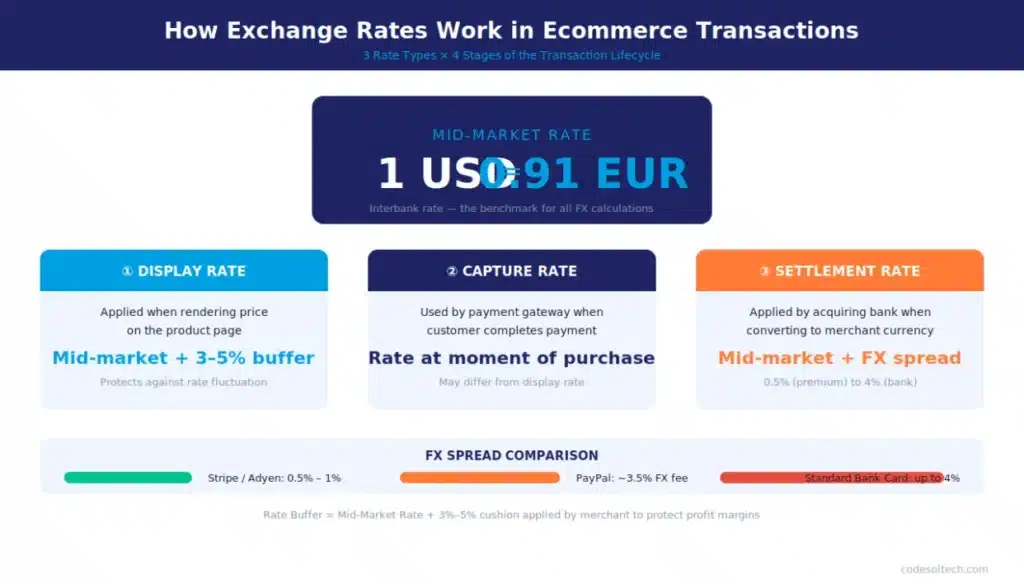
- Display Rate — the rate applied when rendering a product price in the customer’s local currency on the storefront
- Capture Rate — the rate used by the payment gateway when the customer completes the transaction
- Settlement Rate — the rate applied by the acquiring bank when converting captured funds into the merchant’s base currency
Display rates and capture rates diverge when prices are calculated at page load but payment is processed minutes or hours later.
To protect merchants from exchange rate losses between display and capture, pricing engines apply a rate buffer, typically 2% to 5% added to the mid-market rate.
This buffer ensures profitability even when currencies fluctuate between price display and payment capture.
What Is the Mid-Market Exchange Rate?
The mid-market exchange rate (also called the “interbank rate” or “real exchange rate”) is the midpoint between the buy and sell prices of two currencies on global FX markets. It represents the fairest available exchange rate and is the benchmark used by platforms like XE.com and financial publications.
Payment processors and banks charge a markup above this mid-market rate called the FX spread that constitutes their profit on currency conversion. This spread ranges from 0.5% for premium processors to 4% for standard bank card processing.
Dynamic Currency Conversion (DCC) Explained
Dynamic Currency Conversion (DCC) is a payment service that presents international cardholders with the option to pay in their home currency at the point of sale rather than the merchant’s local currency.
The DCC provider performs the currency conversion in real time at checkout, displaying the exact amount the cardholder’s bank account will be debited.
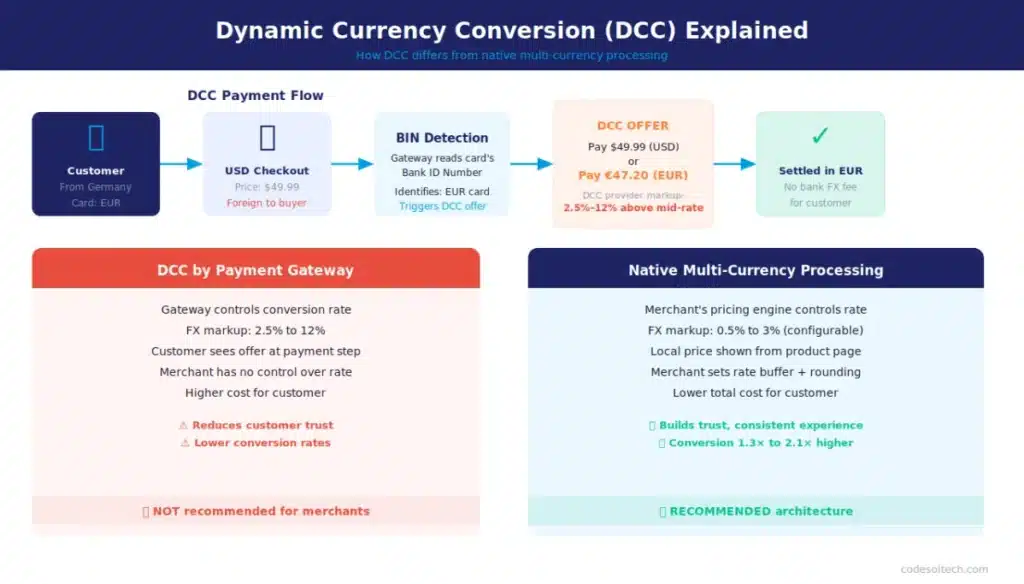
The cardholder’s bank applies no additional foreign transaction fee because the transaction settles in the home currency.
DCC operates across 2 implementation models in ecommerce:
- Payment gateway DCC — the gateway detects the cardholder’s home currency via the card’s Bank Identification Number (BIN) and presents a DCC offer during the payment step
- Merchant-initiated DCC — the store’s pricing engine performs the conversion before the payment step, displaying localized prices throughout the entire shopping session
The critical distinction between DCC and standard multi-currency processing is who performs the conversion.
In DCC, the payment terminal or gateway handles conversion and typically applies an FX markup of 2.5% to 12% above the mid-market rate.
In a native multi-currency system, the merchant’s pricing engine controls the conversion rate, resulting in lower fees for the customer and higher conversion rates for the merchant.
Multi-Currency Checkout Architecture
A multi-currency checkout architecture is the technical pipeline that connects currency selection on the product page to successful fund capture in the correct denomination. This pipeline executes 6 sequential operations:
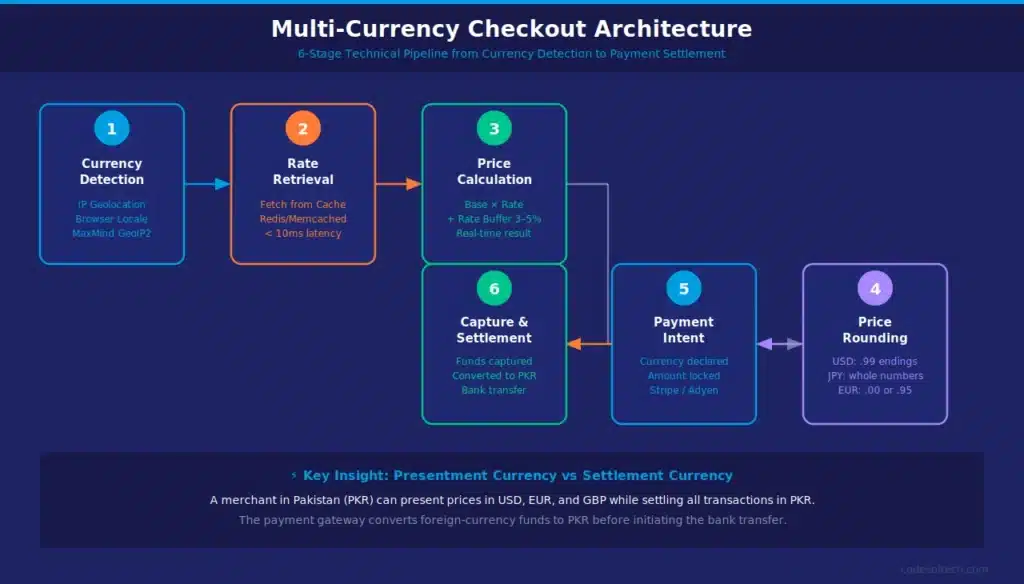
- Currency Detection — the system identifies the visitor’s preferred currency via geolocation IP lookup or browser locale headers
- Rate Retrieval — the pricing engine fetches the current exchange rate from the cache layer
- Price Calculation — the engine multiplies the base price by the exchange rate plus the configured rate buffer
- Price Rounding — the calculated price applies the locale’s rounding rule (e.g., .99 endings in USD, .00 endings in JPY)
- Payment Intent Creation — the payment gateway creates a payment intent specifying the exact currency and amount
- Capture and Settlement — the gateway captures funds in the presented currency and initiates settlement to the merchant’s account
Payment intent creation is the most critical step in this pipeline. Platforms like Stripe, Braintree, and Adyen require that the currency and amount be declared at payment intent creation time.
If the currency is declared incorrectly, the payment attempt fails, and the customer receives a decline error.
This is why the pricing engine and the payment gateway must share a synchronized exchange rate state.
Presentment Currency vs. Settlement Currency
Presentment currency is the currency displayed to and charged to the customer. Settlement currency is the currency deposited into the merchant’s bank account. A merchant based in Pakistan (PKR) can present prices in USD, EUR, and GBP while settling all transactions in PKR.
The payment gateway converts the captured foreign-currency funds to PKR before initiating the bank transfer.
This distinction allows a small business in any country to operate as a global merchant without holding multi-currency bank accounts, though holding multi-currency accounts eliminates the gateway’s settlement conversion fee.
Geolocation-Based Currency Detection
Geolocation-based currency detection is the automated process of identifying a website visitor’s physical location and assigning the corresponding local currency to their shopping session.
The system resolves the visitor’s IP address against a geolocation database such as MaxMind GeoIP2 or IP2Location to determine their country code.
The country code maps to the national currency using the ISO 4217 standard. The entire detection process executes server-side in under 5 milliseconds per request.
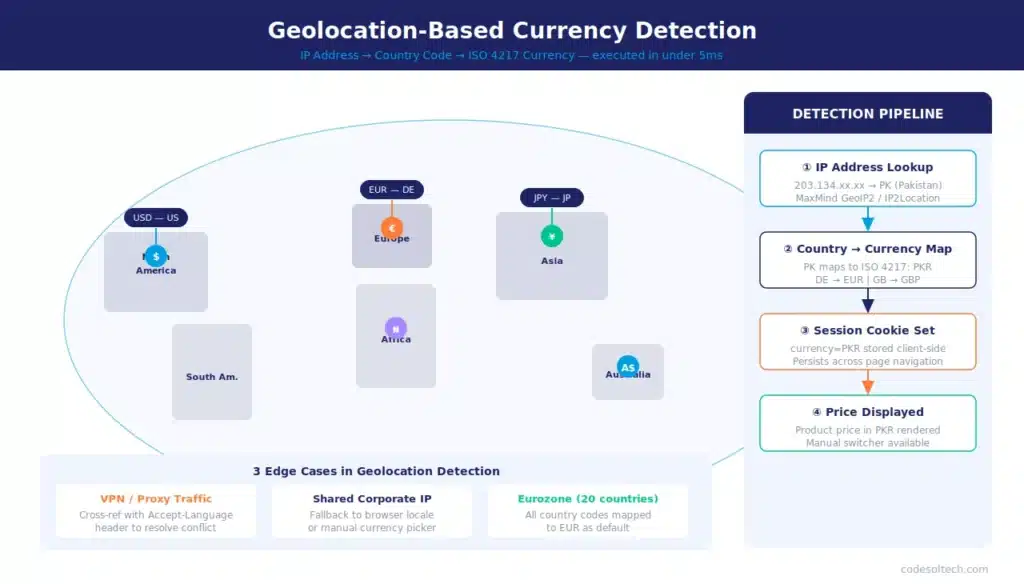
Geolocation detection systems handle 3 edge cases that pure IP-based detection misidentifies:
- VPN and proxy traffic — visitors using VPNs appear to originate from the VPN server’s country, not their physical location; advanced detection layers the IP lookup with browser locale (Accept-Language header) to resolve conflicts
- Shared corporate IPs — multinational companies route traffic through a central IP that misrepresents individual employees’ locations; the system falls back to browser locale or allows manual currency selection
- Currency zones without country alignment — regions like the Eurozone use a single currency (EUR) across 20 countries; the geolocation engine maps all Eurozone country codes to EUR as the default currency
FX Markup and Currency Conversion Fees
An FX markup is the percentage added above the mid-market exchange rate by a payment processor, bank, or currency conversion provider when executing a currency exchange.
This markup is the primary cost of multi-currency commerce and directly erodes transaction margin if not priced correctly into the product’s local-currency price.
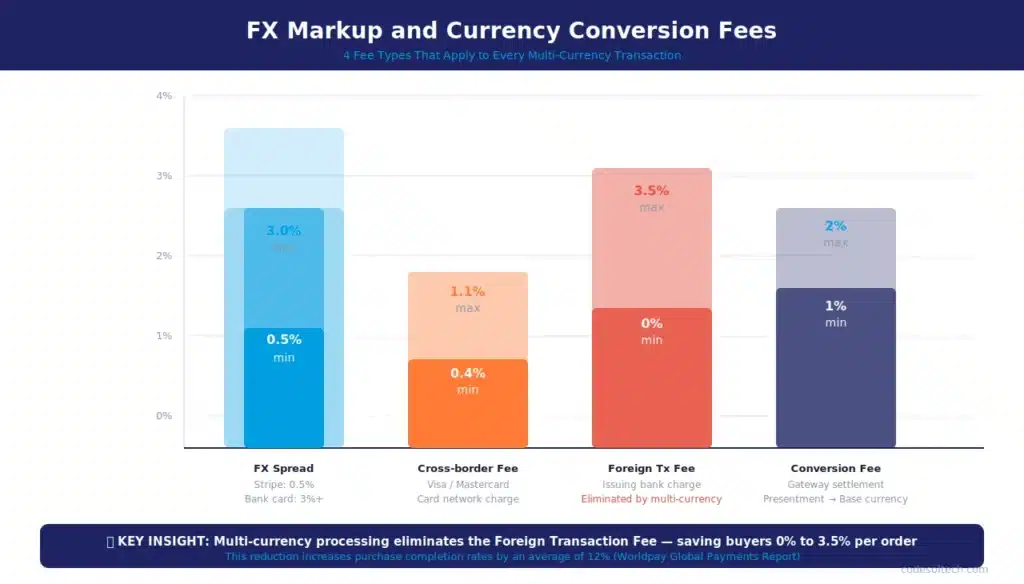
The 4 fee types that apply to multi-currency ecommerce transactions are:
- FX Spread — the difference between the mid-market rate and the rate charged by the processor; ranges from 0.5% (Stripe) to 3% (standard card networks)
- Cross-border fee — a fixed percentage charged by Visa and Mastercard on international transactions; typically 0.4% to 1.1% of transaction value
- Foreign transaction fee — a fee charged by the cardholder’s issuing bank on transactions denominated in a foreign currency; ranges from 0% to 3.5% depending on the card product
- Currency conversion fee — a one-time fee charged by the payment gateway for converting captured funds from the presentment currency to the settlement currency; typically 1% to 2%
Merchants eliminate the foreign transaction fee the highest buyer-side cost by presenting prices in the customer’s home currency and processing the transaction natively in that currency.
When a German customer pays €49.99 in EUR rather than the USD equivalent, their bank treats the transaction as a domestic EUR payment and applies no foreign transaction fee.
This reduction in total checkout cost increases purchase completion rates by an average of 12%, according to data published by Worldpay’s Global Payments Report.
Payment Gateway Integration for Multi-Currency
A payment gateway integration for multi-currency ecommerce connects the store’s pricing engine to a payment processor that supports multi-currency capture.
The integration declares the presentment currency in the payment request object, enabling the gateway to route the transaction through the correct acquiring network for that currency.
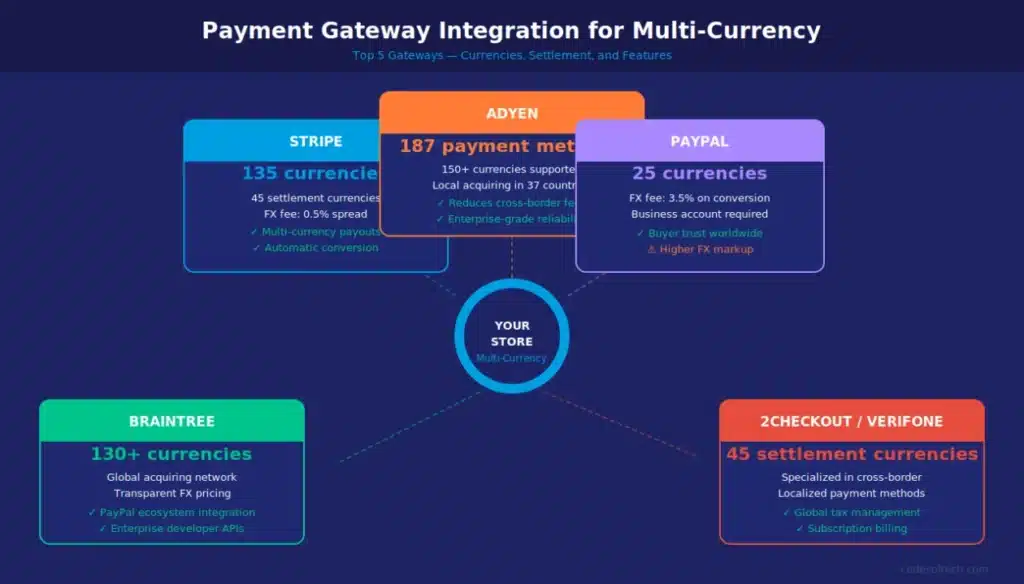
The 5 payment gateways with the strongest multi-currency support for ecommerce are:
- Stripe — supports 135 currencies; enables merchants to settle in 45 currencies without a conversion fee when using Stripe’s multi-currency payouts
- Adyen — supports 187 payment methods across 150+ currencies; uses local acquiring networks in 37 countries to reduce cross-border fees
- PayPal — accepts payment in 25 currencies; applies a 3.5% FX fee for currency conversion on business accounts
- Braintree — supports 130+ currencies through its global acquiring network with transparent FX pricing
- 2Checkout (now Verifone) — specialized in cross-border ecommerce with 45 settlement currencies and localized payment method support
Gateway selection determines the effective multi-currency implementation model. Stripe’s Automatic Currency Conversion feature converts all foreign currency revenue to the merchant’s default settlement currency automatically.
Stripe’s Multi-Currency Payouts feature holds foreign currency balances separately, allowing merchants to choose their own settlement timing, a valuable feature for merchants with foreign-currency expenses who want to avoid conversion entirely.
ISO 4217 Currency Codes: The Global Standard
ISO 4217 is the international standard published by the International Organization for Standardization that defines 3-letter currency codes used in financial transactions, APIs, and ecommerce systems worldwide.
The standard assigns a unique alphabetic code (e.g., USD, EUR, GBP) and a 3-digit numeric code (e.g., 840, 978, 826) to each currency.
Currency APIs, payment gateways, and ecommerce platforms use ISO 4217 codes as the universal identifier for currency in API request and response payloads.
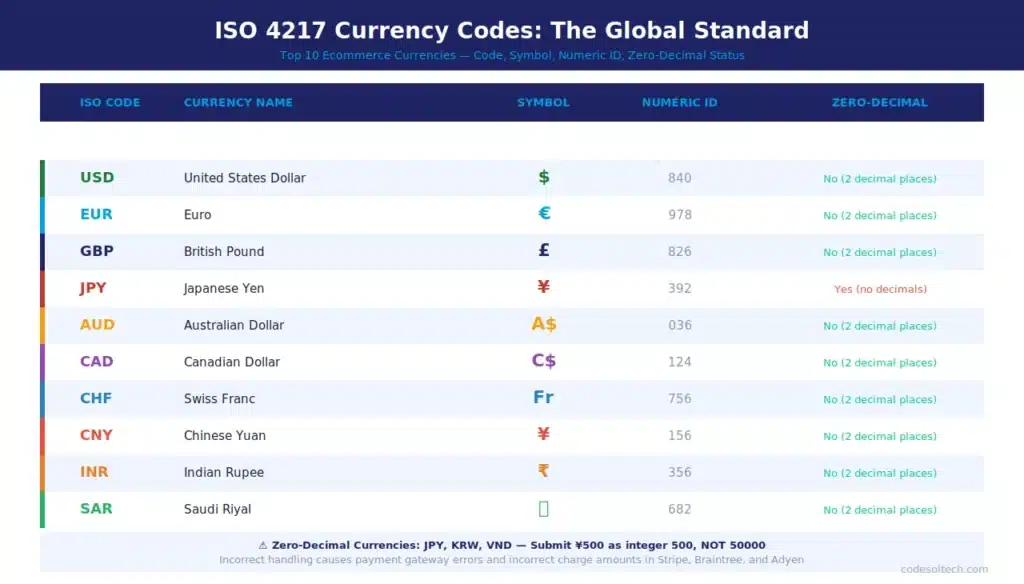
The 10 most transacted currencies in global ecommerce, ranked by international transaction volume, are:
- USD — United States Dollar (ISO 4217: 840)
- EUR — Euro (ISO 4217: 978)
- GBP — British Pound Sterling (ISO 4217: 826)
- JPY — Japanese Yen (ISO 4217: 392)
- AUD — Australian Dollar (ISO 4217: 036)
- CAD — Canadian Dollar (ISO 4217: 124)
- CHF — Swiss Franc (ISO 4217: 756)
- CNY — Chinese Yuan Renminbi (ISO 4217: 156)
- INR — Indian Rupee (ISO 4217: 356)
- SAR — Saudi Riyal (ISO 4217: 682)
Zero-decimal currencies in the ISO 4217 standard require special handling in ecommerce systems. JPY (Japanese Yen), KRW (South Korean Won), and VND (Vietnamese Dong) do not use sub-unit decimal places.
Payment gateways represent these currencies in their smallest unit. Without conversion, a charge of ¥500 is submitted to Stripe as the integer 500, not 50000 (as it would be for USD cents).
Failing to implement this correctly generates payment errors and incorrect charge amounts.
7 Proven Benefits of Multi-Currency Ecommerce
Multi-currency ecommerce systems produce measurable improvements across 7 business performance dimensions:
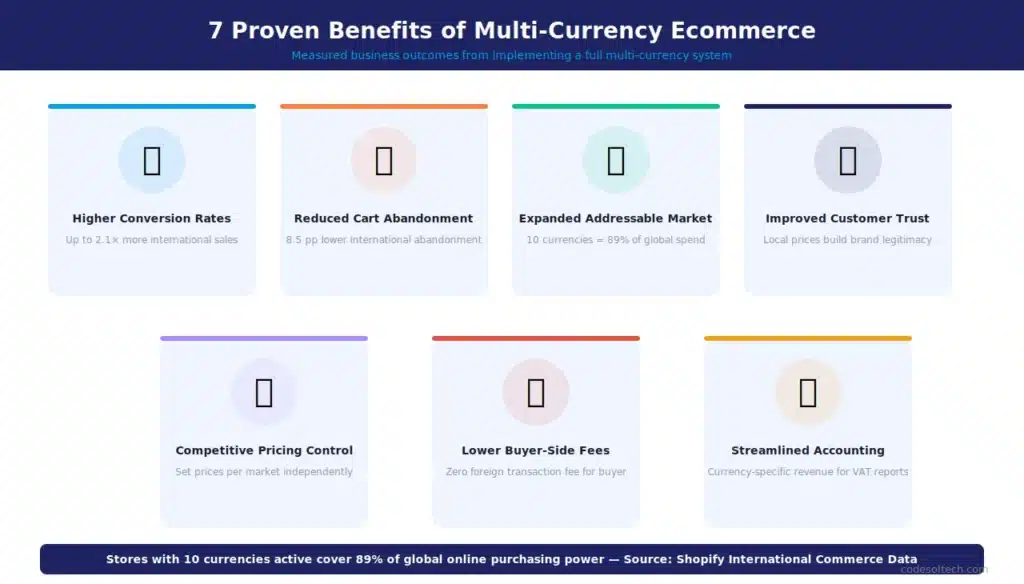
- Higher conversion rates — Stores displaying prices in local currency convert international visitors at rates 1.3× to 2.1× higher than stores displaying prices in the merchant’s base currency (Source: Shopify International Commerce data)
- Reduced cart abandonment — Eliminating currency uncertainty at checkout reduces the “unexpected costs” abandonment driver, lowering international cart abandonment by an average of 8.5 percentage points
- Expanded addressable market — Supporting 10 currencies covers approximately 89% of global online consumer purchasing power, enabling access to markets that single-currency stores exclude by default
- Improved customer trust — Displaying prices in a customer’s local currency increases perceived brand legitimacy and reduces pre-purchase hesitation, particularly in markets where consumers are unfamiliar with the merchant’s home currency
- Competitive pricing control — Fixed local-currency prices decouple the merchant’s pricing strategy from daily exchange rate fluctuations, enabling promotional pricing and competitor matching in each market independently
- Lower buyer-side transaction fees — Customers pay no foreign transaction fees on local-currency purchases, reducing the effective total cost of purchase and increasing repeat purchase rates
- Streamlined international accounting — Multi-currency settlement reports provide currency-specific revenue data that simplifies VAT reporting, transfer pricing documentation, and multi-country financial consolidation
How to Implement Multi-Currency on Your Store
Implementing multi-currency on an ecommerce store requires configuration across 4 system layers: the ecommerce platform, the Currency API connection, the payment gateway, and the tax/compliance module.
The implementation complexity varies by platform but follows a consistent 6-step process.
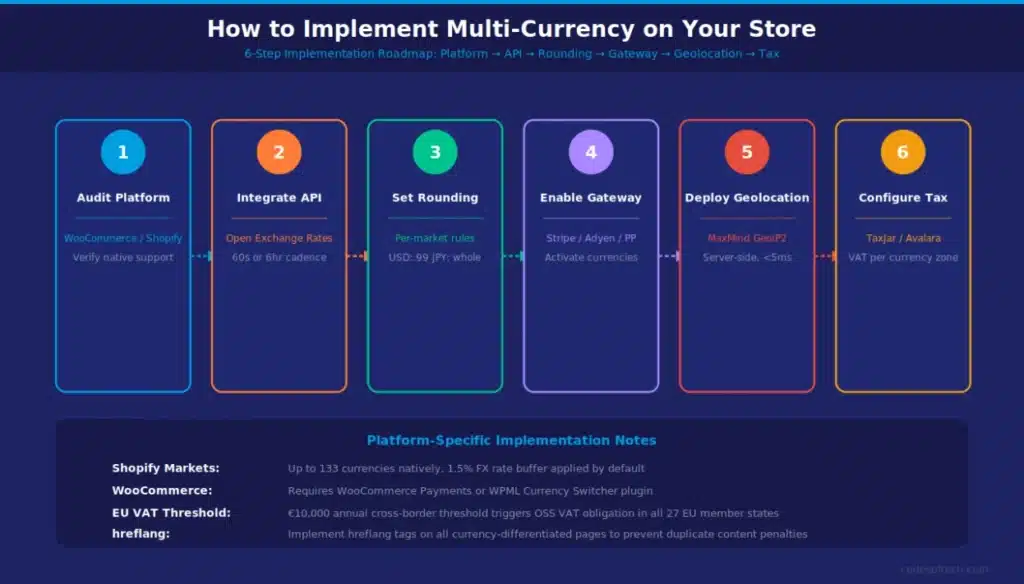
Step-by-Step Multi-Currency Implementation
- Audit your current platform’s multi-currency capabilities
Verify whether your platform (Shopify, WooCommerce, Magento, or custom) supports native multi-currency or requires a third-party plugin. Shopify Markets supports up to 133 currencies natively. WooCommerce requires the WooCommerce Payments extension or a plugin such as WPML Currency Switcher. - Select and integrate a Currency API
Choose an API based on update frequency requirements. High-volume stores with volatile-currency exposure require a Currency API that updates every 60 seconds. Stores with stable-currency focus (USD, EUR, GBP) operate reliably on 6-hour update cycles that reduce API call costs. - Configure currency rounding rules per market
Implement market-specific rounding rules. US and UK markets use .99 price endings. Japanese markets use whole-number pricing (¥1,980 not ¥1,979). German markets prefer .00 or .95 endings. Incorrect rounding creates distrust and signals automated conversion rather than genuine local pricing. - Enable multi-currency on your payment gateway
Activate multi-currency capture in the gateway’s merchant dashboard. For Stripe, enable the currencies in the Dashboard under Settings > Business Settings > Bank Accounts and Scheduling. For PayPal, add currencies under Account Settings > Money, Banks and Cards. - Implement geolocation-based currency auto-detection
Deploy IP geolocation on the server side (not client side) to assign the default currency on the first page load. Always provide a manual currency switcher as a fallback — customers using VPNs or traveling internationally need to override the automatic detection. - Configure tax calculation per currency zone
Multi-currency stores selling to the EU trigger VAT obligations for sales exceeding €10,000 annually across all EU member states (One Stop Shop threshold). Connect a tax API (TaxJar, Avalara, or Stripe Tax) that calculates VAT in the transaction currency and generates compliant invoices.
3 Common Challenges and Their Technical Solutions
Multi-currency ecommerce systems introduce 3 technical and operational challenges that single-currency stores do not encounter. Each challenge has a defined technical solution that eliminates the risk without reducing currency coverage.
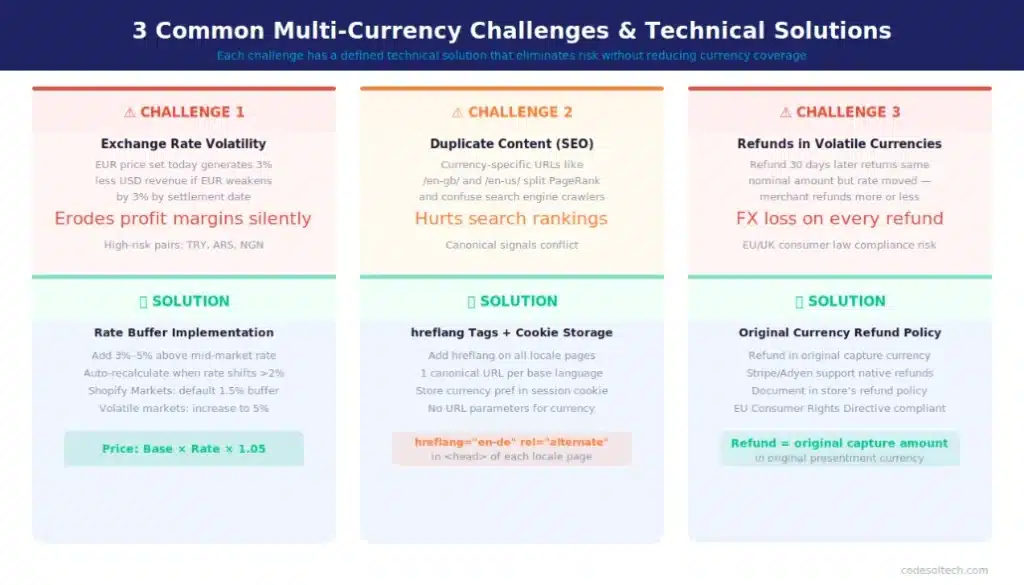
Challenge 1: Exchange Rate Volatility Eroding Margins
Problem: Exchange rates fluctuate continuously, and a price set in EUR today generates 3% less USD revenue tomorrow if the EUR weakens against the USD by 3%.
Solution: Implement a rate buffer (also called a “conversion cushion”) of 3% to 5% above the mid-market rate when calculating local-currency prices. Configure automatic price recalculation when the exchange rate deviates by more than 2% from the rate used to set the current local price.
Platforms like Shopify Markets apply a 1.5% FX rate buffer by default, which merchants increase in high-volatility currency pairs.
Challenge 2: Duplicate Content from Currency-Specific URLs
Problem: Stores that create separate URLs for each currency version (e.g., /en-gb/product and /en-us/product) generate duplicate content that splits PageRank and confuses search engine crawlers.
Solution: Implement hreflang tags on all currency-differentiated pages to signal to Google which version serves which locale. Use a single canonical URL for the base language/currency version and apply hreflang annotations for alternate currency versions.
Store the customer’s currency preference in a session cookie rather than a URL parameter to avoid URL proliferation.
Challenge 3: Chargebacks and Refunds in Volatile Currencies
Problem: A refund processed 30 days after the original purchase returns the same nominal currency amount, but exchange rate movement means the merchant refunds more or less in base-currency terms than was originally received.
Solution: Configure the payment gateway to refund the original captured amount in the original capture currency. Stripe and Adyen both support refunds in the original presentment currency, eliminating exchange rate exposure.
Document this policy in the store’s refund terms to meet consumer protection regulations in the EU (Consumer Rights Directive) and the UK (Consumer Rights Act 2015).
Multi-Currency Ecommerce and SEO: What Developers Miss
Multi-currency implementation directly affects international SEO performance across 3 dimensions. First, currency-specific landing pages, when correctly configured with hreflang tags signal geographic relevance to Google Search and improve rankings for country-specific queries.
Second, localized pricing removes the need for currency conversion tools that redirect users to third-party sites, reducing bounce rate and improving dwell time signals.
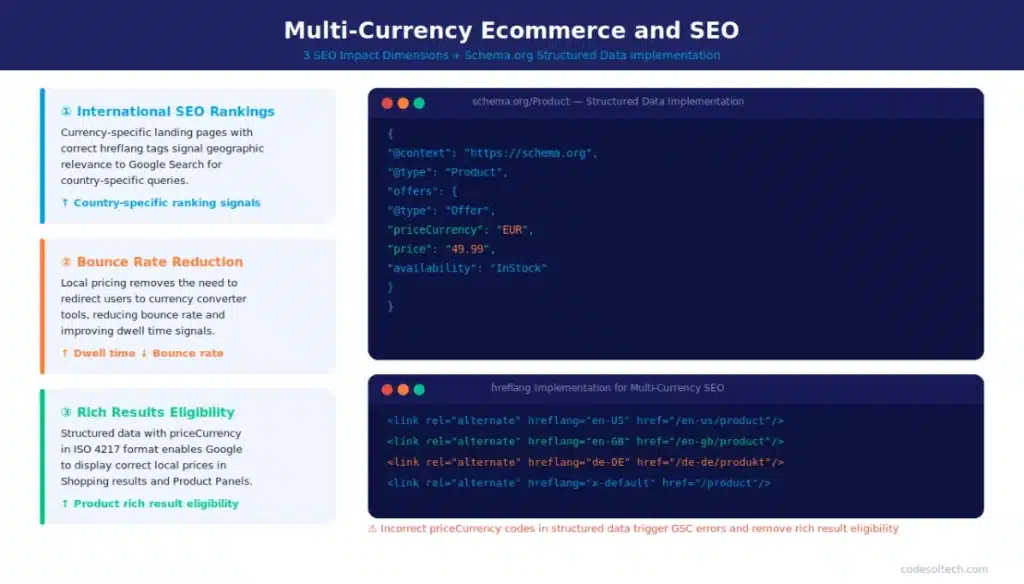
Third, displaying local prices in structured data markup (schema.org/Offer with priceCurrency property) enables Google to display accurate local-currency prices in Shopping results and Product Knowledge Panels.
The schema.org/priceCurrency The property accepts ISO 4217 codes as its value. A product priced at €49.99 requires the following structured data property in its Product schema:
"priceCurrency": "EUR",
"price": "49.99"
Incorrect currency codes in structured data trigger Google Search Console enhancement errors and disqualify the product from rich result eligibility.
This is why the ISO 4217 standard and the Currency API must remain synchronized throughout the pricing pipeline from API response to schema markup to payment intent creation.
Real-Time Exchange Rate Feeds vs. Fixed Conversion Rates
Ecommerce stores implement either real-time exchange rate feeds or fixed (manually set) conversion rates, and each model serves a distinct business use case. Real-time feeds update prices automatically as market rates change, ensuring margin preservation in volatile currency pairs.
Fixed rates provide pricing stability that supports promotional campaigns and competitor price-matching strategies in specific markets.
The 2 rate models compare across 4 operational dimensions:
| Dimension | Real-Time Exchange Rate Feed | Fixed Conversion Rate |
|---|---|---|
| Margin Protection | Automatic — rates refresh continuously | Manual — requires scheduled review |
| Price Stability | Prices change daily with market rates | Prices remain constant until manually updated |
| Implementation Complexity | Higher — requires Currency API integration | Lower — a simple multiplication factor in the platform settings |
| Best Use Case | High-volume stores in volatile currency markets (TRY, ARS, NGN) | Promotional campaigns and flagship market pricing (USD, EUR, GBP) |
High-volume international stores implement a hybrid model: real-time rates for volatile emerging-market currencies and fixed rates for their top 3 to 5 revenue-generating markets.
This hybrid approach balances margin protection with pricing strategy control and reduces the frequency of price display changes that confuse returning customers.
Final Words
Multi-currency ecommerce is not an optional feature for global stores it is the baseline infrastructure for international revenue.
Currency APIs deliver the real-time exchange rate data that powers accurate pricing. Payment gateways execute the capture in the buyer’s currency. Geolocation engines connect the two automatically.
Stores that implement multi-currency correctly convert international traffic at rates up to 2× higher than single-currency competitors.
The investment in Currency API integration, gateway configuration, and localized pricing yields returns on every transaction across every international market.
Ready to Build Your Multi-Currency Ecommerce Store?
Our team specializes in building custom ecommerce solutions with full multi-currency architecture — from Currency API integration to payment gateway configuration and localized checkout flows. We deliver stores that sell globally and settle correctly.