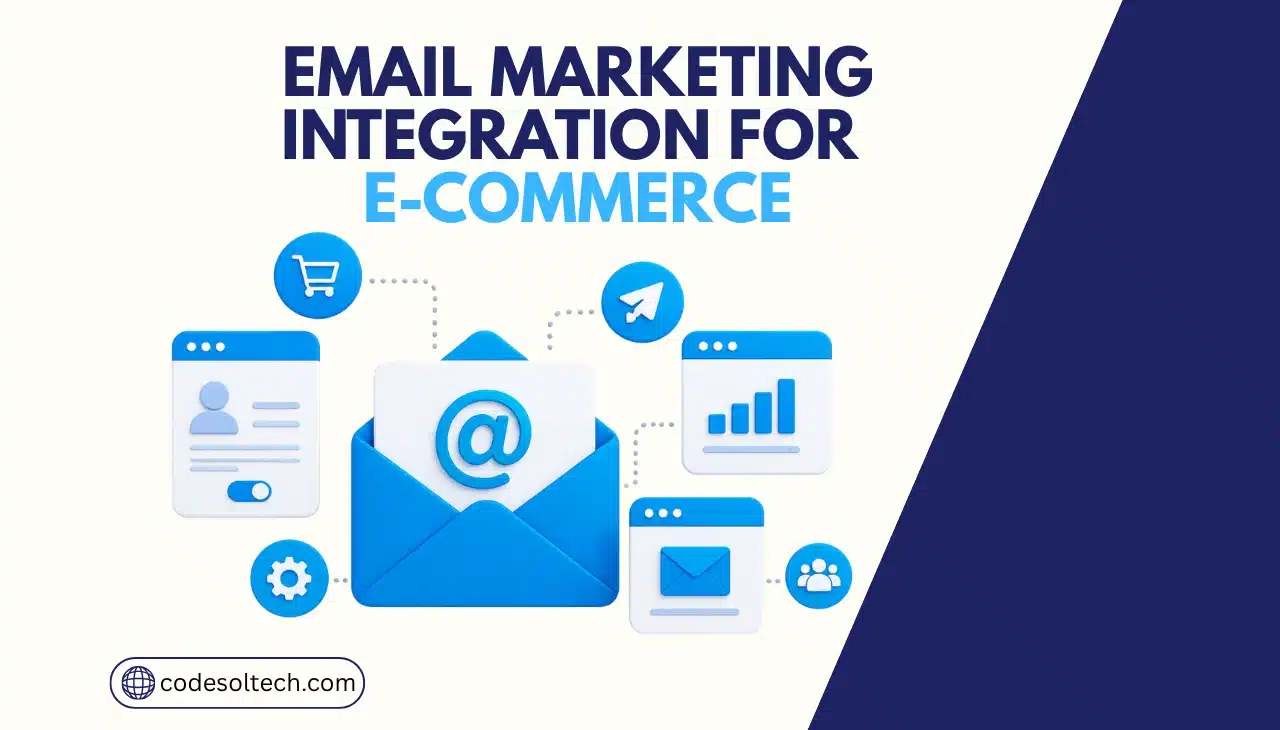
An email marketing integration system connects an ecommerce platform (Shopify, WooCommerce, Magento) to an email service provider (Klaviyo, Mailchimp, Omnisend) through APIs and webhooks. The system syncs customer profiles, order events, and product catalogs in real time, so triggered emails abandoned cart, welcome, and post-purchase fire based on live store behavior instead of manual exports.
Retail and ecommerce brands generate the highest email marketing ROI of any sector at 4,500%, and US ecommerce merchants running optimized, integrated programs push that figure to $72 for every dollar spent.
That gap between the industry average and the optimized figure is the integration layer, the difference between a store that exports CSVs by hand and one where Shopify, the ESP, and the CRM share data automatically.
This article breaks down how these systems are architected, what data moves between platforms, what the integration actually returns in revenue, and where implementations fail.
How Do Email Marketing Integration Systems Connect Ecommerce Platforms to ESPs?
Email marketing integration systems connect ecommerce platforms to ESPs through two mechanisms: REST APIs for scheduled or on-demand data pulls, and webhooks for real-time event pushes.
A webhook fires the instant an event occurs in the store a cart update, an order placement, a refund, and pushes that payload to the ESP within seconds. An API call, by contrast, retrieves or sends data on a defined schedule or in response to a specific request.
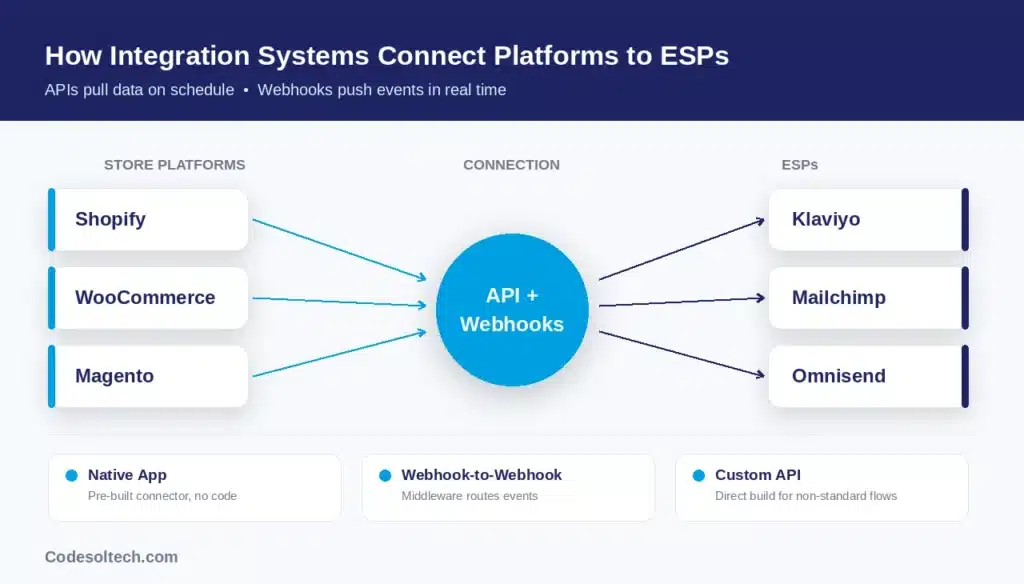
Modern ESP integrations sync ecommerce platform data in milliseconds rather than through nightly batch imports, which is what makes real-time flow triggers possible.
A well-built integration replaces the daily export-and-upload routine with event-driven sync, so stock levels and purchase events reach the ESP within seconds of occurring rather than the next time someone manually runs an export.
Three integration patterns cover most ecommerce-to-ESP connections:
- Native app integrations — pre-built connectors installed directly from a platform’s app store (e.g., Klaviyo’s Shopify app), requiring no custom code
- Webhook-to-webhook automation — middleware tools (Zapier, Make, MESA) that route events between systems without a native connector
- Custom API integrations — direct API-to-API connections built for platforms without native support, or for merchants needing non-standard data flows
Every integration should respect the ESP’s documented rate limits from the start, using queued processing and exponential backoff on retries rather than repeatedly hammering the API until it gets throttled.
When a webhook call fails, it should retry automatically on a backoff schedule, with repeated failures triggering an alert to a real person.
Silent integration failures are one of the most common causes of broken automation flows that go unnoticed for weeks.
What Data Syncs Between an Ecommerce Store and an Email Service Provider?
Five data categories sync between an ecommerce store and an ESP: customer profiles, order events, product catalog data, behavioral/browsing events, and consent status.
Each category powers a different class of automation, and missing any one of them limits the flows a store can run.
| Data Type | What It Includes | Flows It Powers |
|---|---|---|
| Customer profiles | Name, email, phone, location, lifetime value, order count | Segmentation, VIP campaigns, win-back flows |
| Order events | Placed, fulfilled, cancelled, refunded — with line items and value | Post-purchase sequences, replenishment reminders |
| Product catalog | SKUs, names, images, pricing, variants, tags | Dynamic product blocks, recommendation emails |
| Behavioral events | Viewed product, started checkout, added to cart | Abandoned cart flows, browse abandonment flows |
| Consent status | Email opt-in, SMS opt-in, subscription source | Compliance-safe sending, list segmentation by consent |
Behavioral event data is the category most often left unconfigured. Without an on-site tracking snippet installed on the storefront, an integration cannot register viewed-product or started-checkout events, which means browse abandonment flows cannot trigger, and abandoned cart targeting weakens.
This single missing script is the most common reason a store’s “integrated” email program still underperforms.
How Much Revenue Do Integrated Email Systems Generate for Ecommerce Stores?
Integrated, automated email flows generate a disproportionate share of ecommerce email revenue relative to the volume they send.
Automated emails drove 37% of all ecommerce email revenue in 2024, despite representing just 2% of total email volume. A single automated abandoned cart or post-purchase flow outperforms dozens of one-off campaigns.
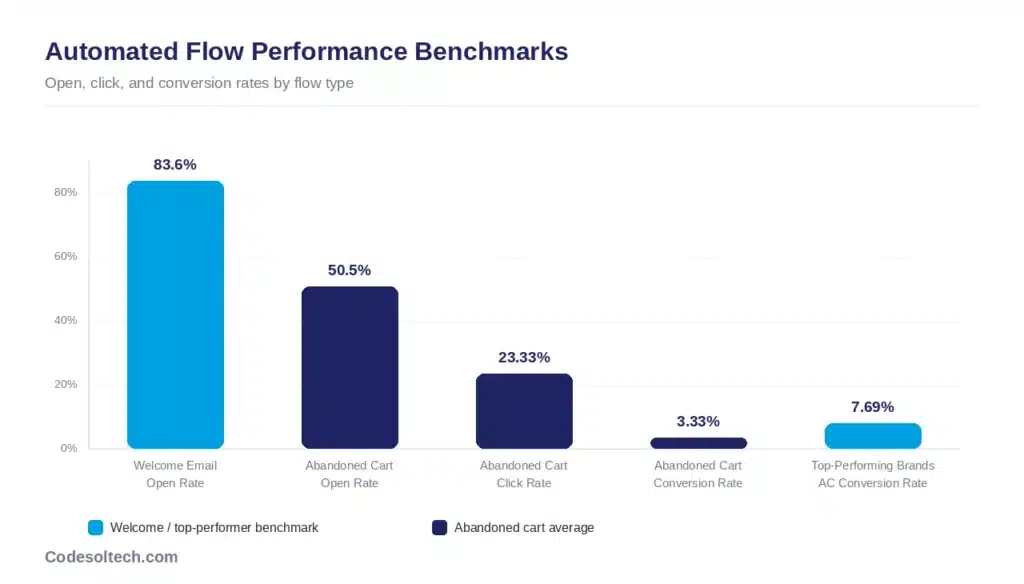
Flow-level performance data from Klaviyo shows why integration quality determines revenue directly:
- Abandoned cart emails achieve an average open rate of 50.5%, a click rate of 6.25%, and a conversion rate of 3.33%, with top-performing brands reaching conversion rates of 7.69%
- Welcome emails achieve an 83.6% open rate in ecommerce the highest of any automated email type
- Abandoned cart emails achieve an average click-through rate of 23.33%, the highest-performing email type by click engagement across all automation types
These numbers depend entirely on real-time data sync. A cart-abandonment email that fires six hours after a checkout event, because the integration runs on a nightly batch rather than via a webhook, reaches a shopper whose intent has already cooled.
Brands that use dedicated email analytics tooling to monitor integration and campaign performance see a 43% higher ROI than those that don’t, reflecting how much of the return depends on catching and fixing sync failures quickly.
What Compliance Requirements Apply to Ecommerce Email Integrations?
Consent status is not just a data field it is a legal requirement that the integration must handle correctly at the point of sync.
A checkout email field does not automatically opt a customer into marketing; the marketing opt-in checkbox must be enabled in the ecommerce platform’s checkout settings, and the consent settings inside the ESP must be aligned with it.
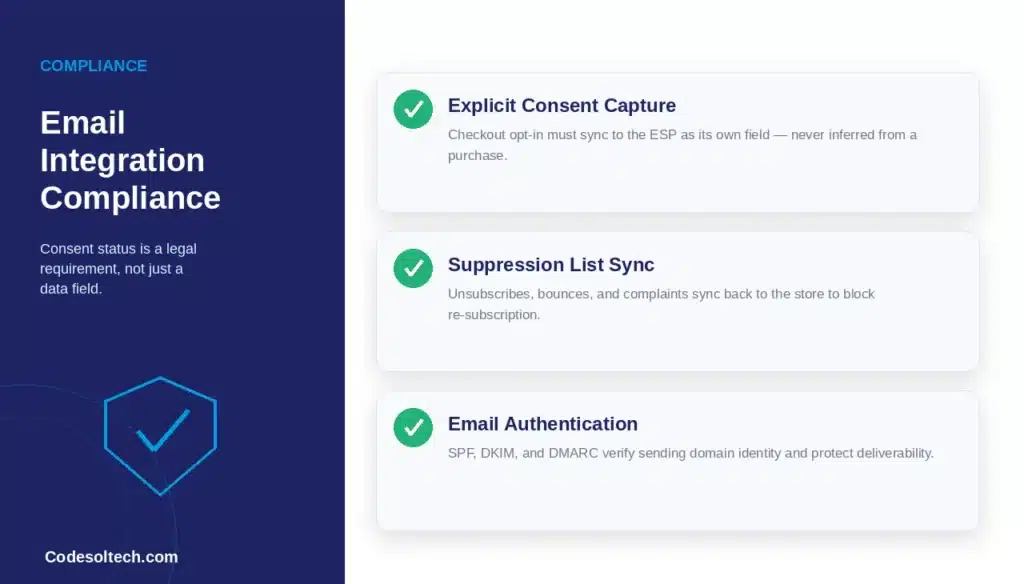
Three compliance mechanisms apply directly to the integration layer:
- Explicit consent capture — the checkout opt-in checkbox status must sync to the ESP as a distinct field, not be inferred from a completed purchase
- Suppression list sync — unsubscribes, bounces, and complaints registered in the ESP must sync back to the ecommerce platform to prevent re-subscription through a later import
- Regional consent rules — onsite tracking events for visitors in the EU, EEA, UK, and Switzerland may be restricted by the platform’s customer privacy settings unless the visitor has provided consent
Email authentication protocols SPF, DKIM, and DMARC sit alongside consent as a second compliance layer, verifying that emails sent through the integrated system are authenticated as coming from the sending domain, which protects deliverability and reduces phishing and spoofing risk.
Common Integration Failures and How to Prevent Them
Three failure patterns account for most broken ecommerce email integrations:
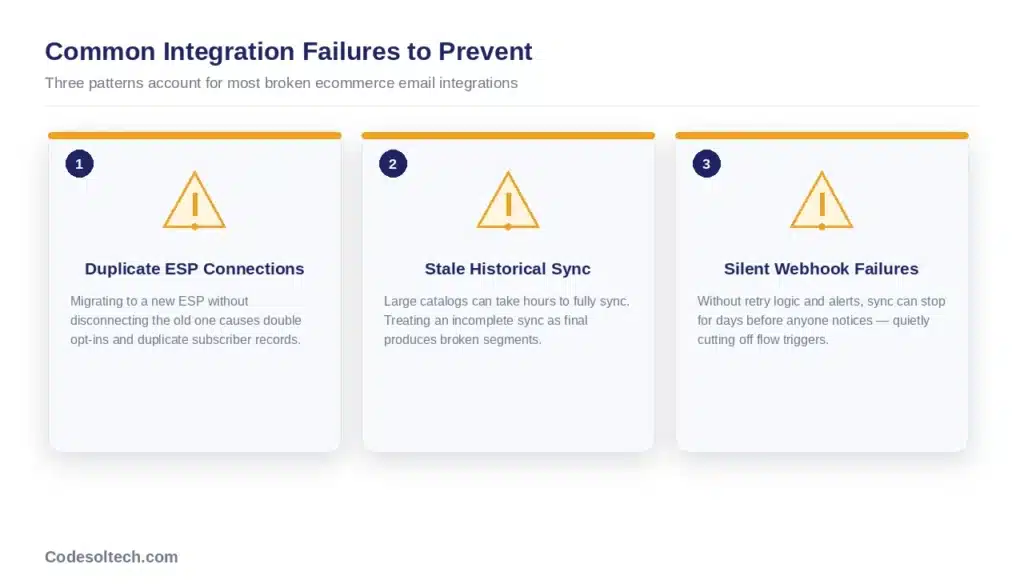
- Duplicate ESP connections — migrating to a new ESP without disconnecting the previous integration causes double opt-in emails and duplicate subscriber records
- Stale historical sync — large catalogs and customer lists can take several hours to fully sync on initial connection; treating an incomplete sync as final produces broken segments
- Silent webhook failures — an integration without retry logic and failure alerts can stop syncing for days before anyone notices, quietly cutting off flow triggers
A pre-launch integration audit should verify live event tracking, test a full order cycle end-to-end, and confirm that consent fields match between the two platforms before any automated flow goes live.
Final Words
Email marketing integration is infrastructure, not a plugin toggle. The revenue difference between a $36 average return and a $72 optimized return comes from real-time sync, correct consent handling, and flows built on complete behavioral data, not from switching ESPs.
Codesoltech builds and audits ecommerce-to-ESP integrations API, webhook, and custom for Shopify, WooCommerce, and Magento stores. Contact our team to review your current integration architecture.