Choosing a CRM usually comes down to three paths. You can build a custom CRM, buy HubSpot, or buy Salesforce.
Each path fits a different kind of team. The wrong choice costs years of workarounds or a rebuild nobody budgeted for.
This comparison uses published 2026 prices and named sources. No vendor supplied the numbers below.
Custom CRM vs HubSpot vs Salesforce at a Glance
Start with the shape of each option. Detail follows in the sections below.
| Factor | Custom CRM | HubSpot | Salesforce |
|---|---|---|---|
| What you get | Software built around your process | Unified sales, marketing, and service platform | Deep enterprise CRM platform |
| Upfront cost | $18,000 to $250,000+ | $0 to start, onboarding on Pro+ | $25 per user per month to start |
| Monthly cost at scale | Hosting plus maintenance only | Per-seat fees that grow with the team | Per-user fees that grow with the team |
| Time to launch | 6 to 36 weeks | Days to weeks | Weeks to months |
| Fit to your process | Exact | Good for standard processes | Deep, with configuration effort |
| Maintenance owner | You, or your development partner | HubSpot | Salesforce, plus your admin |
None of these options wins on every row. The right pick depends on process fit, team size, and time horizon.
What Each Option Actually Is
Custom CRM
A custom CRM is sales and service software built for one business. Contacts, pipelines, quotes, and reports follow your exact workflow.
Typical modules include lead tracking, client portals, and dashboards. Our custom CRM development services page lists the modules teams ask for most.
You own the code and the data model. You also own maintenance, hosting, and future changes.
HubSpot
HubSpot is a customer platform built around its Smart CRM. Sales, marketing, service, and content tools share the same records.
Its strength is unity. A lead captured by marketing is visible to sales and service without extra integration work.
Its weakness is depth. Unusual processes must bend to fit HubSpot objects, pipelines, and workflow limits.
Salesforce
Salesforce is the largest CRM platform by revenue. Sales Cloud covers leads, accounts, opportunities, and forecasting.
Its strength is configurability. Complex approval chains, territories, and custom objects are all possible.
Its weakness is complexity. Most teams need an admin or partner to run it well.

Pricing Compared in 2026
Prices below are list prices as published in 2026. Negotiated discounts exist, especially on Salesforce.
| Option | Entry price | Mid tier | Top tier |
|---|---|---|---|
| Custom CRM | $18,000 to $45,000 build | $45,000 to $110,000 build | $110,000 to $250,000+ build |
| HubSpot Sales Hub | Free, then $20 per seat per month | $90 to $100 per seat per month | From $150 per seat per month |
| Salesforce Sales Cloud | $25 per user per month | $100 per user per month | $175 to $350 per user per month |
Custom build tiers come from Rorixtech’s 2026 cost breakdown. HubSpot and Salesforce tiers come from 2026 pricing guides.
HubSpot Professional adds a $1,500 one-time onboarding fee. Enterprise adds $3,500. Both require annual commitments.
Salesforce prices rose in 2026. Older guides still show $80, $165, and $330 for Pro, Enterprise, and Unlimited.
Use the current vendor price at signing. List prices change, and older comparison posts go stale fast.
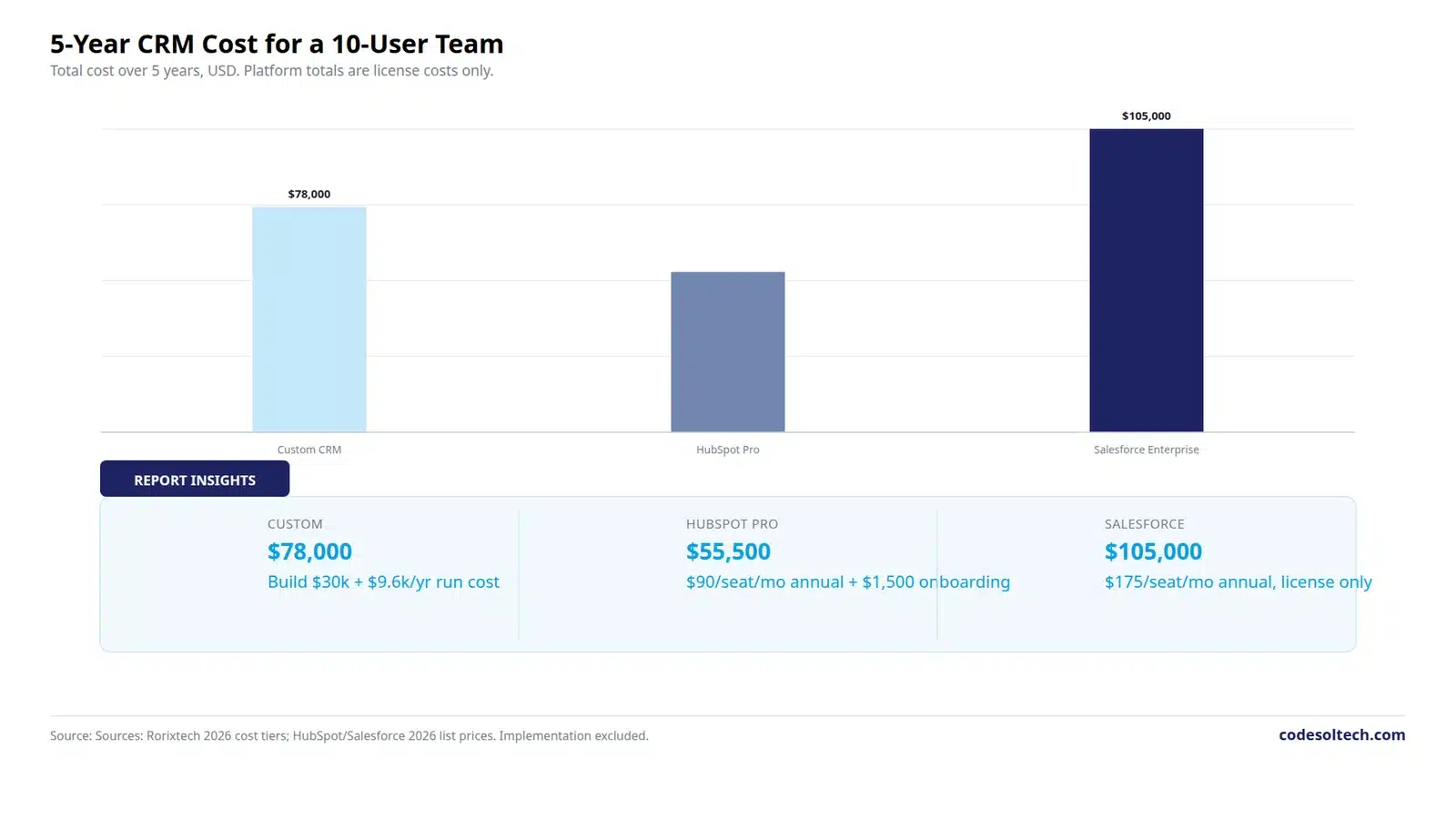
The chart shows five-year totals for a 10-user team. Custom assumes a $30,000 build plus $9,600 per year in running costs.
HubSpot Pro totals $55,500 over five years. Salesforce Enterprise totals $105,000 in license fees alone.
Platform totals exclude implementation. Salesforce implementation often costs more than the first year of licenses.
The Subscription Trap Nobody Prices
Per-seat pricing looks small at five users. It looks very different at fifty users over five years.
HubSpot Professional jumps from $20 to $100 per seat per month. That is a fivefold increase at the exact tier where automation lives.
Salesforce Enterprise costs seven times its Starter Suite. The features most teams need sit above the entry tier.

Custom builds invert this curve. The bill is front-loaded, then flattens to hosting and maintenance.
That only helps if you keep the system for years. A team that churns tools every eighteen months should rent, not build.
Feature Comparison
All three options cover core CRM work. They differ in how far each feature goes.
| Feature | Custom CRM | HubSpot | Salesforce |
|---|---|---|---|
| Contact and pipeline management | Built to your stages | Strong, up to 350 pipelines on Enterprise | Strong, with territory support |
| Marketing automation | Built if scoped | Native and best in class | Separate Marketing Cloud product |
| Sales forecasting | Built if scoped | Yes, from Professional up | Yes, with collaborative forecasting |
| Service and tickets | Built if scoped | Native Service Hub | Service Cloud, sold separately |
| Custom objects and fields | Unlimited by design | Limited by tier | Deep, with API access from Enterprise |
| Reporting | Built to your metrics | Strong, dashboards capped by tier | Strong, with advanced analytics add-ons |
HubSpot wins when marketing and sales must share one system. Salesforce wins when process complexity is the constraint.
Custom wins when neither platform models your process without heavy compromise. That is rarer than vendors admit.
Customization and Control
Customization is where the three paths truly split. Ask how much of your process is standard before you decide.
HubSpot customizes through properties, pipelines, and workflows. It resists deep data-model changes.
Salesforce customizes through configuration and code. It handles almost anything, at the cost of admin effort.
Custom software customizes without limits. Every change is a development task with a price and a timeline.
Control cuts both ways. Owning the code means no vendor can raise your price or retire your feature.
It also means every bug, upgrade, and security patch is your problem. Budget for that honestly.
Ease of Use and Adoption
A CRM nobody opens is worthless at any price. Adoption usually decides the outcome more than features do.
HubSpot is the easiest of the three to learn. Small teams often run it without dedicated training.
Salesforce has the steepest learning curve. Power comes with screens, settings, and terminology to master.
Custom CRMs can be the simplest of all. They show only what your team actually uses, and nothing else.
That simplicity is earned during discovery. A vague spec produces a confusing custom tool, not a simple one.
Integrations and Ecosystem
Your CRM must talk to billing, email, calendars, and support tools. Check your five must-have integrations before shortlisting.
HubSpot offers a large app marketplace. Most common tools connect without custom code.
Salesforce offers the largest ecosystem. AppExchange covers nearly every business niche.
Custom CRMs integrate through APIs. Our guide to a CRM and Stripe integration shows how one payment link is structured.
Count integration cost in the total. A cheap license with five custom integrations is not cheap.
Key CRM Statistics
Eight verified figures that frame this comparison. Each one links to its published source.
Salesforce held 20.7% of the global CRM market in 2024. IDC ranked it first among all CRM vendors. Source: Salesforce, IDC CRM market share ranking 2025.
HubSpot served 306,446 customers at June 30, 2026. That was 14% growth year over year. Source: SQ Magazine, HubSpot statistics 2026.
A focused custom CRM costs $18,000 to $45,000. Operational builds run $45,000 to $110,000. Source: Rorixtech, Custom CRM Development Cost in 2026.
The typical custom software project costs $10,000 to $49,999. The average reviewed project costs about $132,480 over 13 months. Source: Clutch, Software Development Pricing Guide.
Large IT projects run 45% over budget. They also deliver 56% less value than predicted, per McKinsey and Oxford. Source: McKinsey and Oxford, study of 5,400 IT projects.
HubSpot Professional costs five times Starter per seat. The jump is $20 to $100 per seat per month. Source: Resonate, HubSpot vs Salesforce comparison 2026.
Salesforce Enterprise costs seven times Starter Suite. The step is $25 to $175 per user per month. Source: Twelverays, Salesforce pricing 2026.
Maintenance runs 15 to 25% of build cost per year. That rule applies to custom systems and to heavily customized platforms. Source: Pegotec, 2026 maintenance benchmarks.
Honest Pros and Cons
Custom CRM: pros and cons
Pros: exact process fit, no per-seat fees, full data ownership, and a simple interface for your team.
Cons: high upfront cost, months to launch, and maintenance that never ends. Scope creep is a real risk.
HubSpot: pros and cons
Pros: fast launch, easy adoption, unified marketing and sales data, and a genuinely useful free tier.
Cons: steep tier jumps, onboarding fees, contact and seat costs that compound, and customization ceilings.
Salesforce: pros and cons
Pros: unmatched depth, huge ecosystem, and proven scale for complex and regulated operations.
Cons: high license and implementation costs, admin overhead, and a learning curve that slows adoption.
Where CodeSol fits, honestly
CodeSol Technologies is an Austin-based custom CRM builder. Clutch lists a 10 to 49 person team and $25 to $49 hourly rates.
Its honest limitations matter. It publishes no public pricing, and its founded year is not stated on its own site.
It is a fit for small and mid-size teams with a defined process. It is not a like-for-like Salesforce replacement.
Teams needing enterprise scale, global support, or a large admin bench should shortlist the platforms first.
How to Decide in One Week
Run this decision test before you sign anything. It takes a week and saves a year of regret.
| If this is true | Choose this | Why |
|---|---|---|
| You need to launch this month | HubSpot | Fastest path to a working system |
| Your process is standard | HubSpot | Lowest effort for standard work |
| Your process is complex or regulated | Salesforce | Depth and ecosystem to match it |
| Your process is your advantage | Custom CRM | Nothing else models it exactly |
| You will run it 5+ years at 20+ seats | Custom CRM | Per-seat fees overtake build cost |
| Your team resists new software | HubSpot or custom | Simplest interface wins adoption |
Score each option against your top five requirements. Weight process fit double, since it drives daily use.
Trial the platforms with real data, not demo data. A CRM that handles your messiest records is the one to buy.
For cost detail, read our guide to how much custom CRM development costs in 2026 before you request quotes.
Migration and Switching Costs
Switching CRMs costs more than the new license. Data migration is the bill most teams forget.
Clean data moves cheaply. Years of duplicates, dead leads, and free-text fields move expensively.
Budget for cleanup before migration, not during it. A CRM data migration plan should name the owner of every field.
Also budget for retraining. Every workflow your team memorized must be relearned in the new system.
Custom builds add one more cost: exit. Your code needs a maintainer even if you switch vendors later.
Platforms add a different exit cost: data export. Test the export before you sign, not after you leave.
Red Flags When Choosing
Walk away from any vendor who shows these signs. Each one predicts a painful project.
- No itemized quote: a single lump sum hides what is actually included.
- No maintenance terms: support after launch is where most projects fail.
- No references you can call: case studies without contacts prove nothing.
- Per-seat pricing with no seat audit: you will pay for seats nobody uses.
- Custom build with no discovery phase: the vendor is guessing at your process.
- Platform demo using only perfect data: your real data will break it.
Ask every vendor for a three-year total cost. Refusal to provide one is itself a red flag.
Compare specialist firms too. Our roundup of the best CRM development companies for small businesses is a neutral starting point.
Methodology
Prices come from 2026 pricing guides and vendor-adjacent sources, cross-checked across at least two guides each.
Where guides conflicted, this post prints the newer figure and notes the older one. Salesforce 2026 prices are one example.
Market and customer figures come from IDC via Salesforce and from HubSpot quarterly reporting summaries.
Every source link was checked live on October 24, 2026. Figures are quoted as published; your quote will differ.
Frequently Asked Questions
Is a custom CRM cheaper than HubSpot or Salesforce?
Over five years, often yes for larger teams. A custom build costs more upfront, then flattens to hosting and maintenance. Per-seat platform fees compound every year, so the crossover usually comes around year three for teams above 20 seats.
When should a small business choose HubSpot over Salesforce?
Choose HubSpot when marketing and sales must share one system and speed matters. Choose Salesforce when process complexity, territories, or deep customization drive the decision. Most teams under 50 seats find HubSpot easier to adopt.
How long does it take to implement Salesforce?
Starter Suite can run in weeks. Enterprise deployments with customization, integrations, and migration typically take months. Budget for an admin or partner alongside the license, not after go-live.
Can I migrate from HubSpot or Salesforce to a custom CRM later?
Yes, but budget for data cleanup and retraining first. Export your data and test the export before you sign a new contract. Migration cost depends on record quality, not record count alone.
What is the biggest hidden cost in each option?
For custom builds, it is maintenance at 15 to 25 percent of build cost per year. For HubSpot, it is tier jumps and onboarding fees. For Salesforce, it is implementation and admin time beyond the license.
Should I build custom if my process fits HubSpot today?
No. Buy the platform and revisit custom later if the fit breaks. Building custom for a standard process pays a premium for uniqueness nobody uses.
Still deciding between custom, HubSpot, and Salesforce? Get an honest recommendation.