Small businesses do not usually pick a CRM the way enterprises do. Nobody runs a six-month RFP for a 20-person team. But the moment customer data lives in three spreadsheets, a shared inbox, and one salesperson’s memory, the cost of not having a system starts showing up as missed follow-ups and lost deals.
The global CRM market sits at about $112.9 billion in 2025 and is projected to reach roughly $126.2 billion in 2026, according to Fortune Business Insights figures cited by SumatoSoft, and a growing share of that spend comes from smaller companies buying or building systems sized for them.
The choice is crowded. Directories rank whoever pays for placement, agency sites all claim the same capabilities, and review platforms show every firm at five stars.
This guide does something different: seven CRM development companies that serve small businesses, evaluated against the same six criteria, with honest notes on where each one fits and where it does not.
Every fact below was checked against the company’s own website or a third-party directory in October 2026.
The 7 Companies at a Glance
- CodeSol Technologies – Best for Austin SMBs that want automation, not just a CRM
- ScienceSoft – Best for enterprise-grade CRM programs
- Fingent – Best for multi-platform CRM integrations
- Belitsoft – Best for budget-conscious custom CRM builds
- Chetu – Best for end-to-end CRM lifecycle coverage
- Radixweb – Best for Microsoft-ecosystem CRM integrations
- Iflexion – Best for CRM modernization and migration projects
The order above is not a ranking. The right partner depends on your budget, your industry, and how much of your workflow needs to be custom, which is why each profile below ends with an honest note about fit.
How We Evaluated These Companies
Every firm on this list was checked against six criteria in October 2026. If a company failed one, it did not make the list.
- CRM specialization: custom CRM development is a stated service, not a one-off project. The firm builds, customizes, or integrates CRM systems for clients on a regular basis.
- Small business fit: the firm serves SMB budgets and team sizes. Minimum project sizes and published pricing were checked against what a 10 to 100 person company can realistically approve.
- Verifiable track record: CRM or related client work that can be confirmed through portfolios, case studies, or third-party review platforms such as Clutch.
- Integration experience: the firm connects CRMs with the tools small businesses already use, such as email platforms, accounting software, and marketing tools, rather than delivering an isolated database.
- Team depth: enough people to staff a real project and support it after launch, without the founder writing all the code.
- Transparent positioning: the company states clearly what it does and who it serves, instead of claiming to do everything for everyone.
We did not accept payment for placement. Directory data below comes from Clutch and The Manifest, two independent B2B review platforms, unless noted otherwise. Cost ranges in this guide are drawn from 2026 industry pricing guides, cited inline.
Quick Comparison
| Company | HQ | Founded | Team size | Core strength | Best for |
|---|---|---|---|---|---|
| CodeSol Technologies | Austin, Texas, USA | Not publicly disclosed | Not publicly disclosed | Automation-first custom CRM builds | Austin SMBs that want automation, not just a CRM |
| ScienceSoft | McKinney, Texas, USA | 1989 (per Clutch) | 750+ experts (per their website) | Deep platform CRM practice since 1989 | enterprise-grade CRM programs |
| Fingent | White Plains, New York, USA | 2003 (per Clutch) | 450+ professionals (per their website) | CRM integrations across major platforms | multi-platform CRM integrations |
| Belitsoft | Warsaw, Poland | 2004 (per Clutch) | 400+ (per GoodFirms) | Senior engineering at mid-market rates | budget-conscious custom CRM builds |
| Chetu | Sunrise, Florida, USA | 2000 (per Clutch) | 1,000-9,999 (per Clutch) | Full CRM lifecycle: build, migrate, integrate | end-to-end CRM lifecycle coverage |
| Radixweb | Ahmedabad, India; US office in Frisco, Texas (per Clutch) | 2000 (per Clutch) | 650+ experts (per their website) | Microsoft partner with high client retention | Microsoft-ecosystem CRM integrations |
| Iflexion | Tallinn, Estonia; US office in Denver, Colorado (per GoodFirms) | 1999 (per Clutch) | 1,000+ professionals (per their website) | Salesforce Center of Excellence | CRM modernization and migration projects |
1. CodeSol Technologies: Best for Austin SMBs that want automation, not just a CRM
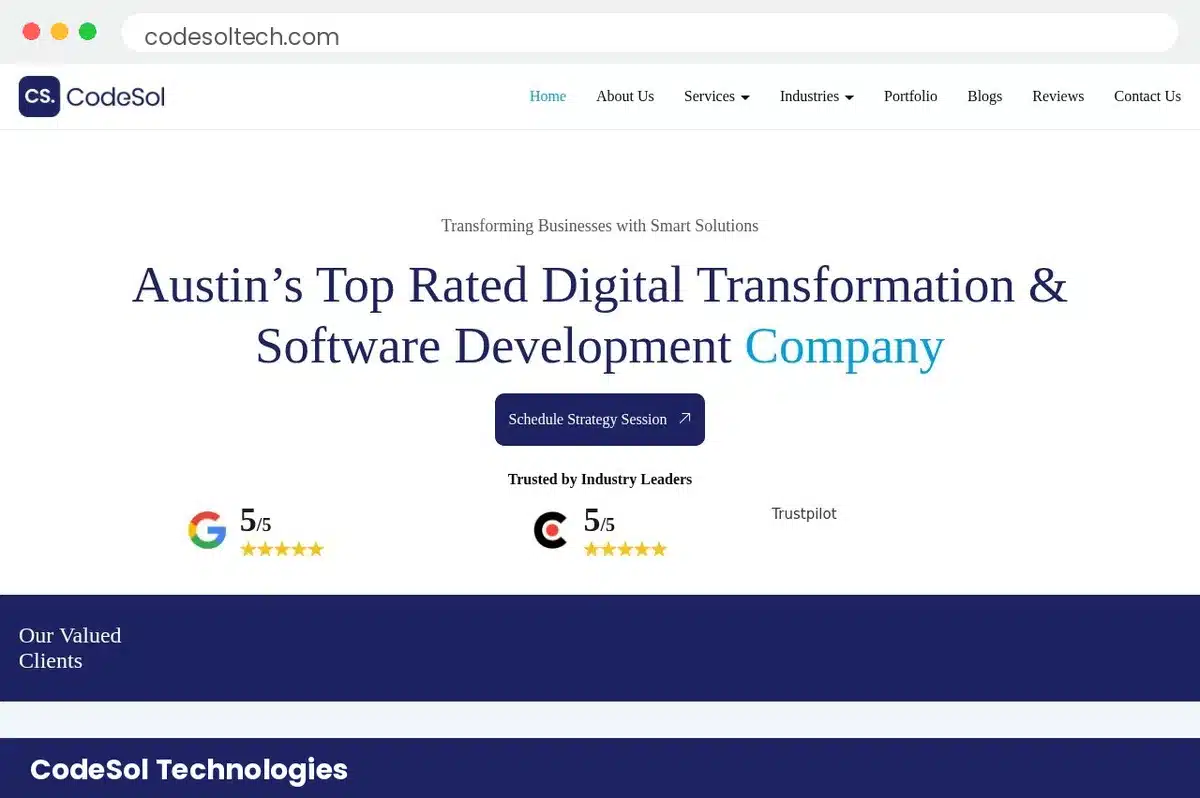
CodeSol Technologies is an Austin-based software development company at 5900 Balcones Drive, focused on custom CRM development and client portals, process and workflow automation, and systems integration.
Its CRM service catalog covers custom CRM builds, lead tracking and pipeline management, Salesforce custom development, HubSpot CRM customization, CRM automation, and role-based access with reporting dashboards, all per its own services page.
The firm also builds industry-specific CRM work, such as CRM development for consulting firms, and its homepage carries 5-out-of-5 ratings on both Google and Clutch.
Key services
Custom CRM development, client portals, lead tracking and pipeline management, Salesforce custom development, HubSpot CRM customization, CRM automation, task and project tools, role-based access, analytics and reporting dashboards,
and systems integration, per the firm’s services page.
Strengths
The differentiation is automation-first thinking. Where most firms sell a database with a login page, CodeSol’s engagements center on removing manual work: CRM builds with automated reminders and follow-up sequences, lead tracking tied to real pipeline stages,
and integrations that connect the CRM to the rest of the business so nothing is entered twice. For service businesses, that framing maps directly to revenue.
Local presence is the second advantage: an Austin address means discovery workshops and working sessions can happen in person, which matters when the CRM has to mirror how a specific team actually works.
Honest note
Pricing is designed for small- and mid-sized business budgets, so confirm the fixed scope and post-launch support terms in writing before signing, as you would with any boutique shop.
2. ScienceSoft: Best for enterprise-grade CRM programs
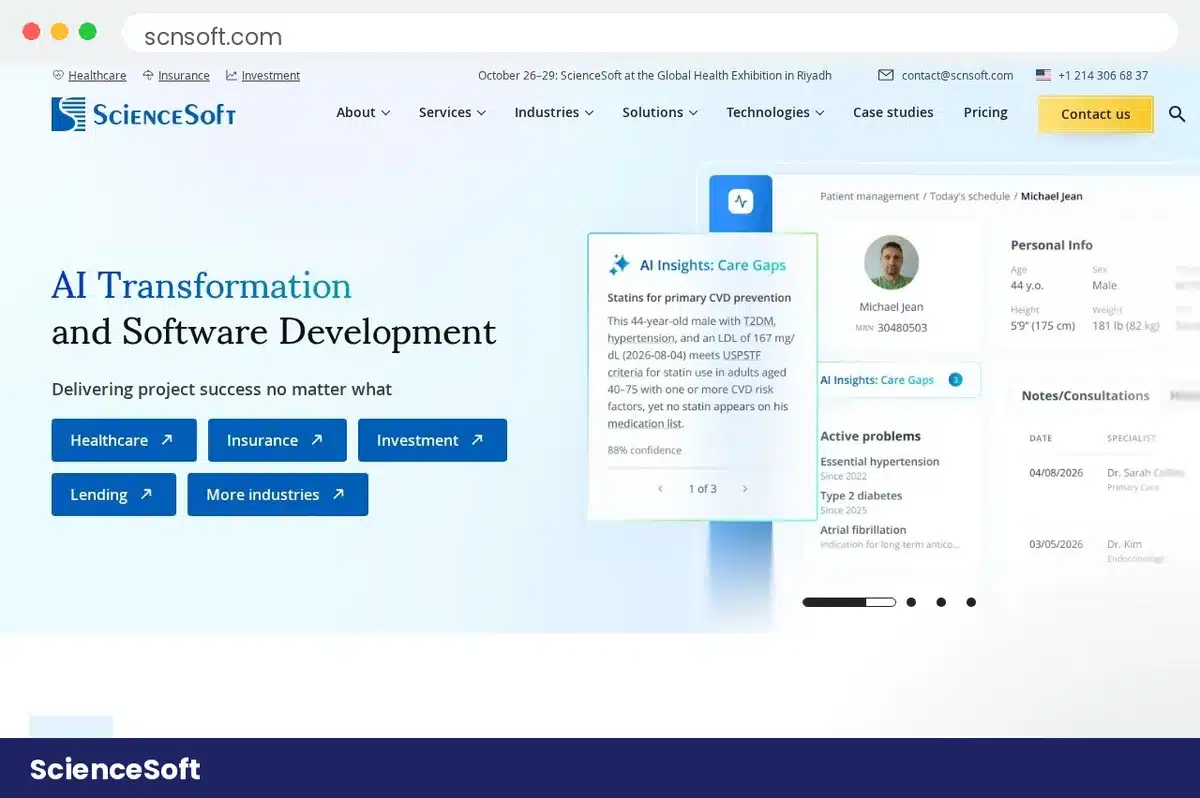
ScienceSoft is a McKinney, Texas firm founded in 1989, per Clutch, with more than 750 consultants, engineers, and architects, per its own website. Its CRM practice covers custom CRM built from scratch, platform-based CRM customization on Salesforce and Microsoft Dynamics, CRM implementation, migration, integration,
and support. The firm lists Microsoft, AWS, and IBM partnerships and holds ISO 9001, 27001, and 13485 certifications, per its website and G2 profile, and appears in the Global Outsourcing 100.
Clutch lists its rate at $50 to $99 per hour with a $5,000-plus minimum project size.
Key services
Custom CRM development from scratch, Salesforce and Microsoft Dynamics customization, CRM implementation, CRM migration, CRM integration, and ongoing CRM support, per the firm’s website.
Strengths
Longevity is the headline argument. A firm operating since 1989 has survived multiple technology cycles, which signals process maturity and financial stability that younger shops cannot demonstrate.
The partner certifications and ISO credentials matter for buyers in regulated or compliance-sensitive industries, where a CRM has to satisfy auditors as well as salespeople.
The Texas headquarters also gives US buyers a domestic contracting entity with onshore accountability.
Honest note
ScienceSoft is built for serious programs, not quick builds. The $50 to $99 per hour rate band means a full custom CRM lands firmly in five-figure territory and up, so very small budgets should look at the budget picks further down.
Enterprise process can also feel heavy for a 15-person team that just needs a clean pipeline and reminders.
3. Fingent: Best for multi-platform CRM integrations
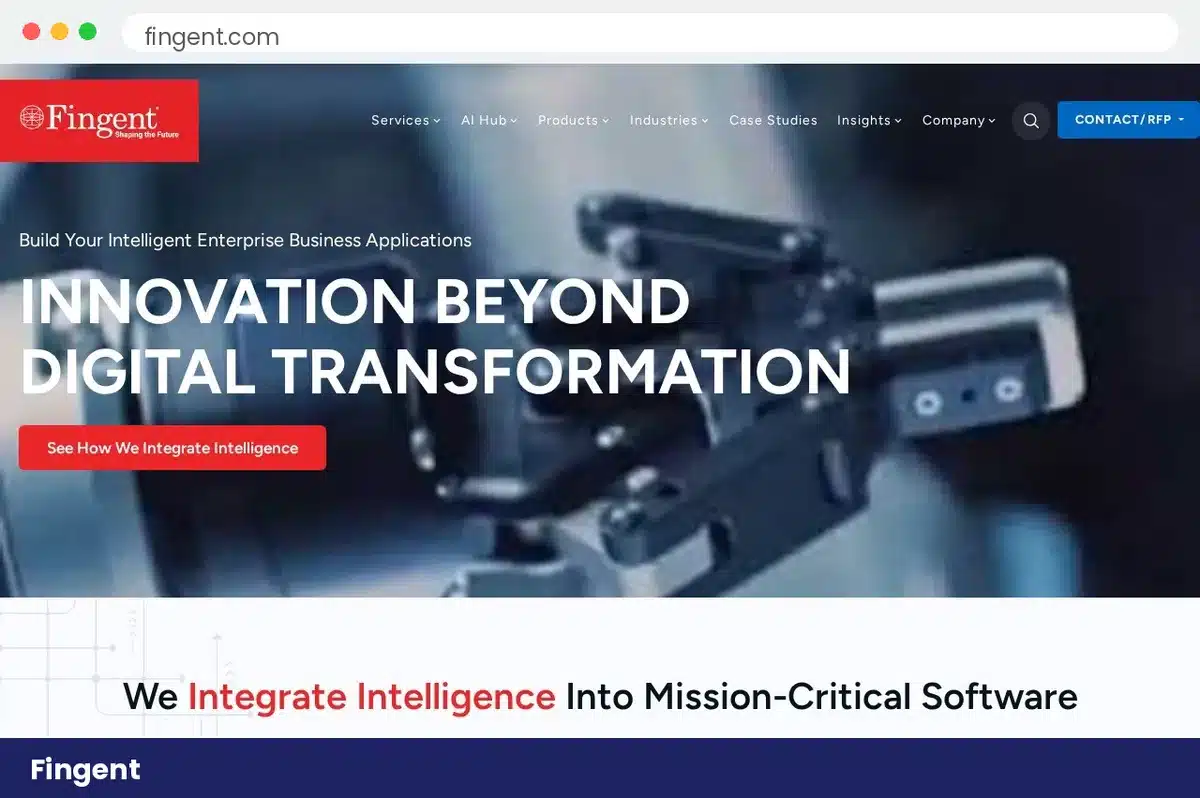
Fingent is a White Plains, New York company founded in 2003, per Clutch, with more than 450 professionals, per its own website. Its CRM work centers on custom CRM development and integration across Salesforce, HubSpot, Pipedrive, Microsoft Dynamics, Zoho,
and custom CRMs through REST APIs, plus Odoo CRM consulting and implementation, per its website. The firm is an official Odoo partner, and named clients include Johnson and Johnson, PwC, and Sony, per OpenPR and GoodFirms.
Clutch lists its rate at $25 to $49 per hour with a $25,000-plus minimum project size.
Key services
Custom CRM development, CRM integration with Salesforce, HubSpot, Pipedrive, Microsoft Dynamics, Zoho, and custom systems via REST API, Odoo CRM consulting and implementation, per the firm’s website.
Strengths
Platform breadth is the argument here. Most small businesses do not need a CRM built from zero; they need their existing Salesforce, HubSpot, or Odoo instance bent to fit their workflow and connected to everything else.
Fingent’s integration-first practice fits that reality, and the Odoo partnership gives open-source-minded buyers a credible low-license-cost path. The named enterprise clients signal procurement-grade delivery discipline.
Honest note
The $25,000-plus minimum project size rules out small starter projects, so this is a mid-market fit rather than a micro-business one. The client roster skews enterprise, so smaller buyers should confirm they will get senior attention and a clear support SLA rather than being a small account in a big portfolio.
4. Belitsoft: Best for budget-conscious custom CRM builds
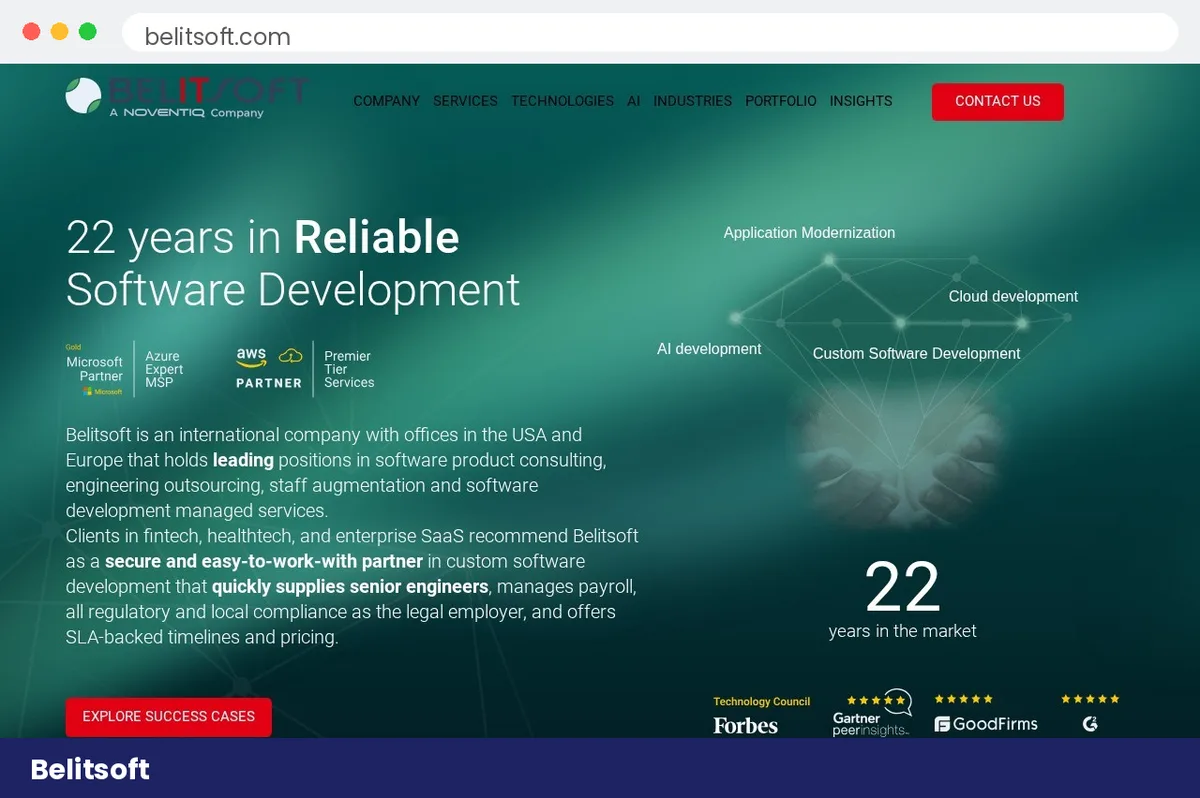
Belitsoft is a Warsaw, Poland company founded in 2004, per Clutch, with more than 400 people, per its GoodFirms profile. Its CRM services include custom CRM development, CRM customization, CRM integration into enterprise software, Microsoft Dynamics extensions,
and maintenance and support, per its website. The firm cites recognition from the Forbes Technology Council and Gartner Peer Insights, per its own site, and its homepage shows Microsoft Partner and AWS Partner badges.
GoodFirms lists its rate at $25 to $49 per hour; Clutch shows pricing as undisclosed.
Key services
Custom CRM development, CRM customization, CRM integration into enterprise software, Microsoft Dynamics extensions, and maintenance and support, per the firm’s website.
Strengths
The value proposition is senior engineering at rates well below US onshore bands. For buyers comfortable with distributed teams, $25 to $49 per hour buys experienced .NET and CRM developers that would cost multiples of that domestically.
Twenty-plus years in business and the partner badges suggest this is not a fly-by-night outsourcing shop, and the maintenance offering means the relationship does not end at launch.
Honest note
The delivery center is in Europe, so US buyers need to plan for timezone overlap and confirm English-language project management in the contract. Pricing is undisclosed on Clutch, so insist on a fixed-scope quote rather than open-ended hourly billing.
Buyers who need in-person workshops should look at the US-based firms on this list.
5. Chetu: Best for end-to-end CRM lifecycle coverage
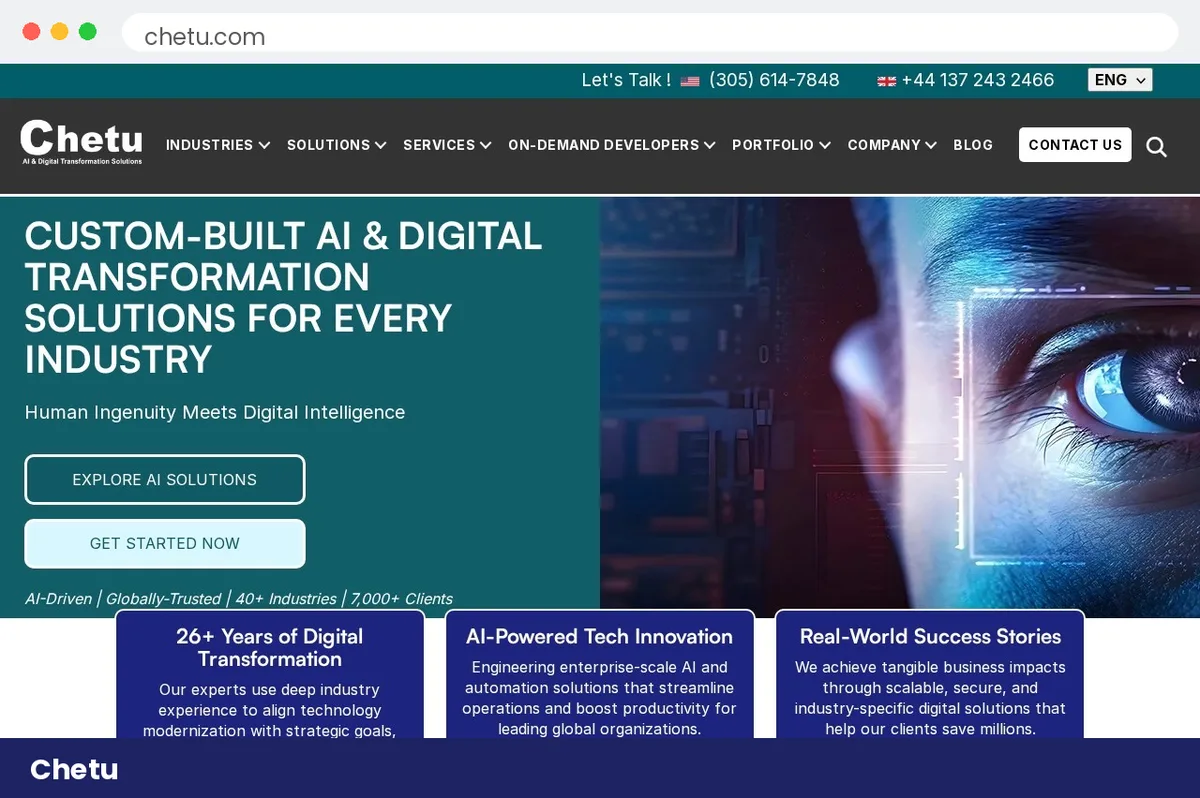
Chetu is a Sunrise, Florida company founded in 2000, per Clutch, with 1,000 to 9,999 employees, per the same directory. Its CRM practice spans custom CRM software development, CRM implementation, CRM migration, CRM integration,
and extensions and plugins for Salesforce, Microsoft Dynamics, Zoho, SugarCRM, and Siebel, per its website. Clutch notes the firm serves startups, small businesses, and Inc. 5000 companies, and lists a $10,000-plus minimum project size with an undisclosed hourly rate.
Key services
Custom CRM software development, CRM implementation, CRM migration, CRM integration, and CRM extensions and plugins for Salesforce, Microsoft Dynamics, Zoho, SugarCRM, OrangeCRM, and Siebel, per the firm’s website.
Strengths
Lifecycle coverage is the differentiator. Few firms handle the full arc from building a custom CRM to migrating legacy data into it, integrating it with the rest of the stack, and maintaining it afterward.
For a small business replacing an old system rather than starting fresh, the migration and integration experience matters more than greenfield development skills.
The $10,000-plus minimum is also one of the more accessible entry points among US-based firms on this list.
Honest note
Chetu is a very large firm, so buyers should confirm exactly who staffs their project rather than assuming the senior people from the sales process. The hourly rate is undisclosed on Clutch, so get fixed-scope pricing in writing.
CRM is one of many practices here, so verify that your team works on CRM systems regularly rather than rotating in from unrelated projects.
6. Radixweb: Best for Microsoft-ecosystem CRM integrations
Radixweb was founded in 2000, per Clutch, and is headquartered in Ahmedabad, India with a US office in Frisco, Texas, per the same directory. The firm reports more than 650 experts, per its website.
Its CRM services include CRM consulting, custom CRM development, CRM implementation, migration, integration, and support and maintenance, per DesignRush and the firm’s own blog.
Proof points include Microsoft Gold Partner status, the IAOP Global Outsourcing 100, and a stated 97 percent repeat client revenue, per the firm’s website.
Clutch lists its rate at $25 to $49 per hour with a $25,000-plus minimum project size.
Key services
CRM consulting, custom CRM development, CRM implementation, CRM migration, CRM integration, and support and maintenance, per DesignRush and the firm’s website.
Strengths
The Microsoft Gold Partner credential is meaningful for buyers running on Microsoft 365 and Dynamics, since CRM integrations with the Microsoft stack are where projects most often go wrong.
The 97 percent repeat client revenue claim, if taken at face value, suggests clients come back, which is the strongest signal a services firm can publish.
The Frisco, Texas office gives US buyers a domestic point of contact even though delivery is largely offshore.
Honest note
Primary delivery happens in India, so confirm working-hours overlap and communication cadence before signing. Despite the low hourly rate, the $25,000-plus minimum project size means the entry ticket is mid-market, not micro-business.
Buyers outside the Microsoft ecosystem get less of the partner-credential advantage.
7. Iflexion: Best for CRM modernization and migration projects
Iflexion was founded in 1999, per Clutch, and reports more than 1,000 professionals and 800-plus customers, per its own website. Its CRM practice covers CRM consulting, end-to-end CRM implementation, custom CRM development, CRM modernization and migration, data migration, integration,
and support, per its website. The firm runs an in-house Salesforce Center of Excellence with more than 30 certified Salesforce specialists, per its site, and names clients including Philips Pronto and a Toyota Motor dealership.
Clutch lists its rate at $25 to $49 per hour with a $10,000-plus minimum project size.
Key services
CRM consulting, end-to-end CRM implementation, custom CRM development, CRM modernization and migration, data migration, CRM integration, and support, per the firm’s website.
Strengths
Modernization is the standout. Many small businesses do not need a first CRM; they need to escape a spreadsheet, an aging on-premise system, or a Salesforce instance that grew into a mess.
Iflexion’s migration and modernization focus, backed by 30-plus certified Salesforce specialists, fits that job precisely. The $10,000-plus minimum project size is also among the lowest entry points on this list.
Honest note
The client list skews heavily enterprise, with names like PepsiCo, Toyota, eBay, and PayPal on the homepage, so smaller buyers should confirm project priority and response times in the contract.
Delivery is offshore-led, which demands clear communication terms. Buyers wanting a fully custom build rather than platform work should weigh the Salesforce-centric positioning.
How to Choose the Right CRM Development Partner
Match the firm to your constraints, not to a ranking. Five questions cut through the noise:
What is your real budget band?
A first custom CRM for a small business commonly lands between $10,000 and $30,000 for a focused build, according to Inventco Labs, while fuller systems with automation and integrations run $25,000 to $150,000 per 2026 pricing guides from Space-O Technologies and Purrweb.
SaaS alternatives like Salesforce or HubSpot charge $25 to $300 per user per month, which compounds fast at scale. Get a fixed-scope quote before comparing hourly rates, because scope differences dwarf rate differences.
Has the firm built for businesses like yours?
Ask for two references in your industry or a similar one. A CRM for a 20-person law firm and a CRM for a home services company share almost nothing except the word CRM. Industry experience shows up in the questions a firm asks during discovery: if they are not asking sharp questions about your workflow, they have not done your kind of work.
Will it integrate with the tools you already use?
A CRM that cannot talk to your email, accounting, and marketing tools becomes another silo. Ask specifically which integrations are included in the quote and which cost extra.
Firms experienced with CRM work will name the APIs and platforms they have connected before, not promise that everything is possible in the abstract.
Who owns the data and the code?
Confirm data ownership, code ownership, and export terms in writing. With a custom build you should own both. With a platform customization, make sure you can export your data in a usable format if you ever leave.
Get the answer in the contract, not in a sales call.
What happens after launch?
Plan for 15 to 20 percent of the build cost per year in maintenance and evolution, the range cited by Infosee Media and SumatoSoft. Ask about maintenance and support plans, response times, and how new features are priced.
A CRM is never finished; the launch is the midpoint, not the end.
Red Flags When Evaluating CRM Firms
Not every firm that looks polished is a safe choice. Watch for these warning signs during evaluation:
No CRM work in the portfolio
A firm that lists CRM development as a service but shows no CRM projects, case studies, or client names in that area is asking you to be the experiment. Legitimate CRM shops can point to shipped systems.
Vague about data migration
Moving your existing contacts, deals, and history into a new CRM is where projects most often stall. If a firm waves this away as a minor step, they have not done it enough times. Ask for their migration process in writing.
One-size-fits-all demos
If the discovery demo shows the same generic sales pipeline every prospect sees, with no questions about your actual workflow, you are being sold a template. Custom CRM work starts with your process, not their slide deck.
No third-party reviews
A firm with only testimonials on its own website and nothing on Clutch, Google, or a similar platform is asking you to take its word for everything. Legitimate firms accumulate independent reviews over time.
Unwilling to discuss failure
Every experienced firm has a project that went sideways, often a CRM adoption that stalled because the team would not use it. How they talk about it tells you more than any case study. Evasion here is a signal to walk away.
Frequently Asked Questions
How much does custom CRM development cost for a small business?
A focused first CRM for a small business commonly lands between $10,000 and $30,000, according to Inventco Labs. Broader 2026 pricing guides put basic builds at $20,000 to $45,000 and fuller systems with automation and integrations at $25,000 to $150,000, per Merehead, Space-O Technologies, and Purrweb. For comparison, SaaS platforms like Salesforce or HubSpot charge $25 to $300 per user per month, per Merehead. Plan for 15 to 20 percent of the build cost per year in maintenance and evolution, the range cited by Infosee Media and SumatoSoft.
Should a small business buy an off-the-shelf CRM or build a custom one?
Buy off-the-shelf when your process already matches the platform’s model and you need to be running this month. Build custom when your workflow is the competitive advantage, when per-seat SaaS fees compound painfully at your headcount, or when you need deep integration with industry-specific tools that platforms handle poorly. Many small businesses land in the middle: a platform like HubSpot or Odoo customized by a firm like the ones on this list. That hybrid is often the best value for teams under 50 people.
How long does it take to build a custom CRM?
A basic CRM with contact management, a sales pipeline, and reporting typically takes 2 to 4 months, per Merehead and Infosee Media. A mid-level system with automation, integrations, and a mobile app runs 4 to 8 months, per Space-O Technologies and Infosee Media. Enterprise-grade builds with AI features and deep ERP integration stretch to 8 to 18 months. The biggest timeline risk is not coding; it is unclear requirements and slow feedback from your own team during discovery.
What should I check before hiring a CRM development company?
Verified client reviews on Clutch or a similar third-party platform, a portfolio with actual CRM projects rather than generic software work, a written data migration process, clear data and code ownership terms, and a defined post-launch support plan. Ask how they handle user adoption, because the most common CRM failure is a system the team refuses to use. Vagueness on any of these is a red flag.
Can a custom CRM integrate with the tools I already use?
Yes, and it should. CRM value comes from connection, not isolation. Integrations with email platforms, accounting software, marketing tools, and phone systems are standard work for the firms on this list. Budget roughly $2,000 to $10,000 per integration depending on API complexity, per Inventco Labs, and ask which integrations are included in the quote versus billed separately.
What are the risks of a custom CRM for a small business?
Three honest ones. First, scope creep: without disciplined discovery, a $25,000 build quietly becomes a $60,000 one. Second, adoption: a technically perfect CRM fails if the team finds it harder than the spreadsheet it replaced, so training and change management are not optional extras. Third, maintenance: custom software needs ongoing care, typically 15 to 20 percent of build cost per year, so a build with no support plan is a liability, not an asset.
Need a CRM built around how your team actually works?