
A coupon and discount engine is a backend service that evaluates, validates, and applies promotional rules to a customer’s cart in real time. It manages the full lifecycle of a promotion from code generation and eligibility checking to redemption recording and analytics.
E-commerce platforms, SaaS products, and marketplace applications rely on this engine to execute discount rules without hardcoding business logic into the application layer.
What Is a Coupon & Discount Engine?
A discount engine is a rule-based decision system that receives cart data as input and returns a modified price as output. The engine processes 3 core operations: eligibility evaluation, discount calculation, and redemption recording. These operations execute in sequence on every checkout request.
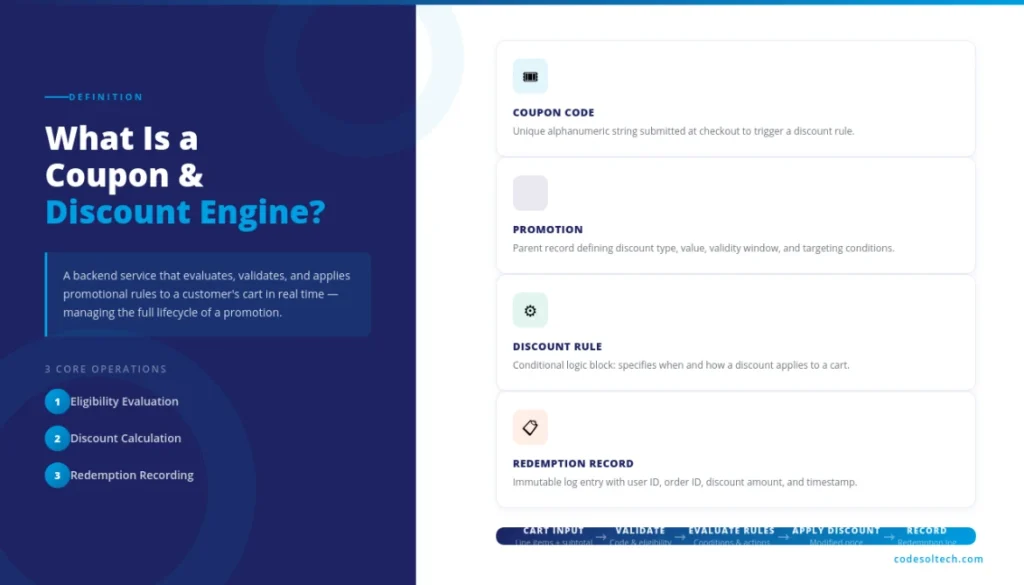
The engine separates promotion logic from the application codebase through a dedicated microservice. This separation lets marketing teams configure new discount rules: percentage off, fixed amount, BOGO, free shipping without requiring a code deployment.
Rule configuration happens through an admin interface that writes to the promotion database.
Core Entities of a Discount Engine
- Coupon Code: A unique alphanumeric string (e.g.,
SUMMER20) that a user submits at checkout to trigger a discount rule. - Promotion / Campaign: The parent record that defines the discount type, value, validity window, and targeting conditions.
- Discount Rule: A conditional logic block that specifies when and how a discount applies — e.g., “10% off orders above $50 for users in Segment A.”
- Redemption Record: An immutable log entry created after a coupon is successfully applied, storing the user ID, order ID, discount amount, and timestamp.
- Voucher: A single-use coupon pre-assigned to a specific user, commonly distributed via email or loyalty programs.
5 Discount Types a Robust Engine Must Support
Every production-grade discount engine supports at least 5 distinct discount types. Each type requires a separate calculation function within the engine’s core pricing module.
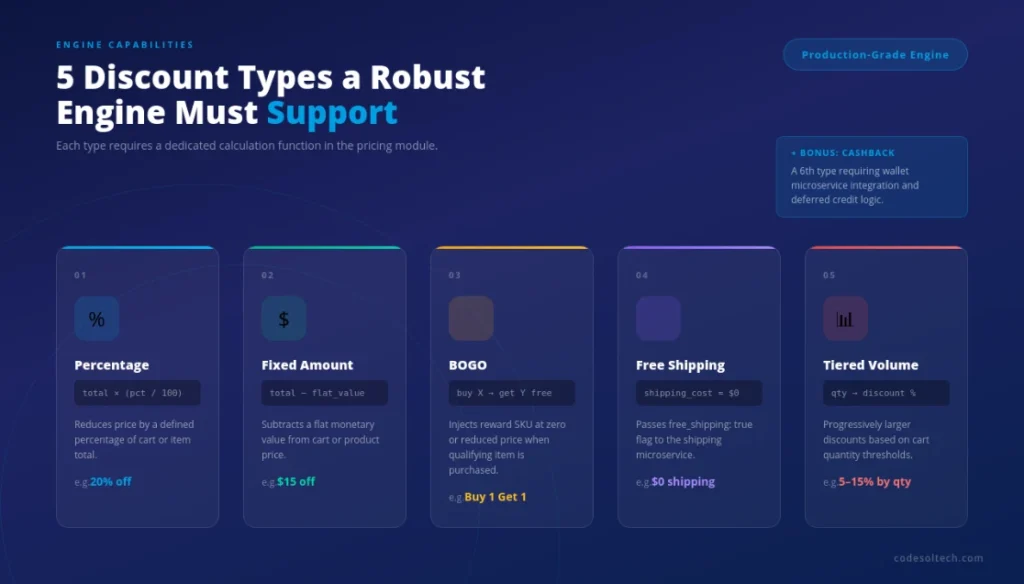
- Percentage Discount: Reduces the order total or item price by a defined percentage. Formula:
discount_amount = cart_total × (percentage / 100). - Fixed Amount Discount: Subtracts a flat monetary value from the cart total or a specific product price. A $15 fixed discount on a $40 order yields a $25 net price.
- Buy X Get Y (BOGO): Adds a free or discounted product to the cart when a qualifying product is purchased. The engine identifies the qualifying SKU and injects the reward SKU at zero or reduced price.
- Free Shipping: Overrides the shipping cost calculation, returning $0 for qualifying carts. The engine passes a
free_shipping: trueflag to the shipping microservice. - Tiered / Volume Discount: Applies progressively larger discounts based on cart quantity thresholds — e.g., 5% off for 3 items, 10% off for 6 items, 15% off for 10+ items.
A cashback discount is a sixth type where the engine records a future credit to the user’s wallet rather than deducting from the current order total. This type requires integration with a wallet microservice and deferred credit logic.
How Do Discount Rules Work in a Coupon Engine?
Discount rules are conditional expressions evaluated against the cart context. The engine receives a cart object containing line items, subtotal, user ID, and shipping address and evaluates each active discount rule against this context to determine eligibility.
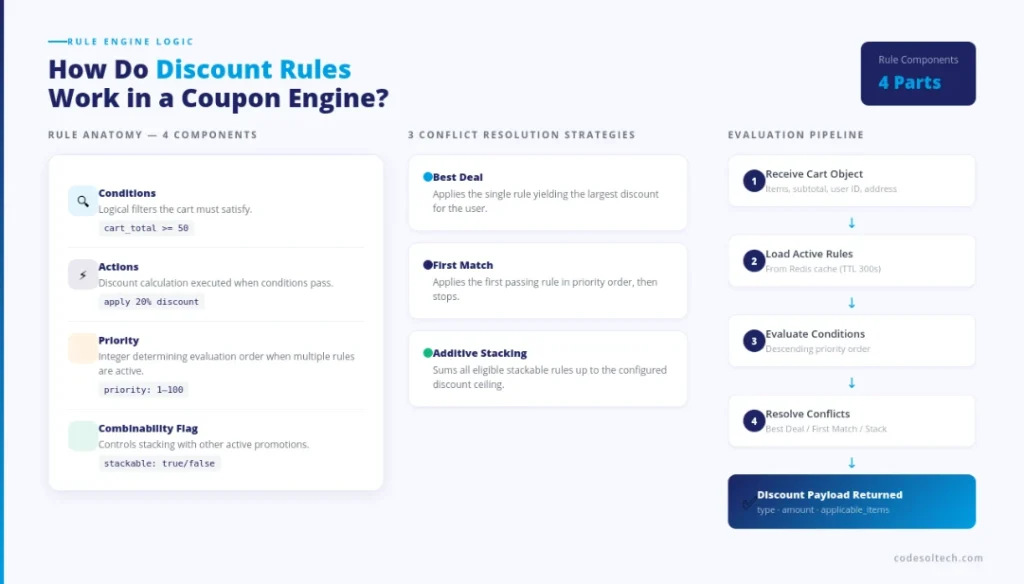
A discount rule contains 4 components:
- Conditions: Logical filters the cart must satisfy — e.g.,
cart_total >= 50,user.segment == "VIP",product_category == "electronics". - Actions: The discount calculation to apply when all conditions pass — e.g., apply 20% discount to matching line items.
- Priority: An integer that determines evaluation order when multiple rules are active simultaneously.
- Combinability Flag: A boolean (
stackable: true/false) that controls whether this rule can combine with other active promotions.
Rule Evaluation Order and Conflict Resolution
The engine evaluates rules in descending priority order. When 2 conflicting non-stackable rules both pass eligibility, the engine applies only the highest-priority rule and skips the rest.
When stackable rules are enabled, the engine applies all passing rules sequentially and caps the total discount at a predefined maximum discount ceiling typically configured as a percentage of cart total (e.g., 40%).
Conflict resolution strategies fall into 3 categories:
- Best Deal: The engine applies the single rule that yields the largest discount amount for the user.
- First Match: The engine applies the first rule that passes eligibility in priority order and stops.
- Additive Stacking: The engine applies all eligible stackable rules and sums the discount amounts up to the configured ceiling.
Coupon Engine System Architecture
A production coupon engine deploys as a standalone microservice with 4 internal layers: the API Gateway, the Validation Service, the Rule Evaluation Engine, and the Persistence Layer.
Each layer has a single responsibility, enabling independent scaling and testing.
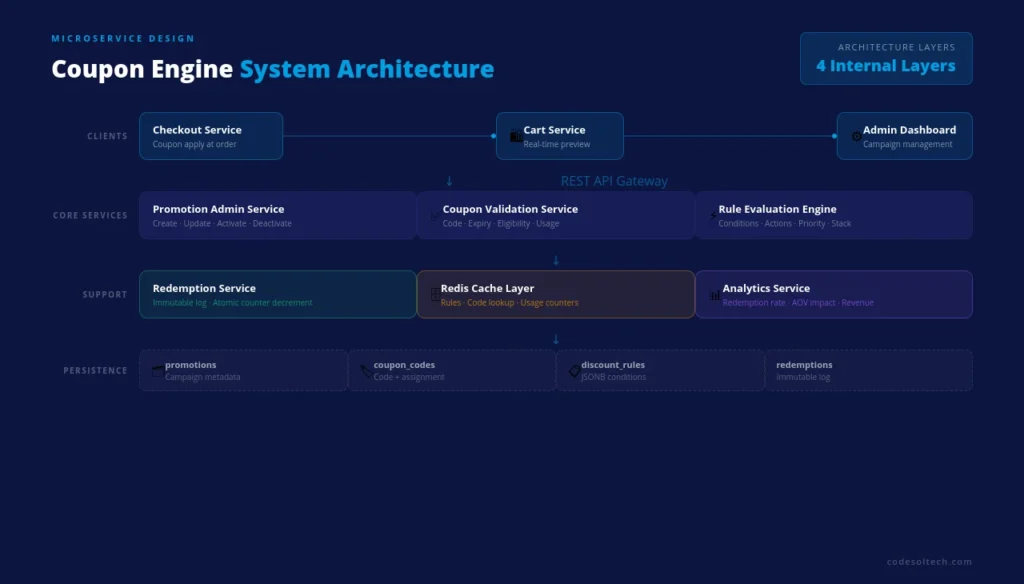
High-Level Architecture Components
- Promotion Admin Service: Provides a REST API for creating, updating, activating, and deactivating promotions. Writes to the promotion database and invalidates the rule cache on every change.
- Coupon Validation Service: Accepts a coupon code and cart context. Checks code existence, expiry date, usage limits, and user eligibility before passing to the rule engine.
- Rule Evaluation Engine: The core processing unit. Loads active rules from cache (Redis), evaluates conditions against the cart context, resolves conflicts, and returns the discount payload.
- Redemption Service: Records a redemption entry in the database after order confirmation. Decrements the usage counter on the promotion record atomically using database transactions.
- Analytics & Reporting Service: Aggregates redemption data to compute metrics — total discount issued, redemption rate per campaign, revenue impact, and average order value (AOV) with/without discount.
Database Schema Design
The promotion database requires 4 primary tables: promotions, coupon_codes, discount_rules, and redemptions. The promotions The table stores the campaign metadata name, start date, end date, budget cap, and max redemptions.
The discount_rules table stores the serialized conditions and actions as a JSON column, enabling flexible rule configuration without schema migrations.
- promotions:
id, name, type, start_at, end_at, max_uses, current_uses, stackable, status - coupon_codes:
id, promotion_id, code, is_unique, assigned_user_id, used_at - discount_rules:
id, promotion_id, priority, conditions (JSONB), actions (JSONB), combinable - redemptions:
id, coupon_code_id, user_id, order_id, discount_amount, redeemed_at
What Are the Critical Validation Checks in Coupon Code Processing?
Coupon validation executes 6 sequential checks before the rule engine runs. Failing any single check returns an error response immediately, preventing unnecessary computation in downstream services.
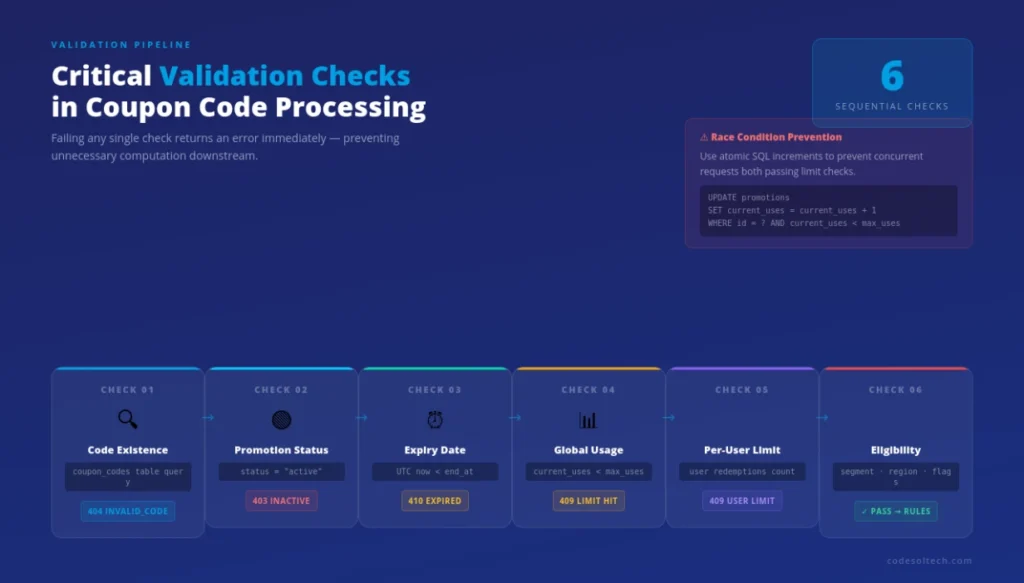
- Code Existence Check: Queries the
coupon_codestable. Returns404 INVALID_CODEif the code does not exist. - Status Check: Verifies the parent promotion has
status = "active". Deactivated or paused promotions return403 PROMOTION_INACTIVE. - Expiry Check: Compares the current UTC timestamp against
promotions.end_at. Expired promotions return410 COUPON_EXPIRED. - Global Usage Limit Check: Compares
promotions.current_usesagainstpromotions.max_uses. Exhausted promotions return409 USAGE_LIMIT_REACHED. - Per-User Usage Limit Check: Counts redemption records for the specific user and coupon. Exceeding the per-user limit returns
409 USER_LIMIT_REACHED. - Eligibility Check: Evaluates user-targeting conditions — segment membership, account age, geographic region, or first-time purchase flag.
Race conditions in usage limit checks require optimistic locking or atomic database increments. Two concurrent requests can both pass the limit check if reads occur before either write commits.
The correct implementation uses a SQL atomic update: UPDATE promotions SET current_uses = current_uses + 1 WHERE id = ? AND current_uses < max_uses. Zero rows affected indicates the limit is already reached.
Coupon Code Generation Strategies
Coupon codes follow 2 structural patterns: generic codes (one code shared across all users) and unique codes (one code per user, generated in bulk). Generic codes are simpler to manage but vulnerable to mass sharing.
Unique codes require a bulk generation service but enable precise per-user tracking and abuse prevention.
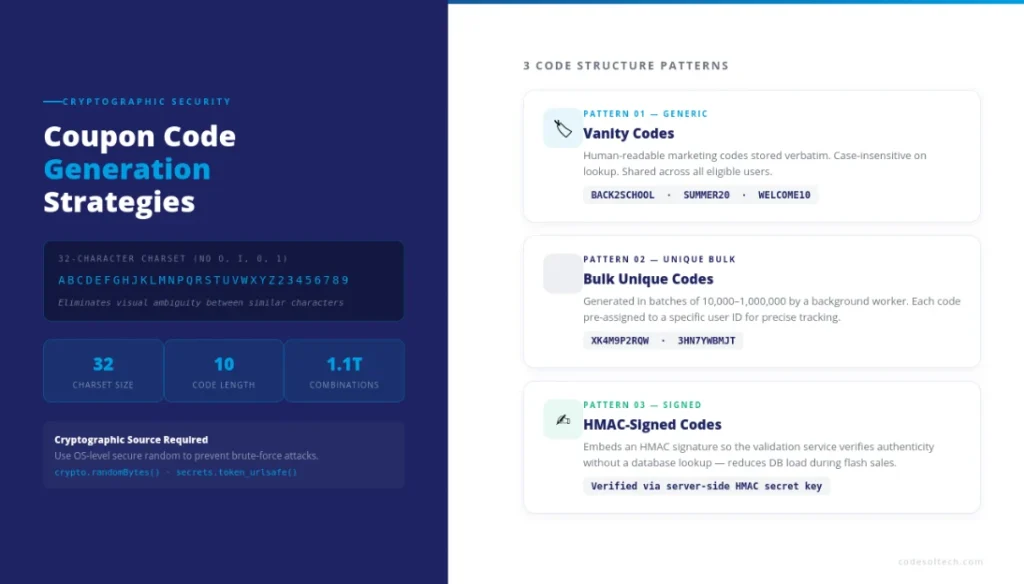
Code Format and Entropy
A coupon code uses a character set of 32 alphanumeric characters (A-Z excluding O, I; 0-9 excluding 0, 1) to eliminate visual ambiguity. A 10-character code from this charset produces 3210 = 1.125 trillion unique combinations, sufficient for any campaign scale.
The code generator uses a cryptographically secure random source (crypto.randomBytes in Node.js or secrets.token_urlsafe in Python) to prevent brute-force guessing attacks.
- Vanity Codes: Human-readable codes like
BACK2SCHOOLfor marketing campaigns. Stored verbatim, case-insensitive on lookup. - Bulk Unique Codes: Generated in batches of 10,000 to 1,000,000 using a background worker. Stored in the
coupon_codestable withassigned_user_idpre-populated. - Signed Codes: Codes that embed an HMAC signature so the validation service verifies authenticity without a database lookup. Reduces database load for large-scale campaigns.
Promotions Management: Campaign Lifecycle and Targeting
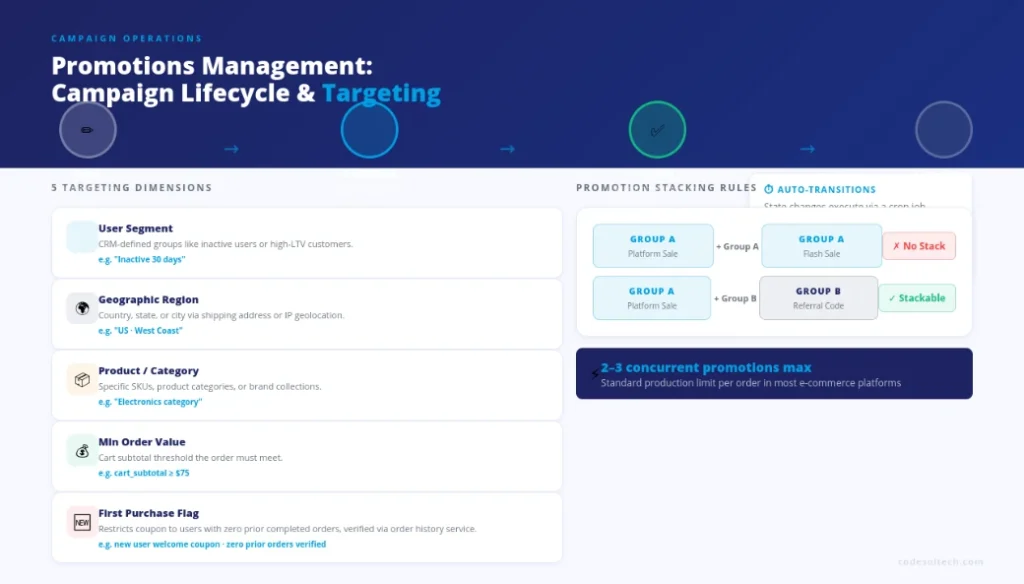
A promotion campaign moves through 4 states: draft → scheduled → active → completed. The promotion admin service manages state transitions. Automated state transitions (scheduled → active at start_at, active → completed at end_at) execute via a cron job or event scheduler that runs every 60 seconds.
Promotion Targeting Options
Targeted promotions deliver discounts to specific user segments rather than all users. Targeting reduces discount budget waste and increases promotion relevance. A promotion supports 5 targeting dimensions:
- User Segment: Targets users belonging to a predefined CRM segment — e.g., “Inactive for 30 days,” “High-LTV customers,” “Mobile app users.”
- Geographic Region: Restricts the promotion to users in specific countries, states, or cities based on shipping address or IP geolocation.
- Product / Category: Applies the discount only to items belonging to specific SKUs, product categories, or brand collections.
- Minimum Order Value: Sets a cart subtotal threshold the order must meet before the discount activates — e.g.,
cart_subtotal >= $75. - First Purchase Flag: Restricts the coupon to users with zero prior completed orders, verified via the order history service.
Promotion Stacking and Combinability Rules
Promotion stacking defines whether multiple active coupons apply simultaneously to one order. Stacking is the most complex business rule in any discount engine.
The standard industry approach uses a promotion group entity: promotions in the same group cannot stack with each other, but a promotion from Group A can stack with a promotion from Group B.
- A platform-wide sale promotion (Group A) stacks with a referral coupon (Group B) but not with another platform sale (Group A).
- The engine checks group membership before applying the second promotion and rejects it if a conflicting group member is already applied.
- A maximum of 2 to 3 concurrent promotions per order is the standard production limit for most e-commerce platforms.
Coupon Engine API Design
The discount engine exposes 4 primary REST API endpoints consumed by the checkout service, the cart service, and the admin dashboard.
All endpoints return JSON. Validation endpoint response time must remain below 200ms at the 95th percentile to avoid impacting checkout conversion rates.
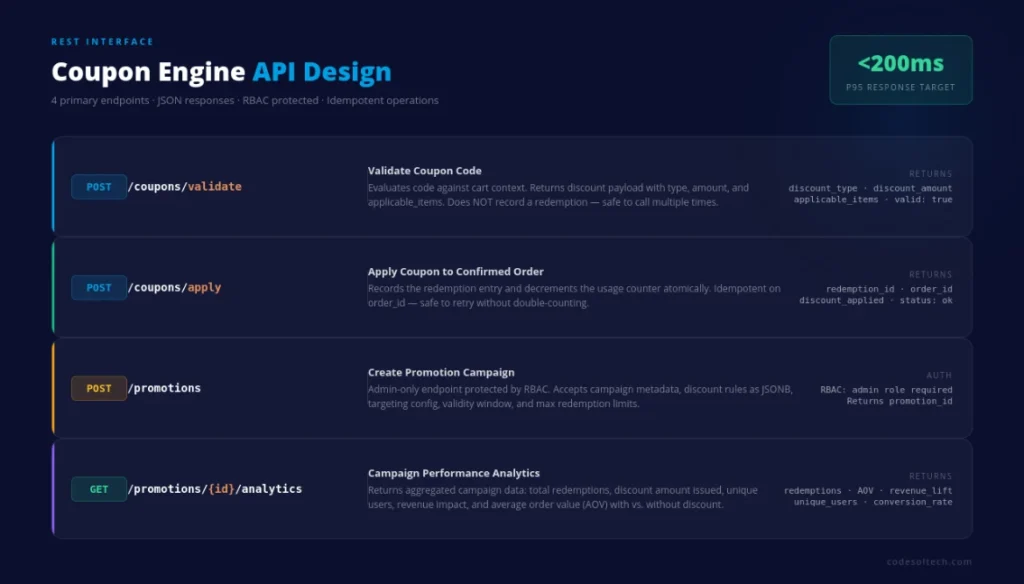
- POST /coupons/validate — Validates a coupon code against a cart context. Returns the discount payload, including
discount_type,discount_amount, andapplicable_items. Does not record a redemption. - POST /coupons/apply — Applies the coupon to a confirmed order. Records the redemption entry and decrements the usage counter. Idempotent on
order_id. - POST /promotions — Creates a new promotion campaign with discount rules and targeting configuration. Admin-only endpoint protected by role-based access control (RBAC).
- GET /promotions/{id}/analytics — Returns campaign performance data: total redemptions, total discount issued, unique users, conversion lift, and revenue impact.
Performance Optimization for Discount Engine at Scale
A high-traffic e-commerce platform processes 500 to 5,000 checkout validation requests per second during peak periods.
The discount engine must serve these requests without degrading checkout performance. 3 caching strategies address this requirement.
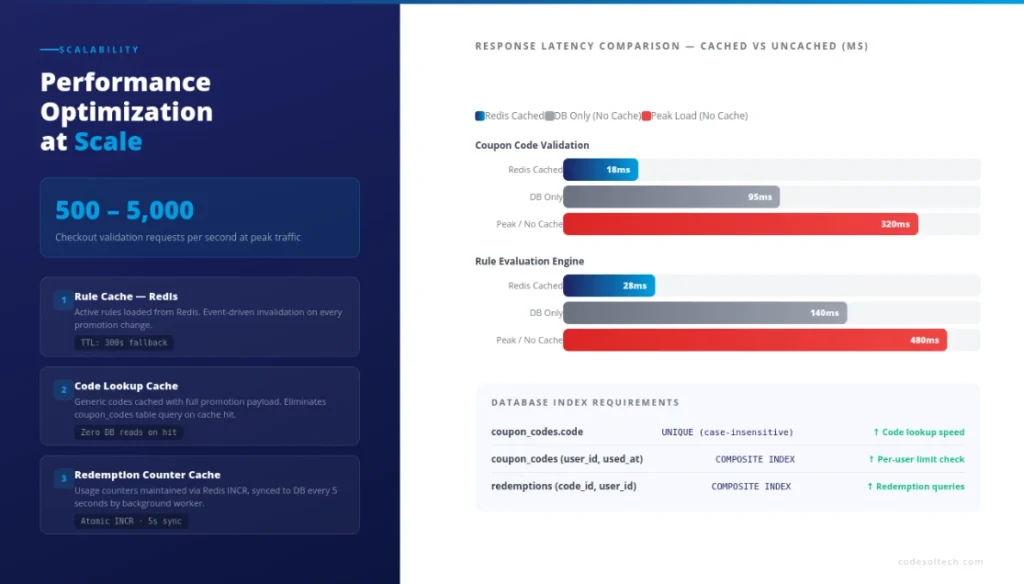
- Rule Cache (Redis): Active discount rules load from Redis on engine startup and on every promotion change event. Cache TTL is set to 300 seconds as a fallback, with event-driven invalidation as the primary mechanism. This eliminates database queries on the hot validation path.
- Code Lookup Cache: Frequently used generic coupon codes (e.g., sitewide sale codes) are cached in Redis with the full promotion payload. A cache hit eliminates the
coupon_codestable query entirely. - Redemption Counter Cache: Usage counters are maintained in Redis using atomic
INCRoperations and synced to the database every 5 seconds by a background worker. This prevents thepromotionstable from becoming a write bottleneck during flash sales.
Database indexing is critical for validation performance. The coupon_codes The table requires a unique index on code (case-insensitive) and a composite index on (assigned_user_id, used_at).
The redemptions The table requires a composite index on (coupon_code_id, user_id) for per-user limit lookups.
Coupon Fraud Prevention Mechanisms
Coupon fraud costs e-commerce businesses an estimated $300 million annually, according to industry reports. A discount engine implements 4 fraud prevention layers to detect and block abusive redemption patterns.
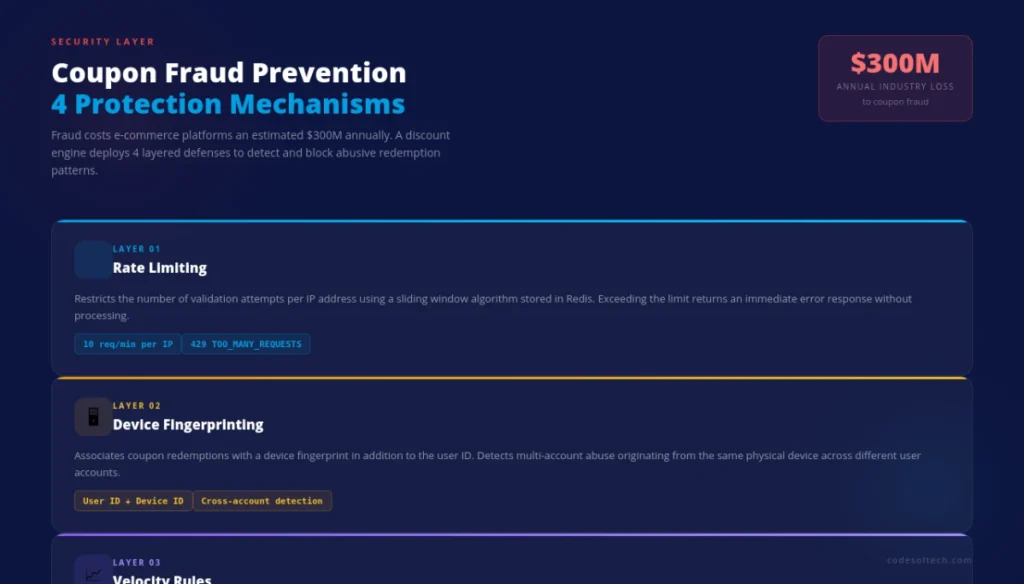
- Rate Limiting: Restricts the number of validation attempts per IP address to 10 per minute using a sliding window algorithm in Redis. Exceeding the limit returns
429 TOO_MANY_REQUESTS. - Device Fingerprinting: Associates coupon redemptions with a device fingerprint in addition to the user ID. Detects multi-account abuse from the same device.
- Velocity Rules: Flags promotions where a single coupon code is validated more than 1,000 times per hour, indicating mass sharing or bot activity. Triggers an automatic pause alert to the admin team.
- HMAC Code Signing: Signed coupon codes embed a server-side HMAC signature that the validation service verifies before any database query. Invalid signatures are rejected immediately, blocking fabricated code attempts.
Build vs. Buy: When to Develop a Custom Discount Engine
The build-vs-buy decision for a coupon engine depends on 3 factors: transaction volume, rule complexity, and integration requirements.
Off-the-shelf solutions like Voucherify, Talon. One and Offer18 handle standard discount types and provide SDKs for rapid integration.
Custom-built engines are necessary when the business requires proprietary rule logic, real-time pricing integration, or data sovereignty.
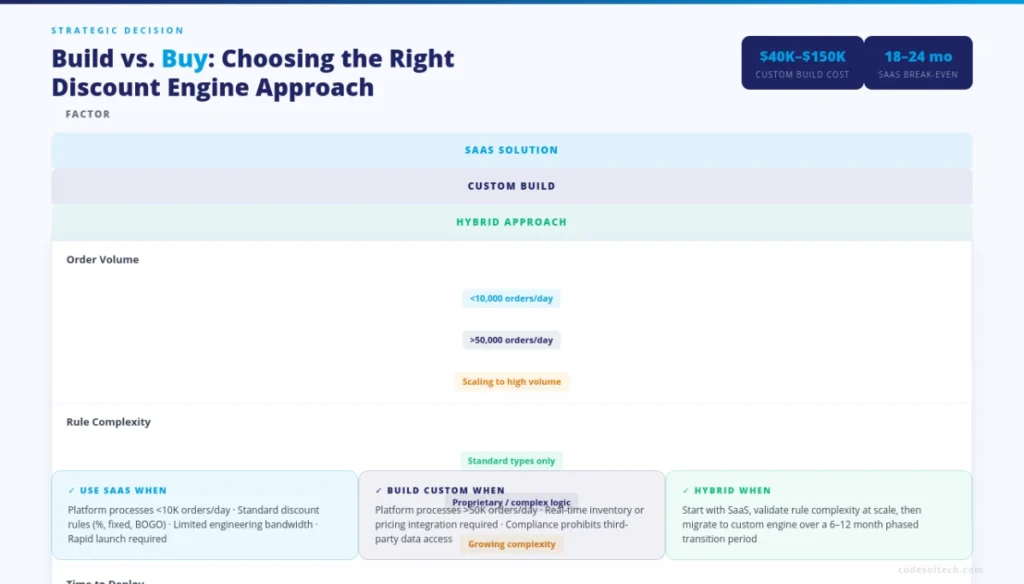
- Use a SaaS solution when: the platform processes fewer than 10,000 orders/day, discount rules are standard (percentage, fixed, BOGO), and engineering bandwidth is limited.
- Build a custom engine when: the platform processes more than 50,000 orders/day, discount rules integrate with real-time inventory or dynamic pricing, or compliance requirements prohibit third-party data access.
- Use a hybrid approach when: the platform starts with a SaaS solution and migrates to a custom engine after validating rule complexity at scale — a 6-to-12 month phased transition is the standard approach.
Custom engine development cost ranges from $40,000 to $150,000 for initial build, depending on team size and feature scope.
SaaS solutions cost $500 to $5,000 per month at mid-scale. Break-even typically occurs at 18 to 24 months of SaaS subscription costs.
Final Words
A coupon and discount engine is not a simple lookup table. It is a rule evaluation system with validation pipelines, fraud layers, and real-time performance requirements.
Businesses that architect this engine correctly, with clear discount-rule separation, atomic redemption recording, and Redis-backed caching, execute promotions that scale without breaking checkout.
The architecture decisions made at the design stage directly determine both the marketing team’s agility and the platform’s revenue integrity.
Ready to Build Your Coupon & Discount Engine?
Our engineering team designs and develops production-grade discount engines from rule configuration interfaces to high-concurrency validation APIs.
Whether you need a custom build or a migration from a SaaS solution, we deliver systems engineered for performance, fraud prevention, and marketing flexibility.