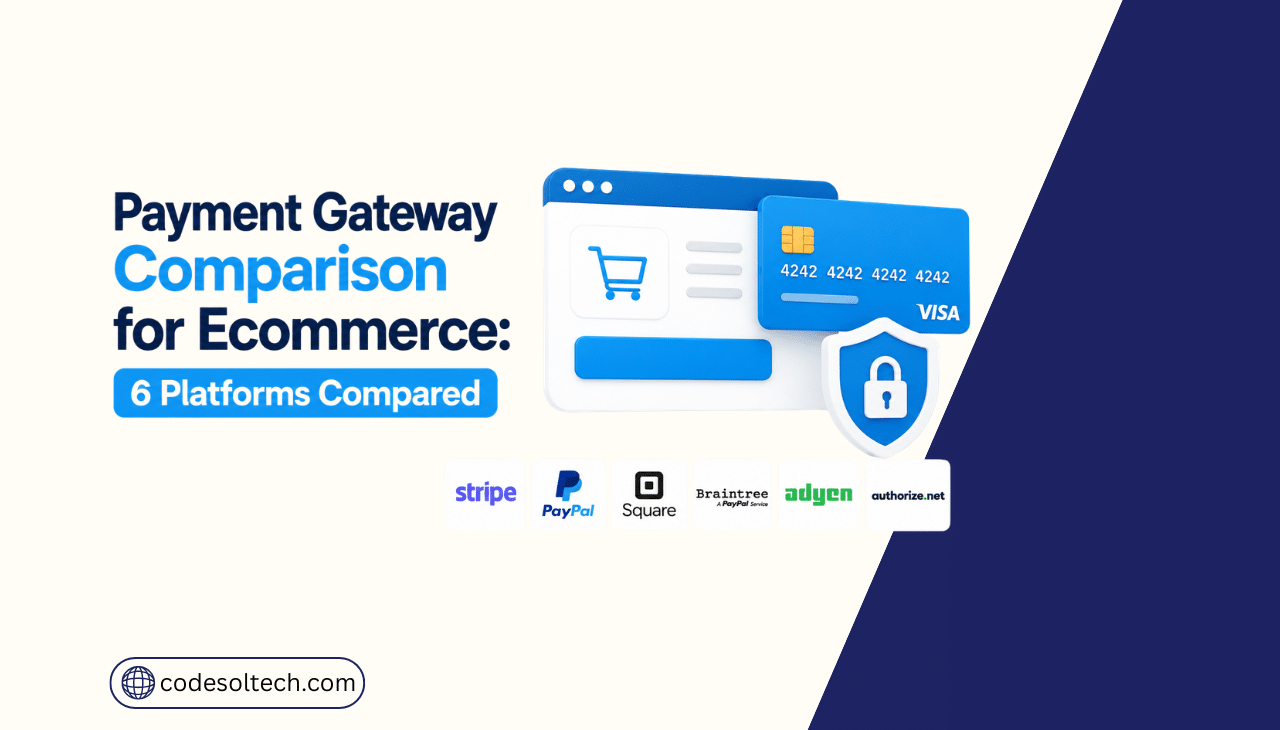
A payment gateway encrypts and routes card data from checkout to the acquiring bank for authorization. Stripe charges 2.9% + 30¢ domestically; PayPal charges 2.99% to 3.49% + $0.49; Square, Braintree, Adyen, and Authorize.net each price differently by architecture and volume. The right choice depends on the integration model, not just the advertised rate.
This article compares six gateways, Stripe, PayPal, Square, Braintree, Adyen, and Authorize.net, on true cost, API architecture, PCI liability, and fit for custom ecommerce checkout builds, using fee schedules published directly by each provider.
What Is a Payment Gateway and How Does It Process Ecommerce Transactions?
A payment gateway is the software layer that captures card data at checkout, encrypts it, and transmits it to a payment processor for authorization.
The processor forwards the request to the card network, which routes it to the issuing bank. The issuing bank approves or declines the transaction in real time and returns the result through the same chain.
Every ecommerce transaction moves through four distinct steps:
- Capture. The gateway collects card or wallet data through a hosted field, SDK, or API call.
- Encryption and tokenization. The gateway converts raw card data into a token, removing the merchant’s server from PCI DSS scope for that data.
- Authorization. The processor sends the token to the card network, which checks the issuing bank for available funds and fraud signals.
- Settlement. Approved funds move from the issuing bank to the merchant’s account, typically within 2 to 7 business days.
Gateways operate in one of two architectures. A hosted gateway redirects the customer to a third-party domain to enter payment data, which reduces the merchant’s PCI compliance burden but adds a page load and a brand discontinuity.
An embedded gateway keeps the customer on the merchant’s domain using tokenized iframes or SDKs, which preserves checkout branding but requires deeper custom ecommerce development work to implement correctly.
Stripe API vs PayPal API: Architecture, Customization, and Developer Experience
Stripe is built API-first. Every product, from Payment Intents to Billing to Connect, is documented as a REST endpoint with SDKs in Node.js, Python, Ruby, Java, PHP, and Go.
Developers build checkout flows, subscription logic, and marketplace payouts entirely through code, without depending on a hosted UI unless they choose Stripe Checkout for speed.
PayPal’s API surface is split across multiple products: PayPal Checkout, Braintree, and Payflow Pro each expose different endpoints and SDKs.
A merchant integrating “PayPal” today typically builds against the PayPal Checkout REST API, which supports Smart Payment Buttons, but deeper customization requires either Braintree (PayPal’s acquired platform) or the legacy Payflow gateway.
This fragmentation increases integration time for teams building fully custom checkout flows.
Three technical differences matter most for custom ecommerce builds:
- Webhook design. Stripe issues granular event types (
payment_intent.succeeded,charge.dispute.created) with automatic retries and a signing secret for verification. PayPal’s IPN and webhook system covers fewer event granularities and requires separate configuration per product line. - Idempotency. Stripe supports idempotency keys on every write request by default, preventing duplicate charges on network retries. PayPal requires manual handling of request IDs to achieve the same level of protection.
- Test environment. Stripe provides a full sandbox with test cards for every failure state (insufficient funds, 3D Secure challenge, currency mismatch). PayPal’s sandbox requires separate developer and business test accounts, adding setup steps before the first test transaction.
Stripe publishes uptime data and processes more than 500 million API requests per day, which it cites as evidence of infrastructure built for high-volume, code-first integration.[1]
PayPal does not publish equivalent uptime figures, but its checkout button remains the most recognized payment brand for buyers who prioritize familiarity over checkout customization.
Payment Gateway Comparison Table: Stripe vs PayPal on Fees and Integration Model
| Factor | Stripe | PayPal |
|---|---|---|
| Domestic transaction fee | 2.9% + 30¢ per successful card charge | 2.99% + $0.49 (standard card) or 3.49% + $0.49 (PayPal Checkout / Venmo) |
| International card surcharge | +1.5% on top of domestic rate | +1.5% on top of domestic rate |
| Currency conversion fee | +1% if conversion is required | 3% to 4% conversion spread |
| Chargeback fee | Varies by risk profile; disclosed at account setup | $20.00 per chargeback (standard rate) |
| Dispute fee | Included in standard pricing for most accounts | $15.00 standard; $30.00 for high-dispute-rate accounts |
| Integration model | API-first; single unified SDK across products | Fragmented across PayPal Checkout, Braintree, and Payflow APIs |
| Checkout architecture | Embedded (hosted fields) or fully custom via Elements | Hosted redirect (Standard) or embedded (Braintree/Payflow Pro) |
| Best fit | Custom checkout builds, subscription billing, marketplaces | Buyer trust and one-click familiarity at checkout |
Rates confirmed against Stripe’s official pricing page and PayPal’s official U.S. merchant fee schedule as of July 2026.[2][3] Both providers revise fee schedules periodically; confirm current rates in your account dashboard before finalizing a build estimate.
Square, Braintree, Adyen, and Authorize.net: Where the Other Four Gateways Fit
Stripe and PayPal cover most standalone ecommerce builds, but four other gateways solve specific architectural problems Stripe and PayPal do not prioritize: omnichannel POS integration, PayPal’s backend with more API control, true interchange-cost transparency at scale, and legacy merchant-account compatibility.
| Gateway | Domestic Fee | Integration Model | Best Fit |
|---|---|---|---|
| Square | 2.9% + 30¢ (Plus/Premium plan); 3.3% + 30¢ (Free plan); +1.5% international | Online API (SAQ A-eligible) plus native in-person POS hardware on the same dashboard | Merchants running online and physical retail through one unified system |
| Braintree | 2.9% + $0.30 standard US rate; custom interchange-plus pricing available at volume | Drop-in UI or Hosted Fields (SAQ A/A-EP); PCI DSS Level 1 validated service provider | Teams that want PayPal, Venmo, and card processing under one PayPal-owned API with more control than PayPal Checkout |
| Adyen | Interchange++ (acquirer markup from 0.60% + actual interchange + scheme fee); no flat blended rate | Single platform API covering cards and local payment methods across countries | High-volume, multi-country merchants who want to pay true interchange cost instead of a blended margin |
| Authorize.net | $25/month + 2.9% + $0.30 per transaction (All-in-One plan) | Gateway-only API; requires a separate merchant account for the Gateway-Only plan | Merchants who already have a merchant account and want a dedicated, stable gateway rather than an all-in-one platform |
Rates confirmed against each provider’s official pricing page as of July 2026.[6][7][8][9] Adyen does not publish a flat blended rate by design; request an interchange++ estimate directly for an accurate quote.
What Do These Gateways Actually Cost After Hidden Fees?
The advertised rate is not the final cost. On a $100 domestic sale, Stripe deducts $3.20 (2.9% + 30¢), PayPal Checkout deducts $3.98 (3.49% + $0.49), Square deducts $3.20 on its Plus/Premium plan, Braintree deducts $3.20, and Authorize.net deducts $3.20 plus a $25 monthly gateway fee regardless of volume.
Adyen’s interchange++ model makes a flat comparison misleading by design, since the merchant pays the card network’s actual interchange rate plus a disclosed markup rather than a blended percentage.
Four cost variables rarely appear in headline pricing:
- Currency conversion spread. PayPal charges 3% to 4% on converted transactions, compared to Stripe’s flat 1%, a material difference for merchants with significant cross-border volume.
- Manually entered cards. Stripe adds 0.5% and Square adds up to 0.6% for card-not-present manual entry, reflecting elevated fraud risk on that channel.
- Chargeback and dispute fees. PayPal charges a flat $20 per chargeback and $15 to $30 per dispute, regardless of transaction size, which disproportionately affects low-average-order-value stores.
- Fixed monthly costs. Authorize.net adds a $25 monthly gateway fee on top of per-transaction pricing, a cost Stripe, PayPal, Braintree, and standard Square plans do not charge.
Baymard Institute’s 2026 aggregate of 50 cart abandonment studies puts the average abandonment rate at 70.22%.[4]
Among shoppers who abandon for reasons other than browsing, 19% cite distrust of the site with their card information, and 10% cite insufficient payment method options, both of which are gateway-selection decisions, not pricing decisions.
PCI DSS Compliance and Tokenization: Reducing Liability in Custom Checkouts
The Payment Card Industry Data Security Standard version 4.0.1 defines 12 requirements that any business storing, processing, or transmitting cardholder data must meet.[5] A merchant’s PCI scope depends entirely on how the gateway is implemented, not which gateway is chosen.
Three integration patterns carry different compliance burdens:
- Hosted redirect (SAQ A). The customer never enters card data on the merchant’s domain. This carries the lightest PCI self-assessment questionnaire, applicable to PayPal Standard redirects, Stripe Checkout, and Square’s hosted checkout link.
- Tokenized iframe (SAQ A-EP). Card fields render inside a gateway-hosted iframe embedded in the merchant’s page. Stripe Elements, Braintree Drop-in, and Adyen’s Web Drop-in use this pattern, keeping raw card data out of the merchant’s server while preserving on-site branding.
- Direct API integration (SAQ D). The merchant’s server touches raw card data before tokenization. This carries the heaviest compliance burden and requires full network segmentation, quarterly vulnerability scans, and annual penetration testing. Authorize.net’s legacy AIM integration can fall into this category if implemented without hosted fields.
Custom checkout builds should default to tokenized iframe integration unless a specific business requirement justifies direct API handling.
Tokenization removes the primary account number from the merchant’s environment entirely, which is the single most effective control for reducing both PCI audit scope and breach liability.
How Should Ecommerce Businesses Choose the Right Payment Gateway?
Choose Stripe for custom checkout UI, subscription billing, or marketplace payment splitting. Choose PayPal for buyer familiarity at checkout. Choose Square if the business runs physical retail alongside ecommerce from one dashboard.
Choose Braintree for PayPal’s backend with more API control than PayPal Checkout.
Choose Adyen at high multi-country volume where true interchange-cost transparency outweighs setup complexity. Choose Authorize.net when an existing merchant account relationship needs a dedicated, stable gateway rather than an all-in-one platform.
Five criteria should drive the final decision:
- Checkout architecture goals. Fully embedded, on-brand checkout favors Stripe, Braintree, or Adyen; fastest time-to-launch with buyer trust favors PayPal.
- Sales channel mix. Businesses selling online and in-person from the same backend favor Square’s unified dashboard over a gateway built for online-only flows.
- Transaction profile. High international volume favors Stripe’s lower currency conversion spread or Adyen’s interchange++ transparency at scale; high dispute-rate categories should model PayPal’s flat chargeback fees against order value.
- Platform and stack. Verify native support in the ecommerce platform or ERP integration layer before committing; plugin maturity varies across all six providers.
- Redundancy. Running a primary gateway with PayPal as a secondary option at checkout is a common pattern that captures buyer preference without forcing a single-provider dependency.
Most enterprise ecommerce builds do not choose exclusively. A primary embedded gateway handles the majority of card volume, and a secondary wallet option is added at checkout to capture the segment of buyers who abandon when their preferred payment method is missing.
Final Words
Stripe fits custom, code-first checkout builds. PayPal fits buyer trust. Square fits omnichannel retail. Braintree fits PayPal’s backend with more control.
Adyen fits high-volume, multi-country merchants. Authorize.net fits existing merchant-account relationships. Cost differences matter less than architecture fit, PCI scope, and dispute exposure. Model your specific transaction mix before committing to one provider.
Need a Custom Payment Gateway Integration?
Codesoltech builds PCI-compliant, tokenized checkout flows on Stripe, PayPal, Braintree, Square, Adyen, and Authorize.net for custom ecommerce platforms. Talk to our integration team about your specific transaction profile and platform requirements.