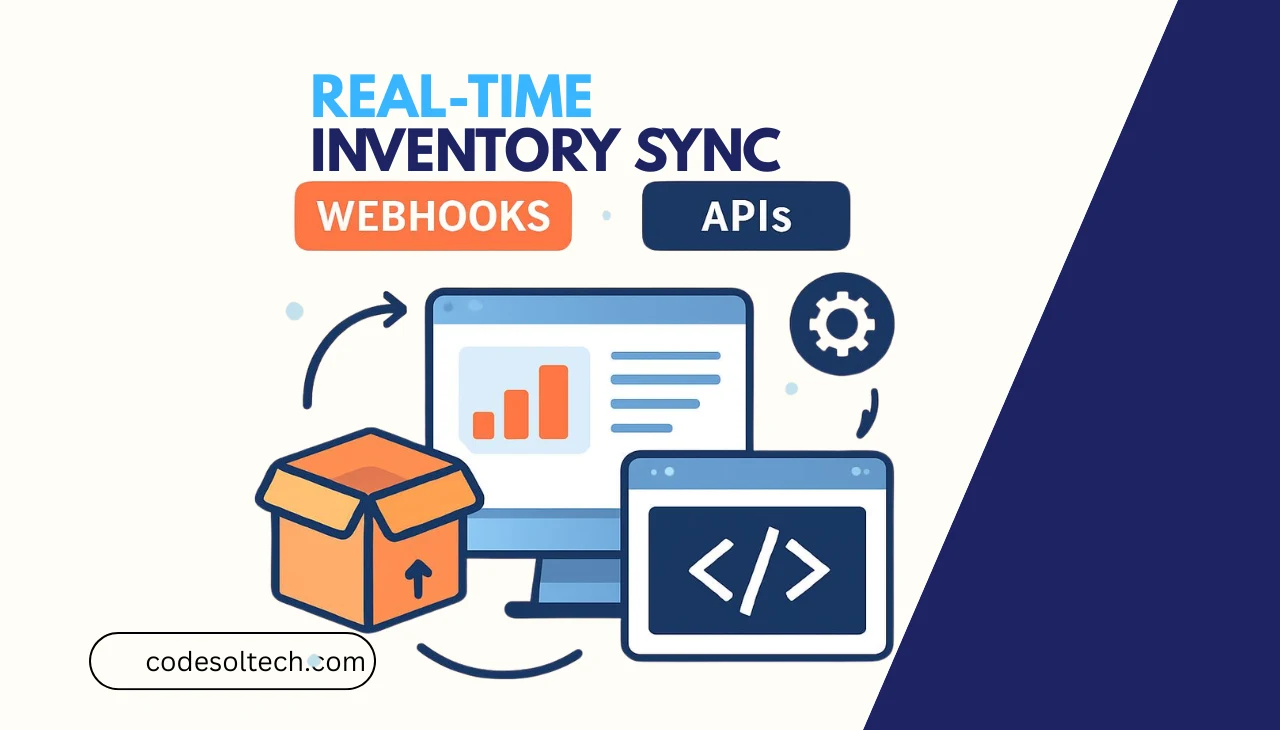
Every time a customer places an order, a return gets processed, or a warehouse receives new stock, your inventory count changes. If that change doesn’t immediately reach every channel you sell on your online store, marketplace listings, and POS system, you risk overselling, losing revenue, and damaging customer trust.
Real-time inventory sync is the practice of keeping stock levels accurate across all systems the moment a change occurs. This guide covers the three core techniques every eCommerce business and developer should understand: Webhooks, APIs, and Stock Sync engines.
Technique 1: Webhooks — Instant Push Notifications for Inventory Events
How Webhooks Work
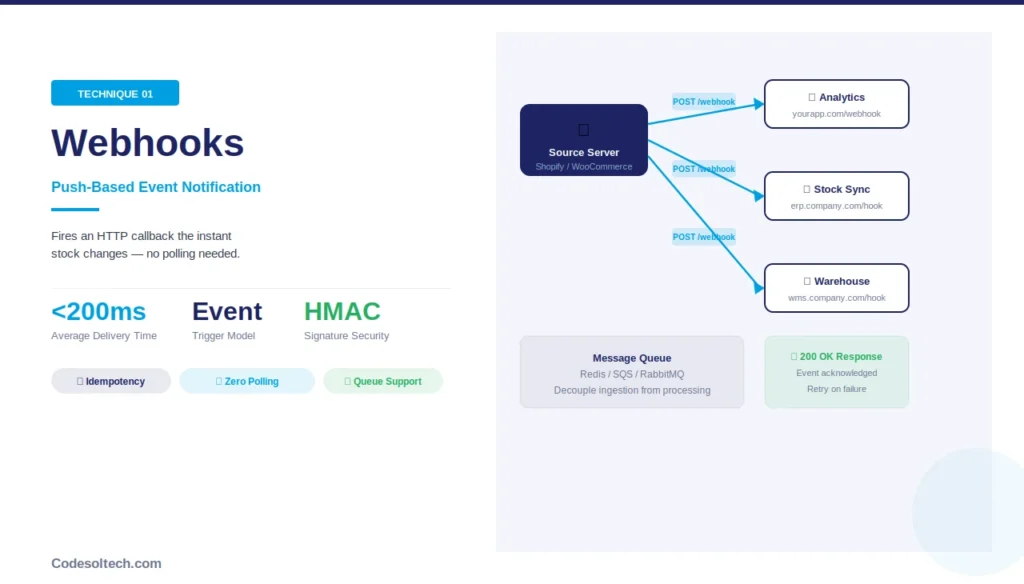
A webhook is an HTTP callback that fires automatically when a specific event happens in your source system. Instead of your application repeatedly asking “has anything changed?”, the source system proactively pushes a notification the instant something does.
For inventory, this means: when a customer completes a purchase, your eCommerce platform (Shopify, WooCommerce, BigCommerce) instantly fires a inventory_levels/update event to every URL you’ve registered. Your receiving server processes the payload and updates downstream systems within milliseconds.
Key Benefits of Webhooks
- Sub-second delivery — stock updates propagate in under 200ms
- No wasted resources — your server only works when there’s actual data to process
- Native platform support — Shopify, WooCommerce, Magento, and most major platforms support inventory webhooks out of the box
- Secure payloads — HMAC signatures let you verify every payload is genuine
Webhook Best Practices
Always verify HMAC signatures. Every webhook payload includes a signature header. Before processing any data, verify this signature against your webhook secret. Skipping this step leaves you vulnerable to spoofed or replayed events.
Build for idempotency. Platforms retry failed webhook deliveries — sometimes for up to 48 hours. Without deduplication logic (storing event IDs and rejecting duplicates), you risk applying the same stock decrement multiple times.
Queue before processing. For high-volume stores, don’t process webhook payloads synchronously. Push them into a message queue (Redis, SQS, or RabbitMQ) first, then process asynchronously. This prevents a traffic spike from overwhelming your sync pipeline.
Webhook Limitations
Webhooks are best-effort delivery — there’s no built-in guarantee that every event reaches your endpoint. Network failures, server downtime, or a misconfigured endpoint can cause missed events. This is why webhooks work best when combined with a periodic API reconciliation (covered next).
Technique 2: APIs — Controlled Polling and On-Demand Stock Reads
How API Polling Works
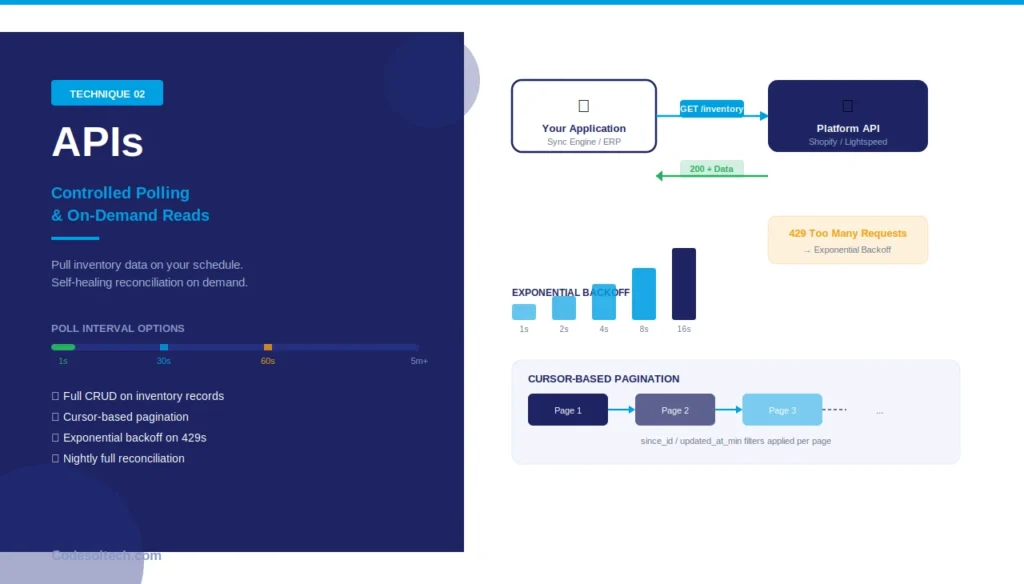
With API polling, your system periodically sends GET requests to the source platform’s inventory endpoints to fetch the current stock levels. You can poll every 30 seconds, every minute, or every hour depending on how frequently your inventory moves.
Modern inventory APIs from platforms like Shopify, Lightspeed, and Square support filtering by updated_at_min — so instead of fetching your entire catalog every cycle, you only retrieve records that changed since the last sync. This dramatically reduces API call volume.
Key Benefits of API Polling
- Guaranteed retrieval — unlike webhooks, you pull the data on your schedule and control the flow
- Full CRUD support — APIs let you read, write, update, and delete inventory records
- Bulk operations — many platforms support batch endpoints to update hundreds of SKUs in a single request
- Self-healing reconciliation — a scheduled API poll catches any inventory drift caused by missed webhook events
API Polling Best Practices
Use cursor-based pagination. Never fetch all records in a single call without pagination. Use since_id or page_info cursors to iterate through large catalogs without missing records between pages.
Respect rate limits. Platforms enforce API rate limits. Read the rate limit headers in every response (e.g., Shopify’s X-Shopify-Shop-Api-Call-Limit) and implement exponential backoff when you receive a 429 Too Many Requests response.
Schedule a nightly full reconciliation. Even if webhooks are your primary sync method, run a full inventory comparison against the source platform at least once daily. This catches any discrepancies caused by missed events, system outages, or manual stock adjustments made directly in the platform.
When to Lead with APIs
API polling is the right primary technique for lower-volume stores (under 1,000 SKUs), for platforms that don’t support webhooks, or when you need to perform a manual sync after a known issue. It’s also the backbone of any reconciliation strategy, regardless of what else you’re using.
Technique 3: Stock Sync Engines — The Centralized Source of Truth
What a Stock Sync Engine Does
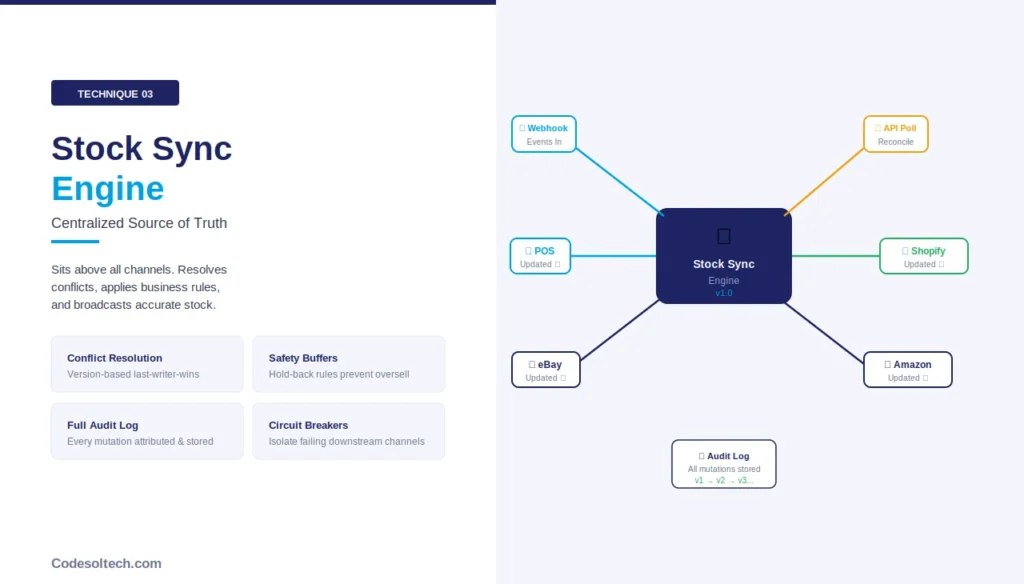
When you sell across multiple channels your own website, Amazon, eBay, a physical store you need a layer that sits above individual webhooks and API calls. A Stock Sync engine is that layer. It ingests inventory events from every source, resolves conflicts, applies business rules, and broadcasts accurate counts to every downstream channel simultaneously.
Think of it as the air traffic controller for your inventory data. Without it, two channels might receive the same piece of stock, or a race condition between simultaneous webhook events might leave your counts in an inconsistent state.
Core Capabilities of a Stock Sync Engine
- Conflict resolution — when two events arrive simultaneously with contradictory data, the engine applies versioning (last-writer-wins or timestamp-based precedence) to determine the correct state
- Safety buffers — hold back a configurable number of units (e.g., show 0 available when real stock is 2) to prevent overselling during sync delays
- Multi-warehouse aggregation — combine stock from multiple warehouse locations into a single sellable quantity per SKU
- Audit logging — every stock mutation is recorded with its source, timestamp, and previous value, giving you a complete history for debugging and compliance
- Circuit breakers — if a downstream channel is unreachable, stop sending updates to it and queue them for replay when it recovers
When You Need a Stock Sync Engine
A dedicated sync engine is essential once you’re selling across three or more channels, managing multiple warehouse locations, or operating at a volume where a single oversell event causes significant financial or reputational damage.
Popular solutions include purpose-built tools like Linnworks, Skubana (now Extensiv), and Cin7, as well as custom-built engines for teams with specific requirements.
Choosing the Right Technique: A Quick Decision Guide
| Your Situation | Recommended Approach |
|---|---|
| Single storefront, low SKU count (<1,000) | API Polling |
| High-velocity store with frequent orders | Webhooks (primary) + API reconciliation |
| Selling on Amazon + Shopify + eBay simultaneously | Stock Sync Engine |
| Multi-warehouse with SLA-bound accuracy | All three, layered |
| Platform doesn’t support webhooks | API Polling only |
Comparing All Three Techniques Side by Side
| Criterion | Webhooks | API Polling | Stock Sync Engine |
|---|---|---|---|
| Latency | Sub-second | 1–60 seconds | Near real-time |
| Reliability | Best-effort (retries) | Guaranteed (pull) | High (with queuing) |
| Conflict resolution | None built-in | Manual logic needed | Native versioning |
| Setup complexity | Low | Low to Medium | Medium to High |
| Multi-channel support | Per-channel config | Per-channel API calls | Centralized |
| Best scale | Small to Medium | Small to Medium | Medium to Enterprise |
Implementation Checklist Before You Go Live
Webhooks
- Register all relevant inventory event topics in your platform dashboard
- Validate HMAC signatures on every incoming payload
- Store event IDs and reject duplicate deliveries
- Route payloads through a message queue before processing
- Configure dead-letter queues for failed deliveries
- Set up monitoring and alerts for webhook delivery failures
API Polling
- Use cursor-based pagination on all list endpoints
- Implement exponential backoff for 429 and 503 responses
- Filter by
updated_at_minto minimize unnecessary calls - Schedule a full reconciliation at least once every 24 hours
- Cache GET responses where appropriate to reduce API call volume
Stock Sync Engine
- Define a canonical inventory data model across all channels
- Assign monotonic version numbers to every state change
- Configure safety buffer rules before broadcasting counts
- Write a complete audit log with source attribution for every mutation
- Build a dashboard that alerts when sync lag exceeds your threshold
- Implement circuit breakers for downstream channel failures
Final Thought
There’s no single “best” technique for real-time inventory sync; the right approach depends on your sales volume, channel count, and tolerance for stock discrepancies.
For most growing eCommerce businesses, the practical answer is a layered strategy: use webhooks for immediate event propagation, API polling for scheduled reconciliation and self-healing, and a Stock Sync engine as the authoritative hub once multi-channel complexity demands it.
Start simple, monitor your sync lag closely, and add complexity only when the data shows you need it. A single channel with reliable API polling is far better than an over-engineered pipeline that’s hard to debug when things go wrong.