
A web development partner is a company or team that designs, builds, deploys, and maintains your website or web application. This relationship directly determines the performance, security, scalability, and long-term cost of your digital product.
Choosing the wrong partner produces technical debt, missed deadlines, and lost revenue. Choosing the right one builds a compounding technical asset.
Businesses spend an average of $5,000 to $150,000 on web development projects, depending on scope, with enterprise-level builds exceeding $500,000. The financial stakes make partner selection a strategic business decision, not a simple procurement task.
What Is a Web Development Partner?
A web development partner is a structured organization that provides end-to-end services: discovery, architecture planning, development execution, quality assurance, deployment, and post-launch maintenance. A freelancer provides isolated labor. A partner provides a complete engineering system.
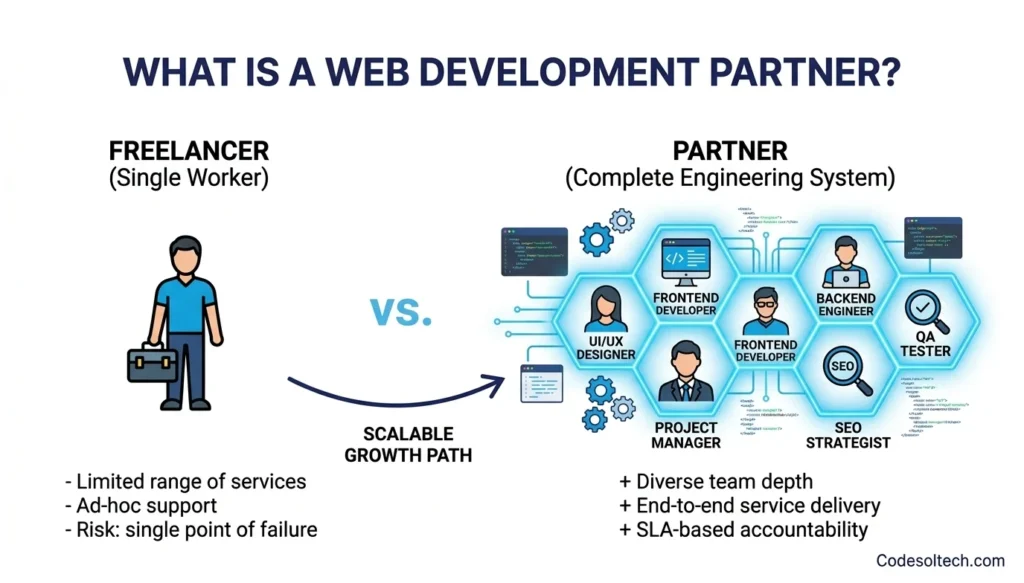
The 3 operational differences between a partner and a freelancer are:
- Accountability structure: A partner operates under a formal Service Level Agreement (SLA) with defined response times and deliverables. A freelancer operates under informal expectations.
- Team depth: A development partner employs frontend developers, backend engineers, UI/UX designers, QA testers, and project managers within one engagement.
- Scalability: A development partner scales team resources up or down based on project phase. A freelancer cannot increase output without replacing themselves entirely.
For any web project exceeding 3 months in duration or a budget above $10,000, a dedicated development partner produces measurably better outcomes than a solo contractor by eliminating single points of failure.
Why the Wrong Development Partner Creates Technical Debt
Technical debt is the accumulated cost of poor engineering decisions made during development. It appears as unoptimized database queries, hardcoded values, undocumented APIs, insecure authentication flows, and tightly coupled code modules.
Every month, technical debt compounds, and the cost to remediate it increases by an estimated 15–20%, according to the Carnegie Mellon Software Engineering Institute.
An unqualified development partner introduces technical debt in 4 specific ways:
- Skipping code reviews: Unreviewed code contains 15× more defects per thousand lines than peer-reviewed code.
- Ignoring scalability architecture: A site built for 1,000 monthly users breaks under 50,000 users when the database and server architecture are not designed for horizontal scaling.
- Using deprecated dependencies: Outdated libraries introduce security vulnerabilities (CVEs) that attackers exploit within 72 hours of public disclosure.
- Skipping documentation: Undocumented codebases require 40–60% more hours to hand off to a new development team, multiplying future maintenance costs.
The solution is an Engineering Audit — a systematic review of code quality, architecture decisions, security posture, and dependency health — conducted both before and after any development engagement.
Businesses that run engineering audits before onboarding a new partner establish a clean technical baseline and eliminate inherited liabilities.
Our business website development services include a pre-build architecture review that identifies technical risk before a single line of code is written.
What Should You Look for in a Web Development Partner?
Evaluate a web development partner across 5 dimensions: engineering audit capability, technology stack transparency, delivery methodology, post-launch support terms, and measurable performance benchmarks from past projects.
1. Engineering Audit Capability
Engineering audit capability is the highest-signal indicator of a development partner’s technical maturity. A qualified partner conducts audits that cover 4 areas:
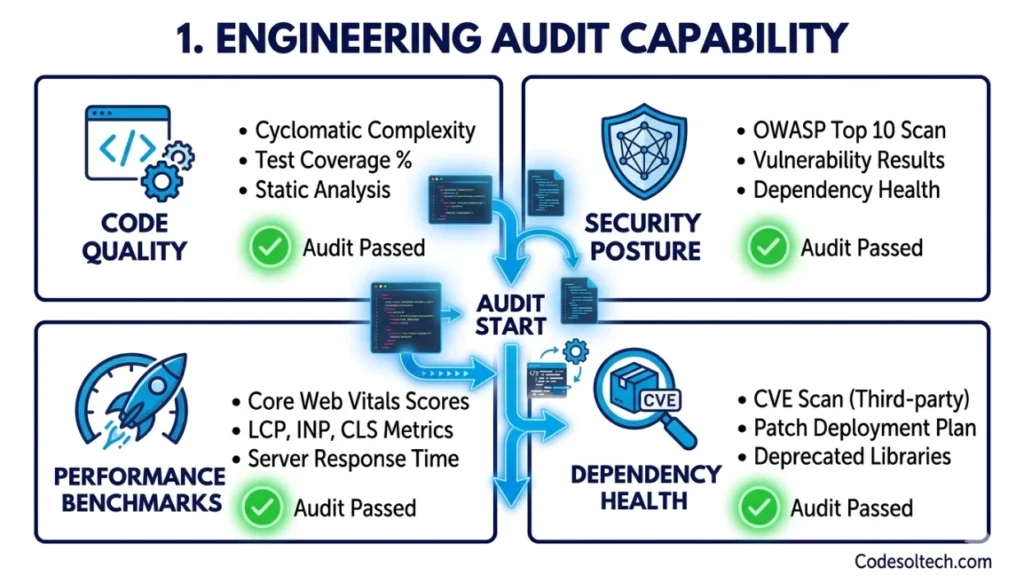
- Code quality: Cyclomatic complexity score and test coverage percentage
- Security posture: OWASP Top 10 vulnerability scan results
- Performance benchmarks: Core Web Vitals scores — LCP, INP, and CLS
- Dependency health: CVE scan across all third-party packages and libraries
Ask every prospective partner: “Do you conduct an engineering audit before starting a project, and can you share a sample audit report?” Partners who cannot produce a structured audit report do not operate a repeatable engineering process.
2. Technology Stack Transparency
A development partner must declare the full technology stack before the project begins. The stack defines performance ceilings, maintenance complexity, and future scalability potential. The 3 critical stack decisions are:
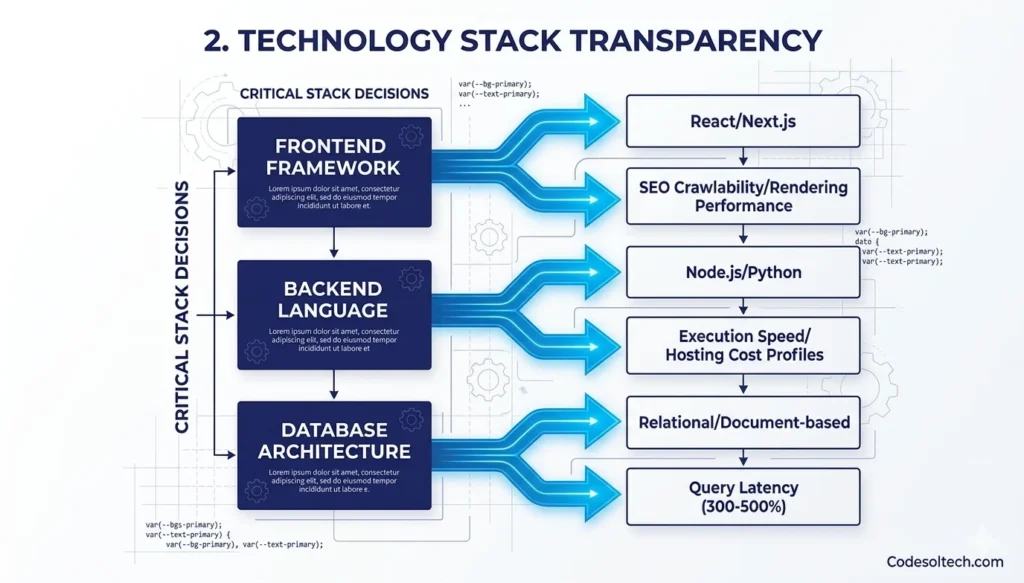
- Frontend framework: React, Next.js, Vue, or plain HTML/CSS — each carries different rendering performance and SEO crawlability implications.
- Backend language and framework: Node.js, PHP (Laravel/WordPress), Python (Django), or Ruby on Rails — each has distinct execution speed and hosting cost profiles.
- Database architecture: Relational (MySQL, PostgreSQL) vs. document-based (MongoDB) — selecting the wrong model for your data structure increases query latency by 300–500%.
A partner who applies one stack to every project type regardless of requirements is delivering a template, not engineering a solution.
3. Project Delivery Methodology
Development partners operate under 2 primary methodologies: Waterfall and Agile (Scrum or Kanban). Agile delivery produces 28% more successful projects than Waterfall, according to the Standish Group CHAOS Report.
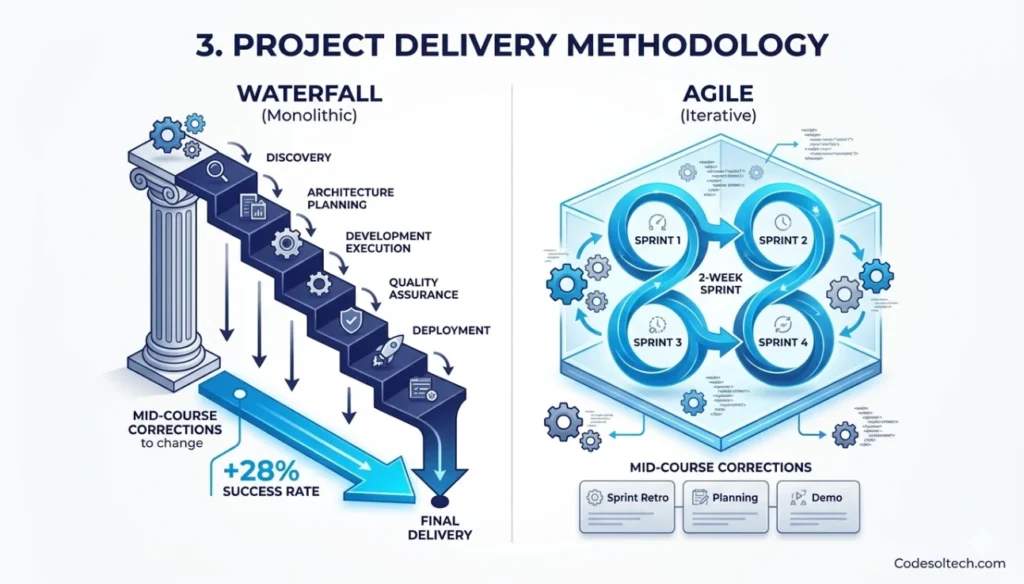
In Agile, work is broken into 2-week sprints with defined deliverables, enabling mid-course corrections before a project is 80% complete and too costly to change.
4. Post-Launch SLA Terms
A development partner’s value is measured by what happens after launch, not just at launch. A structured post-launch SLA defines 3 non-negotiable terms:
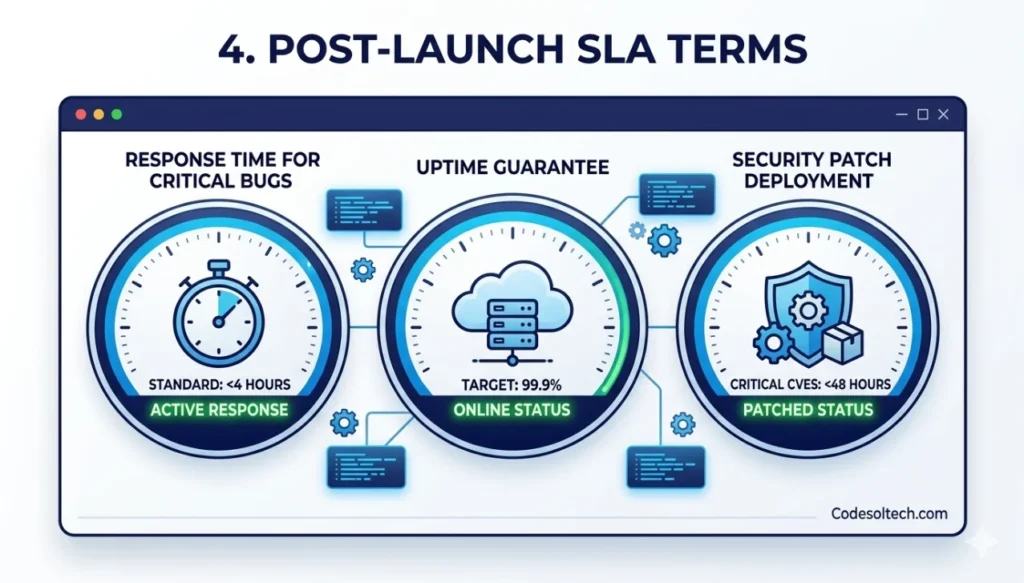
- Response time for critical bugs: Industry standard is under 4 hours for P1 issues — site outage, payment gateway failure, or active security breach.
- Uptime guarantee: Any production website must target 99.9% uptime, equating to fewer than 8.7 hours of downtime per year.
- Security patch deployment: Critical CVEs require patching within 48 hours of public disclosure.
How Do You Evaluate a Web Development Partner Before Signing a Contract?
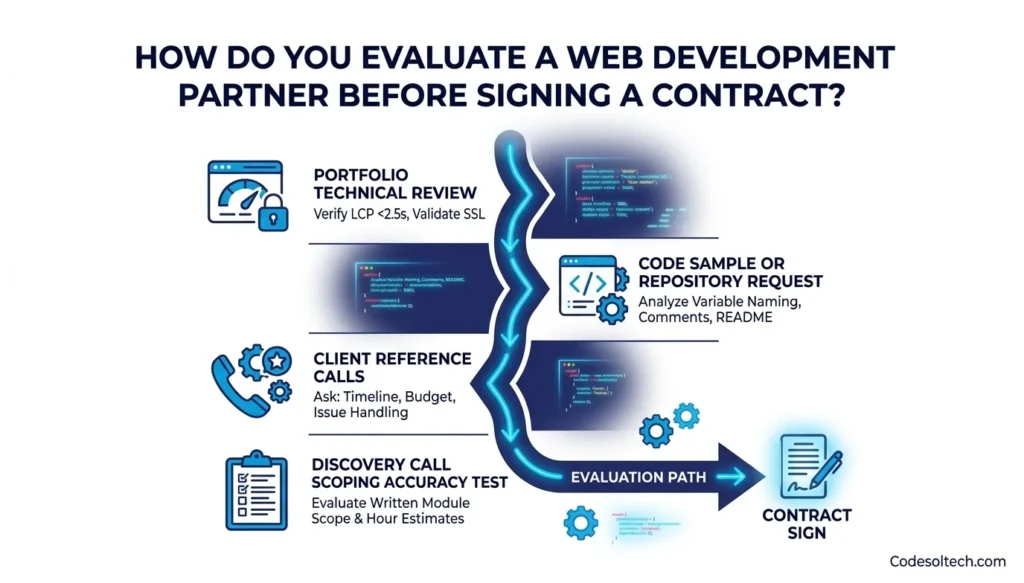
Run a 4-step evaluation process: portfolio technical review, code sample request, client reference calls, and a scoping accuracy test during the discovery call.
Step 1 — Portfolio Technical Review
A portfolio review goes beyond visual design. Use Google PageSpeed Insights to test the Core Web Vitals of every live site in their portfolio. LCP (Largest Contentful Paint) above 2.5 seconds on any portfolio site is a disqualifying red flag. Also verify that all portfolio sites enforce HTTPS with valid SSL certificates — this is the baseline security standard, not a bonus.
Step 2 — Code Sample or Repository Request
Request a sanitized code sample or a link to a public GitHub repository. Evaluate 3 indicators:
- Variable and function naming conventions — descriptive names vs. single-letter variables
- Presence of inline comments and README documentation
- Version control discipline — meaningful commit messages and feature branching
Step 3 — Client Reference Calls
Contact 2–3 past clients and ask these 3 specific questions:
- Did the partner deliver within the agreed timeline and budget?
- How did the partner handle a major technical problem or scope change mid-project?
- Would you hire them again for a project of the same or larger scope?
Reference calls expose the gap between a partner’s sales narrative and their operational track record. A partner who cannot provide references has not built lasting client relationships.
Step 4 — Discovery Call Scoping Accuracy Test
Present your requirements and evaluate the quality of the partner’s written scoping document. A qualified development partner produces a scope that breaks the project into defined modules, assigns hour estimates per module, states technology decisions with rationale, and lists integration dependencies. A partner who responds with vague timelines and no written deliverable definition cannot manage project risk.
What Web Development Services Should Your Partner Offer?
A full-service web development partner covers 4 primary service categories:
- Business Website Development: Custom-built websites for companies, service providers, and brands requiring SEO-optimized architecture, fast Core Web Vitals scores, and CMS integration. Our business website development service covers architecture planning through post-launch performance optimization.
- E-Commerce Store Development: Online stores built on WooCommerce, Shopify, Magento, or fully custom storefronts. E-commerce builds require PCI-DSS compliant payment gateway integration, inventory management systems, and conversion-optimized UX flows. Our e-commerce store development service handles platform setup, custom feature engineering, and ongoing performance tuning.
- Web Application Development: Custom SaaS products, internal tools, dashboards, and API-driven applications that require backend engineering, relational database architecture, and role-based authentication systems.
- Maintenance and Engineering Audits: Ongoing dependency updates, security patching, performance monitoring, and periodic engineering audits to prevent technical debt accumulation before it reaches a crisis stage.
A partner who offers only 1 of these 4 categories forces multi-vendor management, which creates accountability gaps and increases coordination overhead on every project.
7 Red Flags That Identify an Unqualified Web Development Partner
Disqualify any development partner who exhibits these behaviors:
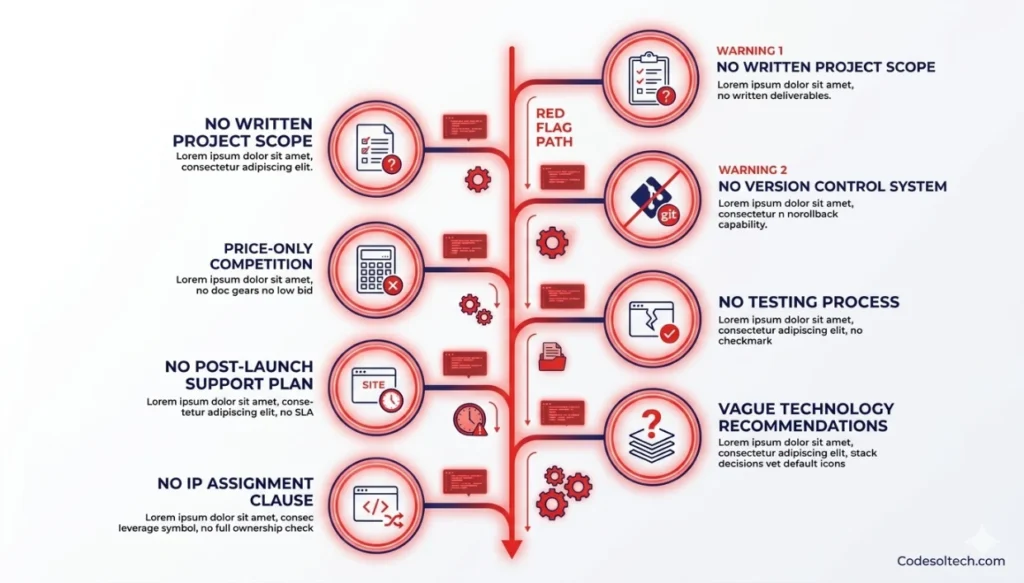
- No written project scope: Verbal agreements are unenforceable. Every project above $1,000 requires a documented scope with defined deliverables.
- No version control system: A team not using Git has no rollback capability. Any production error becomes an unrecoverable data-loss event.
- Price-only competition: The lowest-bid partner eliminates cost by cutting QA, documentation, and security testing — the 3 most expensive problems to fix retroactively.
- No testing process: Partners who do not perform unit testing, integration testing, and UAT (User Acceptance Testing) deploy broken features to production environments.
- No post-launch support plan: A partner who terminates the engagement at launch leaves you unable to apply security patches, fix production bugs, or extend the system.
- Vague technology recommendations: A qualified partner explains the rationale behind every stack decision. An unqualified partner defaults to the only stack they know.
- No IP assignment clause: You must own 100% of the code produced. Any partner who resists a full IP ownership clause retains leverage over your business infrastructure.
10 Questions to Ask Every Web Development Partner Before Hiring
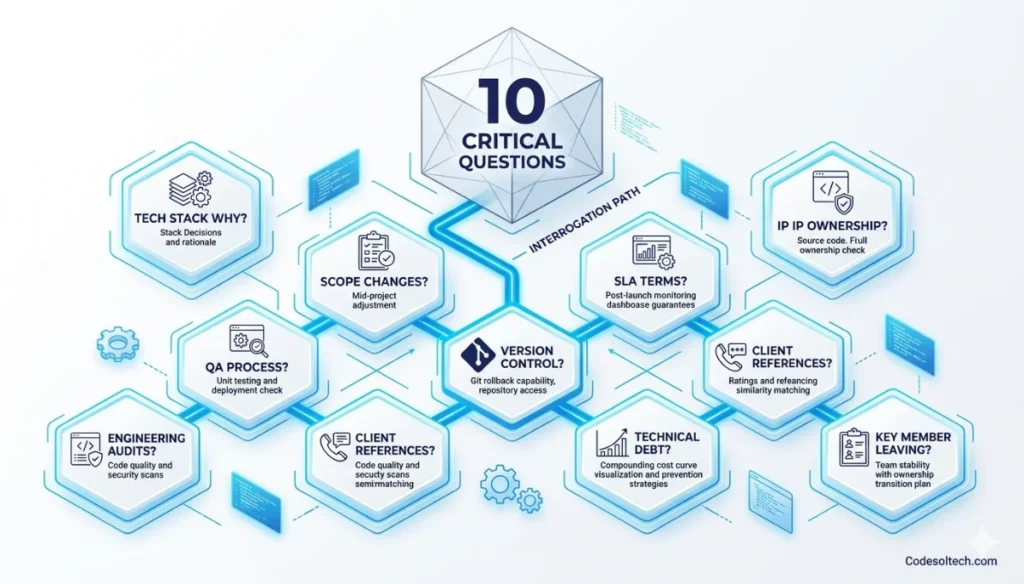
- What technology stack do you recommend for this project, and why?
- How do you handle scope changes that arise mid-project?
- What is your testing and QA process before deploying to production?
- Do you conduct engineering audits before and after a project?
- Who owns the source code and all intellectual property after delivery?
- What version control system do you use, and can I access the repository directly?
- What does your post-launch SLA cover, and what are the response time guarantees?
- Can you provide 3 client references from projects of similar scope and budget?
- How do you measure and prevent technical debt accumulation during development?
- What happens to the project timeline and ownership if a key team member leaves mid-engagement?
A qualified development partner answers all 10 with specificity. Evasive or defensive answers to any of these questions are disqualifying criteria.
Final Words
Choosing a web development partner is an infrastructure decision with compounding consequences.
The right partner prevents technical debt, delivers documented and maintainable code, and supports your system long after launch day.
Run an engineering audit before signing. Verify the stack. Read every clause of the SLA. Every skipped evaluation question becomes a paid lesson after the contract begins.
Start With a Partner Who Audits First and Builds Second
CodeSolTech leads every engagement with a structured discovery and architecture review — so your project starts on a solid technical foundation, not a set of assumptions.