API-First Design is a development methodology that defines, builds, and validates the Application Programming Interface (API) contract before writing any frontend, backend, or infrastructure code. The API acts as the foundational contract between all system components.
Every service, client, and integration consumes or exposes data exclusively through a defined endpoint.
This methodology separates the data layer from the presentation layer, enabling 3 independent development tracks: frontend engineering, backend engineering, and third-party integration.
API-First Design reduces inter-team dependency by 60–70% in distributed engineering teams.
Systems built on this methodology achieve horizontal scalability without requiring architectural rewrites.
How API-First Design Differs From Code-First Approaches
Code-First development generates API documentation as a byproduct of implementation, producing inconsistent contracts across services.
API-First Design inverts this sequence: the OpenAPI Specification (OAS) or GraphQL Schema Definition Language (SDL) is authored first, reviewed, and locked before a single line of implementation code executes.
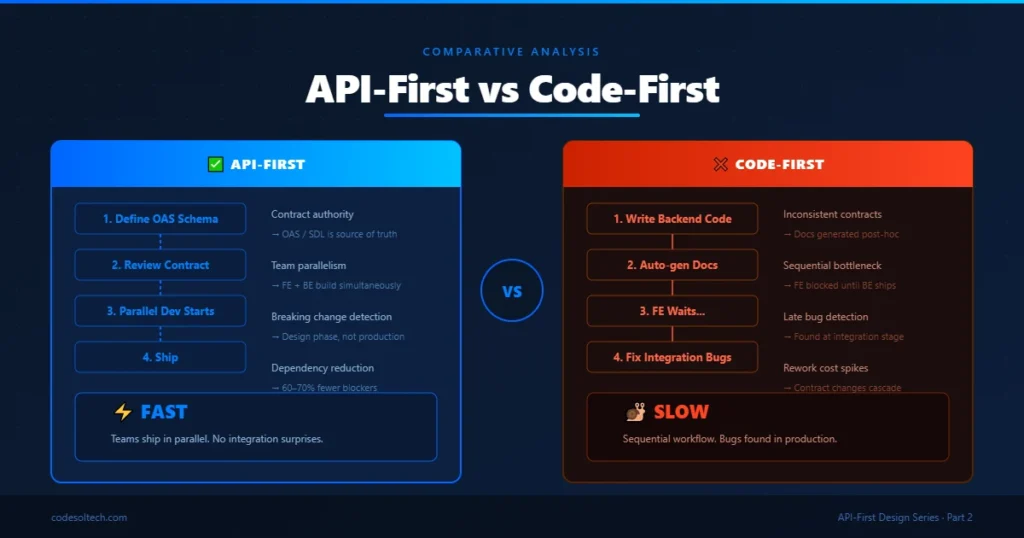
3 structural differences between API-First and Code-First:
- Contract authority: API-First treats the schema as the source of truth; Code-First treats the codebase as the source of truth
- Team parallelism: API-First enables simultaneous frontend and backend development; Code-First creates a sequential dependency chain
- Breaking change detection: API-First detects contract violations at the design phase; Code-First detects them at the integration or production phase
REST API Architecture Within API-First Systems
REST API (Representational State Transfer Application Programming Interface) is the most widely adopted architectural style for API-First systems, operating on 6 uniform constraints defined by Roy Fielding in 2000.
REST communicates over HTTP/HTTPS using 4 primary methods: GET, POST, PUT, and DELETE. Each method maps to a specific CRUD operation against a resource.
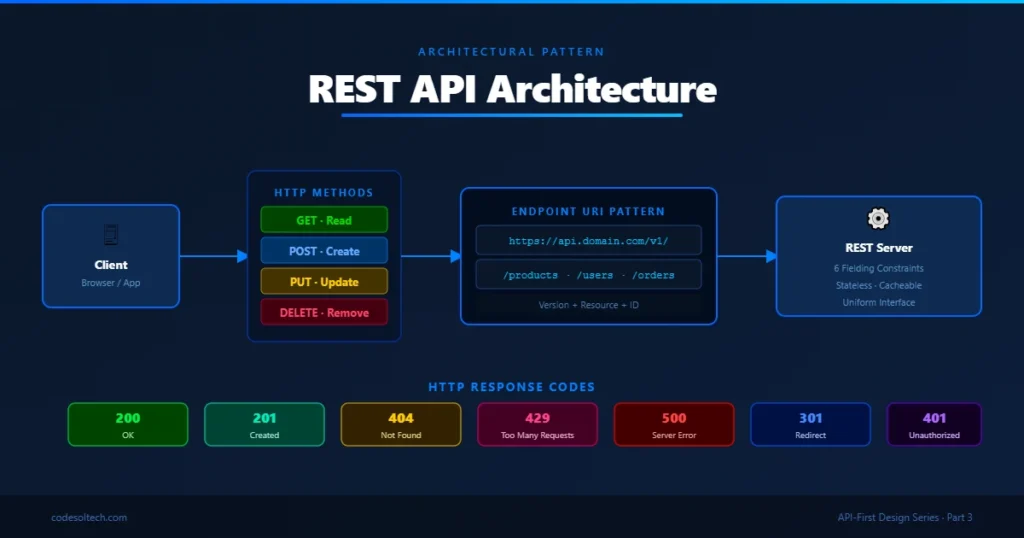
A REST API endpoint is a unique URI (Uniform Resource Identifier) that exposes a specific resource or collection of resources to consumers. A well-structured REST endpoint follows the pattern: https://api.domain.com/v{version}/{resource}/{id}.
Versioning the endpoint at the URI level (/v1/, /v2/) isolates breaking changes and protects legacy consumers from involuntary contract disruption.
REST API Endpoint Design Rules for Scalability
Endpoint design directly determines the cacheability, discoverability, and load tolerance of a REST API system. Non-compliant endpoint design introduces N+1 query problems, over-fetching, and cache-busting at the CDN layer.
6 REST endpoint design rules for scalable web systems:
- Use nouns, not verbs, in the URI path (
/ordersnot/getOrders) - Use plural resource names consistently (
/products,/users) - Apply HTTP status codes precisely:
200 OK,201 Created,404 Not Found,429 Too Many Requests - Implement cursor-based pagination over offset pagination for datasets exceeding 10,000 records
- Enforce rate limiting at the gateway layer using token-bucket or leaky-bucket algorithms
- Use HATEOAS (Hypermedia as the Engine of Application State) to make APIs self-documenting and navigable
GraphQL as an API-First Architectural Pattern
GraphQL is a query language and server-side runtime for APIs developed by Meta (Facebook) in 2012 and open-sourced in 2015. GraphQL exposes a single endpoint (typically /graphql) and allows clients to request exactly the data fields they need, eliminating the over-fetching and under-fetching problems inherent in REST’s fixed response structures.
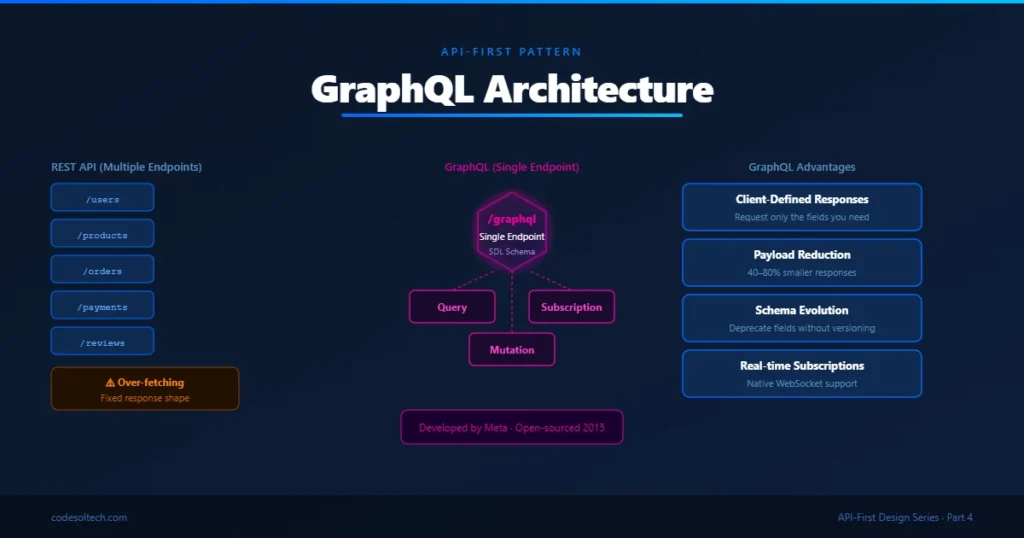
A GraphQL schema defines 3 root operation types: Query, Mutation, and Subscription.
The GraphQL Schema Definition Language (SDL) is the contract document in an API-First GraphQL system. The SDL defines every Type, Field, Argument, and Directive before any resolver function is written.
This schema-first workflow is architecturally equivalent to the OpenAPI Specification workflow in REST API-First systems.
GraphQL vs. REST API: Structural Comparison for Scalable Systems
| Dimension | REST API | GraphQL |
|---|---|---|
| Endpoints | Multiple (one per resource) | Single (/graphql) |
| Data Fetching | Fixed response shape | Client-defined response shape |
| Versioning | URI versioning (/v1/) | Schema evolution via deprecation |
| Caching | HTTP cache (CDN-native) | Persisted queries + APQ |
| Real-time | WebSockets (separate setup) | Native Subscriptions |
| Best Use Case | Public APIs, mobile clients | Complex UIs, data-dense dashboards |
The API Gateway: Central Endpoint Orchestration Layer
An API Gateway is the single entry point that routes, authenticates, rate-limits, and transforms all inbound API traffic before it reaches upstream microservices. In an API-First web architecture, the gateway enforces the API contract at the network boundary.
Tools including Kong, AWS API Gateway, Apigee, and Traefik implement this pattern in production environments.
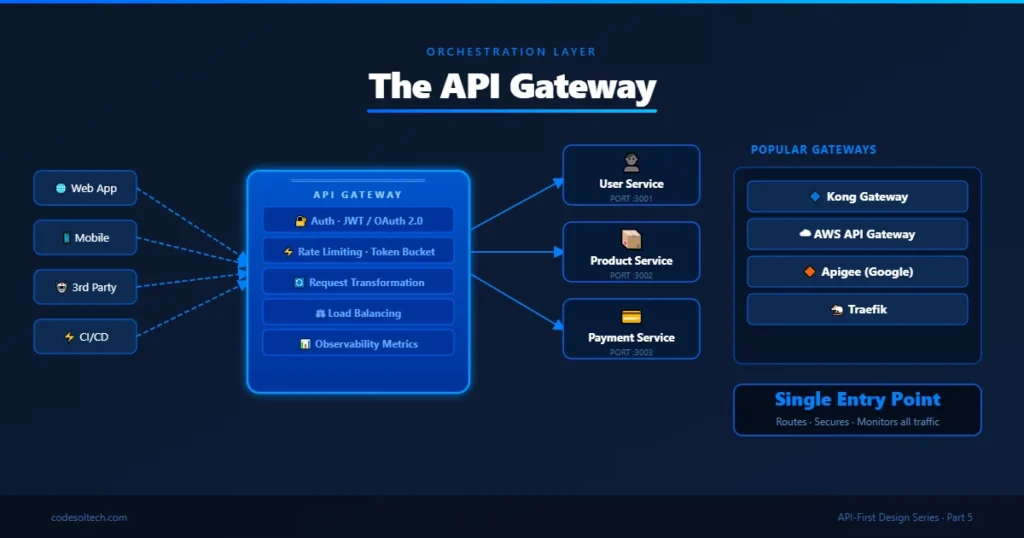
The API Gateway performs 5 critical functions in a scalable web system:
- Authentication & Authorization: Validates JWT tokens, OAuth 2.0 bearer tokens, or API keys before routing
- Rate Limiting: Enforces request quotas per client, preventing DDoS and quota abuse
- Request Transformation: Converts request formats (e.g., SOAP to REST) to match upstream service contracts
- Load Balancing: Distributes traffic across service replicas using round-robin or weighted routing
- Observability: Collects latency, error rate, and throughput metrics at the entry point
OpenAPI Specification: The API-First Contract Standard
The OpenAPI Specification (OAS), formerly known as Swagger, is the industry-standard format for defining REST API contracts in YAML or JSON. OAS version 3.1.0 is the current stable release, aligning fully with JSON Schema Draft 2020-12.
The OAS document describes every endpoint path, HTTP method, request body schema, response schema, authentication method, and error code before implementation begins.
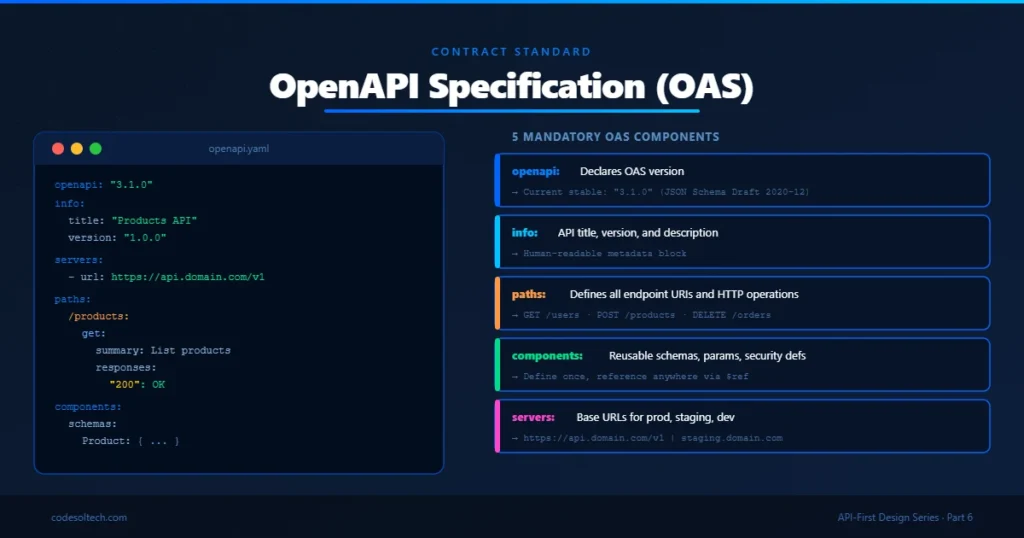
An OAS document contains 5 mandatory structural components:
openapi: Declares the OAS version (e.g.,"3.1.0")info: Contains API title, version, and description metadatapaths: Defines all endpoint URIs and their associated HTTP operationscomponents: Stores reusable schemas, parameters, and security definitionsservers: Lists the base URLs for production, staging, and development environments
API-First Design and SEO: The Technical Connection
API-First architecture directly influences Core Web Vitals and page rendering performance metrics that Google’s ranking algorithm evaluates. A frontend application consuming a well-designed API endpoint retrieves only necessary data payloads, reducing Time to First Byte (TTFB) and Largest Contentful Paint (LCP) scores.
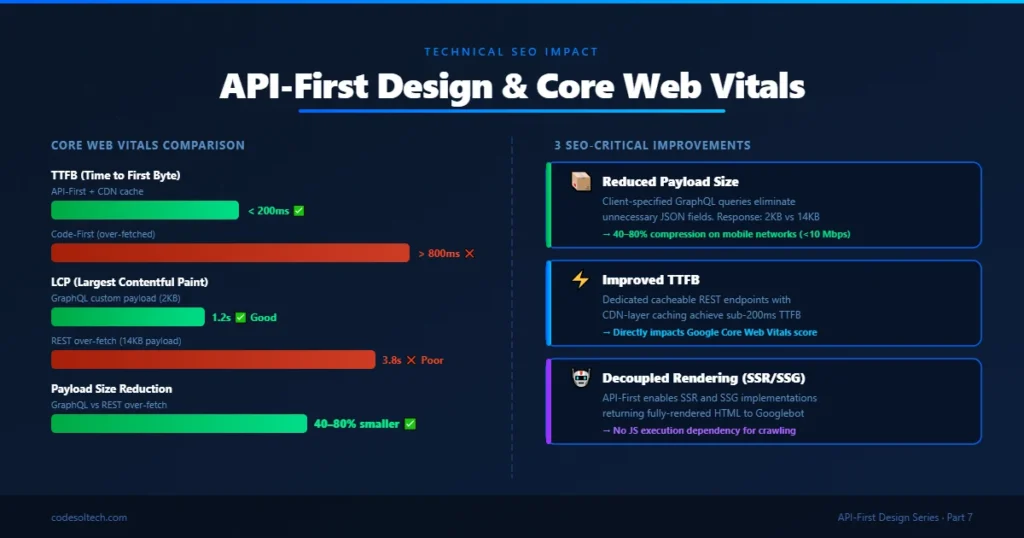
A GraphQL endpoint that returns a 2KB custom payload outperforms a REST endpoint returning a 14KB over-fetched payload on mobile networks with throughput below 10 Mbps.
3 SEO-critical performance improvements from API-First Design:
- Reduced payload size: Client-specified GraphQL queries eliminate unnecessary JSON fields, compressing response payloads by 40–80%
- Improved TTFB: Dedicated, cacheable REST endpoints with CDN-layer caching achieve TTFB values below 200ms
- Decoupled rendering: API-First architecture enables Server-Side Rendering (SSR) and Static Site Generation (SSG) implementations that return fully-rendered HTML to Googlebot without JavaScript execution dependency
Scalability Patterns in API-First Web Systems
Scalability in API-First architecture operates across 3 dimensions: horizontal scaling, vertical scaling, and database sharding. Horizontal scaling adds service replicas behind a load balancer without modifying the API contract.
Vertical scaling increases the compute resources allocated to individual service instances. Database sharding partitions data across multiple database nodes using a consistent hashing algorithm.
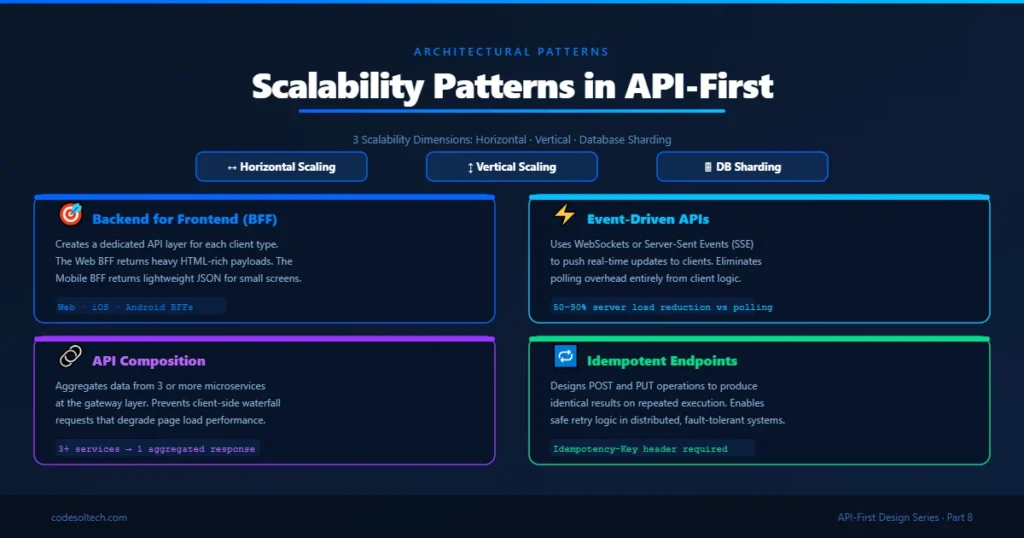
4 API-First patterns that directly enable web scalability:
- Backend for Frontend (BFF): Creates dedicated API layers for each client type (web, iOS, Android), optimizing payload shape per device
- Event-Driven APIs: Uses WebSockets or Server-Sent Events (SSE) to push real-time updates without polling, reducing server load by 50–90% versus long-polling
- API Composition: Aggregates data from 3 or more microservices at the gateway layer, preventing client-side waterfall requests
- Idempotent Endpoints: Designs POST and PUT operations to produce identical results on repeated execution, enabling safe retry logic in distributed systems
API Versioning Strategies for Long-Term Scalability
API versioning preserves backward compatibility while enabling contract evolution across multiple consumer generations. 3 versioning strategies exist in production API systems: URI versioning, Header versioning, and Query parameter versioning.
URI versioning (/v1/, /v2/) is the most widely adopted because it is explicit, cache-friendly, and visible in server logs and analytics tools.
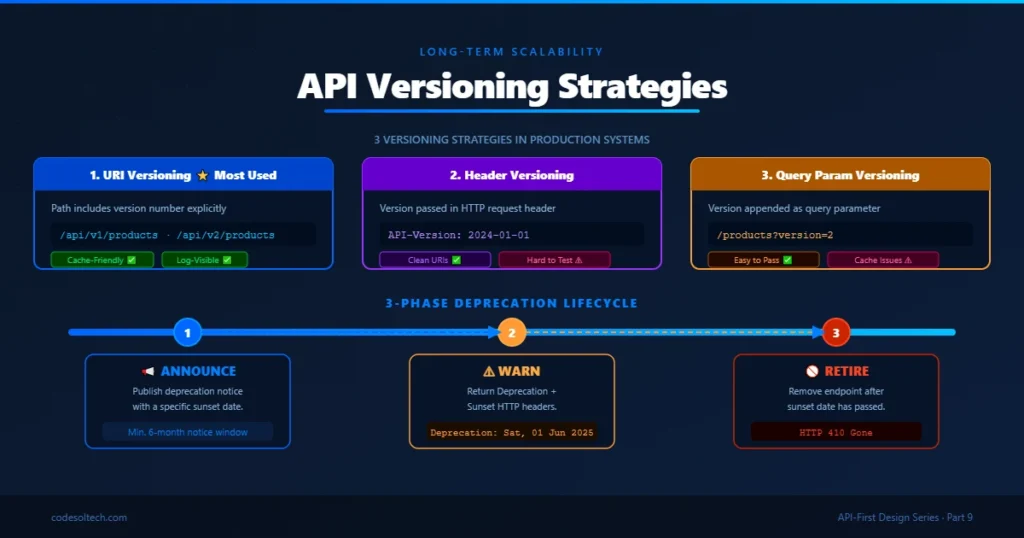
API deprecation follows a 3-phase lifecycle:
- Announce: Publish deprecation notice in API documentation with a specific sunset date (minimum 6-month notice window)
- Warn: Return
DeprecationandSunsetHTTP response headers on every request to the deprecated endpoint - Retire: Remove the endpoint after the sunset date and return
410 Goneto all remaining consumers
Security Architecture for API-First Systems
API security is a structural concern in API-First Design, not a post-deployment addition. Every endpoint must authenticate, authorize, and validate input before processing any request.
The OWASP API Security Top 10 identifies the 10 most critical API vulnerabilities, including Broken Object Level Authorization (BOLA) and Excessive Data Exposure.
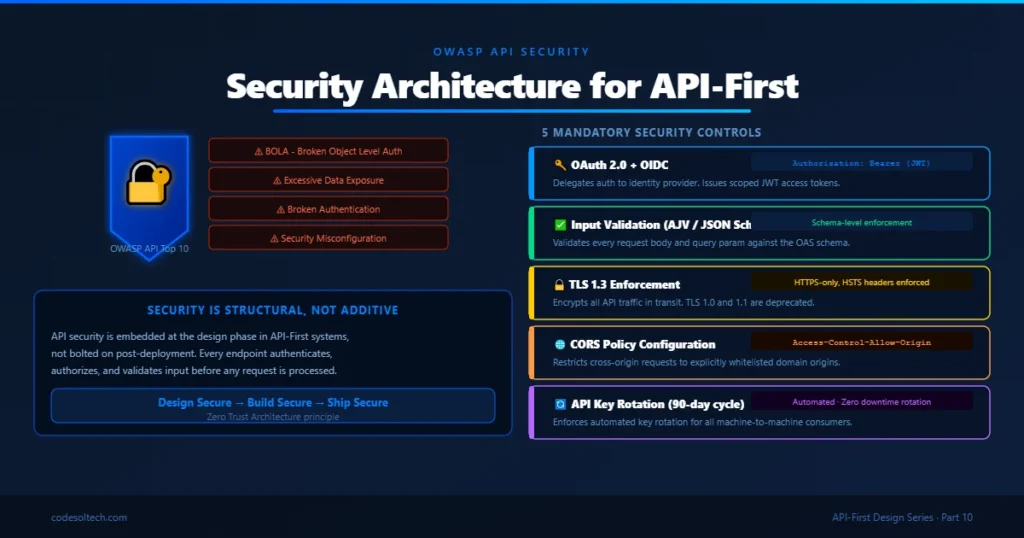
5 mandatory security controls for production API endpoints:
- OAuth 2.0 + OIDC: Delegates authentication to an identity provider and issues scoped JWT access tokens
- Input Validation: Validates every request body and query parameter against the defined OAS schema using a validation library (e.g., AJV for JSON Schema)
- TLS 1.3 Enforcement: Encrypts all API traffic in transit; TLS 1.0 and 1.1 are deprecated
- CORS Policy Configuration: Restricts cross-origin requests to explicitly whitelisted domain origins
- API Key Rotation: Enforces automated key rotation on a 90-day cycle for all machine-to-machine consumers
Final Words
API-First Design is the structural foundation of every scalable, maintainable web system built in the modern engineering era. It transforms the REST API endpoint and the GraphQL schema from implementation outputs into architectural inputs.
Organizations that adopt this methodology reduce time-to-market, eliminate integration failures, and build systems that scale horizontally without contract renegotiation.
Start with the contract. Ship with confidence.
Ready to architect a scalable web system using API-First principles?
Audit your current endpoint structure, define your OpenAPI Specification today, and eliminate the integration bottlenecks slowing your team’s release velocity. Share this article with your engineering team or bookmark it as your API-First reference guide.

![Electrician CRM: Win More Jobs [Faster Estimates Guide]](https://www.codesoltech.com/wp-content/uploads/2026/10/Crm-for-an-electricians-business.webp)