Manual work slows business growth because it caps what each employee can produce, multiplies errors, and delays decisions. Every order, invoice, and follow-up that passes through human hands takes longer and costs more than the same step done by software.
The fix is not to automate everything at once. Audit where time leaks, automate the three or four processes that hurt most, and let the savings fund the next round.
The Hidden Costs of Manual Processes
Manual work creates invisible barriers that stop a business from reaching its full potential. These barriers grow clearer as the company tries to expand.
When employees spend hours on repetitive tasks, they cannot focus on work that actually drives revenue. A marketing agency with staff manually entering client data into spreadsheets has less time for campaigns and client relationships.
This pattern repeats across countless businesses every day. It looks like diligence, but it is really capacity leaking out of the working week.
Manual processes also lead to higher error rates. Mistakes in data entry, invoicing, or inventory can cost thousands of dollars a year, and they damage customer trust at the same time.

What the Research Says About Manual Work
The cost of manual work is not a guess. Three widely cited studies measure it from different angles, and they all point the same way.
Workers lose a quarter of the week to repetitive tasks
In Smartsheet’s Automation in the Workplace report, over 40% of workers said they spend at least a quarter of their work week on manual, repetitive tasks.
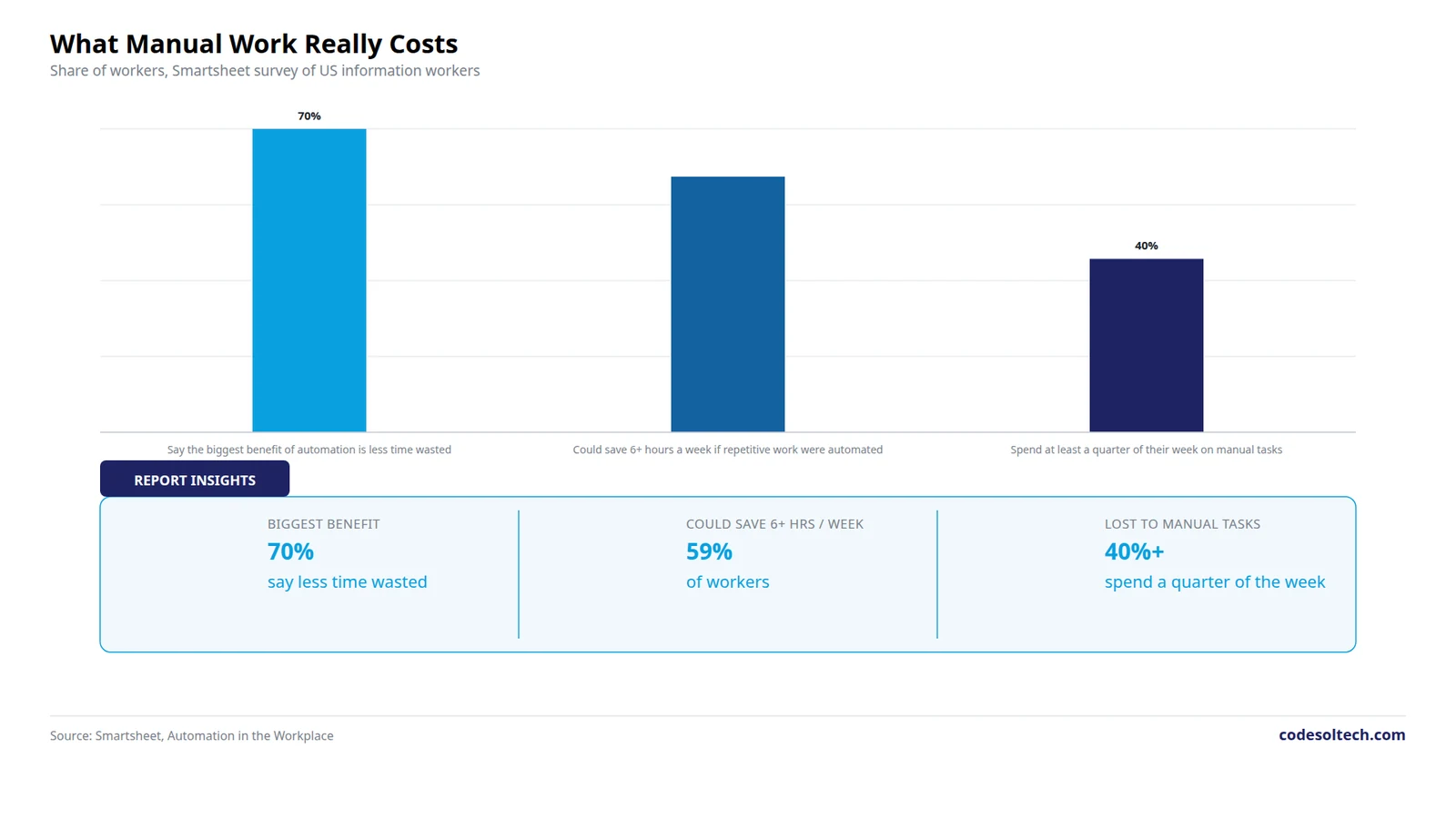
Email, data collection, and data entry were the three biggest categories. In the same survey, 59% of workers said they could save six or more hours a week if the repetitive parts of their jobs were automated.
Almost 70% said the biggest benefit of automation would be less time wasted on repetitive work. That is ten hours a week in a standard 40-hour week, per affected employee.
Most work hours are technically automatable
The McKinsey Global Institute’s November 2025 report, Agents, Robots, and Us, found that current technology could in theory automate tasks accounting for 57% of US work hours.
AI software agents account for 44% of those hours, and robots for another 13%. McKinsey is careful to call this technical potential, not a forecast of jobs disappearing.
The point for a small business is narrower and more useful. Most of the work that slows a team down is rules-based, digital, and repetitive, which is exactly the kind of work software handles well.
Small businesses already see the payoff
According to Zapier’s 2025 Automation Report for Small Business, 66% of small businesses say automation is now essential for daily operations.
In the same report, 44% said automation helps them get more done with fewer people, and one in five owners reported saving five or more hours a week. Zapier’s separate research on AI workflow tools found professionals save an average of 8.4 hours a week.
Why Manual Work Slows Down Business Growth
Manual work slows growth mainly because it limits scalability. As a business grows, manual tasks multiply. Companies end up hiring more staff just to hold current operations together instead of expanding services.
Take a small e-commerce business that processes ten orders a day by hand. At one hundred orders a day, manual processing breaks. The owner must hire several people or lose customers to slow fulfilment.
Competitors using automated systems handle rising order volumes without the same cost increase. That gap is a direct competitive disadvantage for businesses that rely on manual work.
Time Drain on Valuable Resources
Employees are the most valuable asset a business owns. Manual work traps talented people in repetitive, low-value activities instead of letting them solve problems or innovate.
Smartsheet’s research puts a number on it: over 40% of workers spend at least a quarter of their week on manual, repetitive tasks. For a ten-person team, that is roughly 100 hours a week going to work software could do.

Time lost to manual processes also delays decisions. When reports are compiled by hand, owners lack real-time insight into performance, so they respond slowly to market changes and customer needs.
Talented employees notice the waste too. People stuck doing mundane work get frustrated, and frustrated people leave. That turnover cost is rarely counted when a business prices manual work.
Impact on Customer Experience
Customers expect quick responses and seamless service. Manual work creates bottlenecks that slow down every interaction.
When a client emails a question, manual systems can force staff to search through several files before answering. Manual invoicing or payment processing leaves customers waiting for confirmation they expected instantly.

Local businesses compete with national brands that offer fast, digital experiences. Manual processes put them at a serious disadvantage in that comparison.
Response times suffer at every touchpoint. Order processing, support, and service delivery all slow down, and the delays add up into a poor experience.
Financial Implications of Manual Operations
The financial impact of manual work goes beyond obvious labour costs. Businesses pay employees to perform tasks that automation could handle for a fraction of the cost.
Manual processes also need physical space for filing and paper storage, and they generate error-correction costs. Each mistake takes time and money to fix, and the fixes pile up as volume grows.
Manual systems also cap revenue. A business can only grow as fast as its manual processes allow, and that ceiling hits profitability and market share directly.
The first step is to see the full cost clearly. A focused look at how to cut operational costs usually starts with the same manual tasks this article describes.
Scalability Challenges
Growth needs systems that expand efficiently. Manual work scales linearly at best. Each new customer or transaction needs a proportional increase in staff and time, which makes profitable growth very hard.
An accounting firm using manual bookkeeping can only serve a limited number of clients. To double its client base, it would need to double its staff. A firm using automated accounting software serves many more clients with the same team.
Businesses stuck on manual processes hit growth walls sooner than competitors using technology. Breaking through those walls means heavy spending on hiring and training, which strains finances.
Most of the wall is built from small, repeated tasks. Spotting the everyday tasks that waste teams’ time is usually the fastest way to find where scale breaks down.
Technology Gap and Competitive Disadvantage
The business landscape changes fast, and technology adoption separates leaders from followers. Companies that embrace automation gain speed, accuracy, and cost advantages. Businesses that cling to manual methods fall further behind.
The gap also affects hiring. Top talent prefers companies with modern systems and efficient workflows. Manual processes signal outdated thinking, which makes it harder to attract skilled people.
Closing the gap does not mean replacing everything. It means knowing where manual work ends and software should begin. A clear view of digital transformation vs traditional software helps owners make that call without overspending.
Employee Burnout and Retention Issues
Repetitive manual work burns people out faster than challenging, varied tasks. When team members spend their days on monotonous activity, they lose motivation and engagement, and service quality drops with it.
Burned-out employees leave. High turnover brings recruiting, hiring, and training costs, and for a small business, losing an experienced employee can disrupt operations for weeks.
Manual work also limits professional development. Employees stuck in routine tasks cannot build new skills or take on bigger responsibilities, which frustrates ambitious people who want to grow.
Breaking Free from Manual Processes
Understanding the cost of manual work is the first step. The good news is that affordable automation tools now exist for businesses of every size, from cloud software to workflow platforms and AI assistants.
Start small by automating one process at a time. Simple wins like automated email responses, digital appointment scheduling, or inventory software deliver benefits right away, and each win funds the next project.
Training matters as much as the tool. When staff see automation as something that removes boring work rather than threatening their jobs, adoption goes far more smoothly.
For a bigger picture of what changes when manual work goes away, read the digital transformation benefits for business growth. If the work spans several systems, process workflow automation services can connect them into one flow.
5 Proven Strategies to Eliminate Manual Work and Accelerate Growth
Knowing the cost is only the first step. These five approaches help companies move from manual processes to efficient, scalable operations.
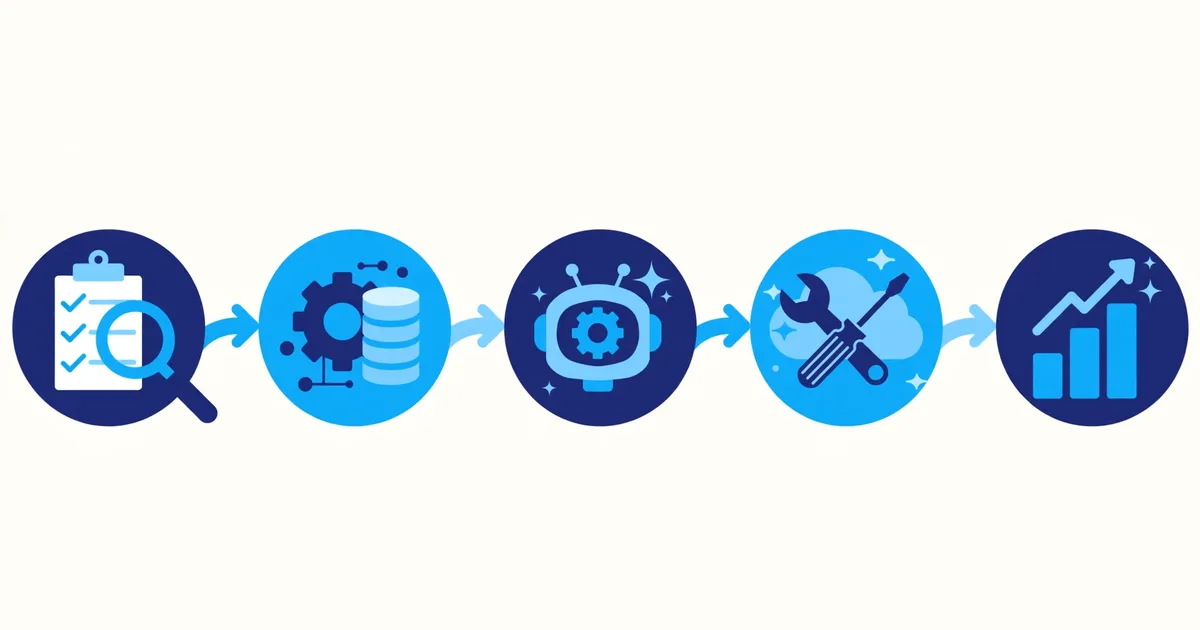
Strategy 1: Conduct a Comprehensive Process Audit
Before changing anything, find where manual work creates the biggest bottlenecks. Document every process the team performs regularly, then measure how much time each task takes per week.
Track data entry, customer communication, report generation, and admin tasks. The audit shows which processes drain the most time and should be automated first.
Use simple tools like spreadsheets or process mapping software to visualise workflows. The goal is a short list of high-impact processes, not a perfect map of everything.
Strategy 2: Implement Cloud-Based Automation Tools
Cloud software gives small businesses affordable automation with minimal upfront investment. These platforms scale as the company grows and usually include automatic updates, which cuts IT work.
Start with a CRM system to automate client communication and sales tracking. For finance, QuickBooks Online or Xero automate invoicing, expenses, and reporting. Email tools like Mailchimp remove manual outreach.
Cloud tools also enable remote work and mobile access. Teams update information from anywhere, which ends duplicate data entry and improves real-time collaboration.
Strategy 3: Adopt Workflow Automation Platforms
Workflow platforms connect different apps and automate repetitive tasks between them. Tools like Zapier, Make, or Microsoft Power Automate build bridges between software without coding.
A retail business could set up automation that adds new website customers straight into its CRM, sends welcome emails, and creates follow-up tasks. The whole chain runs without manual steps.
Start with simple tasks and build up. Zapier’s research found professionals using AI workflow tools save an average of 8.4 hours a week, and that saving usually starts with one or two basic workflows.
Strategy 4: Invest in Employee Training and Change Management
Technology alone does not fix manual work. Employees must understand and accept new systems, so training is essential.
Create step-by-step materials for each new tool, and name automation champions inside the team who can help colleagues learn and troubleshoot. Internal experts make the transition smoother and cut resistance.
Explain clearly how automation helps employees personally. When people see it as removing boring work rather than threatening their role, adoption rises sharply.
Hold regular check-ins to hear concerns and gather feedback. Staff often spot extra automation opportunities from their daily work, and that bottom-up input builds better solutions.
Strategy 5: Start Small and Scale Gradually
Trying to automate everything at once overwhelms teams and often fails. Take a phased approach that builds confidence and shows value step by step.
Begin with one department or one painful process. If customer onboarding needs too much manual data entry, automate that first, then document the time saved and the accuracy gained.
Use each win to build momentum for the next project. A realistic pace is one major process per quarter, which still transforms operations within a year.
Track metrics throughout. Measure time saved, error reduction, customer satisfaction, and cost savings. Real numbers justify continued investment and guide what to automate next.
Final Words
Manual work slows business growth because it caps scalability, wastes skilled time, increases errors, and weakens customer experience. The research backs that up with hard numbers, not just opinion.
The solution is within reach. By finding the true cost of manual work and automating one process at a time, businesses can unlock growth that manual methods block. The transition needs effort upfront, but the long-term return outweighs it.
Businesses that act now position themselves for lasting success in a market where customers expect speed and accuracy from day one.
What is considered manual work in business?
Manual work includes any task employees perform by hand or through repetitive actions without automation. Examples include data entry, manual invoicing, paper-based filing, and manual inventory counting.
How much time do businesses waste on manual tasks?
Smartsheet’s Automation in the Workplace report found over 40% of workers spend at least a quarter of their work week on manual, repetitive tasks. In the same survey, 59% said they could save six or more hours a week if the repetitive parts of their jobs were automated.
What are the first processes a business should automate?
Start with repetitive, time-consuming tasks like email follow-ups, appointment scheduling, invoicing, and customer relationship management. These give quick returns and build momentum for bigger projects.
Is automation expensive for small businesses?
Not necessarily. Many cloud tools offer free starter tiers or low monthly plans, and the time saved often covers the cost within weeks. Start with one process and a free trial before committing to a paid plan.
Will automation replace employees?
Automation usually strengthens employees rather than replacing them. It removes tedious tasks so staff can focus on work that needs human creativity and judgment, like solving problems and building client relationships.
Tired of manual work eating your team’s week?