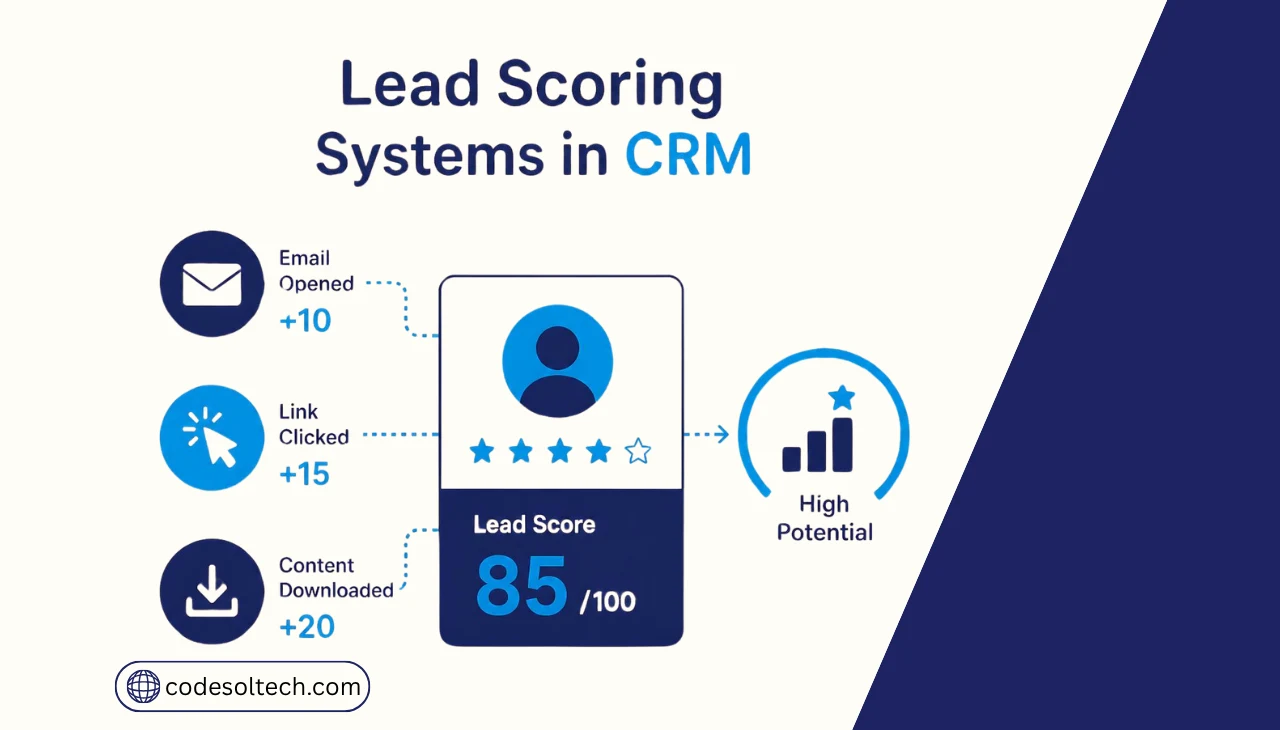
CRM lead scoring is a system that assigns numeric points to each lead based on demographic fit, company data, and recorded behavior. The score ranks every contact by conversion likelihood, so sales teams contact high-value prospects first and stop wasting time on low-intent leads.
- Lead scoring measures how ready a lead is to buy right now, based on activity and fit
- Lead qualification is the manual or automated decision that follows the score accept, nurture, or reject the lead
- A CRM updates lead scores automatically as new activity arrives, unlike a static spreadsheet ranking
- Sales and marketing teams both use the score, but marketing typically owns the scoring model and sales owns the follow-up action
How Does CRM Lead Scoring Work
A CRM lead scoring model works in five sequential stages. The CRM captures lead data, tracks ongoing activity, calculates a running score, checks the score against a qualification threshold, and triggers a sales action.
Lead Data → Activity Tracking → Score Calculation → Qualification Threshold → Sales Action
- Define scoring criteria before launch demographic, firmographic, and behavioral rules
- Assign a point value to each lead attribute, such as +10 for a demo request or +2 for an email open
- Track customer behavior continuously through page visits, form fills, and email engagement
- Update scores automatically inside the CRM as each new activity is logged
- Set a qualification threshold for example, 75 points that moves a lead into the sales queue
CRM Lead Scoring Factors
A CRM lead scoring model draws on ten core data points. Each factor either increases or decreases the lead’s total score.
- Job title and seniority within the company
- Industry classification
- Geographic location
- Website activity and page-visit frequency
- Email open and click engagement
- Form submissions
- Content downloads, such as whitepapers or case studies
- Demo or meeting requests
- Previous interactions logged in the CRM
- Purchase intent signals, including pricing-page visits
Types of CRM Lead Scoring
CRM platforms support six distinct lead scoring types. Most businesses combine two or three of these types into one scoring model.

Demographic Lead Scoring
Demographic scoring evaluates personal characteristics that indicate whether a lead matches the target buyer profile. Common factors include job title, seniority, role, location, and other relevant personal attributes.
Firmographic Lead Scoring
Firmographic scoring evaluates the lead’s company characteristics rather than the individual. Factors such as industry, annual revenue, employee count, company size, and location can help determine how closely a business matches the ideal customer profile.
Behavioral Lead Scoring
Behavioral scoring assigns points based on actions a prospect takes across digital channels. Website visits, content downloads, product-page views, form submissions, and other measurable actions can indicate increasing purchase intent.
Engagement Lead Scoring
Engagement scoring measures how frequently and recently a prospect interacts with your business. Email replies, link clicks, repeated visits, and other interactions can help distinguish actively engaged leads from prospects who have shown limited interest.
Negative Lead Scoring
Negative lead scoring removes points when a prospect displays signals that indicate low purchase potential or poor fit. Examples include competitor domains, student email addresses, irrelevant job titles, or other disqualifying attributes.
Predictive Lead Scoring
Predictive lead scoring uses machine learning to analyze historical customer and sales data. Instead of relying entirely on manually assigned point values, the system identifies patterns in past wins and losses to determine which lead attributes and behaviors are associated with conversion.
CRM Lead Scoring Examples
Website Engagement
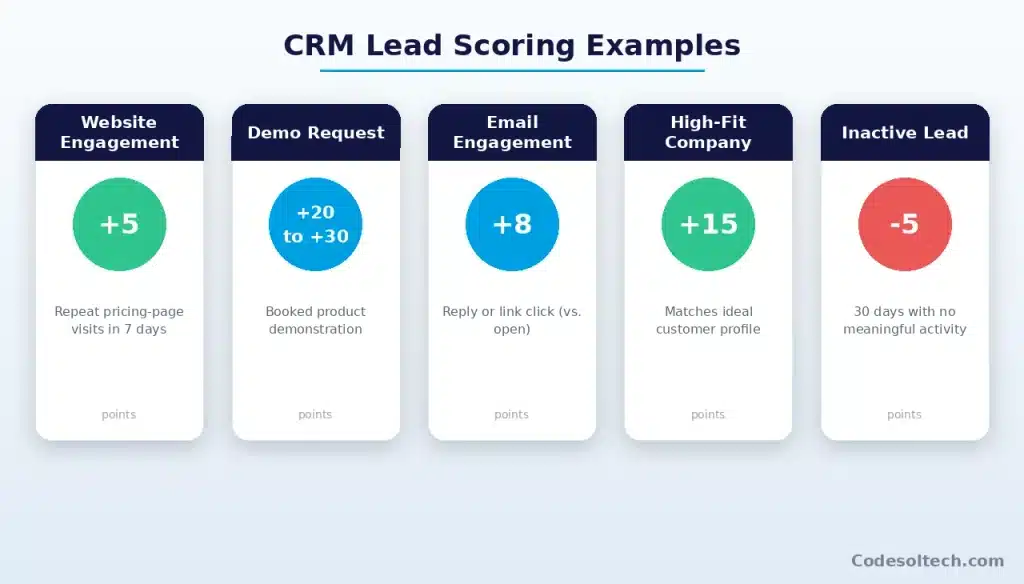
A CRM can increase a lead’s score when a prospect repeatedly visits high-intent pages, such as service or pricing pages, within a defined seven-day period.
Demo Request
A booked product demonstration is a strong buying signal. The CRM can assign a significant score increase, such as 20 to 30 points, when a prospect schedules a demo.
Email Engagement
Not all email interactions indicate the same level of interest. A CRM can award more points for replies or link clicks while assigning fewer points to basic email opens.
High-Fit Company
Firmographic data can help identify leads that match the ideal customer profile. The CRM can add a scoring bonus when a prospect’s company meets criteria such as industry, company size, location, or revenue.
Inactive Lead
Lead scores can decrease when prospects stop engaging. For example, the CRM might deduct 5 points after 30 days without meaningful activity, helping sales teams prioritize currently active prospects.
CRM Lead Scoring vs. Lead Grading
Lead scoring and lead grading answer two different questions. Scoring measures buying interest; grading measures whether the lead fits the target customer profile at all.
| Lead Scoring | Lead Grading |
|---|---|
| Measures behavior and engagement | Measures lead fit |
| Usually point-based | Usually attribute-based (A, B, C, D) |
| Changes as new activity occurs | Stays fixed unless firmographic data changes |
| Shows current buying interest | Shows long-term suitability |
| Helps prioritize timing | Helps prioritize which accounts to pursue |
How to Set Up Lead Scoring in a CRM
- Define the ideal customer profile using firmographic data
- Identify the highest-value behaviors, such as demo requests or pricing-page visits
- Choose the scoring criteria — demographic, behavioral, or a blend of both
- Assign point values to each criterion
- Create a qualification threshold that separates cold leads from sales-ready leads
- Connect the score to a sales workflow, such as an automatic task or alert
- Test the scoring rules against a sample of closed-won and closed-lost deals
- Review the model on a fixed schedule monthly or quarterly and adjust point values
This setup process runs inside the CRM itself, but the accuracy of the score depends on clean, accurate customer data feeding into it. A CRM built on inconsistent records produces an unreliable score regardless of how the point values are configured.
How Does CRM Lead Scoring Improve Sales Performance
CRM lead scoring improves sales performance by directing rep time toward the leads most likely to close. Sales reps typically spend a measurable share of each week on manual prioritization work that a scoring model automates.
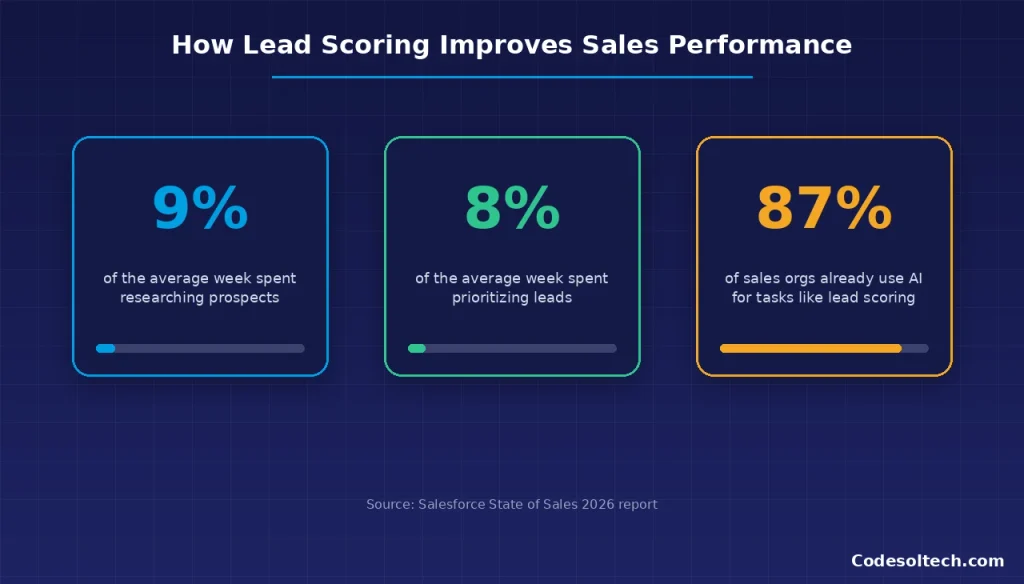
- Sales reps spend 9% of their average week researching prospects and 8% prioritizing leads and opportunities, according to the Salesforce State of Sales report — time a scoring model reduces by pre-ranking the queue
- 87% of sales organizations already use AI for tasks including lead scoring, prospecting, and forecasting, according to the Salesforce State of Sales 2026 report
- Lead scoring reduces manual qualification work by pre-filtering low-fit contacts before a rep opens the record
- Lead scoring speeds up response time by flagging high-score leads for immediate follow-up
- Lead scoring improves sales and marketing alignment by giving both teams one shared definition of a qualified lead
Common CRM Lead Scoring Mistakes
Overcomplicating the Scoring Model
Adding too many scoring rules can make the model difficult to understand, maintain, and audit. Focus on the behaviors and attributes that have a clear relationship with sales outcomes.
Assigning Arbitrary Point Values
Point values should be based on actual customer and sales data rather than assumptions. Comparing scoring patterns with closed-deal data can help determine which actions and attributes deserve greater weight.
Ignoring Negative Lead Signals
Not every lead interaction indicates buying intent. Factors such as personal email domains, student titles, irrelevant industries, or poor-fit company profiles can reduce a lead’s likelihood of becoming a customer and should be reflected in the scoring model.
Treating Every Activity Equally
An email open does not demonstrate the same intent as requesting a demo or contacting sales. Giving identical scores to low- and high-intent activities can distort lead prioritization.
Using Outdated CRM Data
Lead scoring becomes less reliable when it depends on outdated or disconnected customer information. A properly connected CRM integration architecture helps keep lead attributes and activity data synchronized across systems.
Never Reviewing Score Accuracy
A lead scoring model should not be treated as a one-time setup. Regularly comparing scores with conversion and closed-deal data helps identify rules that need adjustment.
Disconnecting Scores From Sales Workflows
A score has limited value if it does not trigger a practical sales action. High-scoring leads can be routed to sales representatives, added to priority queues, or used to trigger alerts and follow-up workflows.
FAQs
What is lead scoring in CRM?
Lead scoring in CRM is a point-based system that ranks leads by fit and behavior. The CRM assigns each lead a numeric score, then sales teams use that score to decide which prospects to contact first.
How does CRM lead scoring work?
CRM lead scoring works by tracking lead data and activity, converting each signal into points, and totaling those points into one score. The CRM checks the score against a set threshold and triggers a sales action once the lead qualifies.
What is a good lead score?
A good lead score is the threshold a business sets after testing point values against its own closed-won deals — there is no universal number. Most B2B teams set this threshold between 60 and 100 points on a 100-point scale.
What is the difference between lead scoring and lead grading?
Lead scoring measures current buying interest through behavior and activity. Lead grading measures how well a lead’s company and role fit the ideal customer profile.
Can CRM lead scoring be automated?
Yes. Most CRM platforms automate lead scoring by updating point totals in real time as new activity is logged, then triggering assignment rules, tasks, or alerts once a lead crosses the threshold.
Is lead scoring useful for small businesses?
Yes. A small business with a lower lead volume still benefits from lead scoring because it removes manual prioritization work and directs limited sales hours toward the highest-fit prospects.
Can lead scoring be customized?
Yes. A business can customize point values, scoring criteria, and qualification thresholds to match its own sales cycle, customer segments, and custom CRM development setup.
Final Words
CRM lead scoring turns scattered lead data into one clear number sales teams can act on immediately. It removes guesswork from prioritization and connects marketing activity directly to sales follow-up. Businesses that skip it rely on gut instinct instead of data a slower, less consistent path to revenue.
Ready to build a CRM lead scoring system that actually fits your sales process?
Talk to our CRM development team and get a scoring model built around your real customer data.
You May Like
Task & Activity Tracking in CRM: Why Deals Slip Through