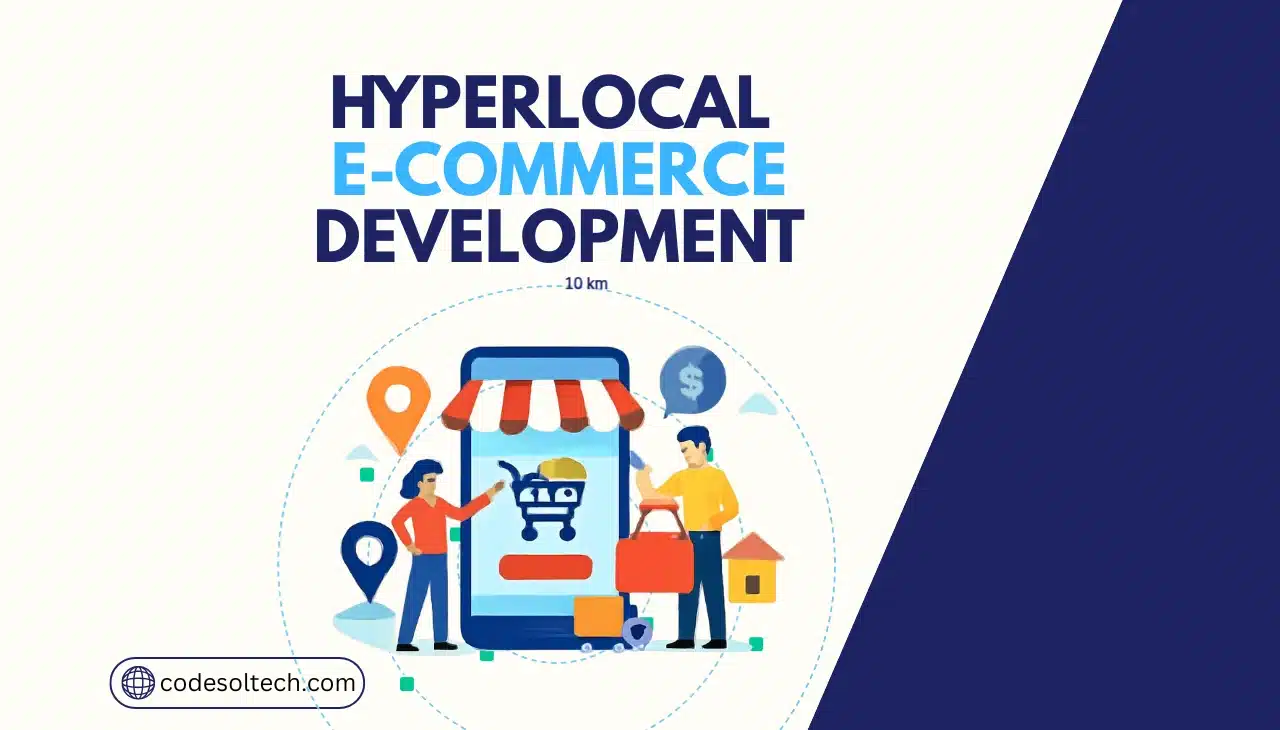
Hyperlocal ecommerce development builds software that connects buyers to sellers within a 2 to 10 kilometer radius and fulfills orders in under 60 minutes. The system combines geofencing, real-time inventory sync, and dispatch algorithms to route orders from the nearest stock point. Retailers use this model to compete with same-day delivery leaders without national warehouse networks.
What Is Hyperlocal Ecommerce Development?
Hyperlocal ecommerce development is the process of designing, building, and deploying a platform that fulfills online orders from a supplier located within a small geographic zone.
The platform matches each order to the closest available inventory source a dark store, a partner retailer, or a micro-fulfillment center instead of a centralized warehouse. This structure cuts delivery distance and delivery time.
The model powers three business categories today:
- Quick commerce (Q-commerce): grocery and convenience delivery in 10 to 30 minutes
- On-demand local marketplaces: multi-vendor platforms connecting neighborhood stores to nearby buyers
- Retailer-owned hyperlocal apps: single-brand platforms that ship from existing store inventory
The global instant grocery market the largest hyperlocal segment was valued at $126.4 billion in 2021 and is projected to reach $588.2 billion by 2030, growing at a CAGR of 19.0%, according to Grand View Research.
Dark stores now anchor this growth because they let retailers hold pre-positioned stock inside delivery-dense zones instead of routing every order through a distant warehouse.
How Does Hyperlocal Ecommerce Development Work?
A hyperlocal ecommerce platform works by mapping a delivery radius around each fulfillment point, syncing live inventory within that radius, and automatically assigning the nearest available rider to each order. Four systems run this process end-to-end.
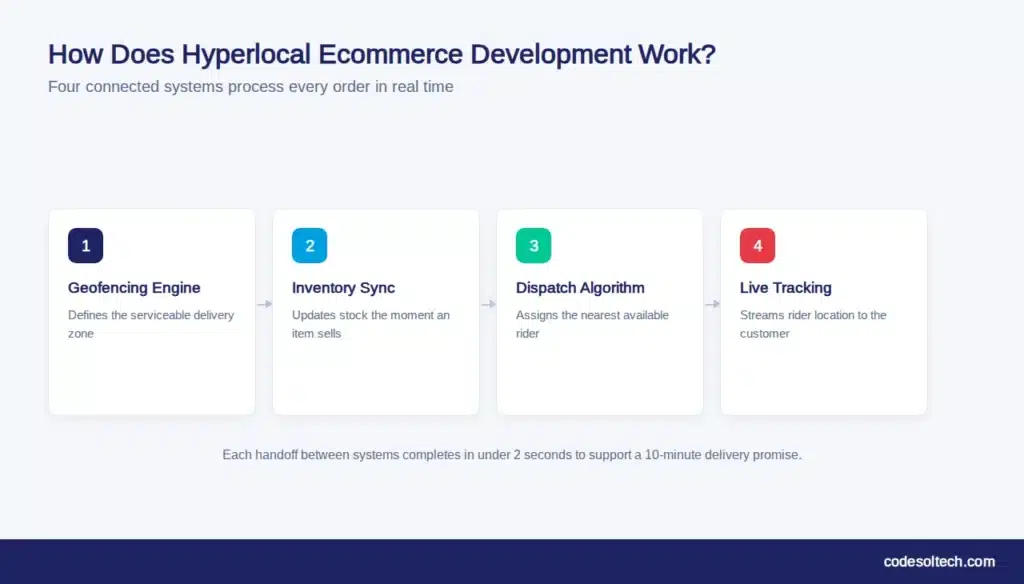
- Geofencing engine: defines serviceable zones and blocks orders outside the delivery radius
- Real-time inventory management: updates stock counts across every connected store the moment an item sells
- Order dispatch algorithm: assigns delivery riders based on proximity, load, and delivery deadline
- Live tracking layer: streams rider GPS data to the customer app and the admin dashboard
These four systems exchange data through APIs. The inventory management system pushes stock updates to the marketplace app. The marketplace app pushes order data to the dispatch algorithm.
The dispatch algorithm pushes rider assignments to the tracking layer. Each handoff must be completed in under 2 seconds to support a 10-minute delivery promise.
Core Technology Stack
Development teams build hyperlocal platforms on a specific stack because generic ecommerce architecture cannot handle real-time location logic.
- Backend: Node.js or Django for order orchestration and API management
- Database: PostgreSQL with PostGIS for geospatial queries
- Real-time layer: WebSocket connections or Firebase for live order tracking
- Maps and routing: Google Maps Platform or Mapbox for distance calculation and route optimization
- Payments: Stripe or Razorpay with support for cash-on-delivery reconciliation
- Inventory sync: REST or GraphQL APIs connecting POS systems to the central inventory database
Hyperlocal Ecommerce Business Models
Businesses build hyperlocal platforms on four distinct fulfillment models. Each model changes the technical architecture and the cost of development.
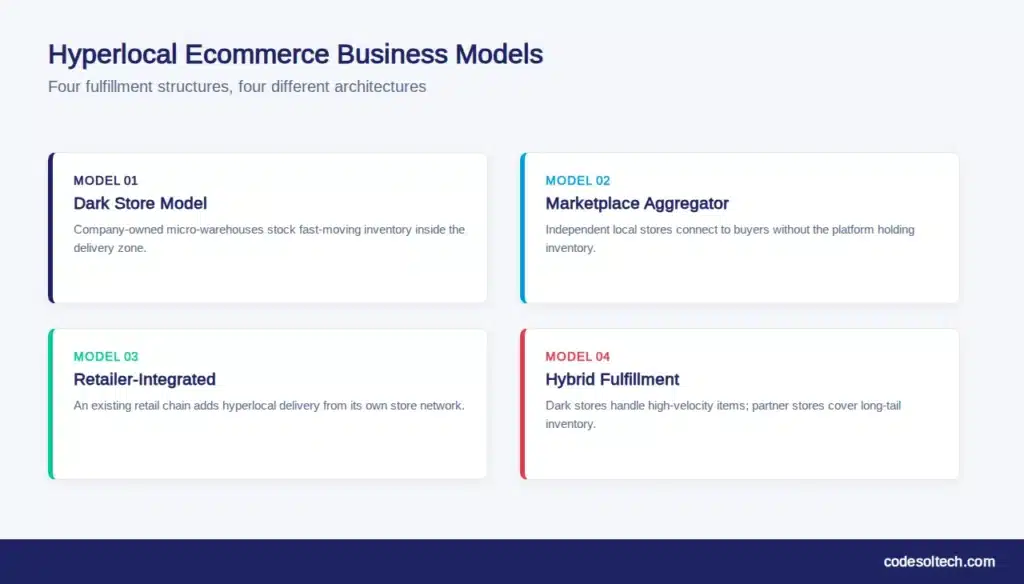
- Dark store model: the company leases small warehouses inside delivery zones and stocks fast-moving inventory. Development requires an internal inventory management system and a picker-facing app.
- Marketplace aggregator model: the platform connects independent local stores to buyers without holding inventory. Development requires a multi-vendor admin panel and a vendor onboarding API.
- Retailer-integrated model: an existing retail chain adds hyperlocal delivery from its own store network. Development requires integration with the retailer’s existing POS and ERP systems.
- Hybrid fulfillment model: the platform combines dark stores for high-velocity SKUs with partner stores for long-tail inventory. Development requires a routing layer that selects the fulfillment source per order.
Hyperlocal vs. Traditional vs. Quick Commerce: A Direct Comparison
| Factor | Traditional Ecommerce | Hyperlocal Ecommerce | Quick Commerce |
|---|---|---|---|
| Delivery radius | National or international | 2–10 km | 1–3 km |
| Delivery time | 2–7 days | 1–3 hours | 10–30 minutes |
| Inventory model | Centralized warehouse | Local stores or dark stores | Dark stores only |
| Core technology | Standard cart and checkout | Geofencing and real-time sync | Geofencing, sync, and dispatch AI |
| Typical use case | Apparel, electronics, furniture | Grocery, pharmacy, local retail | Grocery, convenience, essentials |
Why Do Businesses Need Hyperlocal Ecommerce Development?
Businesses need hyperlocal ecommerce development because delivery speed now drives purchase decisions more than price in categories like grocery and pharmacy.
A platform built for hyperlocal fulfillment lets a business compete with national delivery leaders using local inventory instead of a national warehouse budget.
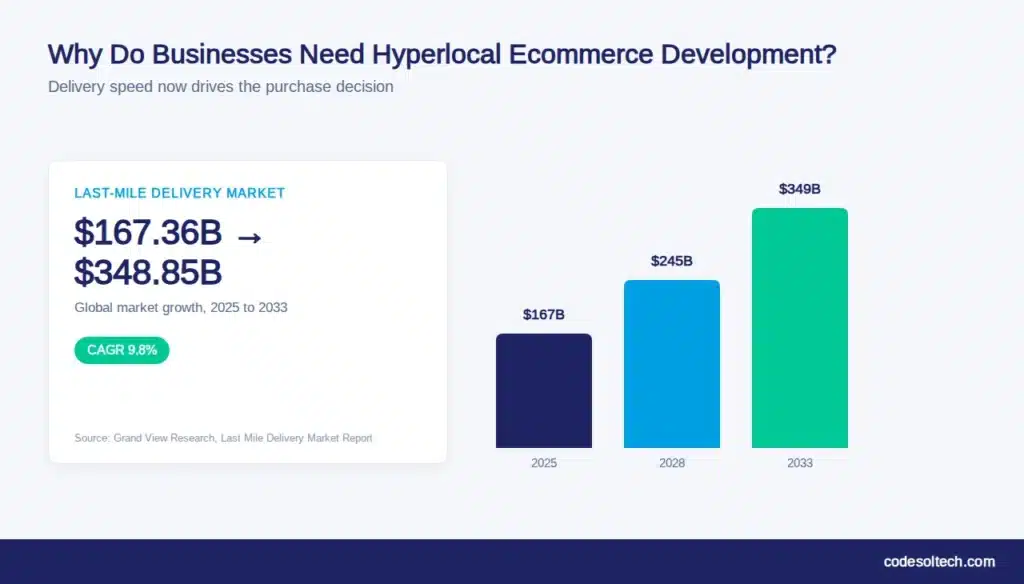
The global last-mile delivery market, the infrastructure layer behind hyperlocal fulfillment, reached $167.36 billion in 2025 and is projected to hit $348.85 billion by 2033 at a CAGR of 9.8%, according to Grand View Research.
The same report identifies dark stores and hyperlocal delivery models as a direct growth driver, particularly in the food and beverage segment, which is expanding at the fastest CAGR of 11.9% within the category.
Three business outcomes follow directly from hyperlocal adoption:
- Higher order frequency: shorter delivery windows increase repeat purchase rate for daily-use categories
- Lower cart abandonment: customers commit faster when the delivery estimate is under 60 minutes
- Reduced fulfillment cost per order: local dispatch removes long-haul freight and centralized warehouse overhead
Key Features to Build Into a Hyperlocal Ecommerce Platform
A production-ready hyperlocal platform needs 8 core feature sets across the customer app, vendor panel, rider app, and admin dashboard.
- Location-based store discovery that shows only sellers within the buyer’s serviceable radius
- Real-time inventory management connected to each seller’s point-of-sale system
- Dynamic delivery time estimation calculated from live rider location and traffic data
- Multi-vendor order splitting for baskets that pull items from more than one local store
- Rider allocation and route optimization to minimize distance per delivery
- In-app payments with COD reconciliation for markets where cash-on-delivery remains common
- Vendor and rider performance dashboards tracking fulfillment time, order accuracy, and cancellation rate
- Push notification and live tracking covering order confirmation through doorstep delivery
Challenges in Hyperlocal Ecommerce Development
Development teams face four recurring technical challenges when building hyperlocal platforms.
- Inventory sync latency: stale stock data causes order cancellations when an item sells out between the app refresh and order placement
- Peak-load rider allocation: demand spikes during meal hours require dynamic rider pooling across multiple zones
- Fragmented vendor systems: local stores often run different POS software, which complicates a single integration layer
- Delivery radius overlap: dense urban zones require conflict resolution logic when two dark stores can serve the same address
How CodeSol Technologies Builds Hyperlocal Ecommerce Platforms
CodeSol Technologies develops hyperlocal ecommerce platforms on a modular architecture that separates the customer app, vendor panel, rider app, and admin dashboard into independently scalable services.
This structure lets a business start with a single dark store model and expand into a hybrid fulfillment model without rebuilding the core platform.
Our development process integrates directly with existing ERP systems and CRM platforms so that inventory, customer data, and order history stay synchronized from day one.
For businesses evaluating which model best fits their market, our teams also build on-demand ecommerce platforms and B2B ecommerce portals as complementary solutions on the same technical foundation.
Final Words
Hyperlocal ecommerce development turns delivery speed into a competitive asset. The model needs geofencing, real-time inventory, and dispatch automation working together.
Businesses that build this stack correctly cut delivery time, reduce fulfillment cost, and capture the growing demand for same-hour delivery documented across the grocery and last-mile delivery markets.
Ready to Build Your Hyperlocal Ecommerce Platform
CodeSol Technologies designs and develops custom ecommerce built for real-time fulfillment. Contact our team to scope your hyperlocal development project.