A real estate CRM (Customer Relationship Management system) centralizes buyer and seller data, tracks every lead from first inquiry to closed transaction, and automates follow-up across the property sales pipeline. Real estate agencies deploy CRM software to log inquiries, score leads by intent, schedule showings, and monitor deal stages across multiple agents.
Customer Relationship Management software captured the largest share of the U.S. real estate software market in 2022, at 27.3 percent, ahead of enterprise resource planning and property management tools, according to Grand View Research.
Real estate CRM platforms differ from general-purpose CRM tools because they include property-specific fields. These fields include:
- MLS (Multiple Listing Service) property references
- Buyer budget range and financing pre-approval status
- Showing schedules and open house attendance
- Listing status: active, under contract, or closed
- Commission split and referral source
How Does a Real Estate CRM Track Leads
A real estate CRM tracks leads through five stages: capture, qualification, nurture, conversion, and retention. The CRM records the lead’s source at capture, assigns a score based on buying signals during qualification, then triggers automated emails or texts during nurture until the agent converts the lead into an active client.
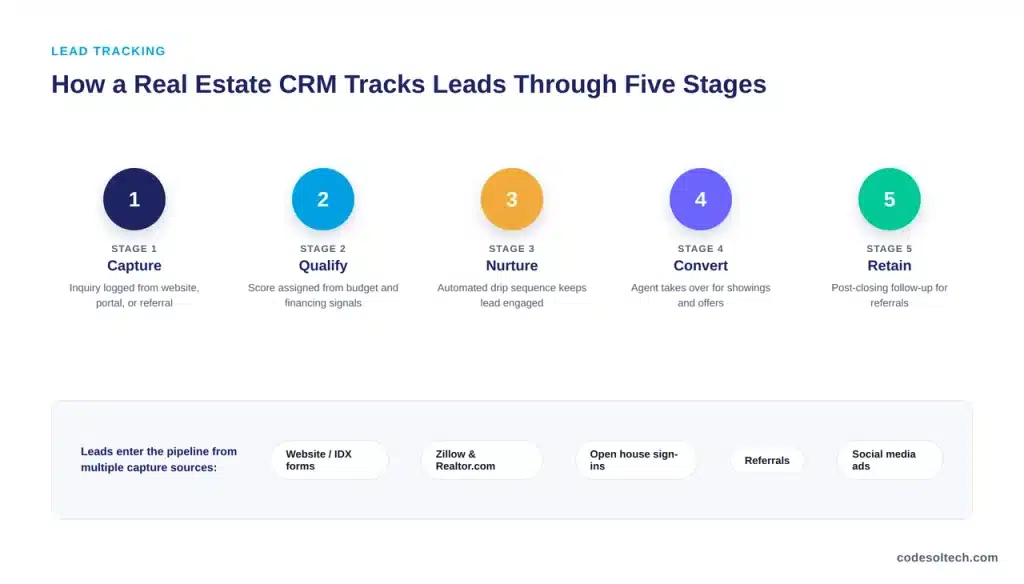
CRM systems capture leads from multiple channels and route each one into the same pipeline. Common capture sources include:
- Website inquiry and IDX (Internet Data Exchange) search forms
- Zillow Premier Agent, Realtor.com, and other portal integrations
- Open house sign-in sheets, digitized through mobile apps
- Referrals logged manually by agents
- Social media lead ads on Facebook and Instagram
Social media generated the highest share of quality leads for REALTORS® in 2025, at 39 percent, followed by CRM software itself at 23 percent and local MLS access at 17 percent, according to the National Association of REALTORS® 2025 Technology Survey.
This ranking places CRM software as the second most effective lead-generating technology reported by agents, ahead of MLS access and paid advertising.
Once a lead enters the CRM, the system logs every interaction: phone calls, emails, text messages, and property views. Each interaction updates the lead’s score.
A high score triggers an alert for the assigned agent to follow up directly instead of waiting for the automated sequence to continue.
Lead Scoring in a Real Estate CRM
Lead scoring assigns a numeric value to each contact based on behavior and profile data, then ranks leads by likelihood to transact.
A CRM raises a lead’s score when the contact opens emails, clicks property links, requests a showing, or submits pre-approval documents.
The score drops when a contact goes silent for a defined period, typically 14 to 30 days.
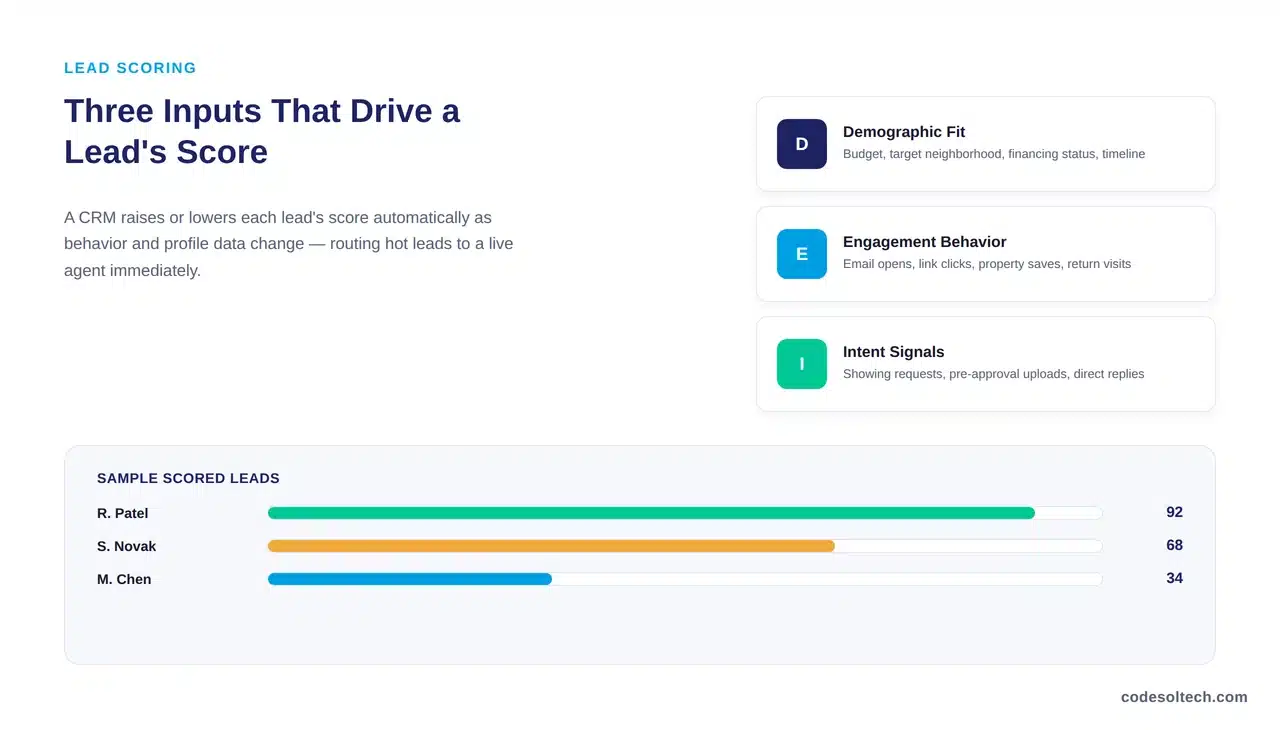
Real estate CRM systems typically score leads across three categories:
- Demographic fit: budget range, target neighborhood, financing status, and timeline to purchase
- Engagement behavior: email opens, link clicks, property saves, and website return visits
- Intent signals: showing requests, mortgage pre-approval uploads, and direct replies to agent messages
Agencies configure score thresholds to route hot leads directly to a live agent while cold leads stay inside an automated nurture sequence. This routing logic prevents agents from spending time on unqualified contacts while ensuring qualified buyers receive an immediate response.
Core Features of Property Sales Management Software
Property sales management software requires eight core features to move a lead from inquiry to closing without manual data re-entry. Each feature maps to a specific stage of the transaction pipeline.
- Pipeline visualization: a kanban or funnel view showing every deal by stage (new lead, qualified, showing scheduled, offer submitted, under contract, closed)
- MLS/IDX integration: live property data synced into lead and deal records
- Automated drip campaigns: scheduled email and SMS sequences triggered by lead behavior
- Transaction management integration: e-signature and document workflows connected to the deal record
- Showing and task scheduler: calendar sync across agents and clients
- Commission tracking: automatic split calculation by agent, team, and referral source
- Mobile access: full CRM functionality on iOS and Android for field use
- Reporting dashboards: conversion rate, average days-to-close, and lead-source ROI by agent
Agencies that skip MLS/IDX integration force agents to re-enter property data by hand for every lead conversation. This manual step is the most common cause of stale or duplicate records in agency databases.
Why Do Real Estate Agencies Need CRM Software
Real estate agencies need CRM software because manual lead tracking loses deals to slow follow-up, fragmented records across agents, and no visibility into pipeline stage. Agents who rely on spreadsheets cannot see which leads a teammate already contacted, which produces duplicate outreach and missed follow-ups on cold leads that later re-engage.
Client-facing data confirms the payoff of structured technology adoption. Eighty-two percent of buyers and sellers responded positively when their agent integrated more technology into the transaction process, according to NAR’s 2025 Technology Survey.
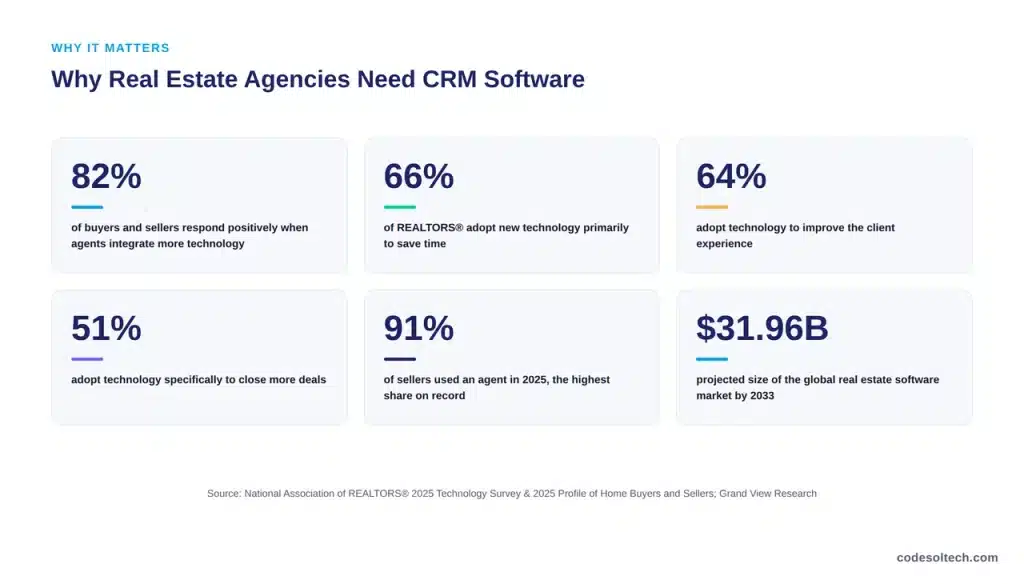
REALTORS® cited three primary reasons for adopting new technology: saving time (66 percent), improving the client experience (64 percent), and closing more deals (51 percent), per the same 2025 NAR Technology Survey findings.
Agent reliance on professional representation remains high, which raises the stakes for how agencies manage every lead.
Eighty-eight percent of buyers purchased their home through an agent or broker in 2025, and 91 percent of sellers used an agent, the highest share on record, according to NAR’s 2025 Profile of Home Buyers and Sellers.
The median buyer search took 10 weeks in 2025, which means a CRM must sustain lead engagement across a multi-week decision cycle rather than a single conversation.
Market investment reflects this dependency on software infrastructure. The global real estate software market is projected to reach $31.96 billion by 2033, expanding at a 12.2 percent compound annual growth rate from 2026 to 2033, according to Grand View Research. CRM software represents the largest single category inside that market.
Real Estate CRM vs. Spreadsheet-Based Lead Tracking
A spreadsheet stores static data. A CRM stores live, automated, multi-agent data. The table below compares both approaches across the functions that determine whether a lead converts into a closed transaction.
| Capability | Spreadsheet | Real Estate CRM |
|---|---|---|
| Automated follow-up | Not available; requires manual entry | Triggered by lead behavior and stage |
| Multi-agent visibility | Prone to version conflicts and duplication | Single shared record per lead |
| MLS/IDX sync | Manual copy-paste | Live property data feed |
| Lead scoring | Not available | Automatic, behavior-based |
| Mobile access | Limited, no real-time sync | Full functionality on mobile apps |
| Reporting | Manual formulas per agent | Automated dashboards agency-wide |
How Should a Real Estate Agency Choose a CRM
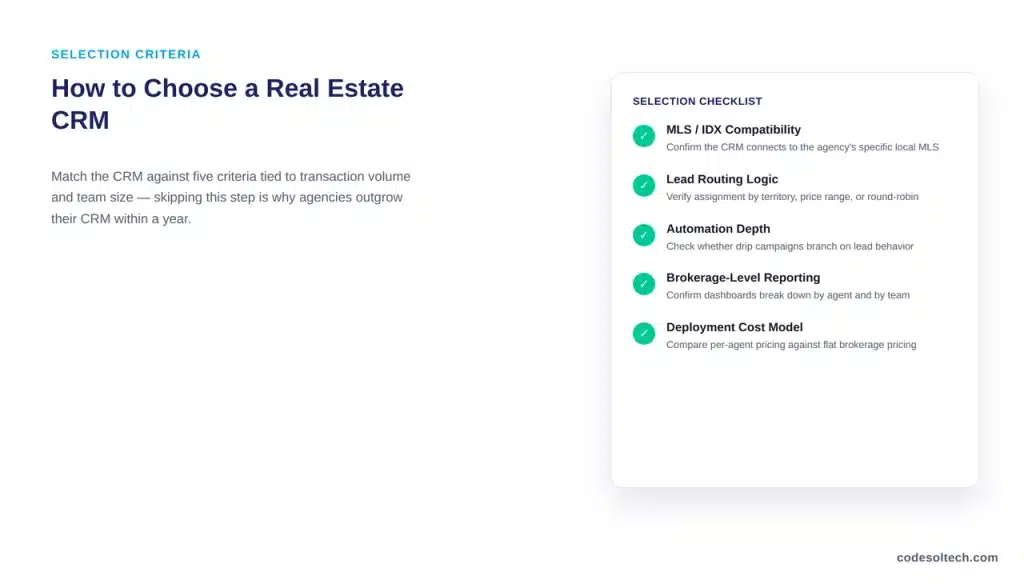
A real estate agency should choose a CRM by matching five criteria against its transaction volume and team size: MLS integration depth, lead routing rules, mobile functionality, automation capability, and multi-agent reporting. Agencies that skip this evaluation frequently select a CRM designed for solo agents and outgrow it within a year.
- MLS/IDX compatibility: confirm the CRM connects to the agency’s specific local MLS, not a generic feed
- Lead routing logic: verify the system can assign leads by territory, price range, or round-robin across agents
- Automation depth: check whether drip campaigns branch based on lead behavior or run on a fixed schedule only
- Brokerage-level reporting: confirm dashboards break down performance by individual agent and by team
- Deployment cost model: compare per-agent licensing against flat brokerage pricing at current headcount and projected growth
Custom-configured CRM systems solve a specific limitation of off-the-shelf platforms: rigid workflow structures that do not match an agency’s actual sales process.
Development teams that build or heavily customize a CRM configure lead-routing rules, commission logic, and reporting fields to the agency’s exact structure instead of forcing the agency to adapt to a fixed template.
Agency size determines the correct CRM category. A solo agent or a two-person team typically needs a lightweight CRM with basic automation and a low per-seat cost.
A brokerage managing 15 or more agents needs a CRM built for territory-based lead routing, team-level commission splits, and consolidated reporting across every agent’s pipeline.
Selecting the wrong category creates one of two problems: the CRM lacks features the team needs, or the agency pays for enterprise functionality it never uses.
Real Estate CRM vs. Transaction Management Platform
A real estate CRM does not replace a transaction management platform; the two systems handle different stages of the deal. The CRM manages the relationship and pipeline before a contract exists.
The transaction management platform manages documents, disclosures, and compliance after a buyer and seller sign an agreement.
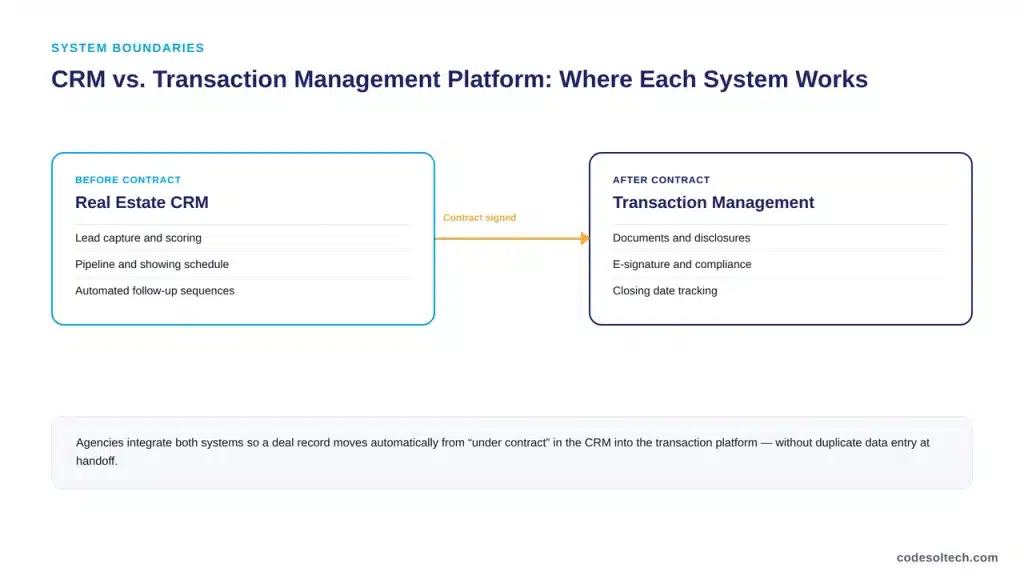
Agencies connect both systems through an integration so that a deal record moves automatically from “under contract” in the CRM into the transaction management platform without duplicate data entry. Common integration points include:
- Contact and property data transfer at contract signing
- Document status sync back to the CRM deal record
- Closing date updates that trigger post-sale follow-up sequences in the CRM
Agencies that run these systems separately, without integration, require an agent or coordinator to re-enter data manually at every handoff. This manual step is a common source of closing delays in multi-agent brokerages.
Final Words
A real estate CRM turns scattered leads into a tracked, measurable pipeline. It replaces manual follow-up with automation, gives every agent shared visibility, and connects directly to MLS data. Agencies that adopt one convert more inquiries into closings and lose fewer leads to slow response times.
Ready to build a CRM tailored to your agency’s exact sales process?
Talk to CodeSoltech’s development team about a custom real estate CRM built around your lead sources, your commission structure, and your MLS.


![Electrician CRM: Win More Jobs [Faster Estimates Guide]](https://www.codesoltech.com/wp-content/uploads/2026/10/Crm-for-an-electricians-business.webp)