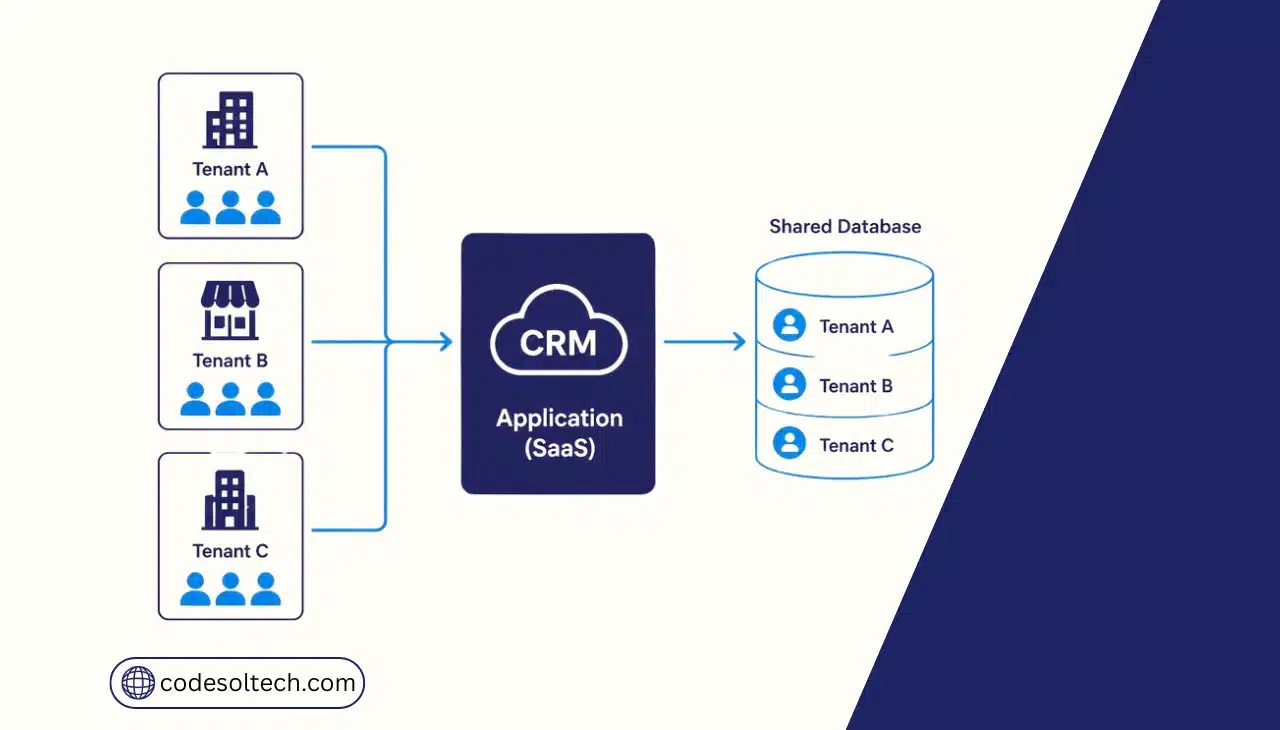
Multi-tenant CRM architecture runs one CRM application instance that serves multiple customer organizations, called tenants, from a single codebase and shared infrastructure. Each tenant’s data stays logically isolated through tenant IDs, separate schemas, or separate databases.
SaaS businesses use this model to cut infrastructure costs, deploy updates once, and onboard new customers without provisioning new servers.
What Is Multi-Tenant CRM Architecture?
Multi-tenant CRM architecture is a software design pattern in which a single CRM application serves multiple customer organizations simultaneously. The application layer and, often, the database layer remain shared.
Each tenant experiences the CRM as if they own a private instance, but the underlying infrastructure runs one codebase for everyone.
The alternative model, single-tenant architecture, gives each customer a dedicated application instance and a dedicated database. Single-tenant deployments increase infrastructure cost linearly with every new customer.
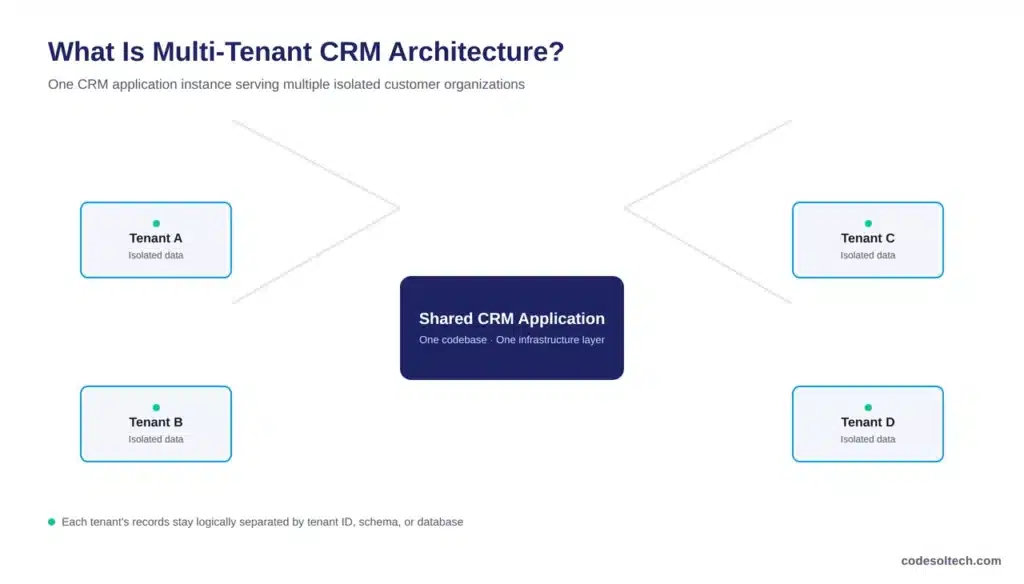
Multi-tenant architecture decouples customer growth from infrastructure growth, which is why Salesforce, HubSpot, and Zoho all run multi-tenant CRM platforms at scale.
Gartner’s Market Share report on Customer Experience and Relationship Management confirms the scale of this shift: the worldwide CRM software market grew 13.4% to reach $128 billion in 2024.
The CRM sales software segment specifically grew 12.2% to $25.7 billion in 2024 and is forecast to reach $28.7 billion in 2025, expanding at a 12.8% CAGR through 2029.
Multi-tenant architecture is the infrastructure layer that makes this growth economically possible for CRM vendors.
3 Types of Multi-Tenant CRM Architecture
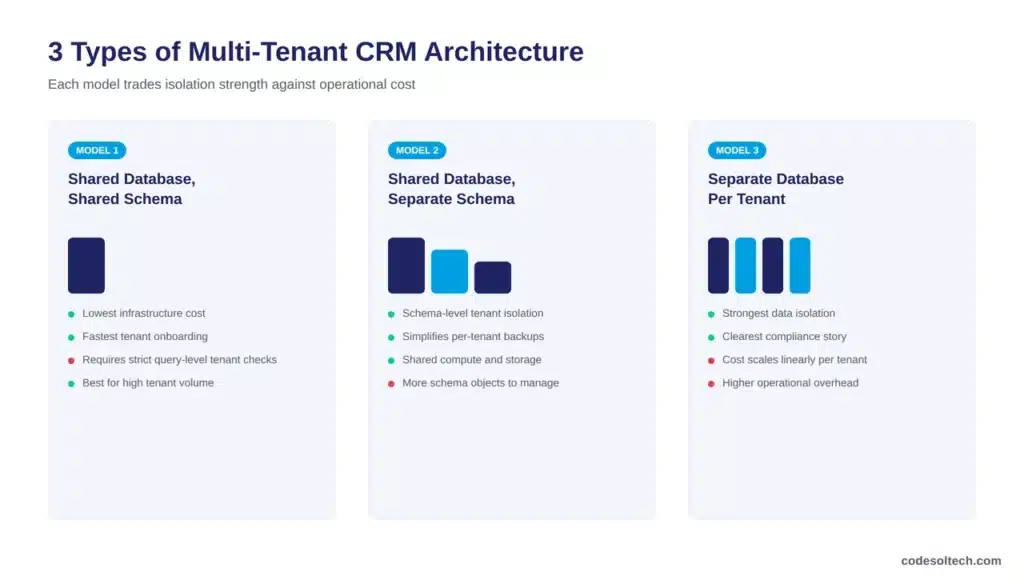
SaaS businesses choose between three tenancy models. Each model trades isolation strength against operational cost.
- Shared database, shared schema: All tenants store data in the same tables, separated by a
tenant_idcolumn on every row. This model delivers the lowest infrastructure cost and the fastest tenant onboarding, but requires strict query-level enforcement to prevent cross-tenant data leaks. - Shared database, separate schema: Each tenant gets a dedicated schema inside a shared database instance. This model isolates tenant data at the schema level, simplifies per-tenant backups, and still shares compute and storage infrastructure across all tenants.
- Separate database per tenant: Each tenant receives a fully dedicated database. This model delivers the strongest data isolation and the clearest compliance story for regulated industries, but database count scales linearly with customer count, which raises operational cost at scale.
Enterprise CRM vendors frequently combine these three models into a hybrid architecture. Standard-tier customers share a database and schema. Enterprise-tier customers with strict compliance requirements receive a dedicated database.
This hybrid design lets a single CRM platform serve small businesses and regulated enterprises without maintaining two separate codebases.
Development teams select a model based on three variables: expected tenant count, compliance obligations, and per-tenant data volume.
A CRM targeting thousands of small business tenants gains the most from a shared-schema model, since onboarding speed and infrastructure cost dominate the decision.
A CRM targeting a smaller number of enterprise tenants in healthcare, finance, or government gains more from a separate-database model, since regulatory audits often require proof of physical data separation.
This decision determines database schema design at the outset, so reversing it after launch requires a full data migration rather than a configuration change.
Tenant provisioning logic also depends on the chosen model. Shared-schema systems provision a new tenant by inserting a tenant record and assigning a tenant ID, a process that completes in seconds.
Separate-database systems provision a new tenant by creating a new database instance, applying the schema, and configuring backup and monitoring policies, a process that typically takes longer and consumes more operational resources per customer.
How Does Multi-Tenant CRM Architecture Keep Tenant Data Secure?
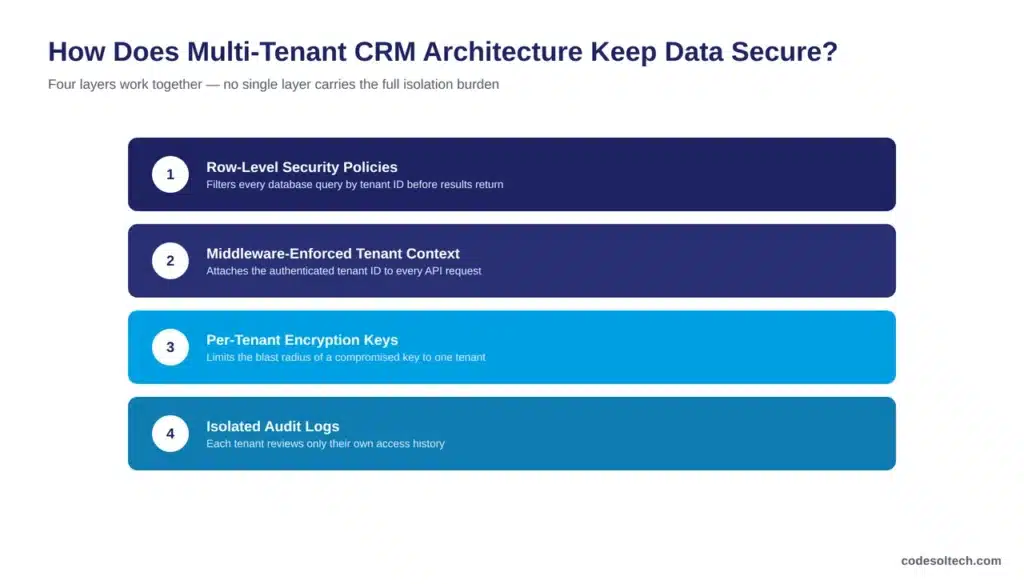
Multi-tenant CRM architecture keeps tenant data secure through tenant-scoped access controls enforced at the database, API, and application layers simultaneously.
No single layer carries the full isolation burden. Row-Level Security (RLS) policies at the database layer, tenant-ID validation at the API layer, and session-scoped authentication at the application layer work together to prevent one tenant from ever querying another tenant’s records.
The cost of getting this wrong is measurable.
IBM’s Cost of a Data Breach Report 2025 found that breaches involving data spread across multiple environments cost an average of $5.05 million and took 276 days to contain, compared to $4.01 million for breaches confined to a single on-premises environment.
Multi-tenant CRM systems that mix shared infrastructure with inconsistent isolation enforcement fall directly into this higher-cost, higher-complexity category.
Development teams reduce this risk with four specific controls:
- Row-Level Security policies that filter every database query by tenant ID before results reach the application layer.
- Middleware-enforced tenant context that attaches the authenticated tenant ID to every API request, independent of client-supplied parameters.
- Per-tenant encryption keys that limit the blast radius of a single compromised key to one tenant’s data.
- Isolated audit logs that let each tenant review their own access history without visibility into other tenants’ activity.
Multi-Tenant vs. Single-Tenant CRM: Key Differences
| Factor | Multi-Tenant CRM | Single-Tenant CRM |
|---|---|---|
| Infrastructure cost | Shared across all tenants; cost per tenant decreases as tenant count grows | Dedicated per customer; cost scales linearly with customer count |
| Deployment speed | New tenants onboard in minutes using existing infrastructure | New tenants require a new environment provisioning cycle |
| Update rollout | One deployment updates every tenant simultaneously | Each tenant instance requires a separate update cycle |
| Data isolation | Logical isolation via tenant ID, schema, or shared-infra controls | Physical isolation via dedicated database and server |
| Customization depth | Limited to configuration-level customization per tenant | Supports deep code-level customization per customer |
| Compliance fit | Suitable for most industries with schema or database-level isolation | Preferred for highly regulated sectors requiring physical data separation |
5 Business Benefits of Multi-Tenant CRM Architecture
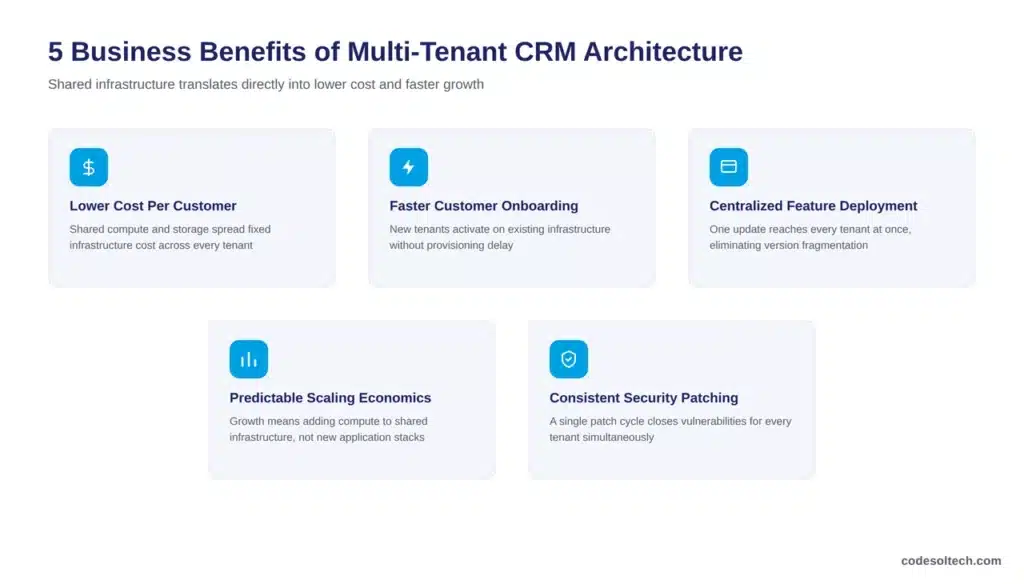
- Lower infrastructure cost per customer: Shared compute and storage spread fixed infrastructure cost across every tenant on the platform.
- Faster customer onboarding: New tenants activate on existing infrastructure without a provisioning delay.
- Centralized feature deployment: Engineering teams ship one update that reaches every tenant at once, eliminating version fragmentation.
- Predictable scaling economics: Adding tenant capacity means adding compute resources to shared infrastructure, not deploying new application stacks.
- Consistent security patching: A single patch cycle closes vulnerabilities for every tenant simultaneously, instead of patching dozens of isolated environments on separate schedules.
4 Technical Challenges in Multi-Tenant CRM Development
- Noisy neighbor effect: A single tenant running a heavy data import or complex report can consume a disproportionate share of shared compute, degrading response times for every other tenant on the same infrastructure. Development teams control this with per-tenant resource quotas and workload throttling.
- Schema migration complexity: Updating the data model in a shared-schema system requires a migration strategy that applies to every tenant simultaneously, without downtime for any single tenant.
- Customization ceiling: Multi-tenant systems limit customization to configuration options rather than custom code, which constrains enterprise tenants that need bespoke workflows.
- Compliance segmentation: Regulated tenants, such as healthcare or financial services clients, often require dedicated infrastructure that breaks the pure multi-tenant model, forcing a hybrid architecture decision.
Is Multi-Tenant CRM Architecture Right for Your SaaS Business?
Multi-tenant CRM architecture fits SaaS businesses that plan to serve a large number of small-to-mid-sized customers under a standardized feature set.
It is the correct default for horizontal SaaS products where customers share similar workflows and do not require deep code-level customization.
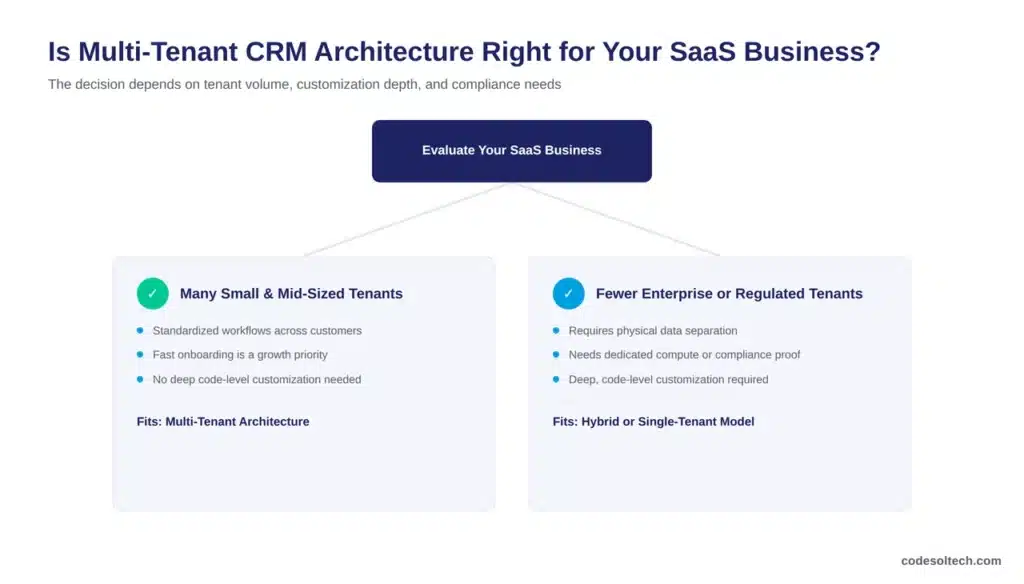
A hybrid or single-tenant model fits better when a SaaS business serves a small number of enterprise or regulated customers who require physical data separation, dedicated compute, or code-level customization that a shared codebase cannot support.
The decision determines the data model, the API design, and the authentication layer, so it needs to happen before the first sprint, not after tenant count creates migration pressure.
How CodeSol Technologies Builds Multi-Tenant CRM Systems
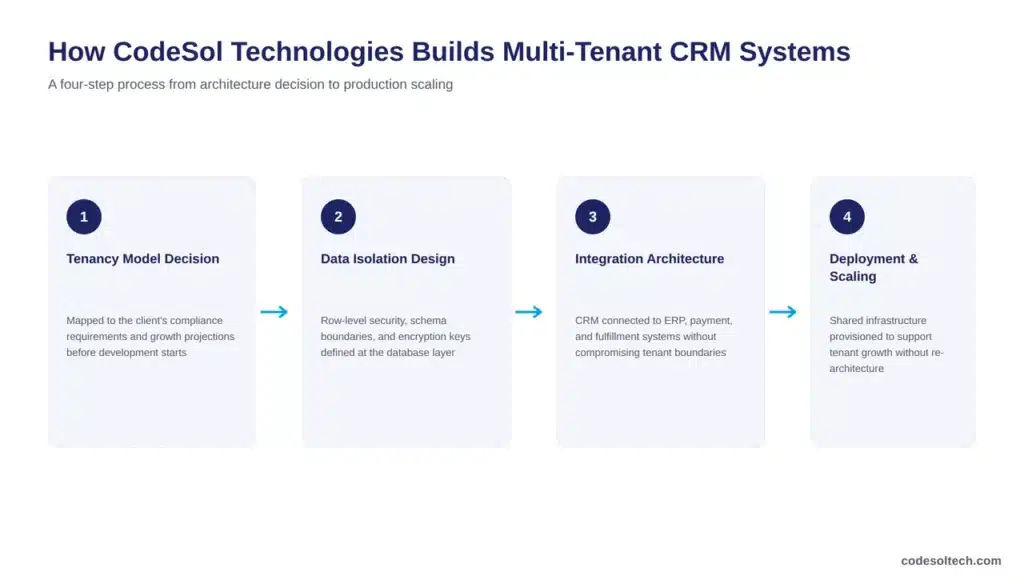
CodeSol Technologies designs multi-tenant CRM architecture around three technical priorities: tenant data isolation, workflow automation, and integration readiness.
Every CRM build starts with a tenancy model decision mapped to the client’s compliance requirements and growth projections, followed by a CRM integration architecture that connects the CRM to existing ERP, payment, and fulfillment systems without compromising tenant boundaries.
For SaaS businesses evaluating build options, the choice between a custom CRM and an off-the-shelf platform directly affects how much control the business retains over its tenancy model.
Custom builds also allow direct integration of AI-powered CRM features and structured customer lifecycle management workflows, both of which depend on clean, tenant-isolated data structures to function accurately.
FAQs
What is the difference between multi-tenancy and multi-instance architecture?
Multi-tenancy runs one application instance for all customers, with data separated logically. Multi-instance architecture runs a separate application instance for each customer, with data separated physically. Multi-tenancy reduces cost; multi-instance increases isolation.
Can a multi-tenant CRM support enterprise-level customization?
A multi-tenant CRM supports configuration-level customization, such as custom fields, workflows, and permission rules. Deep code-level customization requires either a hybrid architecture with a dedicated tenant instance or a single-tenant deployment.
Does multi-tenant architecture increase data breach risk?
Multi-tenant architecture does not inherently increase breach risk when tenant isolation is enforced at the database, API, and application layers. Risk increases when isolation controls are incomplete or inconsistently applied across those layers.
How many tenants can a single CRM database handle?
Tenant capacity depends on the tenancy model, database engine, and per-tenant data volume. Shared-schema models typically support thousands of small-to-mid-sized tenants on a single database cluster; separate-database models scale to lower tenant counts per cluster due to per-tenant overhead.
Final Words
Multi-tenant CRM architecture gives SaaS businesses a cost-efficient path to scale, provided tenant isolation is enforced correctly from the first sprint.
The tenancy model decision shapes the data model, the API design, and the compliance posture of the entire product.
Businesses that treat this as a product decision, not an engineering afterthought, avoid the expensive rework that follows a poorly isolated architecture.
Building or scaling a multi-tenant CRM for your SaaS platform?
CodeSol Technologies designs and develops secure, scalable multi-tenant CRM architecture tailored to your compliance and growth requirements.