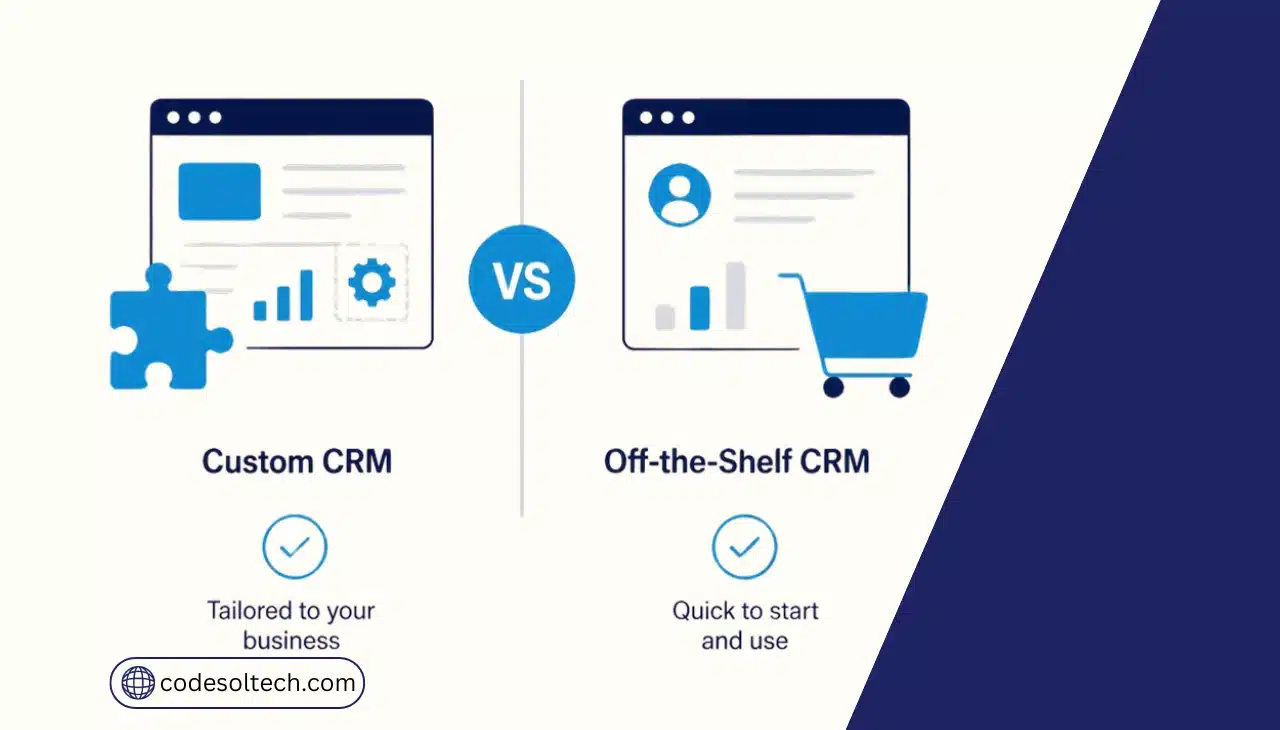
Off-the-shelf CRM is pre-built software that a vendor sells to thousands of businesses through a subscription model. Custom CRM is software built for one business, matched to that business’s exact sales process, data structure, and integration requirements.
The distinction isn’t about quality. It’s about who the software is designed for: everyone, or you.
Off-the-shelf platforms like Salesforce, HubSpot, and Zoho CRM run on shared codebases. Every customer gets the same core architecture, the same feature set, and the same upgrade schedule.
Configuration options exist, but they operate within limits the vendor sets. A business adapts its workflow to fit the software.
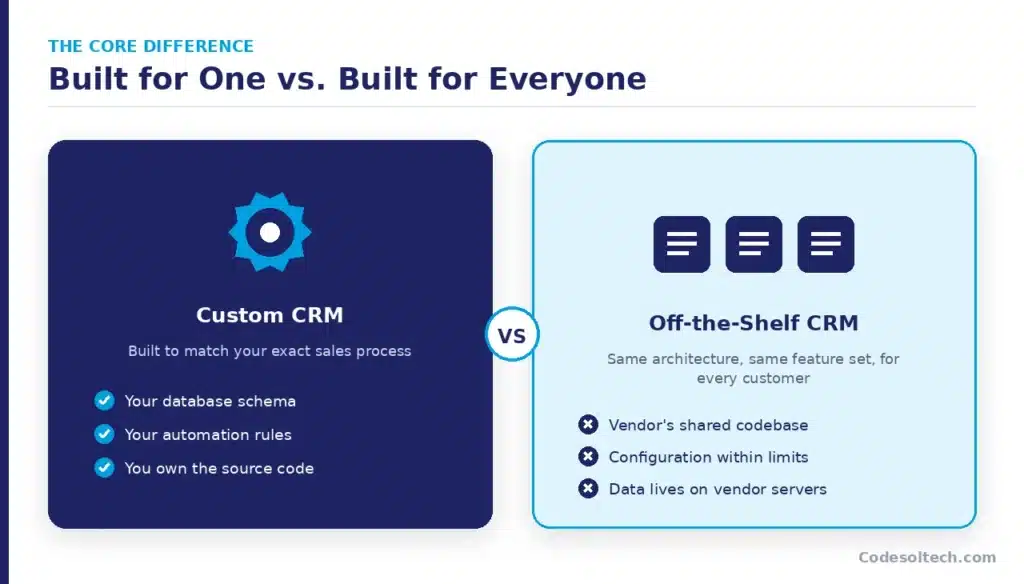
Custom CRM development reverses that relationship. A development team builds the database schema, the automation rules, and the user interface around how the business already operates.
The business owns the source code. No vendor can raise prices, discontinue a feature, or force an upgrade cycle.
Three factors separate the two models most clearly for a small business:
- Deployment speed — off-the-shelf CRM launches in days to weeks; custom CRM takes 3 to 9 months
- Cost structure — off-the-shelf CRM charges recurring per-user fees; custom CRM charges a one-time build cost plus maintenance
- Ownership — off-the-shelf CRM data lives on vendor infrastructure; custom CRM data and code belong entirely to the business
How Much Does Custom CRM Cost Compared to Off-the-Shelf CRM?
Off-the-shelf CRM pricing follows per-user, per-month tiers. Entry-level plans run $10 to $50 per user per month.
Mid-tier plans from established vendors run $75 to $150 per user per month. Enterprise tiers with advanced automation and reporting run $150 to $300 or more per user per month.
A 10-person sales team on a mid-tier plan pays $9,000 to $18,000 per year in licensing alone, before add-ons for integrations or advanced reporting.
Custom CRM development follows a build-cost-plus-maintenance structure instead of a per-seat model. Costs scale with feature complexity, not headcount:
- Small/MVP CRM — a lean build covering contact records, pipeline stages, and basic reporting
- Mid-complexity CRM — a build that adds third-party integrations, custom automation, and role-based access
- Enterprise-grade custom CRM — a build with deep ERP integration, compliance architecture, and multi-team workflows
Ongoing maintenance for a custom CRM typically runs 15% to 20% of the original build cost per year.
That figure covers bug fixes, security patches, and incremental feature work the same categories a SaaS vendor bundles into its subscription price except the business controls the scope and timing instead of the vendor.
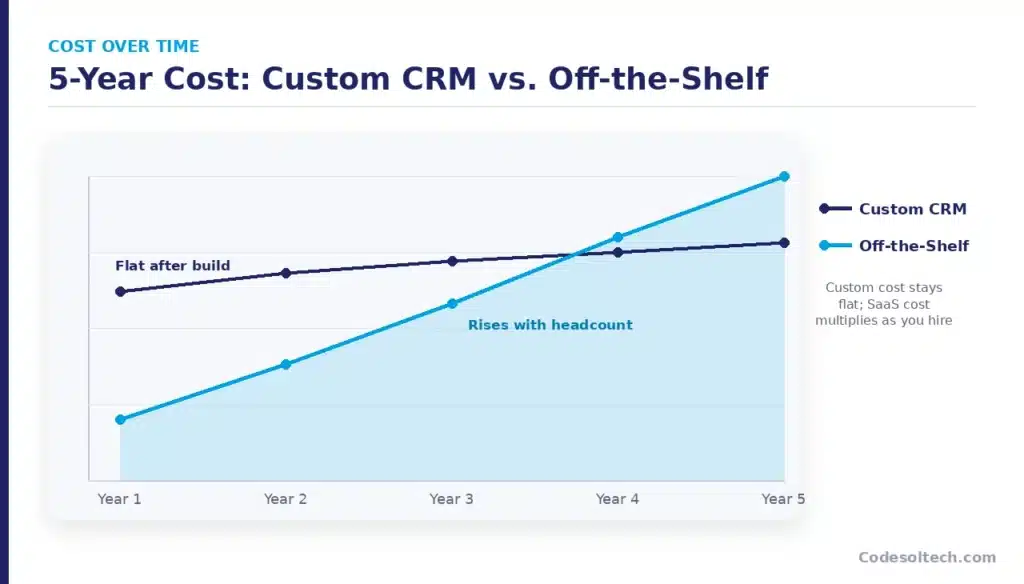
The number that matters most for a small business isn’t the sticker price. It’s total cost of ownership over three to five years. Off-the-shelf CRM costs multiply as headcount grows, since every new hire adds another license fee.
Custom CRM costs stay flat once the build is complete, since adding a user doesn’t trigger a new invoice. Businesses that plan to double their sales team within three years need to model both scenarios before signing a multi-year SaaS contract.
Which CRM Type Fits Your Business Growth Stage?
The right choice depends on process complexity, not company size alone. A five-person team with a genuinely unique sales process can outgrow off-the-shelf CRM faster than a fifty-person team with a standard one.
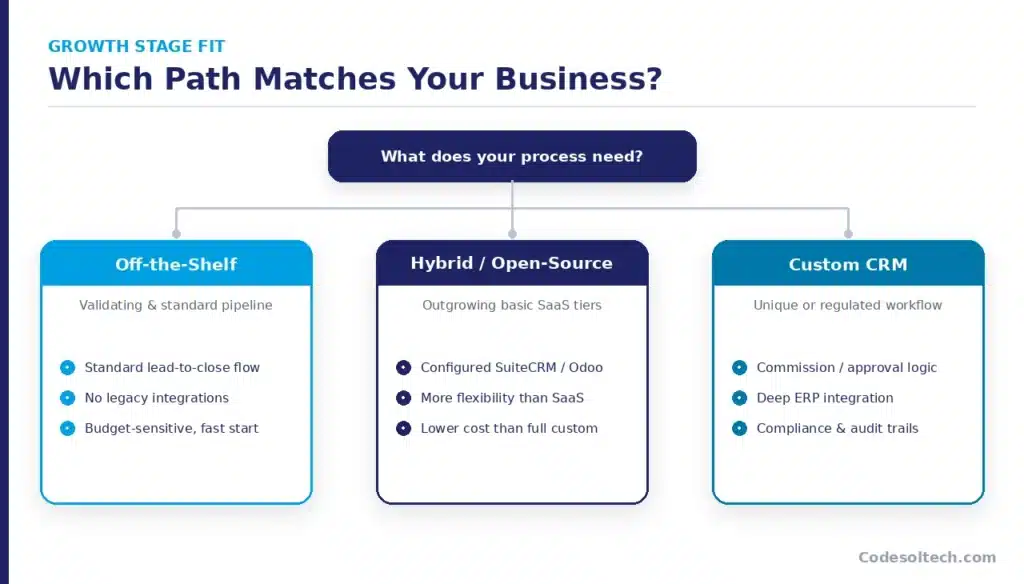
Choose off-the-shelf CRM if these apply
Off-the-shelf CRM fits a business that is still validating its sales process and needs to start tracking customers this week, not this quarter. It fits teams with a standard pipeline lead, qualification, proposal, close, and no requirement to integrate with legacy or proprietary systems.
Budget-sensitive businesses benefit from the predictable monthly cost and the vendor-handled maintenance, since no internal engineering resource is required to keep the system running.
Choose custom CRM if these apply
Custom CRM fits a business whose sales or service process includes logic a generic tool can’t replicate: commission structures, multi-stage approval chains, or industry-specific data fields.
It fits businesses that need to integrate deeply with an ERP, a proprietary database, or legacy software that off-the-shelf connectors don’t support.
It also fits regulated industries healthcare, finance, insurance where data residency and audit-trail requirements exceed what a shared SaaS infrastructure guarantees.
Consider a hybrid path if you’re not sure yet
A configured open-source CRM, such as a customized SuiteCRM or Odoo build, sits between the two extremes. It costs less than a full custom build and offers more flexibility than a rigid SaaS tier.
This path works well for a business that has outgrown basic SaaS plans but isn’t ready to commit to a full custom development timeline.
Custom CRM vs Off-the-Shelf CRM: Side-by-Side Comparison
| Factor | Custom CRM | Off-the-Shelf CRM |
|---|---|---|
| Upfront cost | Higher | Lower |
| Cost at 3–5 years, growing headcount | Flat after build | Rises with every new user |
| Time to launch | 3–9 months | Days to a few weeks |
| Customization | Unlimited | Limited to vendor’s framework |
| Data ownership | Full ownership | Vendor-hosted |
| Integration with legacy/ERP systems | Native, unrestricted | Limited to available APIs |
| Vendor lock-in | None | Moderate to high |
| Maintenance responsibility | Business or dev partner | Vendor |
| Best fit | Unique or scaling workflows | Standard sales processes, fast starts |
What Does the Market Data Show About CRM Adoption and Cost?
The global CRM software market was valued at $79.6 billion in 2025 and is projected to grow to $86.4 billion in 2026, reaching $161.3 billion by 2033 at a compound annual growth rate of 9.3%, according to Grand View Research (Grand View Research, 2026).
Grand View Research also reports the small and medium enterprise segment growing at a faster 14.9% CAGR, which confirms small businesses are adopting CRM software at a rate that outpaces the broader market.
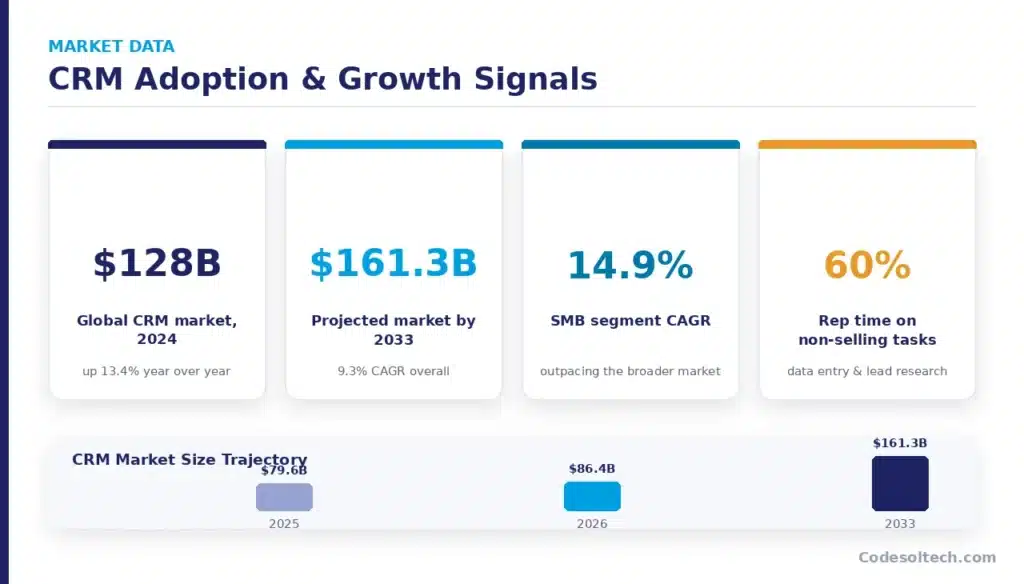
Gartner reports the global CRM software market reached $128 billion in 2024, up 13.4% from the prior year, making CRM the largest and fastest-growing category of enterprise software Gartner tracks (Gartner, 2024).
Salesforce’s own State of Sales research found that sales reps spend 60% of their time on non-selling tasks, including manual data entry and lead research, rather than on the selling activity a CRM is meant to support (Salesforce, 2026).
That figure is central to the CRM decision: a CRM system that adds administrative overhead instead of removing it fails its core purpose, regardless of whether it’s custom-built or off-the-shelf.
FAQs
Is custom CRM development worth it for a small business?
Custom CRM development is worth it for a small business when the sales process includes unique logic, when legacy systems need deep integration, or when the business has already outgrown two or three off-the-shelf tools. For a business with a standard sales process, off-the-shelf CRM delivers equal or better value at lower risk.
Can a small business switch from off-the-shelf CRM to custom CRM later?
Yes. Many small businesses start on off-the-shelf CRM to validate their sales process, then commission a custom build once specific workflow limitations become clear. Data migration from the SaaS platform is a standard part of that transition.
Does custom CRM development require an in-house development team?
No. Most small businesses partner with an external custom software development company for the build and for ongoing maintenance, rather than hiring full-time developers.
How long does it take to build a custom CRM?
A small business custom CRM build typically takes 3 to 9 months, depending on the number of integrations, the complexity of the workflow logic, and the scope of the reporting requirements.
Does off-the-shelf CRM integrate with ERP and payment systems?
Off-the-shelf CRM integrates with mainstream tools through pre-built connectors, but integration with legacy ERP systems, proprietary databases, or non-standard payment gateways often requires custom API development regardless of which CRM base is used.
Final Words
Neither CRM model wins by default. Off-the-shelf CRM wins on speed and predictable cost for standard workflows. Custom CRM wins on ownership, integration depth, and long-term cost control for unique or scaling operations.
The right call depends on your process complexity today and your growth trajectory over the next three years — not on which option sounds more impressive.
Not sure which path fits your business? Talk to CodeSol Technologies about a CRM assessment before you commit to a platform or a build.