
CRM data quality management is the ongoing process of keeping customer records accurate, complete, unique, and consistent across a CRM system. It combines data cleansing, validation rules, ownership, and monitoring.
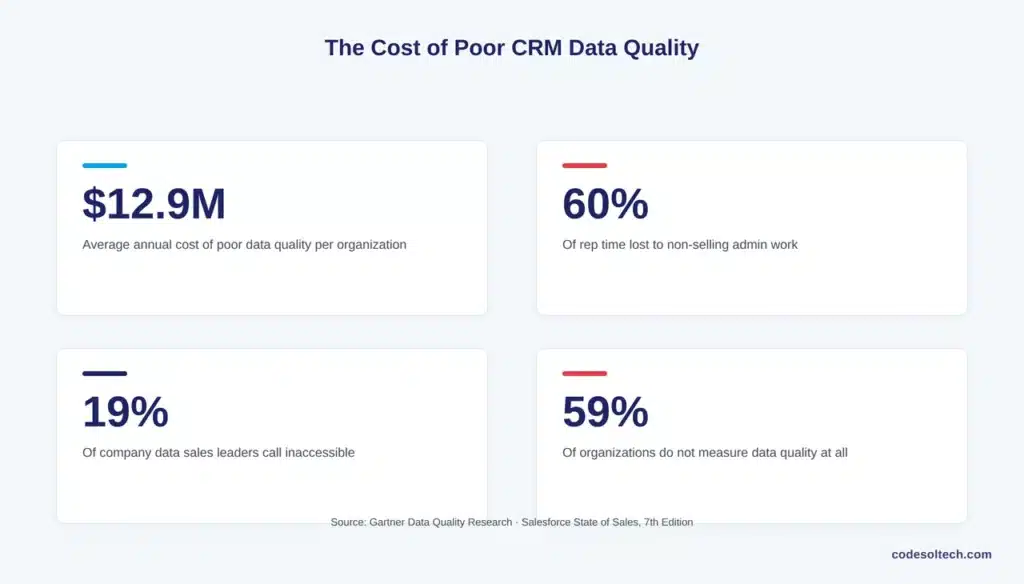
Gartner reports that poor data quality costs organizations an average of $12.9 million every year, which is why sales teams treat CRM data quality as a revenue function, not an IT task.
What Is CRM Data Quality Management?
CRM data quality management is the discipline of measuring, maintaining, and improving the accuracy, completeness, consistency, and uniqueness of customer records stored in a CRM platform. It governs how contact fields, deal stages, and company records are entered, validated, merged, and archived.

The goal is a single, trustworthy source of truth that sales, marketing, and finance teams can act on without re-verifying data first.
The 9 Dimensions of CRM Data Quality
Gartner defines 9 dimensions organizations use to measure data quality, and each one applies directly to CRM records:
- Accessibility — a rep can retrieve the record when a deal requires it.
- Accuracy — the field value matches the real-world contact or account.
- Completeness — required fields are populated, not left blank.
- Consistency — the same customer is represented the same way across every system.
- Precision — data is recorded at the level of detail sales workflows require.
- Relevancy — the field supports an active sales or marketing process.
- Timeliness — the record reflects the customer’s current status, not a stale one.
- Uniqueness — each contact or account exists as one record, not three duplicates.
- Validity — the data conforms to defined formatting and business rules.
Why CRM Data Quality Differs From General Data Quality
General data quality management covers every dataset an organization owns, including finance, HR, and operations data. CRM data quality management focuses specifically on customer-facing records that directly drive pipeline, quota attainment, and retention.
A malformed field in a CRM triggers an immediate, visible failure: a missed follow-up, a duplicate email to the same prospect, or a forecast that overstates revenue.
This direct link to revenue is why sales operations teams treat CRM data quality as a distinct, higher-priority discipline.
How Poor CRM Data Quality Damages Sales Performance
Bad CRM data does not fail quietly. It produces specific, measurable losses across revenue, rep productivity, and forecast reliability.
Revenue Loss From Inaccessible and Inaccurate Records
Sales leaders estimate that 19% of their company’s data is inaccessible, according to Salesforce’s State of Sales research.
Inaccessible data blocks personalization, delays lead routing, and forces reps to sell without full account context. Every inaccessible or inaccurate record is a deal that closes slower or does not close at all.
Lost Selling Time From Manual Data Cleanup
Salesforce’s State of Sales report found that sales reps spend 60% of their time on non-selling tasks, including manual CRM data entry and cleanup.
A rep correcting duplicate contacts or re-entering deal stages is a rep not prospecting, not on a call, and not advancing pipeline.
Broken Trust in Forecasts and AI Tools
Gartner surveys show 59% of organizations do not measure data quality at all, which means most sales teams cannot even quantify how unreliable their CRM has become.
Salesforce data adds to this: 84 of data and analytics leaders agree that AI output quality depends entirely on input data quality. Any AI lead-scoring or forecasting model built on a dirty CRM inherits and amplifies that dirt.
The Direct Cost of Poor Data Quality
Gartner estimates poor data quality costs organizations an average of $12.9 million per year. This figure spans missed opportunities, wasted marketing spend on unreachable contacts, compliance exposure, and the labor cost of manual correction. CRM records represent a large share of this exposure because they touch every revenue-generating process a company runs.
Why Do Sales Reps Stop Trusting CRM Data?
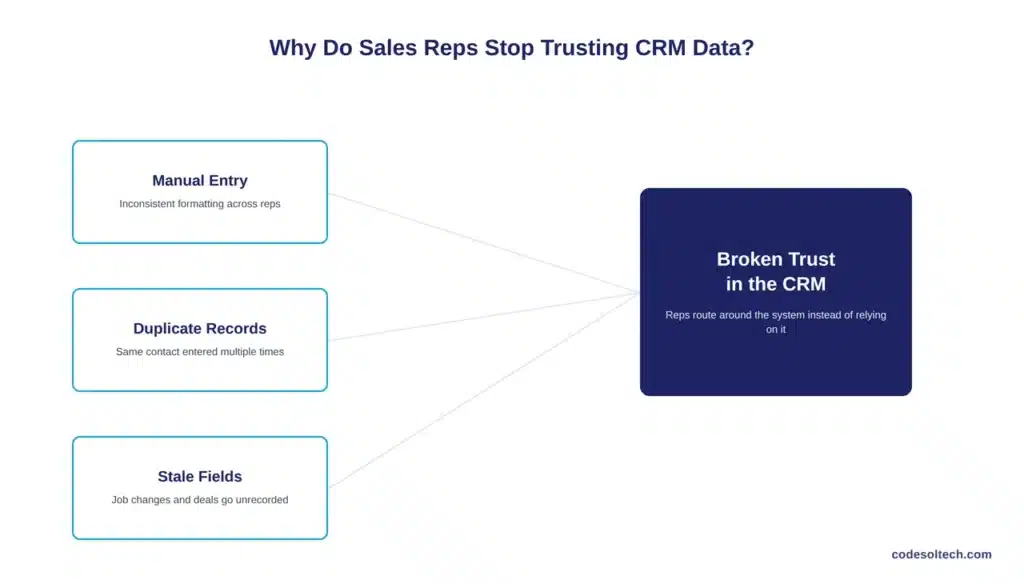
Sales reps stop trusting CRM data when the data has already caused a visible failure, such as a call to a disconnected number or a proposal sent to the wrong contact. Distrust is a rational response to unreliable information, not a training problem.
Three root causes drive this pattern.
Manual Entry and Inconsistent Formatting
Reps enter company names, job titles, and phone numbers in different formats depending on habit and urgency. Without enforced field rules, “VP Sales,” “VP of Sales,” and “Vice President, Sales” become three inconsistent values for the same job function.
Inconsistent formatting breaks segmentation, reporting, and automated workflows that filter on exact field values.
Duplicate Records From Multiple Entry Points
A single contact frequently enters a CRM through a web form, a trade show scan, and a manual sales entry. Without a deduplication rule running at the point of entry, these three interactions create three separate records instead of one.
Duplicate records split activity history, understate account value, and cause reps to contact the same prospect multiple times with conflicting messages.
Stale Fields That Never Get Updated
A contact who changes jobs, a company that gets acquired, or a deal that quietly goes cold all leave stale fields behind if no process forces a refresh.
Stale data compounds over time because every downstream workflow, from lead scoring to renewal alerts, continues to act on outdated information. The longer a field goes unverified, the more expensive it becomes to trust.
CRM Data Cleansing vs. CRM Data Quality Management: What’s the Difference?
Data cleansing corrects existing errors in a CRM at a single point in time. CRM data quality management is the continuous system of rules, ownership, and monitoring that prevents those errors from recurring.
Cleansing is a project; data quality management is an operating discipline.
| Attribute | Data Cleansing | Data Quality Management |
|---|---|---|
| Scope | Fixes existing bad records | Governs how records are created, updated, and archived |
| Frequency | One-time or periodic project | Continuous, built into daily workflows |
| Ownership | Usually assigned to IT or an outside vendor | Shared across sales, marketing, and RevOps |
| Outcome | Temporary improvement that decays again | Sustained accuracy that compounds over time |
| Tools Used | Deduplication scripts, bulk import tools | Validation rules, workflow automation, dashboards, field ownership policies |
How to Build a CRM Data Quality Management Framework
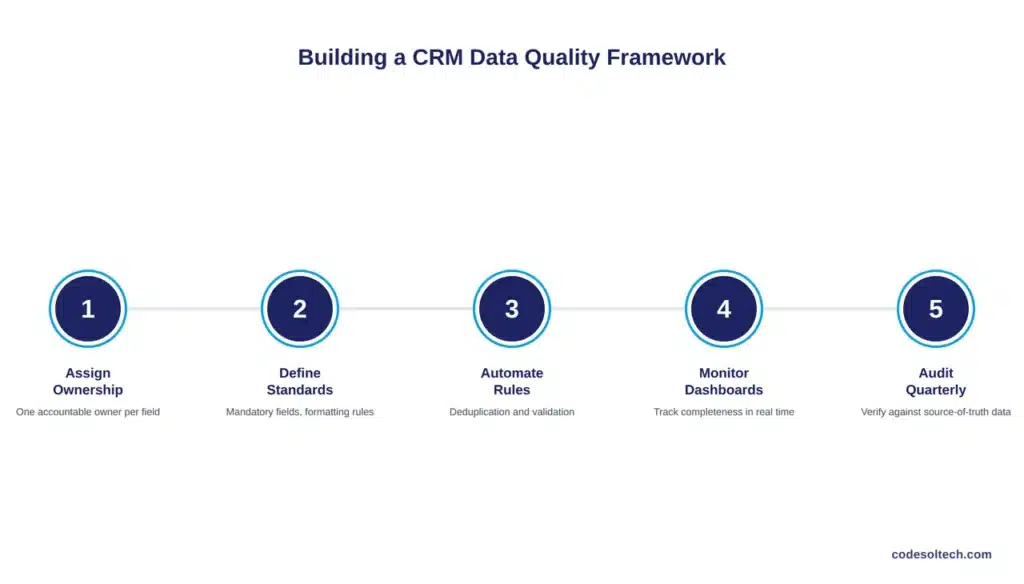
A durable framework combines assigned ownership, enforced standards, automation, and recurring measurement.
Sales operations teams that implement all five steps below convert CRM data quality from a recurring fire drill into a stable, monitored process.
Assign Field-Level Data Ownership
Every core CRM object, including contacts, companies, and deals, needs one accountable owner. Ownership eliminates the ambiguity that lets bad data sit unresolved because no one is responsible for correcting it.
Sales operations typically owns pipeline and deal fields, while marketing operations owns lead source and campaign attribution fields.
Define Mandatory Fields and Formatting Rules
Mandatory fields force completeness at the point of entry instead of relying on retroactive cleanup. Formatting rules, such as standardized job title picklists and phone number masks, prevent the inconsistency that breaks segmentation and automation triggers.
These rules apply equally to manual entry, form submissions, and system-to-system imports.
Automate Deduplication and Validation Rules
Automated deduplication rules match incoming records against existing ones using email domain, phone number, and company name before a duplicate record is ever created. Validation rules reject malformed entries, such as invalid email formats, before they enter the database.
CRM workflow automation handles this matching and validation in real time, which removes the delay and inconsistency of manual review.
Set Up Real-Time Data Quality Dashboards
A dashboard that tracks completeness rate, duplicate count, and stale-record percentage turns data quality into a visible, measurable metric instead of an assumption. Sales leaders use these dashboards during pipeline reviews to flag accounts with unreliable data before they distort a forecast.
Dashboards also surface which teams or entry points generate the most errors, which focuses correction effort where it matters most.
Schedule Recurring Data Audits
A quarterly audit compares a sample of CRM records against source-of-truth data, such as a recent invoice or a verified email exchange, to measure real-world accuracy.
Audits catch the errors that automated rules miss, including outdated job titles and acquired companies still listed under their old name.
Recurring audits also validate that the ownership and formatting rules from earlier steps are actually being followed.
Which CRM Data Quality Metrics Should Sales Teams Track?
Sales operations teams should track a small set of metrics tied directly to revenue risk, not every possible data quality dimension at once.
| Metric | What It Measures | Reasonable Target |
|---|---|---|
| Completeness Rate | Percentage of mandatory fields populated across active records | 95% or higher |
| Duplicate Rate | Share of contact or company records flagged as duplicates | Under 2% |
| Accuracy Rate | Percentage of sampled records that match verified source data | 90% or higher |
| Stale Record Percentage | Records with no update in 180 days on active accounts | Under 10% |
| Error Frequency | Validation rule failures logged per 1,000 records | Declining trend month over month |
Teams evaluating a CRM rebuild or a new integration should also review our guide to CRM integration architecture to see how data quality rules carry across connected systems, and our breakdown of custom CRM development for teams that need data validation built into the platform itself.
Final Words
CRM data quality management is not a cleanup project you finish once. It is a system of ownership, rules, and monitoring that keeps every deal, contact, and forecast accurate as your CRM scales.
Firms that build this discipline convert their CRM into a reliable revenue asset instead of a liability that quietly costs millions.
Ready to fix your CRM data quality before it costs you another deal?