Most small and mid-sized businesses are not slow to adopt automation because the technology is weak. They are slow because they believe things about automation that are simply not true.
Here is the real number. According to OECD research on SME AI adoption, 82% of businesses with fewer than five employees believe automation does not apply to their type of work. That is not a technology problem. That is a myth problem.
Every month, an SME that runs on manual workflows instead of automated ones pays a hidden tax: slower response times, repeated errors, and staff hours spent on tasks a system could handle. This article breaks down the ten myths causing that tax, and what is actually true instead.
Why SMEs Get Stuck on Automation
Three things repeatedly block SMEs from automating, and none of them are really about cost.
Misinformation from vendors. Software companies oversell “set it and forget it” automation, then owners get burned by one bad rollout and swear off automation entirely.
Comparison to enterprise tools. Owners assume automation means the kind of complex systems large enterprises run, built by dedicated IT teams they do not have.
Outdated mental models. Many SME owners formed their opinion of automation five or ten years ago, before no-code platforms and AI agents made it accessible without a developer.
The result: large enterprises still capture 71% of workflow automation revenue, while SMEs are actually growing automation adoption faster, at roughly 10 to 15% CAGR depending on the segment, according to Mordor Intelligence data cited by Cflow. SMEs are catching up. The myths are just slowing the pace.
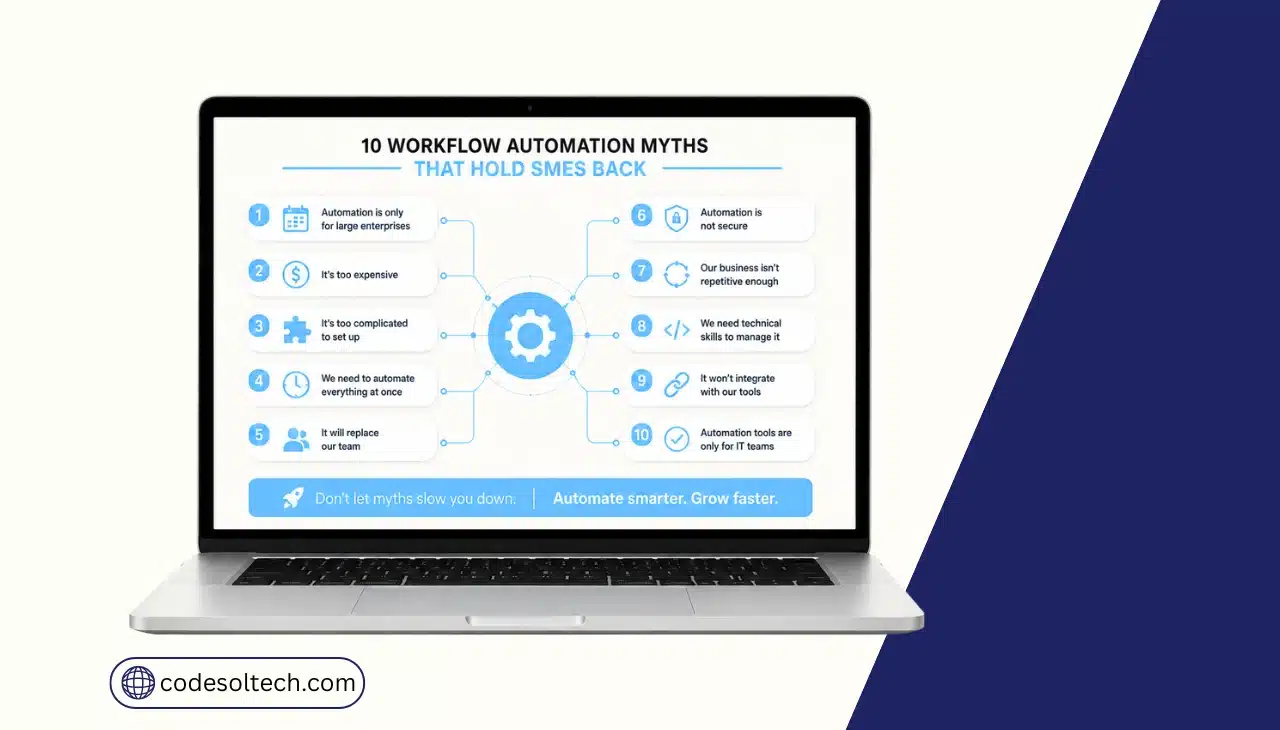
The 10 Myths, Broken Down
Myth 1: Automation Is Only for Large Companies
The claim: You need enterprise budgets and IT departments to automate anything meaningful.
The truth: No code automation platforms are growing SME adoption at 38.6% CAGR, far faster than the overall automation market, largely because pricing and setup complexity dropped, according to no code adoption data from this+that. A single owner can connect a form, a spreadsheet, and an email sequence in an afternoon.
What this means: The barrier used to be technical skill. Now it is mostly awareness. If you have not looked at automation tools in the last two years, your information is outdated.
Myth 2: Automation Replaces Staff
The claim: Automating a workflow means cutting jobs.
The truth: Most SME automation targets repetitive administrative tasks, like data entry, scheduling, and follow-up emails, freeing staff for higher value work rather than replacing them. Salesforce’s SMB Trends Report found 90% of SMB owners using AI tools say it improves efficiency, not headcount reduction.
What this means: Frame automation internally as removing drudge work, not removing people. Staff resistance drops sharply when this distinction is made clear from day one.
Myth 3: You Need to Automate Everything at Once
The claim: A real automation strategy means overhauling every process simultaneously.
The truth: Full, hands-free automation across an entire business is rare. Only 4% of businesses report fully automated, hands-free operations, while 31% have automated at least one key function successfully, based on adoption benchmark data compiled by shno.co. Success comes from automating one high-friction workflow at a time.
What this means: Pick the single most repetitive, most error-prone task in your business. Automate that one thing first. Expand only after it works.
Myth 4: Automation Is Too Expensive for a Small Budget
The claim: Automation tools only pay off at enterprise scale.
The truth: No code automation adopters report average annual savings of roughly $187,000 with ROI realized within 6 to 12 months, according to this+that’s platform data. Even scaled down to SME size, the pattern holds: automation adopters see productivity increases of 20 to 30% in the first year, per McKinsey Global Institute research.
What this means: The real question is not whether you can afford automation. It is whether you can afford to keep paying staff to do work a $30 a month tool could handle.
Myth 5: Automation Tools Are Too Complicated to Learn
The claim: You need a developer or IT background to set up automation.
The truth: AI agent platforms have cut setup time from weeks to minutes, and conversation flow builders let owners design automated processes without writing code, according to Omago’s SME AI adoption data. The learning curve is now closer to setting up an email inbox rule than programming software.
What this means: If a platform requires a developer to configure a basic workflow, it is the wrong platform for an SME, not proof that automation is inherently complex.
Myth 6: More Automation Always Equals More Efficiency
The claim: The more tasks you automate, the more efficient your business becomes.
The truth: 72% of automation adopters report ongoing struggles with tool integration and daily usage, according to SS&C Blue Prism’s State of AI Report. Stacking automations without a clear process map creates tangled workflows that break more often than the manual process did.
What this means: Efficiency comes from automating the right bottleneck, not from the total count of automations running. Map the process before you automate it.
Myth 7: Automation Is a One-Time Setup
The claim: Once a workflow is automated, it runs forever without attention.
The truth: Business processes change: pricing updates, new staff, new tools. An automation built for last year’s workflow silently breaks or produces wrong outputs when the underlying process shifts. This is a leading cause of the integration struggles cited above.
What this means: Treat automations like equipment, not furniture. Review them quarterly, especially anything tied to customer-facing tasks like booking or invoicing.
Myth 8: AI and Automation Are the Same Thing
The claim: Any tool with “AI” in the name is automation, and any automation tool uses AI.
The truth: Basic workflow automation follows fixed rules: if this happens, do that. AI automation makes judgment calls on unstructured input, like reading an email and deciding how to route it. SMB AI adoption jumped from 22% to 38% between 2024 and 2026, per AdAI News data, but rule based automation still covers most SME use cases like scheduling and reminders.
What this means: Do not pay for AI-powered complexity when a simple rule-based trigger solves the problem. Match the tool to the task, not the trend.
Myth 9: Automation Removes the Need for Human Oversight
The claim: Once it is automated, you can stop checking it.
The truth: 70% of automation adopters report ongoing data privacy or accuracy concerns with tools they are actively running, per the same SS&C Blue Prism research. Automated systems fail silently more often than manual ones, because there is no human in the loop to notice the error in real time.
What this means: Every automated workflow needs a simple check, a weekly report, a spot check, an error alert, so failures get caught before they compound into customer-facing problems.
Myth 10: Small Businesses Are Too Different to Automate
The claim: Automation works for standardized enterprise processes, not for a business with unique, hands-on operations.
The truth: Standard Chartered’s SME Index found most SMEs already using AI apply it to repetitive administrative tasks: invoicing, scheduling, follow-ups, which exist in nearly identical form across almost every small business regardless of industry. The uniqueness of your business is in service delivery, not in the admin work behind it.
What this means: You are probably not too unique to automate. You are automating the wrong layer if you think that.
Why This Matters: The Real Cost of Believing These Myths
Put numbers on it:
- A business owner spending 5 hours a week on manual scheduling loses roughly 260 hours a year, more than six full work weeks, to a task automation typically handles in seconds.
- Manual data entry error rates run consistently higher than automated entry, and each error in invoicing or customer records costs staff time to catch and fix later.
- Competitors who automated their lead response are answering inquiries in minutes. Businesses relying on manual follow up are losing those same leads to whoever replies first.
- SMEs report a 35% average reduction in operational costs after adopting AI automation, according to AdAI News research. Businesses stuck on manual processes are paying that 35% premium every month, without realizing it is optional.
The 3-Step Automation Fix Framework
Use this sequence instead of trying to automate everything at once.
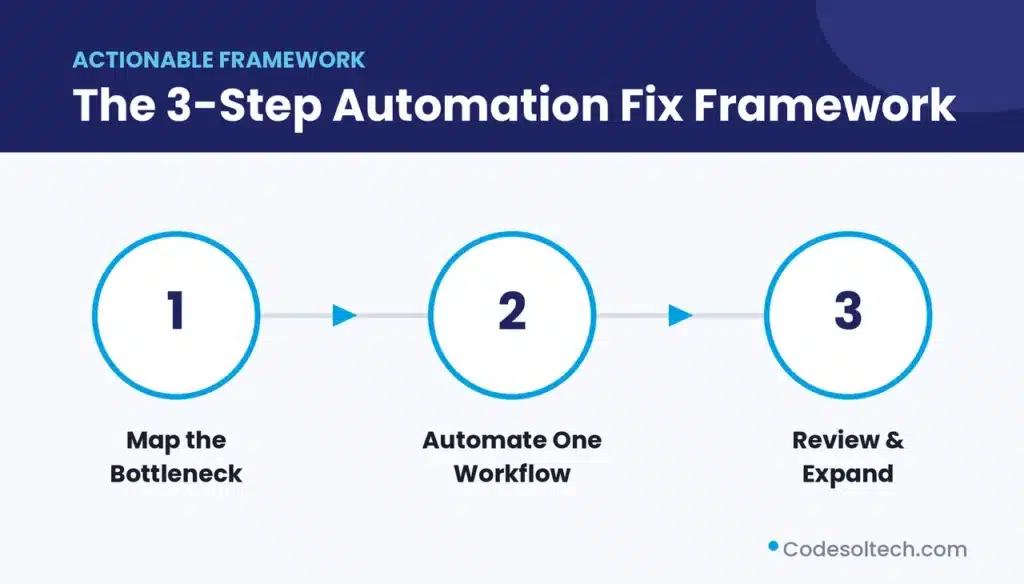
Step 1: Map the bottleneck. List every recurring task done more than five times a week. Rank them by time spent and error rate. The top item is your starting point, not the flashiest tool on the market.
Step 2: Automate one workflow completely. Pick a no-code or low-code tool matched to that single task. Build it, test it for two weeks, and fix the failure points before touching anything else.
Step 3: Review and expand quarterly. Once the first automation is stable, add a review cadence, then move to the next bottleneck on your list. Growth comes from sequence, not speed.
Myth vs Truth: Quick Reference
| Myth | Truth |
|---|---|
| Automation is only for large companies | No code tools are built for SME budgets and skill levels |
| Automation replaces staff | Automation removes repetitive tasks, not jobs |
| You must automate everything at once | One workflow automated well beats ten automated badly |
| It is too expensive | Most SME automations pay for themselves within a year |
| It is too complicated to learn | Modern platforms need no coding background |
| More automation equals more efficiency | The wrong automation adds complexity, not value |
| Setup is a one-time task | Workflows need quarterly review as your business changes |
| AI and automation are identical | Rule-based automation covers most SME needs already |
| No oversight needed once automated | Silent failures require regular human checks |
| Small businesses are too unique to automate | Admin tasks are nearly identical across industries |
Frequently Asked Questions
What is workflow automation for a small business?
Workflow automation is the use of software to complete repetitive business tasks, like scheduling, data entry, invoicing, or follow-up emails, without manual input each time.
Do small businesses actually benefit from automation?
Yes. SMEs adopting automation report productivity gains of 20 to 30% within the first year and average operational cost reductions of around 35%, based on McKinsey and AdAI News data.
Is automation too expensive for a small business?
Most SME focused automation tools cost far less than enterprise software, and typical ROI is realized within 6 to 12 months, according to no code platform benchmark data.
Do I need coding skills to set up automation? No. Current no code and AI agent platforms are built for setup without a developer, often in minutes rather than weeks.
Will automation replace my employees?
Automation typically removes repetitive administrative work, not entire roles. Most SME owners report improved efficiency, not job cuts, after implementation.
How many processes should I automate at once?
Start with one high-friction, high-frequency task. Expanding automation gradually, with review cycles, produces more stable results than automating everything simultaneously.
Why do automated workflows sometimes fail?
Workflows fail most often because the underlying business process changed and the automation was not updated, or because no one was checking outputs for errors.
Is AI required for effective workflow automation?
No. Most SME workflows, scheduling, reminders, and data routing run on simple rule-based automation. AI is only necessary for tasks involving judgment on unstructured input.
Get a Clear Picture of Where Automation Fits in Your Business
Before choosing a tool, it helps to see exactly where your workflows are losing time and where automation would make the biggest difference. A short process audit shows which one task to fix first, instead of guessing.