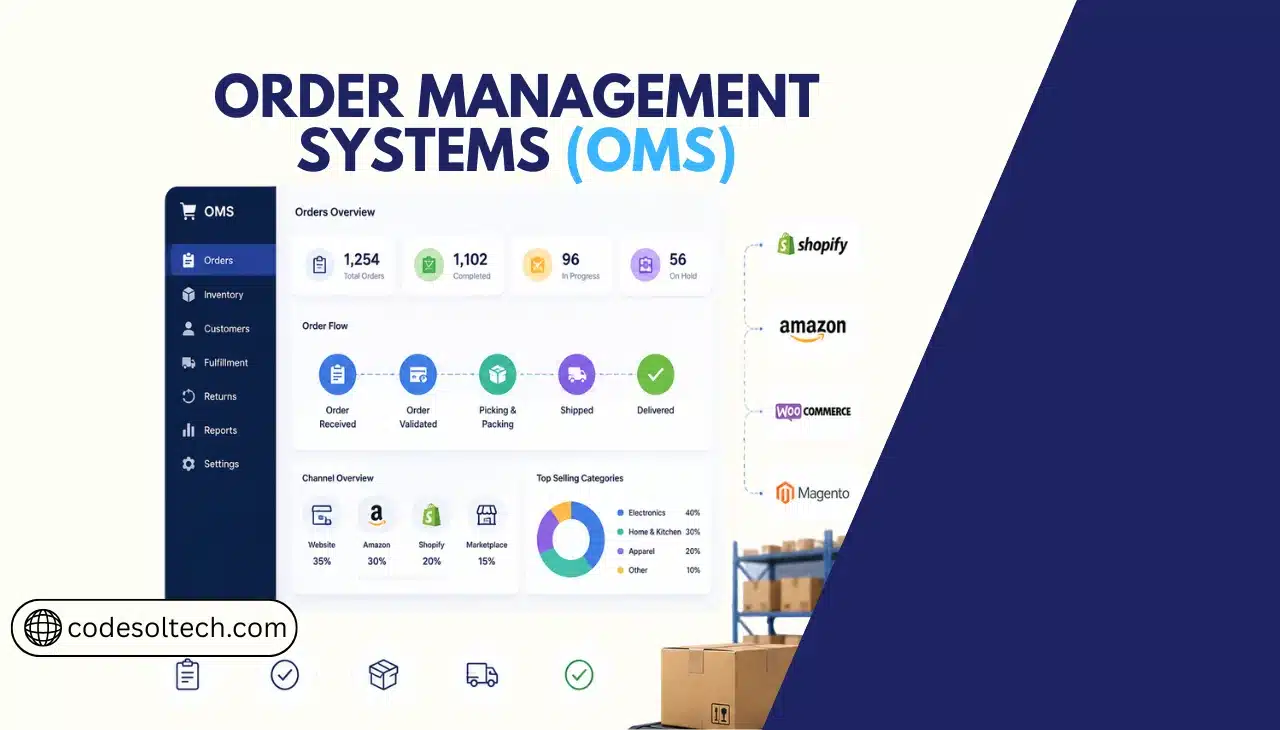
An Order Management System (OMS) is software that tracks and processes. It fulfills customer orders across every sales channel from the moment a customer clicks “Buy” to the moment the product arrives at their door. It connects inventory, warehouses, payment processors, and shipping carriers into one unified workflow.
Businesses that sell across multiple channels, websites, marketplaces, retail stores, and call centers require an OMS to prevent overselling, reduce fulfillment errors, and deliver real-time order visibility to both staff and customers.
What Is an Order Management System?
An OMS is a digital system that manages the full lifecycle of an order, including order entry, inventory management, fulfillment, and after-sales service. It acts as the operational backbone between a customer’s purchase decision and physical delivery.
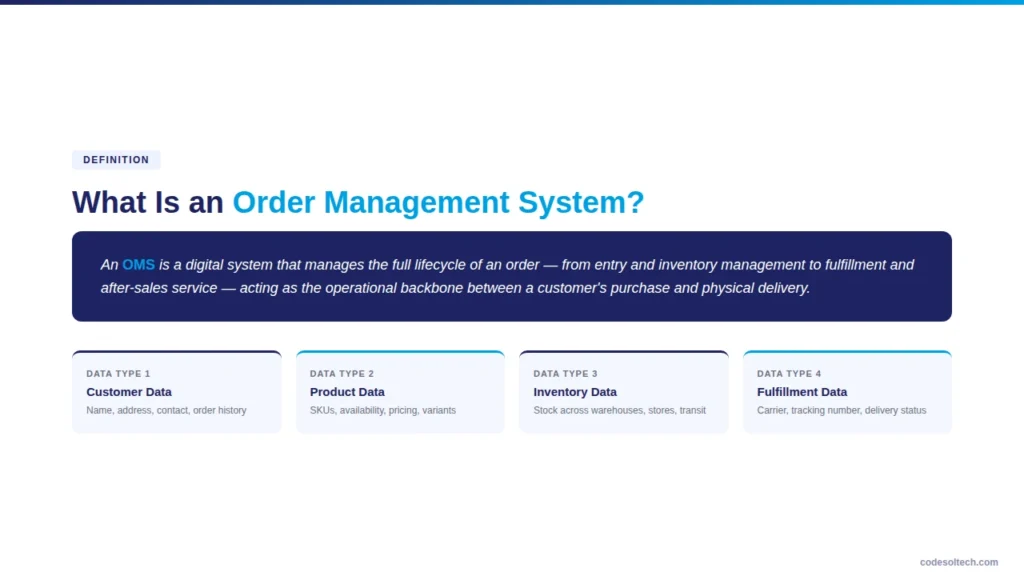
An OMS stores and processes 4 core data types in every transaction:
- Customer data — name, address, contact details, order history
- Product data — SKUs, availability, pricing, variants
- Inventory data — stock levels across warehouses, stores, and transit
- Fulfillment data — shipping carrier, tracking number, delivery status
Modern OMS platforms integrate with ERP systems, Warehouse Management Systems (WMS), Customer Relationship Management (CRM) tools, and eCommerce platforms like Shopify, Magento, and WooCommerce.
How Does an Order Management System Work?
An OMS executes a 6-stage process for every order placed, regardless of the channel:
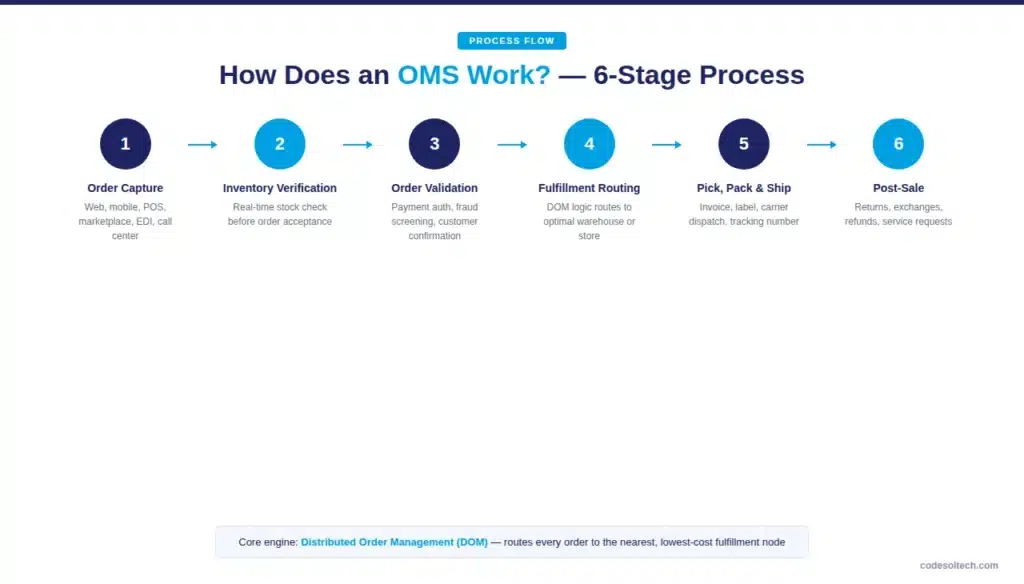
- Order capture — The system receives the order from any channel: web, mobile app, marketplace, in-store POS, or call center.
- Inventory verification — The OMS checks real-time stock levels and confirms availability before accepting the order.
- Order validation — Payment is authorized, fraud checks are run, and order details are confirmed with the customer.
- Fulfillment routing — The system uses Distributed Order Management (DOM) logic to route the order to the optimal fulfillment location: warehouse, store, or drop-shipper.
- Pick, pack, and ship — Warehouse staff or automated systems execute the order. The OMS generates invoices, shipping labels, and tracking information.
- Post-sale management — Returns, exchanges, and customer service interactions are logged and processed within the same system.
At the core of an OMS is the Distributed Order Management (DOM) capability software that intelligently routes orders to the optimum destinations or resources for fulfillment. DOM logic reduces shipping costs by selecting the fulfillment node closest to the customer.
Why Do Businesses Need an Order Management System?
Order management touches virtually every system and process in the supply chain. Most companies involve multiple partners, suppliers, assembly services, and distribution centers, making it easy to lose visibility and control of an order, resulting in costly manual processes.
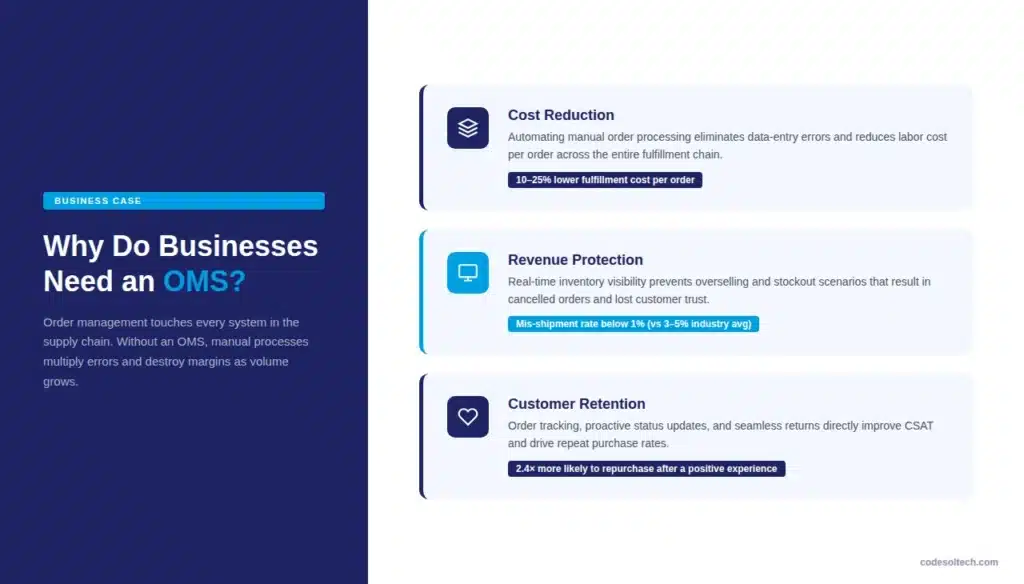
The 3 primary business drivers for OMS adoption are:
- Cost reduction — Automating manual order processing eliminates data-entry errors and reduces labor costs per order.
- Revenue protection — Real-time inventory visibility prevents overselling and stockout scenarios that result in cancelled orders.
- Customer retention — Order tracking, proactive status updates, and seamless returns directly improve customer satisfaction scores (CSAT).
In an omnichannel retail environment, customers complete purchases across 3 or more touchpoints before delivery. A customer may order online, change the order through a call center, and pick it up in a physical store. An OMS handles all 3 interactions within a single order record.
Key Features of an Order Management System
An enterprise-grade OMS delivers 7 functional capabilities:
- Real-time inventory visibility — A unified view of stock across all locations: warehouses, stores, suppliers, and in-transit shipments. This eliminates safety stock excess and prevents costly emergency shipments.
- Omnichannel order capture — Accepts and normalizes orders from web, mobile, marketplace, EDI (Electronic Data Interchange), POS, and B2B portals into one system.
- Distributed Order Management (DOM) — Applies configurable business rules to route each order to the lowest-cost, fastest fulfillment node available.
- Fulfillment optimization — Analyzes carrier rates, delivery windows, and customer preferences to select the optimal shipping method for each order.
- Returns management (Reverse Logistics) — Processes return requests, issues refunds or exchanges, and restocks returned inventory automatically.
- Customer self-service portal — Provides customers with real-time order status, tracking updates, and return initiation without requiring agent intervention.
- Analytics and reporting — Tracks KPIs including Order Fulfillment Rate, Order Cycle Time, Perfect Order Rate, and Return Rate to identify operational bottlenecks.
OMS vs. ERP: What Is the Difference?
An ERP (Enterprise Resource Planning) system manages company-wide business processes, finance, HR, procurement, manufacturing, and supply chain in a single database. An OMS focuses exclusively on the order lifecycle from customer purchase to final delivery.
| Feature | OMS | ERP |
|---|---|---|
| Primary focus | Order lifecycle management | Enterprise-wide operations |
| Real-time inventory | Yes — across all fulfillment nodes | Partial — often warehouse-only |
| Omnichannel support | Native | Requires customization |
| Fulfillment routing | DOM logic built-in | Not standard |
| Customer-facing tracking | Yes | No |
| Best for | Retailers, eCommerce, 3PLs | Manufacturers, finance-driven enterprises |
Most enterprise organizations deploy both: the ERP manages financial records and procurement while the OMS handles customer-facing order execution. The two systems exchange data through API integrations or middleware platforms.
OMS vs. WMS: How Are They Different?
A Warehouse Management System (WMS) manages physical warehouse operations: receiving, putaway, picking, packing, and shipping.
An OMS operates at a higher level it decides where an order is fulfilled; a WMS manages how it is fulfilled within that location.
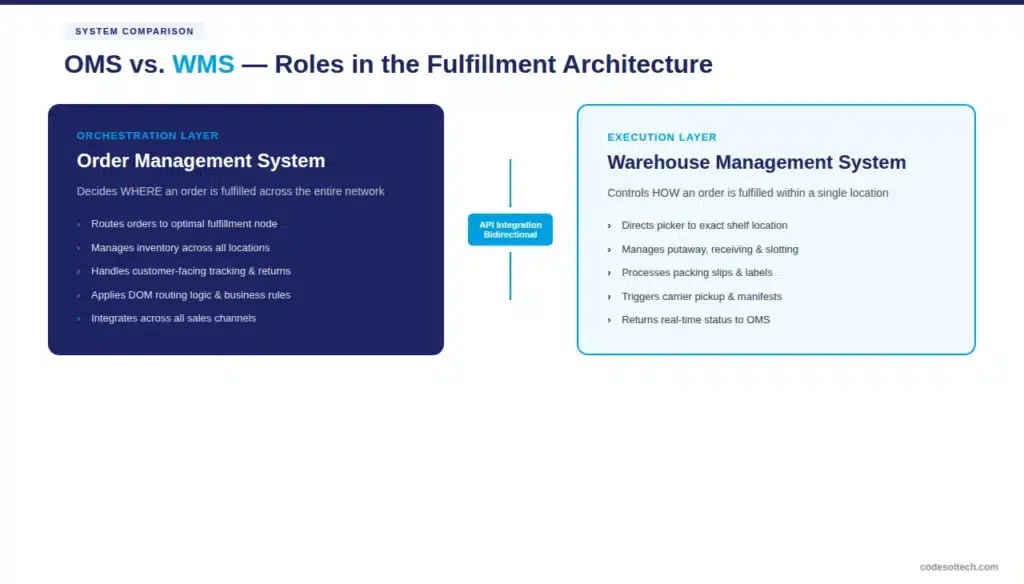
- The OMS routes an order to Warehouse B based on proximity and stock availability.
- The WMS at Warehouse B directs a picker to shelf 4C, processes the packing slip, and triggers the carrier pickup.
In a modern fulfillment architecture, the OMS and WMS integrate bidirectionally: the OMS sends fulfillment instructions and the WMS returns real-time status updates, shipment confirmations, and inventory adjustments.
4 Types of Order Management Systems
OMS platforms are classified into 4 deployment and functional categories:
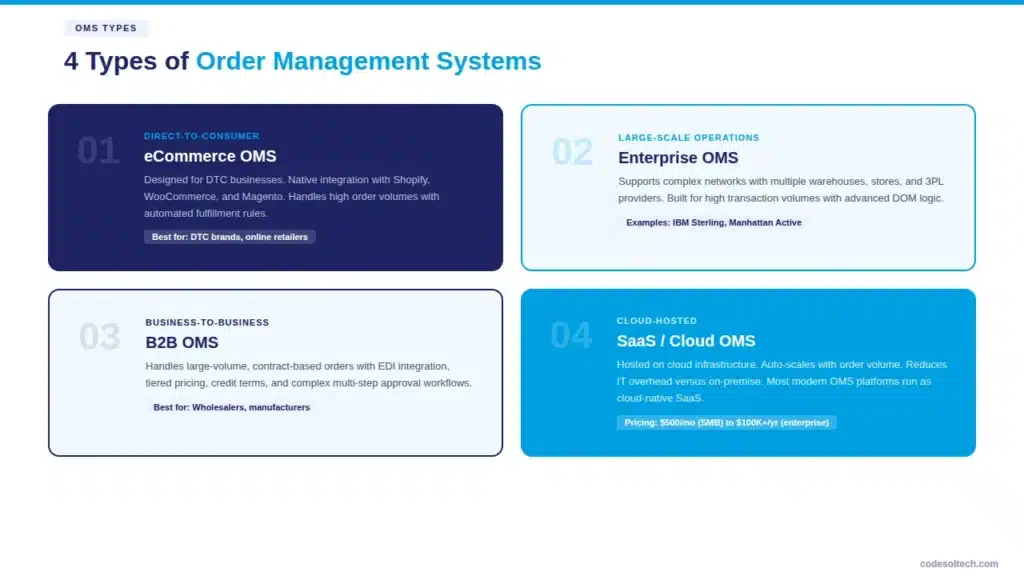
- eCommerce OMS — Designed for direct-to-consumer (DTC) businesses. Integrates natively with Shopify, WooCommerce, or Magento. Manages high order volumes with automated fulfillment rules.
- Enterprise OMS — Deployed by large retailers and manufacturers. Supports complex fulfillment networks with multiple warehouses, stores, and third-party logistics (3PL) providers. Examples include IBM Sterling OMS and Manhattan Active OMS.
- B2B OMS — Handles large-volume, contract-based orders with EDI integration, tiered pricing, credit terms, and complex approval workflows.
- Cloud-based OMS (SaaS) — Hosted on cloud infrastructure. Scales automatically with order volume. Reduces IT overhead compared to on-premise deployments. Most modern OMS platforms operate as cloud-native SaaS solutions.
What Is Omnichannel Order Management?
Omnichannel order management is the practice of unifying order processing across all sales channels into a single system so that customers receive a consistent experience regardless of how or where they purchase.
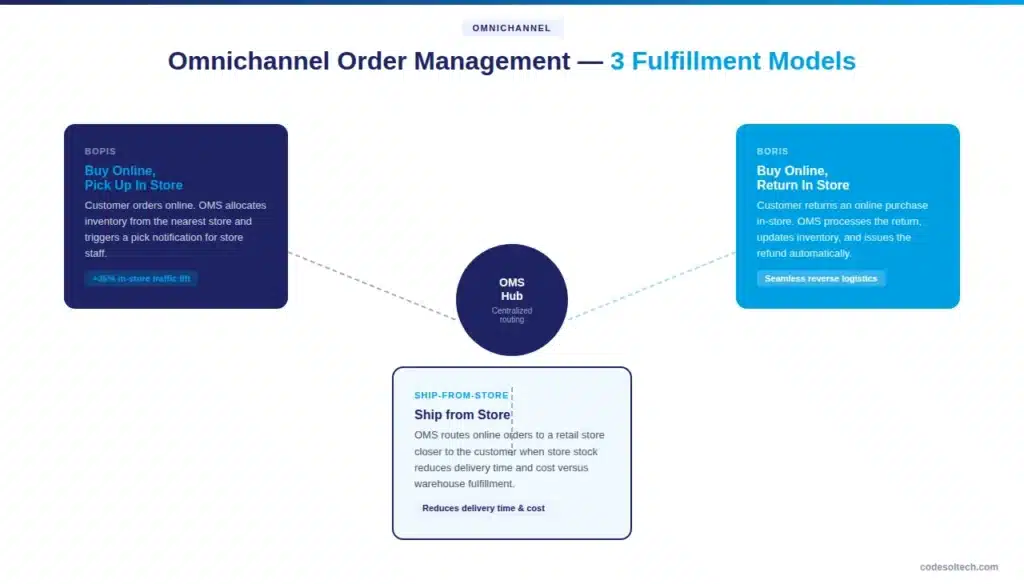
Omnichannel OMS enables 3 fulfillment models that are critical to modern retail:
- BOPIS (Buy Online, Pick Up In Store) — The customer orders online; the OMS allocates inventory from the nearest store and triggers a pick notification for store staff.
- BORIS (Buy Online, Return In Store) — The customer returns an online order to a physical store. The OMS processes the return, updates inventory, and issues the refund.
- Ship-from-Store — The OMS routes an online order to a retail store instead of a warehouse when the store stock is closer to the customer, reducing delivery time and cost.
Retailers that implement BOPIS report a 35% increase in in-store traffic and a measurable uplift in cross-sell revenue from customers who visit to collect their orders (Harvard Business Review).
How to Choose the Right OMS for Your Business
Selecting an OMS requires evaluating 5 criteria against your operational requirements:
- Integration capability — Confirm the OMS connects via API to your existing eCommerce platform, ERP, WMS, and carriers. Pre-built connectors reduce implementation time by 40–60% compared to custom integrations.
- Scalability — The system must handle peak order volume spikes (Black Friday, seasonal surges) without performance degradation. Cloud-native OMS platforms auto-scale during peak periods.
- Fulfillment network complexity — Businesses with 3 or more fulfillment nodes require DOM logic. Single-warehouse operations can use simpler OMS configurations.
- Total Cost of Ownership (TCO) — SaaS OMS pricing ranges from $500/month for SMB tools to $100,000+/year for enterprise platforms. Include integration, implementation, and training costs in the TCO calculation.
- Vendor support and SLA — Enterprise OMS vendors must guarantee 99.9%+ uptime SLAs. Downtime during peak sales periods directly translates to lost revenue.
OMS Implementation: What Does the Process Look Like?
A standard OMS implementation follows 5 phases over a 3 to 9 month timeline depending on complexity:
- Discovery and requirements — Document current order flows, integration points, and fulfillment rules.
- System configuration — Configure business rules, fulfillment routing logic, and user roles.
- Integration development — Connect the OMS to ERP, WMS, eCommerce platform, and carriers via API.
- Data migration — Transfer historical order data, customer records, and product catalogs.
- Testing and go-live — Execute end-to-end order scenarios, validate data accuracy, and launch.
Businesses that engage experienced eCommerce development partners reduce implementation risk and go-live delays. If you are planning an OMS implementation alongside a new eCommerce platform, contact our team to scope the project.
What ROI Does an OMS Deliver?
OMS ROI is measured across 4 operational dimensions:
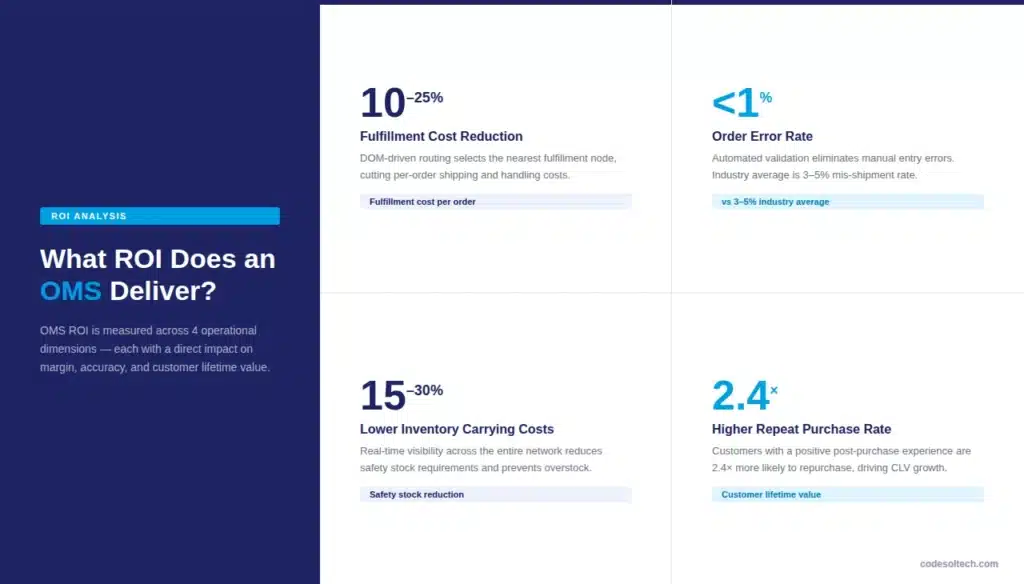
- Fulfillment cost per order — DOM-driven fulfillment routing reduces shipping costs by selecting the nearest fulfillment node. Businesses report 10–25% reduction in per-order fulfillment costs after OMS deployment.
- Order error rate — Automated validation eliminates manual data-entry errors. OMS adopters reduce mis-shipment rates to below 1% from an industry average of 3–5%.
- Inventory carrying costs — Real-time visibility across the entire inventory network reduces safety stock requirements by 15–30%.
- Customer lifetime value (CLV) — Accurate order tracking and frictionless returns increase repeat purchase rates. Studies show that customers with a positive post-purchase experience are 2.4x more likely to repurchase.
Final Words
An OMS is not optional for businesses selling across multiple channels. It is the operational layer that connects inventory, fulfillment, and customer experience into one controlled process.
Without it, order errors multiply as volume grows. With it, businesses fulfill faster, spend less per shipment, and retain more customers.
Ready to Build or Integrate an OMS for Your Business?
CodeSol Technologies develops custom eCommerce solutions and OMS integrations that connect your sales channels, inventory, and fulfillment operations.
Whether you need a WooCommerce OMS integration or a full enterprise implementation, our team delivers production-ready systems.