Ecommerce checkout flow architecture is the structured sequence of frontend UX states, backend service layers, and payment-processing integrations that moves a buyer from cart review to order confirmation. Every architectural decision inside that sequence directly affects conversion rate, cart abandonment rate, and average order value (AOV).
The global average cart abandonment rate sits at 70.19%, according to the Baymard Institute’s aggregate of 49 studies. Of every 100 shoppers who initiate checkout, only 29 complete a purchase. A well-engineered checkout architecture closes that gap by eliminating friction at every system boundary.
This guide maps the complete checkout funnel architecture from the technical layer model to UX flow states, payment gateway integration, and the 2026 composable commerce patterns that modern ecommerce development architecture uses to drive conversion.
What Is the Checkout Funnel? (The 6-Stage Architecture)
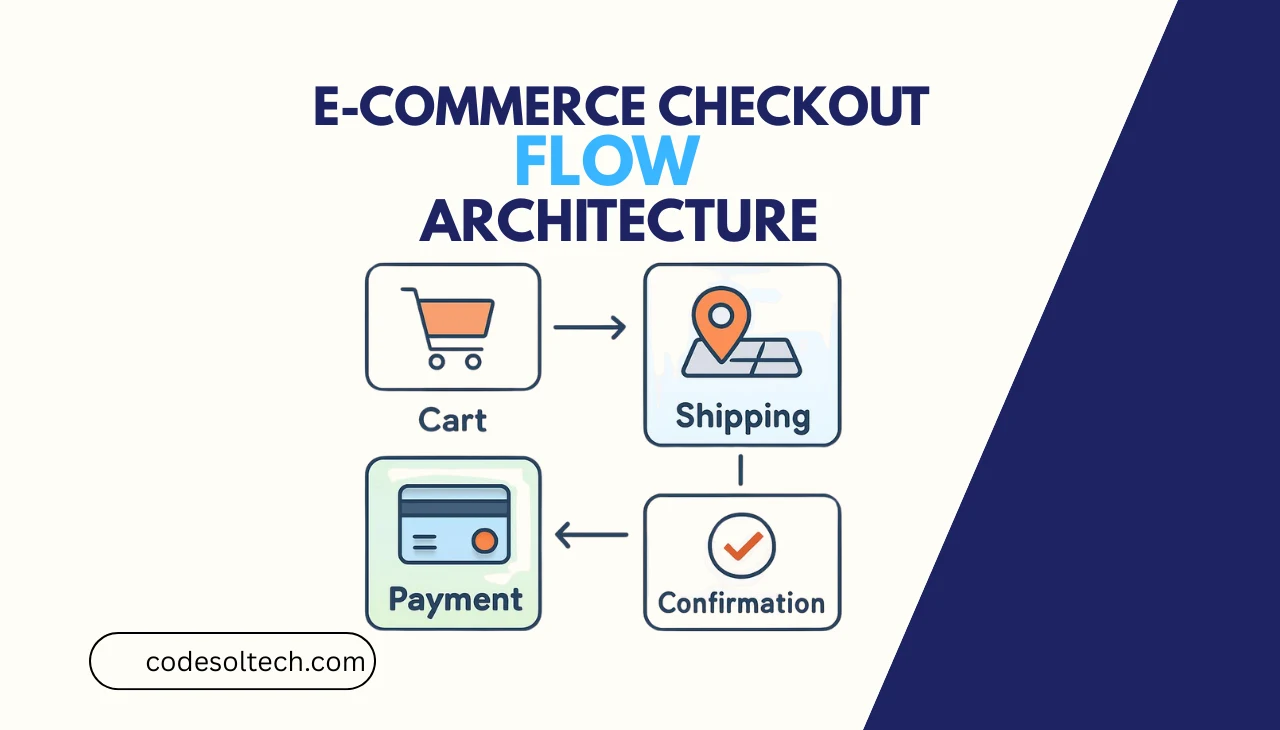
The checkout funnel is a 6-stage transactional pipeline that transforms cart intent into a confirmed, paid order. Each stage represents a distinct system state with defined inputs, validation rules, and output transitions. Skipping or merging stages incorrectly increases drop-off; over-expanding them increases cognitive load.
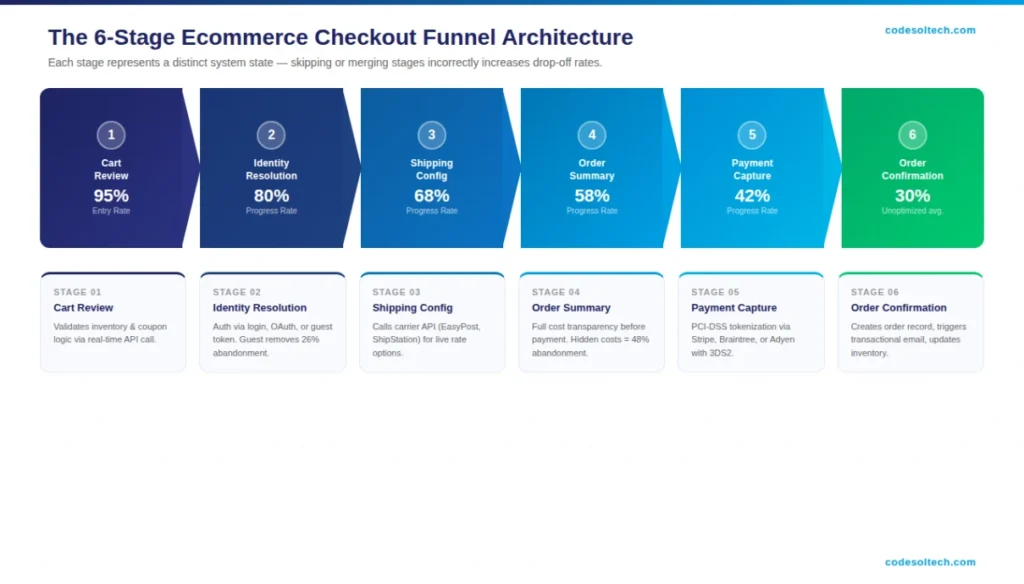
The 6 architectural stages of an ecommerce checkout funnel are:
- Stage 1 — Cart Review: The buyer inspects line items, quantities, and promotional codes. The system validates inventory availability and coupon logic in real time via API.
- Stage 2 — Identity Resolution: The system authenticates the user (registered login, social OAuth, or guest token). Guest checkout eliminates forced registration, which accounts for 26% of checkout abandonment.
- Stage 3 — Shipping Configuration: The buyer selects a delivery address and shipping method. The system calls a shipping-rate API (e.g., EasyPost, ShipStation) and returns carrier options with live pricing.
- Stage 4 — Order Summary & Cost Transparency: The system renders the complete order total — subtotal, shipping, taxes, and discounts — before the buyer commits to payment. Hiding costs until this stage is the single largest driver of abandonment at 48%.
- Stage 5 — Payment Capture: The buyer submits payment credentials. The system tokenises card data via PCI-DSS-compliant gateway (Stripe, Braintree, Adyen), executes a charge or authorization-capture sequence, and handles 3D Secure (3DS2) authentication when required.
- Stage 6 — Order Confirmation: The system creates an order record, triggers a transactional email via SMTP or ESP API, updates inventory counts, and returns an order ID to the buyer. This stage closes the UX flow loop and begins post-purchase logic.
Collapsing these 6 stages into a single-page checkout layout reduces perceived complexity without removing any functional step.
Single-page architectures present all 6 stages as accordion sections within one HTTP route, which reduces page-load latency and eliminates cross-page state loss.
Checkout Flow Architecture: The 3-Layer Technical Model
A production-grade checkout flow operates across 3 distinct technical layers. Designing each layer independently and connecting them through well-defined APIs gives engineering teams the ability to optimize conversion at each level without coupling changes to unrelated systems.
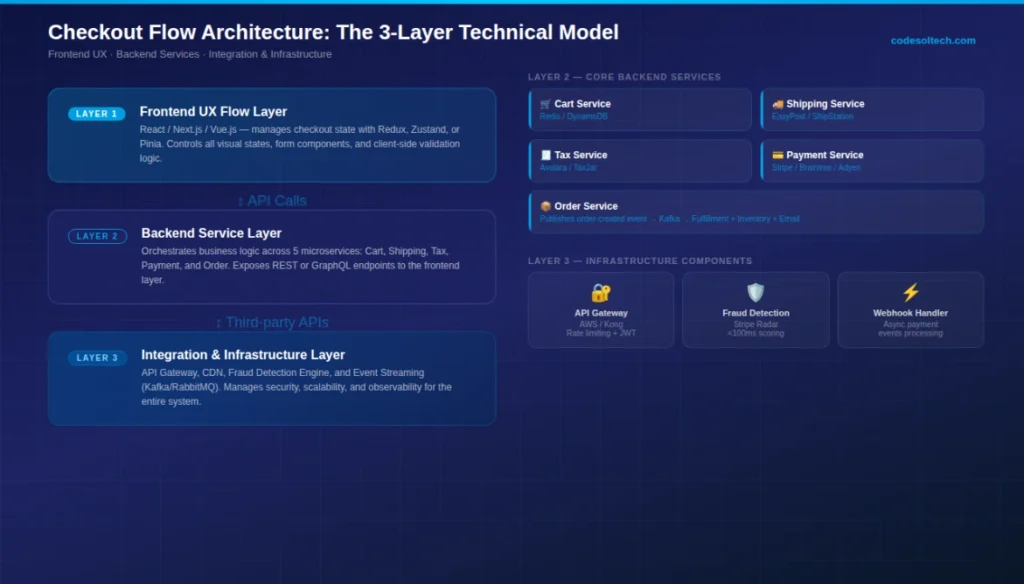
Layer 1: The Frontend UX Flow Layer
The UX flow layer governs the visual states, form components, and client-side validation logic the buyer interacts with. This layer is built on a JavaScript framework (React, Next.js, Vue.js) and manages checkout state using a predictable state container (Redux, Zustand, or Pinia).
The 4 core UX flow principles that directly lift conversion are:
- Progressive Disclosure: Reveal form fields in sequence. Presenting all fields at once increases cognitive load and reduces completion rates by an average of 20%.
- Inline Validation: Validate each field on blur, not on form submission. Inline validation reduces form error rates by 22%, per research published by the Nielsen Norman Group.
- Address Autocomplete: Integrate a Places API (Google Places, Loqate) to autocomplete shipping addresses. Autocomplete reduces address entry time from an average of 47 seconds to 8 seconds.
- Payment Element Embedding: Render payment fields as an embedded iFrame component (e.g., Stripe Elements, Braintree Hosted Fields) to handle PCI-DSS scope reduction and remove the risk of card data touching the merchant’s own DOM.
Layer 2: The Backend Service Layer
The backend service layer orchestrates business logic between the frontend and third-party APIs. It exposes a RESTful or GraphQL API to the frontend and communicates downstream with payment processors, tax engines, fraud detection services, and order management systems (OMS).
The 5 core backend services in a checkout architecture are:
- Cart Service: Manages line items, quantity validation, and price calculation. It reads from the product catalog service and writes to a session-based or persistent cart store (Redis, DynamoDB).
- Shipping Service: Queries carrier APIs and returns available shipping options with live rate calculations. It applies business rules for free shipping thresholds.
- Tax Service: Integrates with a tax calculation engine (Avalara, TaxJar) to compute jurisdiction-specific tax obligations. Tax is calculated server-side to prevent client-side manipulation.
- Payment Service: Manages the full payment lifecycle — tokenization, authorization, capture, refunds, and webhook event handling. It abstracts the payment gateway behind a service interface to allow gateway swapping without frontend changes.
- Order Service: Creates the canonical order record upon successful payment confirmation. It publishes an order-created event to a message broker (Kafka, RabbitMQ) that downstream services — fulfillment, inventory, email — consume asynchronously.
Layer 3: The Integration & Infrastructure Layer
The integration layer connects the backend service layer to external platforms and manages non-functional requirements: security, scalability, and observability. This layer includes the API gateway, CDN configuration, fraud detection service, and the event-streaming infrastructure.
The 3 critical infrastructure components for checkout reliability are:
- API Gateway: Routes checkout API requests, enforces rate limiting, and handles JWT authentication. An API gateway (AWS API Gateway, Kong) prevents denial-of-service attacks on the payment endpoint.
- Fraud Detection Engine: Applies machine-learning risk scoring to every transaction. Services like Stripe Radar, Signifyd, or Kount generate a risk score in under 100 milliseconds using 1,000+ signals, including device fingerprinting, IP geolocation, and behavioral velocity.
- Payment Webhook Handler: Processes asynchronous payment events from the gateway (payment.succeeded, payment. failed, chargeback.created). The handler updates the order status atomically to prevent duplicate fulfillment on retry logic.
What Causes Cart Abandonment? (Data-Driven Architecture Fixes)
Cart abandonment is a measurable symptom of architectural failure. Each abandonment causes maps directly to a system or UX flow defect that engineering and product teams resolve through targeted architectural changes.
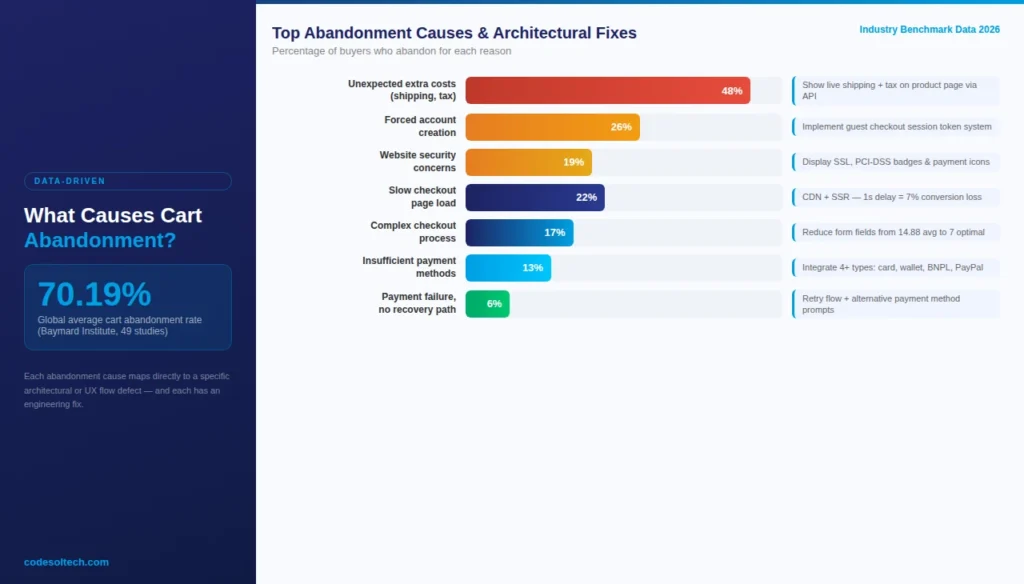
The 7 primary abandonment causes, and their architectural solutions are:
- Unexpected extra costs (48%): Render live shipping and tax estimates on the product detail page and cart page — not only at checkout. Use the shipping and tax service APIs to calculate totals before the buyer enters the checkout funnel.
- Forced account creation (26%): Implement a guest checkout token system. Issue a temporary session token that persists cart and order data without requiring database account creation. Convert the guest post-purchase with a one-click account creation flow.
- Slow checkout page load (22%): Deploy the checkout frontend on a CDN edge network. Use server-side rendering (SSR) or static generation for the checkout shell. A 1-second delay in page response time reduces conversion by 7%, per an Akamai study.
- Complex checkout process (17%): Reduce the number of required form fields to the absolute minimum. Baymard Institute research shows the average checkout contains 14.88 form fields, while the optimal number is 7.
- Website security concerns (19%): Display SSL certificate badges, PCI-DSS compliance indicators, and recognizable payment method icons (Visa, Mastercard, PayPal, Apple Pay). Trust signals increase buyer confidence and reduce security-driven abandonment.
- Insufficient payment methods (13%): Integrate a minimum of 4 payment method types: credit/debit card, digital wallet (Apple Pay, Google Pay), Buy Now Pay Later (BNPL) via Affirm or Klarna, and PayPal. Digital wallet adoption grew 62% in 2023 and continues accelerating in 2026.
- Payment failure with no recovery (6%): Implement a payment retry flow with alternative method prompting. When a card authorization fails, the UX flow presents the buyer with alternative payment options instead of a dead-end error state.
UX Flow Mapping: The Checkout State Machine
A checkout UX flow is a finite state machine (FSM) with defined states, transitions, and guard conditions. Modeling checkout as a state machine prevents invalid UI states — such as displaying the confirmation page before payment succeeds — and makes the flow deterministic and testable.
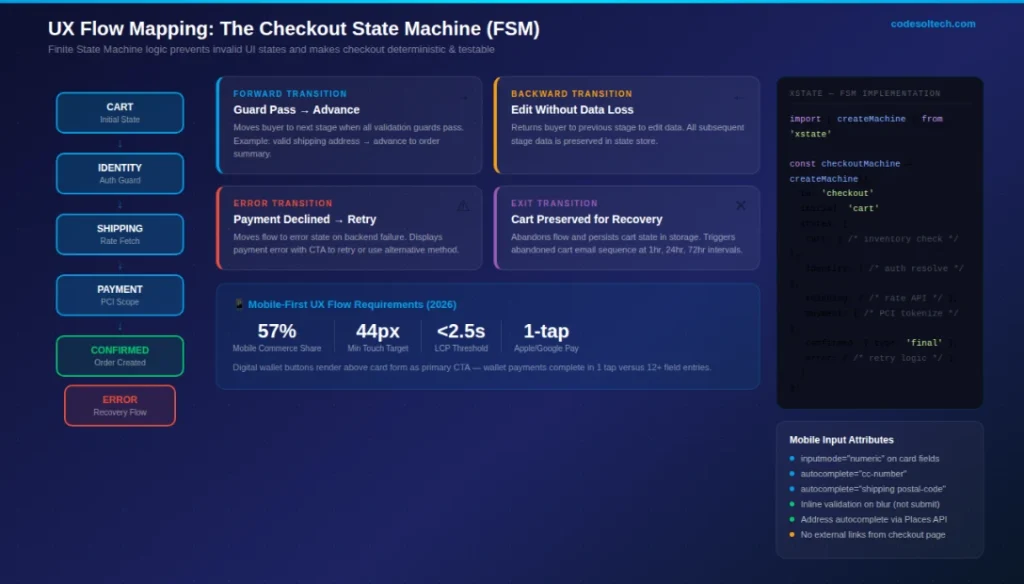
The checkout state machine defines 4 transition types:
- Forward transitions: Move the buyer to the next stage when all validation guards pass (e.g., shipping address validated → advance to order summary).
- Backward transitions: Return the buyer to a previous stage to edit data without losing information already captured in subsequent stages.
- Error transitions: Move the flow to an error state when a backend call fails (e.g., payment declined → display payment error state with retry CTA).
- Exit transitions: Abandon the checkout flow and preserve cart state in persistent storage for abandoned cart recovery sequences.
Libraries like XState (JavaScript) implement formal state machine logic in the frontend layer, eliminating the class of bugs where buyers reach impossible UI combinations during checkout.
Mobile-First Checkout UX Flow Requirements
Mobile commerce transactions account for 57% of all global ecommerce transactions in 2026. A checkout UX flow designed for desktop degrades severely on a 375px viewport. Mobile-first checkout architecture enforces 5 specific constraints:
- Touch targets on all interactive elements are a minimum of 44×44 CSS pixels, per Apple Human Interface Guidelines.
- Numeric keyboards trigger automatically for card number, CVV, and ZIP code fields via the
inputmode="numeric"HTML attribute. - Autofill is enabled across all address and payment fields via the
autocompleteattribute with correct token values (shipping name, street-address, postal-code, cc-number). - Digital wallet buttons (Apple Pay, Google Pay) render above the card form as the primary payment CTA, because wallet payments complete in 1 tap versus 12+ field entries.
- Checkout pages load in under 2.5 seconds on a 4G connection (Largest Contentful Paint < 2.5s) to meet Google’s Core Web Vitals threshold for mobile ranking.
Payment Gateway Architecture: Integration Patterns
Payment gateway integration defines the security boundary, data flow, and failure-recovery model of the checkout system. 3 integration patterns exist, each with distinct trade-offs in complexity, PCI-DSS scope, and user experience.
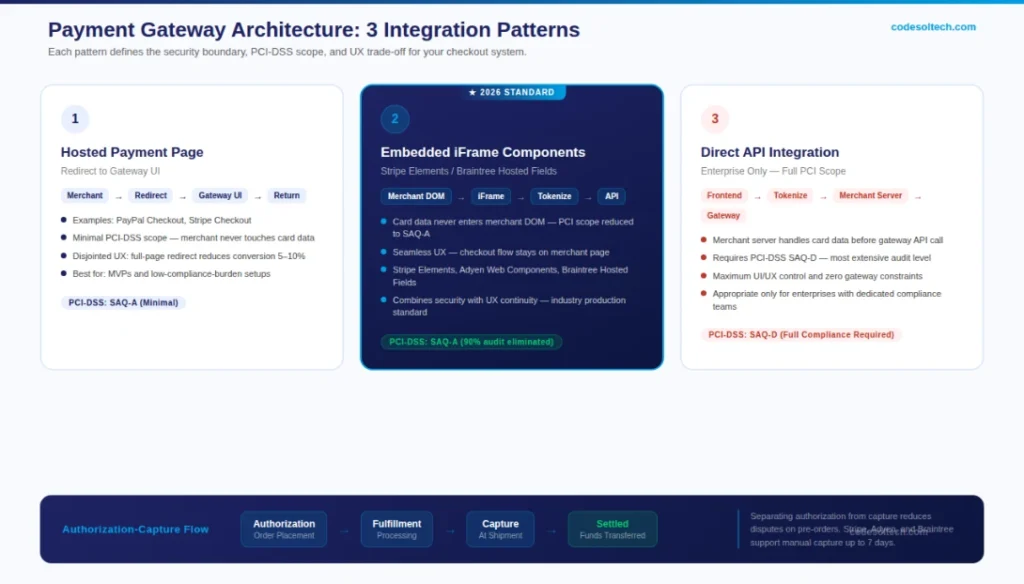
- Hosted Payment Page (Redirect): The buyer is redirected to the payment gateway’s own UI (e.g., PayPal Checkout, Stripe Checkout). PCI-DSS scope is minimal — the merchant never touches card data. The trade-off is a disjointed UX flow with full-page redirects that reduce conversion by 5–10% versus embedded flows.
- Embedded iFrame Components: The gateway renders payment fields inside iFrame elements (Stripe Elements, Braintree Hosted Fields) embedded within the merchant’s checkout page. Card data never enters the merchant’s DOM, reducing PCI-DSS scope to SAQ-A. This pattern combines security with UX continuity and is the standard for 2026 production deployments.
- Direct API Integration: The merchant’s frontend collects card data and sends it directly to the gateway API after tokenization. This pattern requires PCI-DSS SAQ-D compliance — the most extensive audit level — and is appropriate only for large enterprises with dedicated compliance infrastructure.
The authorization-capture payment flow separates the act of verifying a card (authorization) from the act of debiting it (capture). Authorizing at order placement and capturing at shipment reduces disputes on pre-orders and delayed-fulfillment products.
Stripe, Adyen, and Braintree all support manual capture with a configurable capture window of up to 7 days.
2026 Checkout Architecture Trends: Composable Commerce & AI
Composable commerce architecture replaces the monolithic ecommerce platform with a collection of best-of-breed, API-connected services. In a composable checkout architecture, each checkout function — cart, pricing, payment, tax, fraud is an independent microservice selected and swapped independently of others.
The MACH Alliance (Microservices, API-first, Cloud-native, Headless) defines the technical standard for this architectural approach.
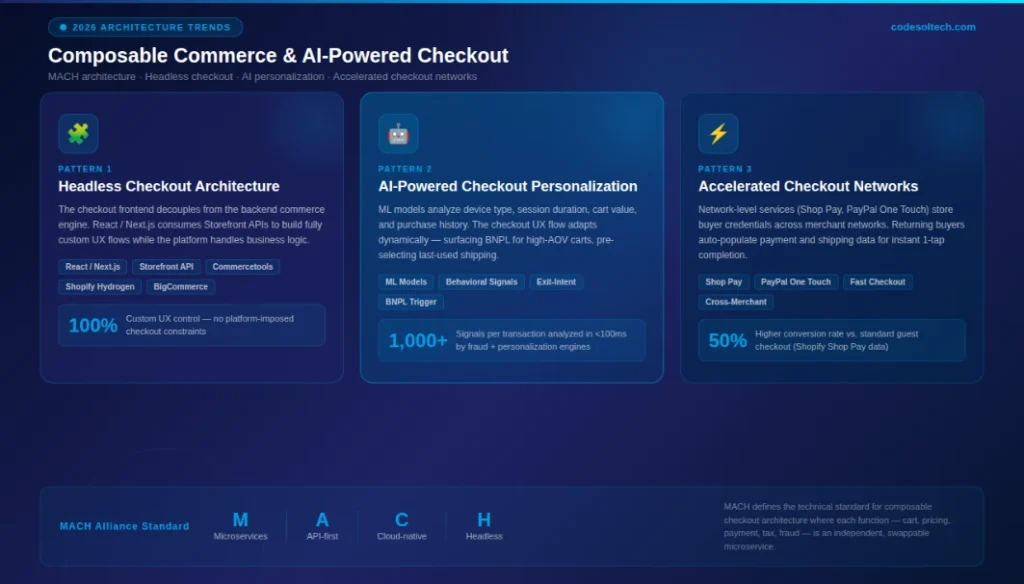
The 3 composable checkout patterns gaining adoption in 2026 are:
- Headless Checkout: The checkout frontend (React, Next.js) decouples from the backend commerce engine (Commercetools, BigCommerce, Shopify Hydrogen). The frontend consumes the Storefront API to build a fully custom UX flow while the backend handles business logic. This pattern eliminates platform-imposed checkout constraints.
- AI-Powered Checkout Personalization: Machine-learning models analyze buyer behavior signals — device type, session duration, cart value, purchase history — and dynamically adjust the checkout UX flow. Examples include surfacing BNPL options for high-AOV carts, pre-selecting the buyer’s last-used shipping address, and triggering exit-intent discount modals at specific abandonment probability thresholds.
- One-Click & Accelerated Checkout Networks: Network-level checkout services (Shop Pay, Fast, PayPal One Touch) store buyer payment and shipping data across merchant networks. When a returning buyer reaches checkout, their credentials pre-populate automatically. Shopify reports that Shop Pay delivers a 50% higher conversion rate than standard guest checkout flows.
Checkout Conversion Rate Optimization: 8 Measurable Tactics
Conversion rate optimization (CRO) for checkout is a data-driven engineering and design discipline. Each tactic below produces a measurable conversion lift, supported by A/B test data from published industry studies.
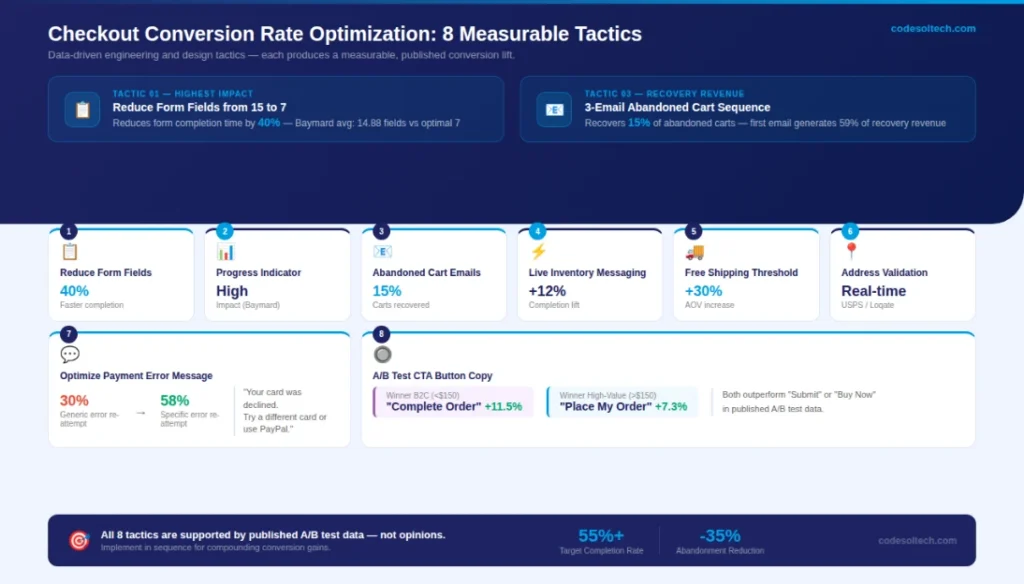
- Reduce form fields from 15 to 7: Eliminating optional fields (company name, address line 2, phone number) reduces form completion time by 40%. Map required fields to only those needed for shipping and fraud verification.
- Display a checkout progress indicator: A step indicator (e.g., “Step 2 of 3”) communicates endpoint proximity. Baymard Institute identifies progress indicators as a high-impact UX pattern for multi-step checkouts.
- Implement abandoned cart email sequences: A 3-email recovery sequence sent at 1 hour, 24 hours, and 72 hours post-abandonment recovers an average of 15% of abandoned checkouts. The first email generates 59% of all recovery revenue.
- Add real-time inventory messaging: Displaying “Only 3 left” or “12 people viewing this” inside the checkout flow activates scarcity bias and reduces hesitation. This tactic increases checkout completion rates by 8–12% in published A/B tests.
- Offer free shipping thresholds: Displaying a “Add $X more for free shipping” message in the cart increases AOV by an average of 30% while simultaneously reducing the 48% abandonment rate caused by unexpected shipping costs.
- Enable address validation at entry: Real-time address validation (USPS, Royal Mail, Loqate) prevents failed deliveries and reduces post-purchase service contacts. Validating at input prevents buyers from advancing with an invalid address.
- Optimize the payment error message: Generic error messages (“Your payment failed”) produce re-attempt rates of 30%. Specific messages (“Your card was declined. Please try a different card or use PayPal”) produce re-attempt rates of 58%.
- A/B test the CTA button copy: “Complete Order” outperforms “Submit” by 11.5% in conversion rate. “Place My Order” outperforms “Buy Now” by 7.3% for high-consideration purchases above $150.
Checkout Security Architecture: PCI-DSS Compliance Framework
PCI-DSS (Payment Card Industry Data Security Standard) Version 4.0, effective March 2025, defines the security controls that every merchant processing card payments must implement. The compliance level determines the audit scope and the architectural constraints imposed on the checkout system.
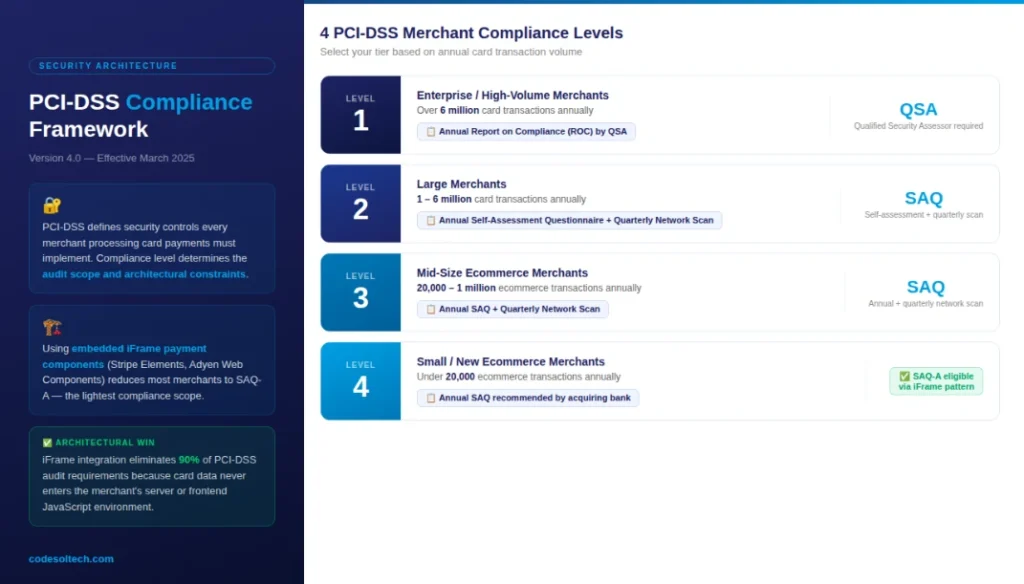
The 4 PCI-DSS merchant compliance levels are:
- Level 1: Merchants processing over 6 million card transactions annually. Requires an annual Report on Compliance (ROC) by a Qualified Security Assessor (QSA).
- Level 2: Merchants processing 1–6 million transactions annually. Requires an annual Self-Assessment Questionnaire (SAQ) and quarterly network scan.
- Level 3: Merchants processing 20,000–1 million ecommerce transactions annually. Requires an annual SAQ and quarterly network scan.
- Level 4: Merchants processing under 20,000 ecommerce transactions annually. Requires an annual SAQ recommended by the acquiring bank.
Using embedded iFrame payment components (Stripe Elements, Adyen Web Components) reduces most merchants to SAQ-A, the lightest compliance scope, because card data never enters the merchant’s server or frontend JavaScript environment. This architectural choice eliminates 90% of PCI-DSS audit requirements.
How to Measure Checkout Flow Performance: 7 KPIs
Checkout flow performance measurement requires 7 specific KPIs tracked across each stage of the funnel. Aggregate conversion rate alone fails to identify which stage drives abandonment — stage-level metrics expose the exact failure point.
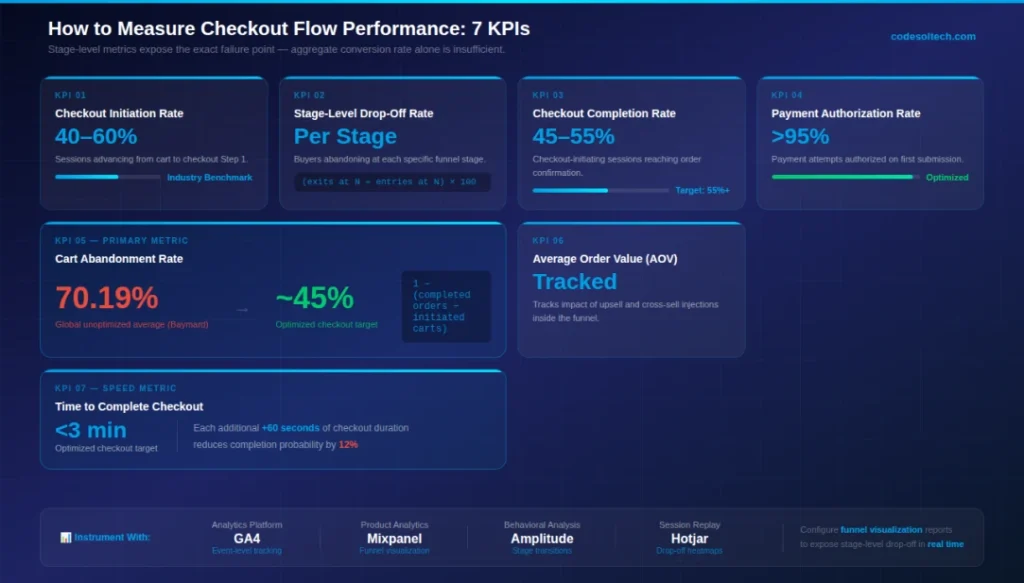
- Checkout Initiation Rate: Percentage of sessions that advance from cart to checkout Step 1. Industry benchmark: 40–60%.
- Stage-Level Drop-Off Rate: Percentage of buyers who abandon at each specific funnel stage. Calculated as: (exits at stage N ÷ entries at stage N) × 100.
- Checkout Completion Rate: Percentage of checkout-initiating sessions that reach order confirmation. Industry benchmark: 45–55%.
- Payment Authorization Rate: Percentage of payment attempts authorized by the gateway on first submission. Benchmark: >95% for optimized checkouts.
- Cart Abandonment Rate: Percentage of carts that are not converted to orders. Calculated as: 1 − (completed orders ÷ initiated carts). Global benchmark: 70.19%.
- Average Order Value (AOV): Mean transaction value across completed checkout sessions. AOV tracks the impact of upsell and cross-sell injections inside the checkout funnel.
- Time to Complete Checkout: Median time in seconds from cart page entry to order confirmation. Optimized checkouts complete in under 3 minutes. Each additional 60 seconds of checkout duration reduces completion probability by 12%.
Instrument each KPI using a behavioral analytics platform (Google Analytics 4, Mixpanel, Amplitude) with event-level tracking at every checkout stage transition. Configure funnel visualization reports to expose stage-level drop-off in real time.
Final Words
Ecommerce checkout flow architecture is not a design task — it’s an engineering discipline with direct revenue consequences.
A 6-stage funnel, 3-layer technical model, PCI-DSS-compliant payment integration, and mobile-first UX flow are the non-negotiable foundations. In 2026, composable and AI-personalized checkout patterns separate high-conversion stores from average ones.
Every friction point removed is a percentage of revenue recovered.
Build a Checkout Architecture That Converts Talk to Our Team
Our engineers design and develop production-grade ecommerce architectures built for conversion, compliance, and scale. From headless checkout builds to payment gateway integrations, we deliver architectures that reduce cart abandonment and increase revenue.