
A Product Information Management (PIM) system is a centralized software platform that collects, enriches, manages, and distributes product data across all sales channels and data sources. Retailers, manufacturers, and distributors use PIM systems to eliminate data silos, reduce manual errors, and accelerate time-to-market for new products.
According to Wikipedia’s definition of PIM, product information management covers the processes and technologies required to manage marketing information about products.
A PIM system serves as the single source of truth (SSOT) for all product content. It ingests raw product data from multiple data sources, including ERP systems, supplier spreadsheets, DAM platforms, and direct data feeds and outputs enriched, channel-ready content to e-commerce storefronts, print catalogs, marketplaces, and retail partners.
What Is a PIM System and How Does It Work?
A PIM system functions through a 4-stage data lifecycle: ingestion, enrichment, governance, and distribution. During ingestion, the system imports raw product data from connected data sources. During enrichment, product managers add marketing copy, technical specifications, high-resolution images, and SEO metadata.
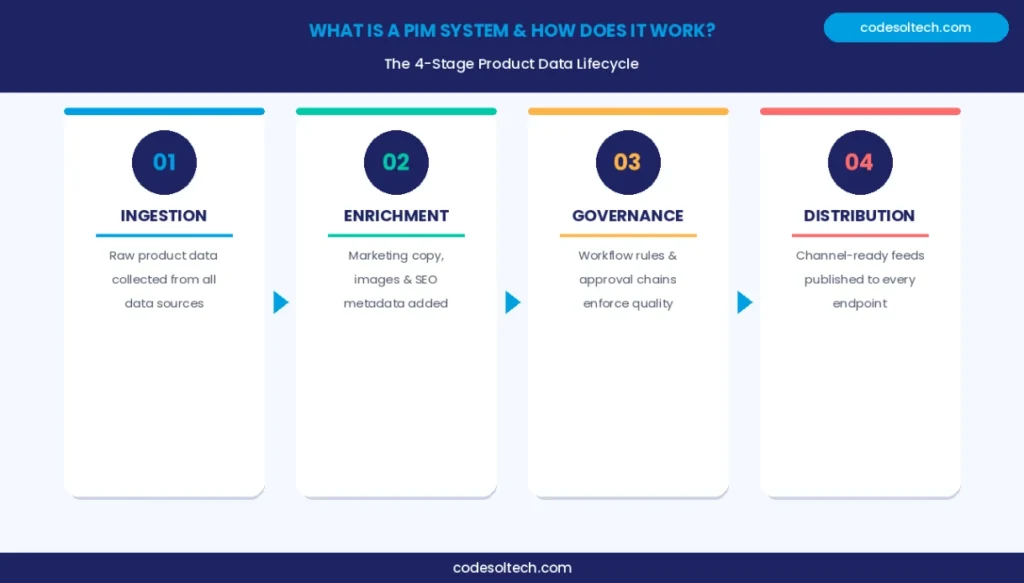
During governance, workflow rules enforce data completeness scores and approval chains. During distribution, the PIM publishes channel-specific product feeds to every connected endpoint.
The core architecture of a PIM system consists of 3 primary components:
- Data Model: Defines product attributes, categories, taxonomies, and relationships (e.g., variants, bundles, accessories).
- Workflow Engine: Manages enrichment tasks, approval processes, and role-based access control (RBAC) for product teams.
- Channel Syndication Layer: Transforms and exports product data into channel-specific formats — JSON, XML, CSV, or API feeds.
PIM systems integrate with adjacent platforms through native connectors or open APIs. Common integrations include ERP systems, Digital Asset Management (DAM) platforms, e-commerce platforms (Shopify, Magento, WooCommerce), and marketplace syndication tools (Amazon Vendor Central, Google Merchant Center).
Product Data: Types, Attributes, and Quality Standards
Product data encompasses every piece of structured and unstructured information that describes a product across its commercial lifecycle. A complete product data record contains 5 distinct data types:

- Technical Data: Dimensions, weight, material composition, certifications (CE, RoHS), and compatibility specifications.
- Marketing Data: Product titles, descriptions, feature bullets, brand storytelling, and SEO keywords.
- Digital Assets: Product images (minimum 1200×1200px for e-commerce), 360° videos, instruction manuals, and CAD files.
- Commercial Data: SKU codes, GTIN/EAN barcodes, pricing tiers, and availability status.
- Localization Data: Translated content, region-specific compliance data, and currency-adjusted pricing for international markets.
Product data quality is measured using a data completeness score a percentage metric that calculates how many mandatory attributes are populated for each product record. Industry benchmarks set a minimum completeness score of 85% for products published to tier-1 marketplaces like Amazon.
Low completeness scores directly reduce product discoverability, conversion rates, and Buy Box eligibility on competitive marketplaces.
Poor product data causes 4 measurable business failures: increased product return rates, lower search ranking on marketplace algorithms, higher customer service query volume, and reduced repeat purchase rates. A 2021 Salsify study found that 87% of consumers rate product content as extremely important when making purchase decisions online.
Data Sources in a PIM System: Where Product Data Originates
Data sources are the origin systems and formats from which a PIM ingests raw product information. Managing multiple data sources is the primary operational challenge in product data management.
Enterprises operate an average of 7 to 12 distinct data sources simultaneously, each using different data formats, naming conventions, and update frequencies.
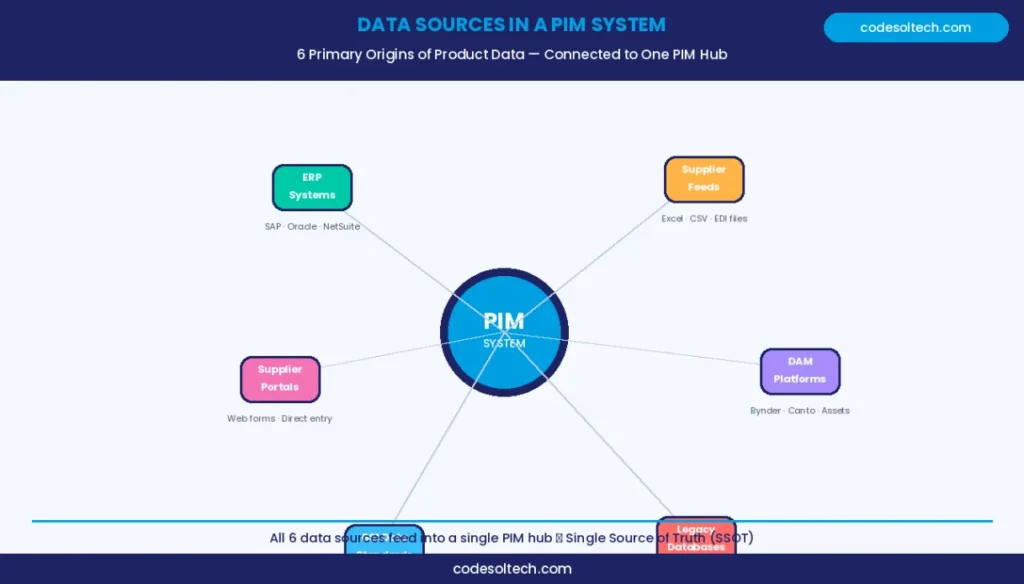
The 6 most common product data sources connected to a PIM system are:
- ERP Systems: SAP, Oracle NetSuite, or Microsoft Dynamics supply master product records including SKUs, pricing, and inventory levels.
- Supplier Data Feeds: Raw spreadsheets (Excel, CSV) or EDI files submitted directly by manufacturers and vendors.
- DAM Platforms: Digital asset repositories (e.g., Bynder, Canto) supply structured digital media linked to product records.
- Legacy Databases: On-premise SQL or flat-file databases containing historical product catalogs requiring migration and normalization.
- Third-Party Data Standards: Industry data pools like GS1 provide standardized product attributes and GTIN registration for global trade.
- Manual Input Portals: Web-based supplier portals allow vendors to submit product data directly into the PIM via structured forms.
Data source consolidation is the first step in a PIM implementation project. The consolidation process involves 3 sequential phases: data auditing (cataloging all active sources), data mapping (aligning source fields to the PIM’s target data model), and data migration (executing ETL — Extract, Transform, Load — pipelines to transfer records).
A structured data migration strategy prevents data loss and attribute mismatches during the transition phase.
3 Types of PIM Systems: Cloud, On-Premise, and Headless
PIM systems are classified into 3 deployment architectures, each suited to different organizational scales and technical requirements.
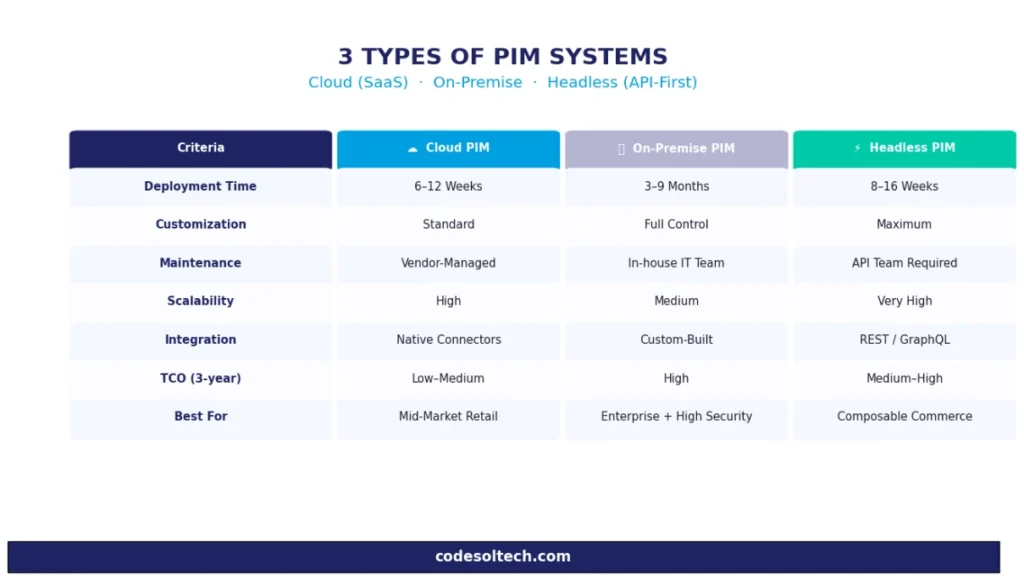
- Cloud PIM (SaaS): Hosted and maintained by the vendor. Examples include Akeneo, Salsify, and inRiver. Cloud PIM delivers faster deployment (typically 6 to 12 weeks), automatic updates, and subscription-based pricing. It suits mid-market and enterprise retailers with standard integration requirements.
- On-Premise PIM: Installed on the organization’s own servers. It provides maximum control over data security and custom configuration. On-premise deployment requires a dedicated IT team and has a longer implementation timeline of 3 to 9 months.
- Headless PIM: An API-first architecture that decouples the data management backend from the presentation layer. Headless PIM integrates with any frontend via REST or GraphQL APIs, making it the preferred architecture for composable commerce stacks and omnichannel publishing.
The choice of PIM architecture directly impacts the total cost of ownership (TCO), integration complexity, and scalability ceiling. Enterprises managing over 500,000 SKUs typically select headless or hybrid PIM architectures to support high-volume data operations and real-time API syndication.
What Is the Difference Between PIM, MDM, and DAM?
PIM, MDM, and DAM are 3 distinct but complementary data management systems. PIM (Product Information Management) manages product-specific marketing and commercial data. MDM (Master Data Management) governs all enterprise master data domains, customers, suppliers, locations, and products as a broader discipline.
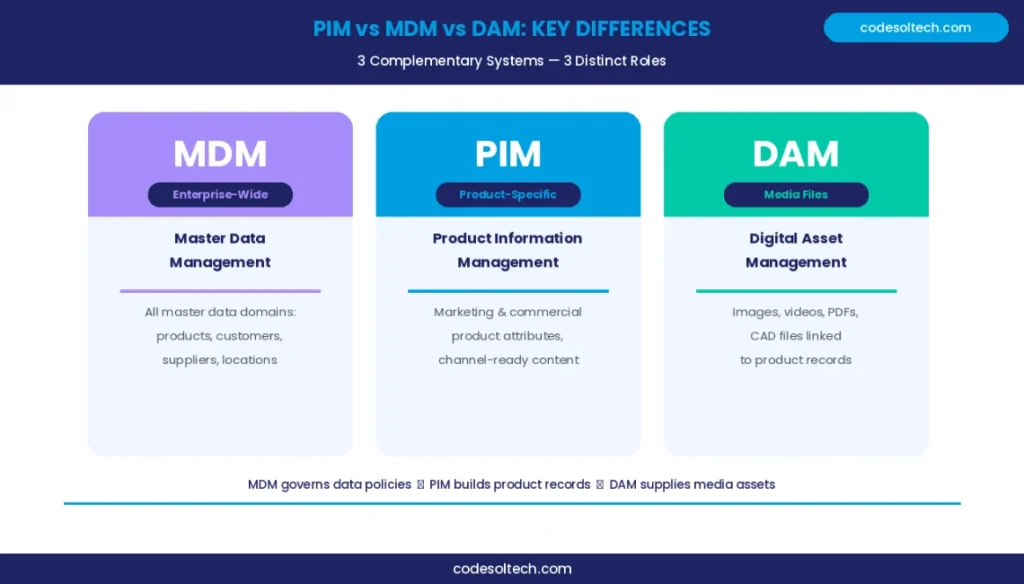
DAM (Digital Asset Management) stores, organizes, and distributes digital media files. A PIM system acts as the operational layer that consumes data from both MDM and DAM to build complete, publishable product records.
- PIM: Manages product attributes, categories, descriptions, and channel-ready content.
- MDM: Governs enterprise-wide master data, including product, customer, and supplier domains, within a single governance framework.
- DAM: Stores and manages digital assets (images, videos, PDFs) that are linked to product records within the PIM.
In a modern e-commerce architecture, DAM assets feed into PIM product records, which are governed by MDM data policies, and then syndicated to downstream channels. This 3-system architecture eliminates redundancy and enforces data consistency across the entire product catalog. Learn more about DAM vs PIM integration patterns in our dedicated guide.
How Does a PIM System Improve E-Commerce SEO?
A PIM system improves e-commerce SEO by enabling systematic, scalable enrichment of product page metadata across every SKU in the catalog. Without a PIM, SEO attributes — title tags, meta descriptions, structured data markup, and canonical URLs — are managed inconsistently at the platform level, creating duplicate content issues and thin-content penalties at scale.
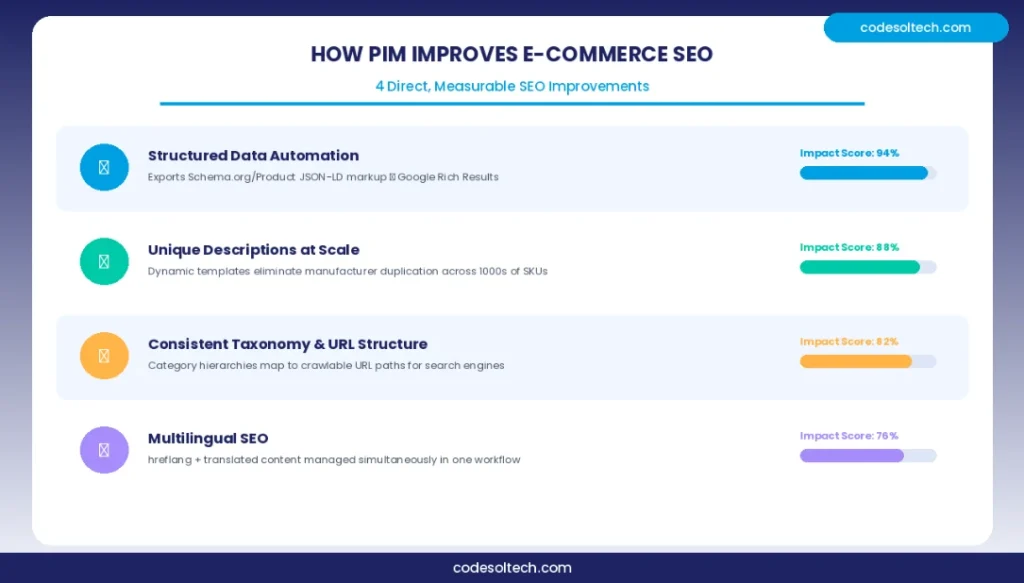
A PIM system delivers 4 direct SEO improvements for e-commerce catalogs:
- Structured Data Automation: PIM exports product data pre-formatted as Schema.org/Product JSON-LD markup, enabling Google’s rich results for price, availability, and reviews.
- Unique Product Descriptions at Scale: PIM templates with dynamic attribute injection generate unique, keyword-rich product descriptions for thousands of variants, eliminating manufacturer description duplication.
- Consistent Taxonomy and URL Structure: PIM category hierarchies map directly to the site’s URL taxonomy, creating logical, crawlable internal linking paths for search engines.
- Multilingual SEO: PIM localization workflows manage hreflang attributes and translated content simultaneously, ensuring correct language targeting for international search queries.
E-commerce platforms connected to a PIM system demonstrate measurably higher crawl efficiency because every product page contains complete, non-duplicate, structured content. Our e-commerce SEO guide covers how PIM-driven content structures improve crawl budget allocation and indexation rates.
Key Features to Evaluate in a PIM System
Selecting a PIM system requires evaluating 8 functional capabilities against the organization’s catalog volume, channel count, and team structure:
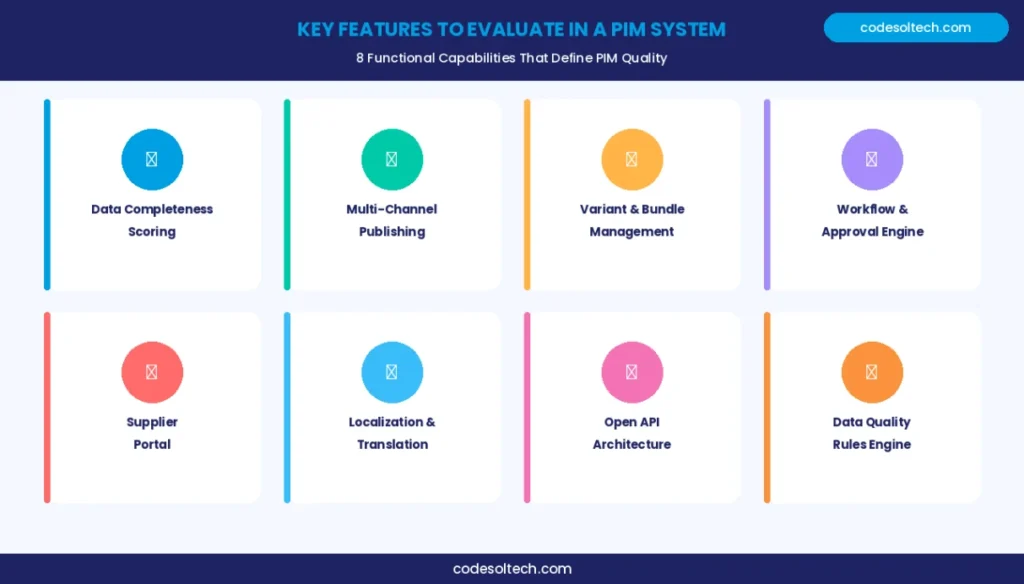
- Data Completeness Scoring: Automatic calculation of attribute fill rates per product, per channel, and per category.
- Multi-Channel Publishing: Native connectors or open API support for publishing to e-commerce platforms, marketplaces, and print production systems.
- Variant and Bundle Management: Ability to manage product relationships — color/size variants, product bundles, and accessory cross-links — within a structured data model.
- Workflow and Approval Engine: Role-based task assignment, SLA tracking, and audit trails for content enrichment and publication approval.
- Supplier Portal: A web interface that allows external suppliers to submit, update, and validate product data directly into the PIM without requiring internal data entry resources.
- Localization and Translation Management: Built-in or integrated translation workflows supporting simultaneous publication across multiple languages and regional data sets.
- Open API Architecture: REST or GraphQL APIs enabling integration with ERP, DAM, OMS, and custom front-end applications within a composable commerce stack.
- Data Quality Rules Engine: Configurable validation rules that reject or flag product records failing to meet minimum attribute standards before channel publication.
Leading PIM Platforms: A Comparison of 5 Solutions
The PIM market contains 5 leading platforms, each positioned for a different segment of the market by catalog size, technical complexity, and industry vertical:
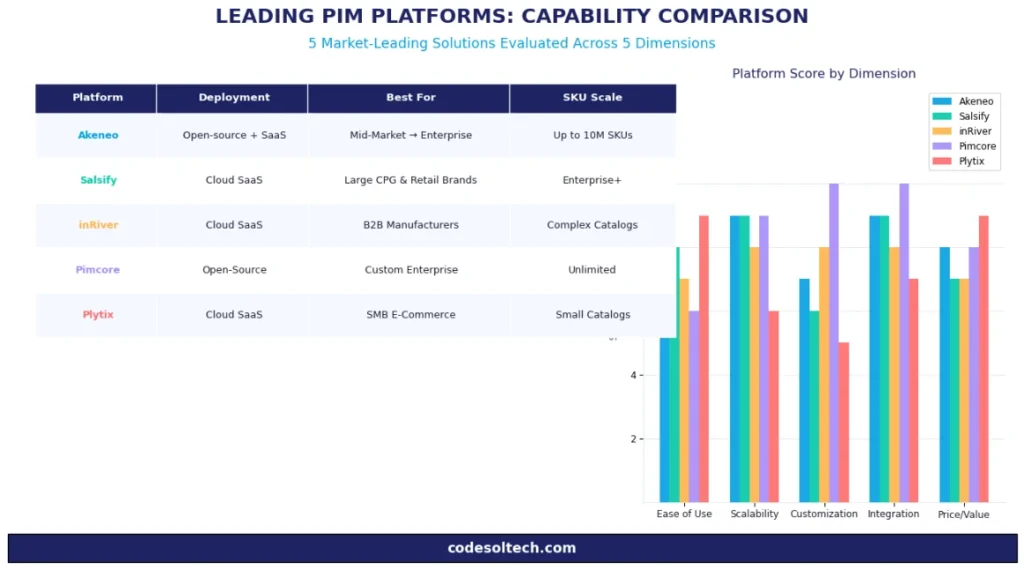
- Akeneo PIM: An open-source and enterprise SaaS PIM built for mid-market and enterprise retailers. Akeneo offers a strong community edition (free) and a Growth Edition for scaling catalogs. It handles catalogs with up to 10 million SKUs in its enterprise tier.
- Salsify: A commerce experience management platform that combines PIM with channel syndication and digital shelf analytics. Salsify targets large consumer goods brands and retailers with complex retailer compliance requirements.
- inRiver: A SaaS PIM focused on complex product relationships and B2B manufacturer use cases. inRiver’s “iPMC” (Intelligent Product Modeling Center) structures product data across multi-level component relationships.
- Pimcore: An open-source, enterprise-grade platform combining PIM, MDM, DAM, and CMS into a unified data platform. Pimcore suits organizations requiring deep customization and tight ERP integration.
- Plytix: A cloud PIM built for small-to-medium e-commerce businesses. Plytix emphasizes ease of use, spreadsheet-style data editing, and built-in analytics for measuring product data performance.
PIM platform selection decisions depend on 3 primary variables: the size of the active product catalog (SKU count), the number of output channels requiring syndication, and the technical resources available for implementation and ongoing API management.
PIM Implementation: A 5-Phase Deployment Framework
A PIM implementation follows a structured 5-phase project framework. Skipping phases particularly data auditing and data modeling is the primary cause of failed or delayed PIM projects.
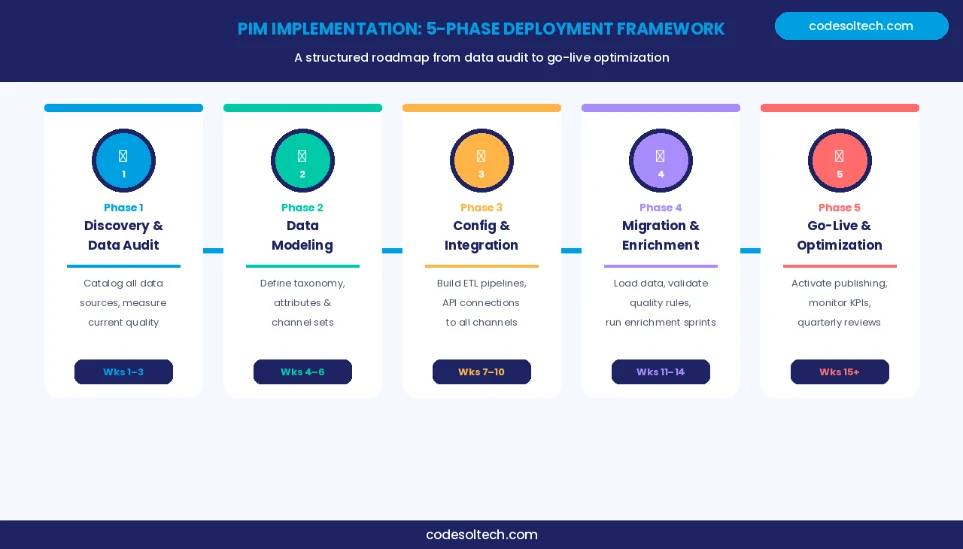
- Phase 1 – Discovery and Data Audit: Catalog all existing data sources, document attribute lists, identify data owners, and measure current data quality scores.
- Phase 2 – Data Modeling: Define the PIM’s product taxonomy, attribute groups, mandatory vs. optional fields, and channel-specific attribute sets. This phase determines the structural integrity of all future product data.
- Phase 3 – System Configuration and Integration: Configure the PIM platform, build ETL pipelines from existing data sources, and establish API connections to downstream channels.
- Phase 4 – Data Migration and Enrichment: Execute the initial data load, run validation rules to identify gaps, and begin enrichment sprints to bring completeness scores to target thresholds.
- Phase 5 – Go-Live and Continuous Optimization: Activate channel publishing, monitor data quality dashboards, onboard supplier portals, and run quarterly data governance reviews.
Enterprise PIM implementations with catalogs exceeding 100,000 SKUs require a dedicated project team of 4 to 6 roles: a PIM project manager, a data architect, 2 to 3 data enrichment specialists, and a system integration engineer.
Average implementation timelines range from 3 months (cloud PIM, standard catalog) to 12 months (on-premise or headless PIM, complex multi-category catalog).
Measuring PIM ROI: 4 Key Performance Indicators
Organizations measure PIM system return on investment (ROI) using 4 operational and commercial KPIs:
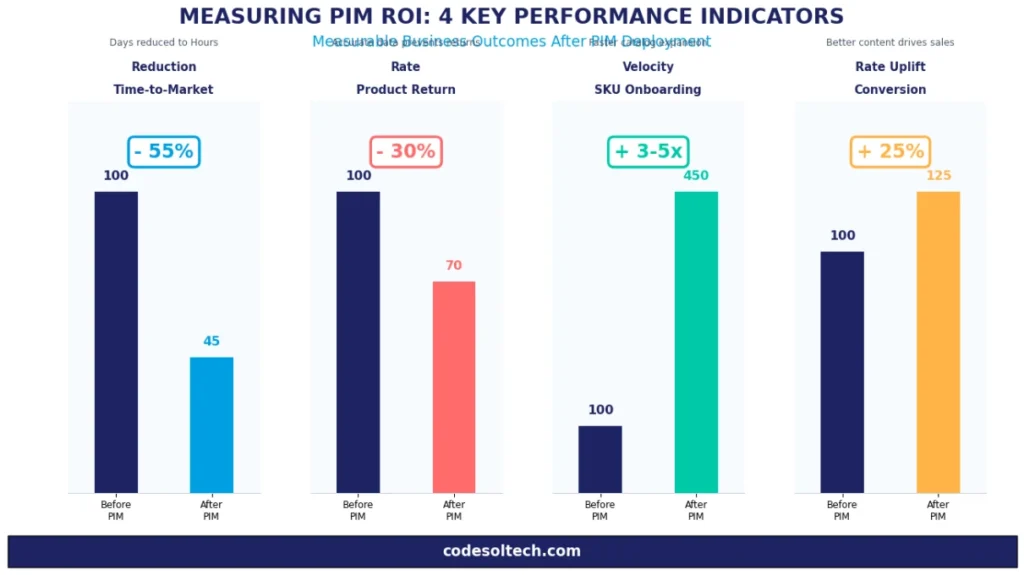
- Time-to-Market Reduction: PIM systems reduce the average time to publish a new product from days to hours by automating enrichment workflows and channel syndication. Benchmarks show a 40% to 60% reduction in time-to-market after PIM deployment.
- Product Return Rate: Accurate, complete product data reduces misleading product listings. Organizations report a 20% to 35% reduction in return rates attributable to improved product content accuracy post-PIM implementation.
- Catalog Expansion Rate: With centralized data management, product teams onboard new SKUs at 3x to 5x the velocity compared to manual spreadsheet-based workflows.
- Channel Conversion Rate: Products with complete attribute sets, high-quality images, and structured data markup convert at higher rates across every channel. A completeness score improvement from 60% to 90% correlates with a 15% to 25% uplift in conversion rates.
Final Words
A PIM system is not an optional tool for scaling e-commerce operations it is the foundational infrastructure for product data accuracy, channel consistency, and SEO performance. Organizations that centralize product data eliminate the compounding cost of manual errors, duplicate content, and slow time-to-market cycles.
The right PIM system transforms product data from a bottleneck into a commercial asset, driving higher conversion rates, stronger marketplace rankings, and measurable revenue growth across every sales channel.
Ready to Build Your Product Data Foundation?
Explore our complete guides on e-commerce development, data migration strategy, and e-commerce SEO to build a PIM-powered catalog architecture that scales.