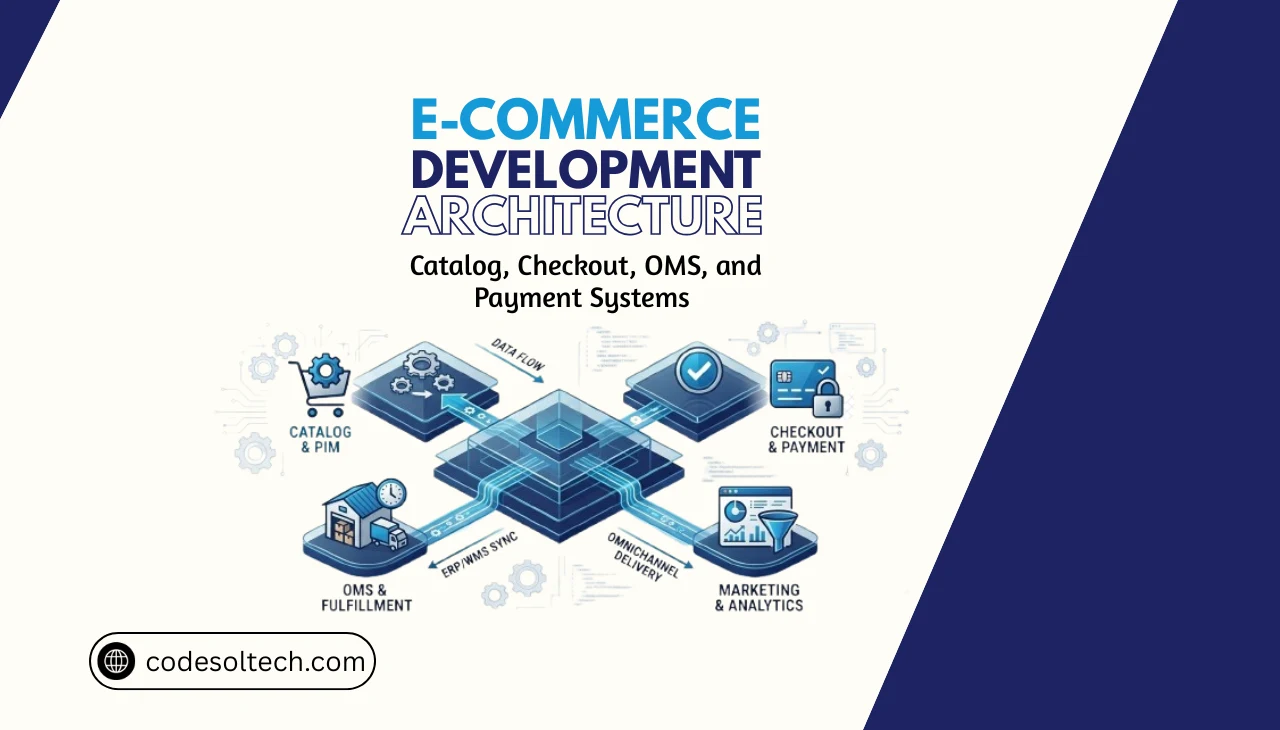
E-commerce development architecture is the structural framework that defines how an online store’s core systems, catalog, checkout, order management, and payment gateway communicate, scale, and execute transactions. It determines site performance, integration flexibility, and long-term technical sustainability.
A poorly designed architecture creates bottlenecks during peak traffic, blocks third-party integrations, and accumulates technical debt that costs 3–5× more to resolve post-launch than to correct in the design phase. Every architectural decision made during e-commerce development directly impacts conversion rates, page load speed, and system uptime.
Quick Summary:
- E-commerce architecture is the blueprint that connects the catalog, checkout, OMS, and payment gateway.
- 4 primary architecture models exist: monolithic, microservices, headless, and composable.
- Architecture choice directly affects Core Web Vitals, crawl budget, and conversion rates.
- MACH (Microservices, API-first, Cloud-native, Headless) is the enterprise standard in 2025.
What is E-commerce Development Architecture?
E-commerce development architecture is the organized system of layers, components, and data flows that power an online store. It encompasses the frontend presentation layer, backend business logic, database layer, and external service integrations, including payment gateways, ERP systems, and shipping APIs.
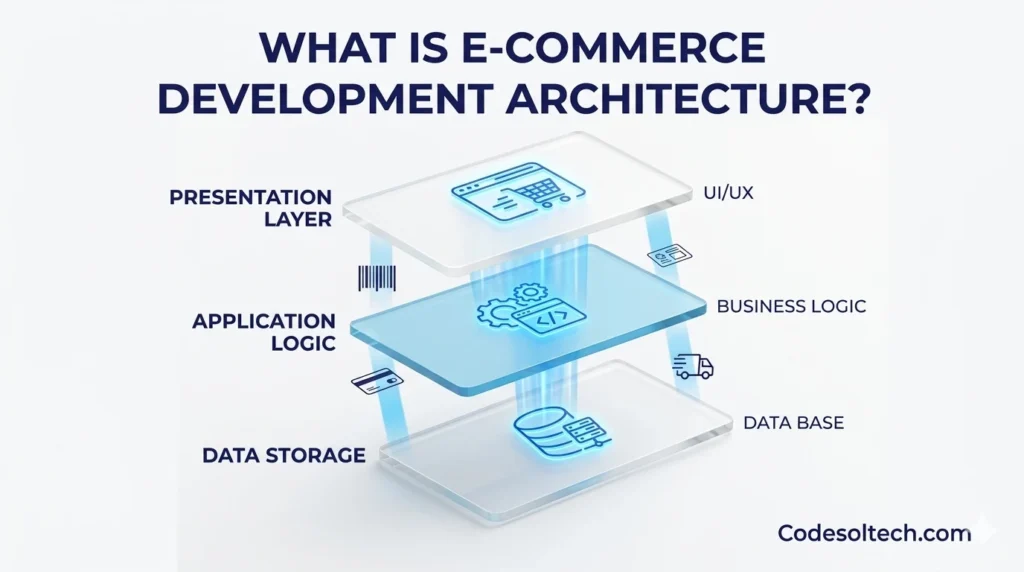
The architecture model defines how data travels from a product catalog request through checkout to a completed, fulfilled order. A three-tier architecture separates the system into 3 independent layers: presentation, application logic, and data storage. Each layer scales without modifying the others.
Architecture is not the same as platform selection. A platform such as Shopify or Magento imposes a default architecture, while a custom-built solution allows teams to design the architecture from the ground up. Understanding the architectural constraints of any platform is the first step in choosing the right e-commerce platform for scalability.
The 4 Core Systems Every E-commerce Architecture Contains
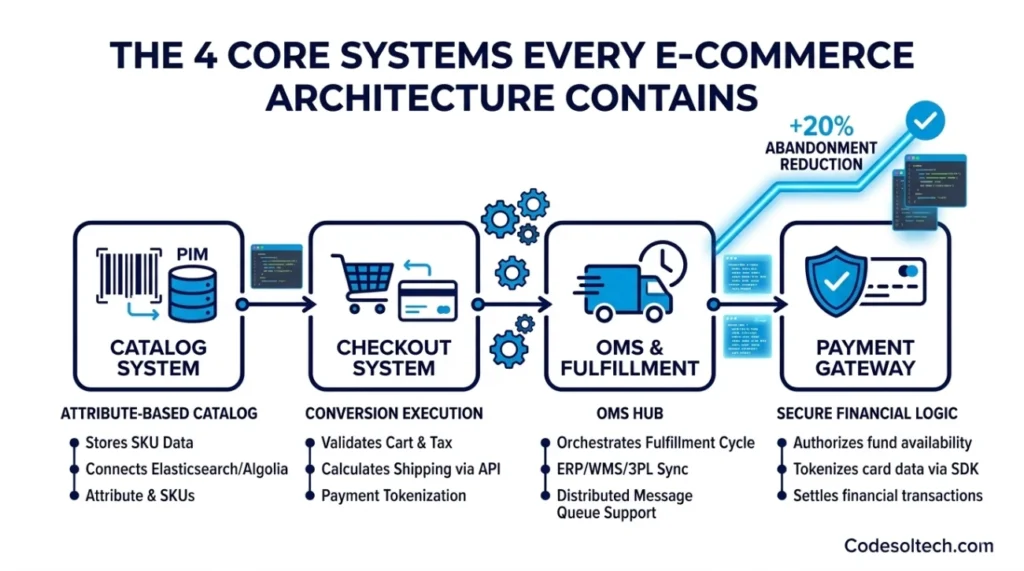
Every e-commerce architecture, regardless of model, contains 4 functional systems. These systems process every transaction on the store, from product discovery to post-purchase fulfillment.
1. Catalog System
The catalog system stores, organizes, and delivers product data to the frontend and downstream systems. It contains product attributes, SKU hierarchies, pricing rules, inventory levels, and category taxonomy. A well-structured catalog system is the performance backbone of every product discovery experience.
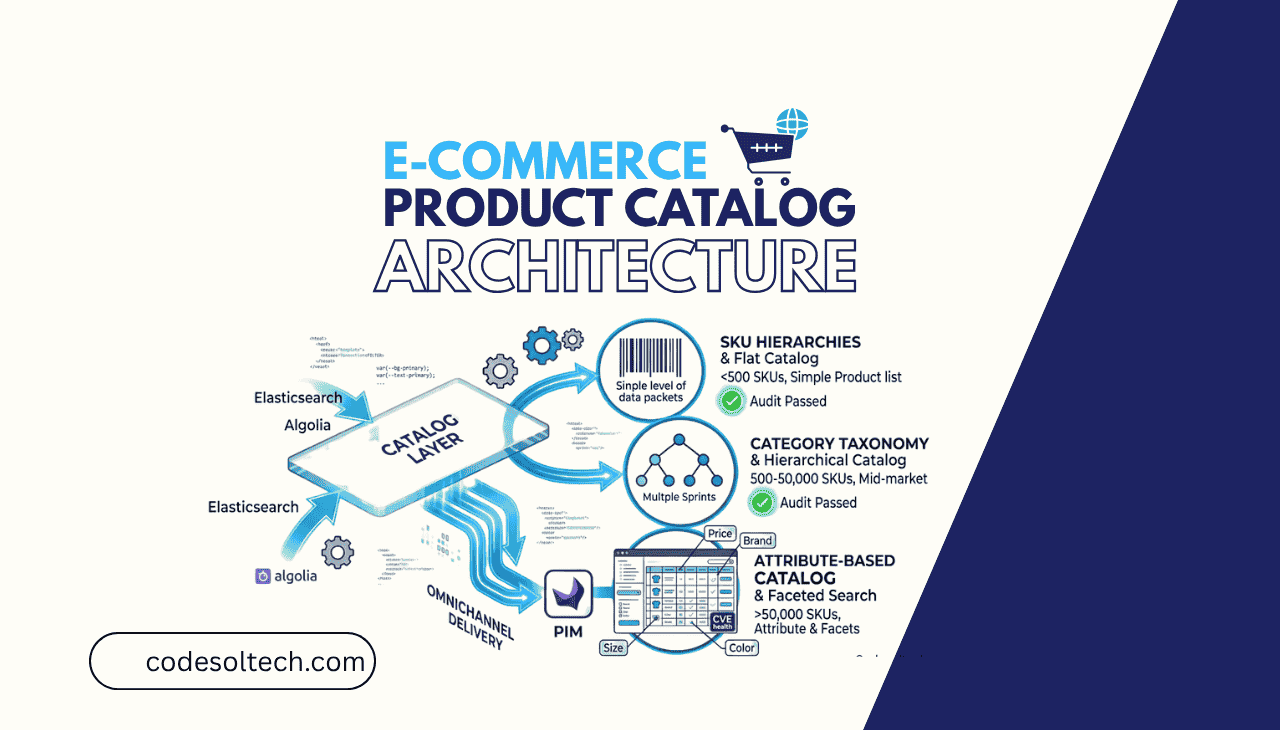
A scalable catalog system supports 3 data structures based on store complexity:
- Flat Catalog: A single-level product list, suitable for stores with fewer than 500 SKUs.
- Hierarchical Catalog: A category-tree structure used by mid-market retailers managing 500–50,000 SKUs.
- Attribute-Based Catalog: A filterable product grid with faceted search, required for stores exceeding 50,000 SKUs.
The catalog system connects directly to the search engine layer — typically Elasticsearch or Algolia — and feeds product data to the checkout system via an internal API. A PIM (Product Information Management) system, such as Akeneo or Pimcore, integrates with the catalog layer to centralize product data governance across multiple sales channels.
2. Checkout System
The checkout system executes the purchase transaction. It collects cart data, applies promotions and tax rules, validates inventory availability, calculates shipping rates, and transmits the completed order object to the OMS.
A checkout system performs 6 sequential operations per transaction:
- Cart validation (confirms item availability and pricing)
- Coupon and promotion resolution
- Tax calculation (via integrated tax engine, e.g., Avalara or TaxJar)
- Shipping rate retrieval (via carrier API, e.g., UPS, FedEx, or EasyPost)
- Payment tokenization (converts card data into a secure token)
- Order object creation and transmission to the OMS
Checkout performance is directly tied to conversion rates. A 1-second delay in checkout page load reduces conversions by 7%, according to Akamai research. A one-page checkout design with pre-filled address fields reduces average checkout abandonment by 20–35%.
3. Order Management System (OMS)
The Order Management System (OMS) is the operational hub that receives confirmed orders from the checkout system and orchestrates fulfillment. It manages order routing, warehouse allocation, split shipments, returns processing (RMA), and real-time order status communication to the customer.
An OMS integrates with 4 external systems to complete the fulfillment cycle:
- ERP (e.g., SAP S/4HANA, Oracle NetSuite) — for financial data synchronization and inventory accounting.
- WMS (Warehouse Management System) — for pick-pack-ship workflow execution.
- 3PL Providers (e.g., ShipBob, Flexport) — for outsourced logistics and last-mile delivery.
- Customer Portal / Storefront — for real-time order tracking and self-service returns.
Retailers processing over 10,000 daily orders require a distributed OMS with message queue support — such as Apache Kafka or RabbitMQ — to prevent fulfillment delays during high-volume events like flash sales and peak seasons. An OMS without event-driven architecture creates a single point of failure in the entire order fulfillment pipeline.
4. Payment Gateway
The payment gateway is the service layer that authorizes, processes, and settles financial transactions between the customer and the merchant. It encrypts payment credentials, communicates with card networks (Visa, Mastercard, American Express), and returns an approval or decline response to the checkout system within 2–3 seconds.
A payment gateway completes transactions through 3 sequential steps:
- Authorization: The card network verifies fund availability and fraud signals.
- Capture: The merchant requests the fund transfer after order confirmation or fulfillment.
- Settlement: Funds transfer to the merchant’s bank account on a T+1 or T+2 schedule.
Payment gateways integrate into ecommerce architecture via 3 methods:
- Hosted Payment Page: The customer completes payment on the gateway provider’s domain (e.g., PayPal Standard). Easiest to implement; lowest PCI scope for the merchant.
- Direct API Integration: Payment fields render on the merchant’s domain; all data routes through the merchant’s server. Requires PCI DSS SAQ D compliance.
- Embedded JavaScript SDK: An iFrame or JS widget (e.g., Stripe Elements, Braintree Drop-in UI) renders on the merchant’s page; card data never touches the merchant’s server. Reduces PCI scope to SAQ A.
PCI DSS Level 1 compliance is mandatory for any payment gateway processing over 6 million annual card transactions. The PCI Security Standards Council defines 6 compliance levels based on annual transaction volume. Enterprise stores using embedded SDKs from Stripe or Adyen reduce their PCI audit scope by 95% compared to direct API implementations.
4 E-commerce Architecture Models Compared
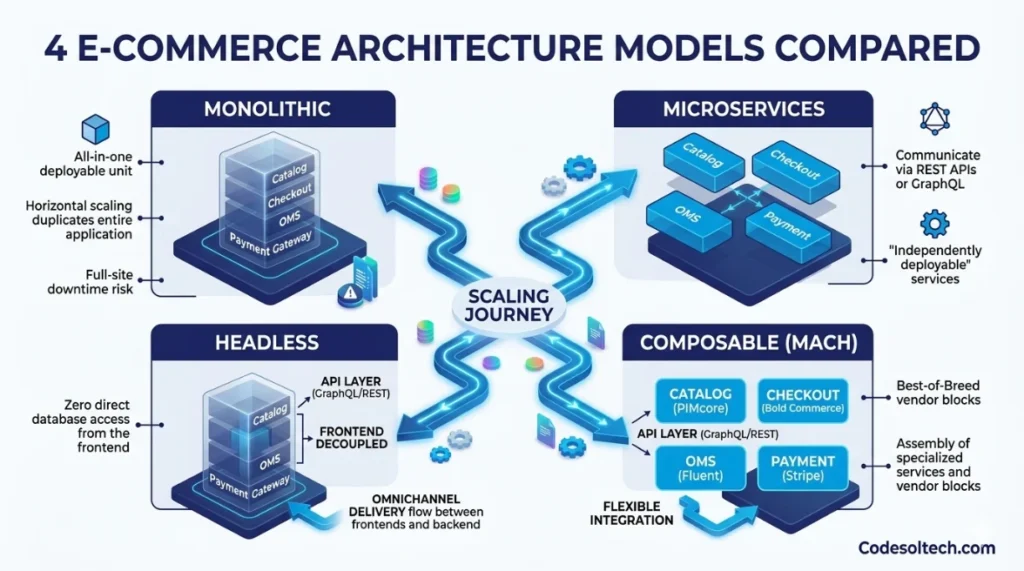
The 4 primary ecommerce architecture models differ in how tightly or loosely the frontend, backend business logic, and service layers couple to each other. The correct model depends on order volume, team size, integration complexity, and growth trajectory.
Monolithic Architecture
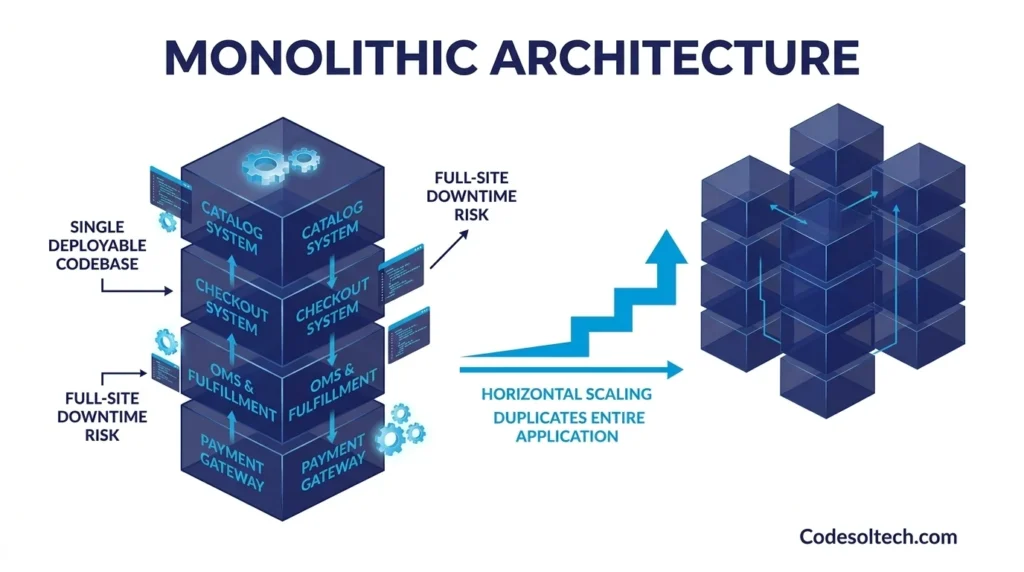
Monolithic architecture packages the frontend, backend application logic, and database into a single deployable codebase. All 4 core systems catalog, checkout, OMS, and payment gateway operate within one application.
- Best For: Stores with fewer than 1,000 daily transactions and single-channel operations.
- Deployment: Single codebase; lower initial infrastructure cost.
- Scaling Limitation: Horizontal scaling duplicates the entire application, not individual components, increasing cloud infrastructure cost by 200–400% at enterprise volumes.
- Risk: A single component failure (e.g., OMS timeout) causes full-site downtime.
Microservices Architecture
Microservices architecture decomposes ecommerce functionality into independently deployable services. The catalog system, checkout system, OMS, and payment gateway each run as separate services, communicating via REST APIs or GraphQL.
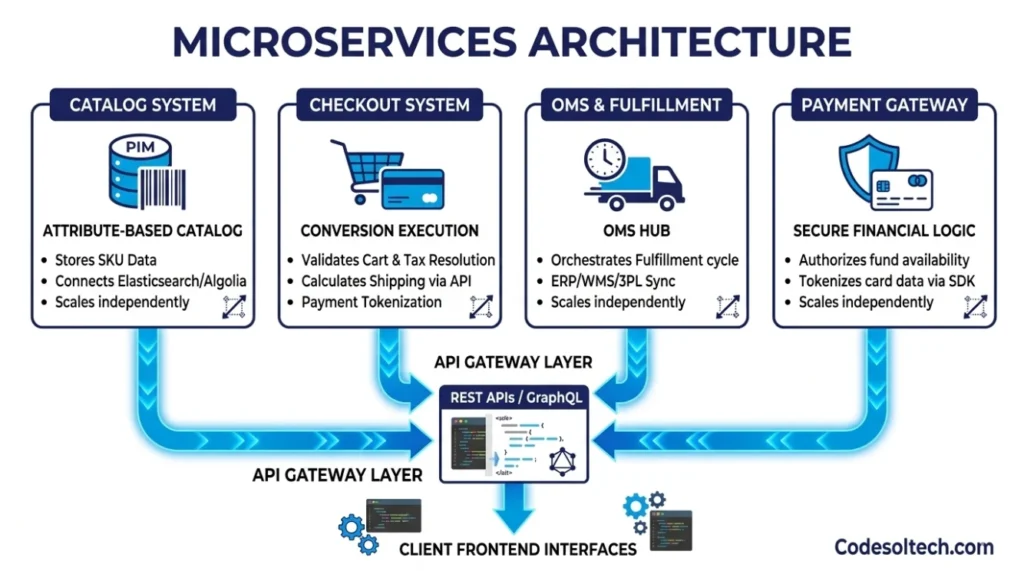
- Best For: Stores with over 10,000 daily orders, multiple sales channels, or complex integration requirements.
- Scaling: Each service scales independently based on demand. The checkout service scales during sales events without affecting the catalog.
- Resilience: A failure in the OMS service does not bring down the catalog or payment gateway.
- Operational Requirement: Requires container orchestration via Kubernetes or Docker Swarm and an API gateway layer (e.g., Kong or AWS API Gateway).
- Time-to-Market: Parallel team development reduces feature deployment cycles by 40% compared to monolithic codebases.
Headless Commerce Architecture
Headless commerce architecture decouples the frontend presentation layer from the backend commerce engine. The frontend — built in React, Next.js, or Vue.js — communicates with backend services exclusively via APIs, with zero direct database access from the frontend.
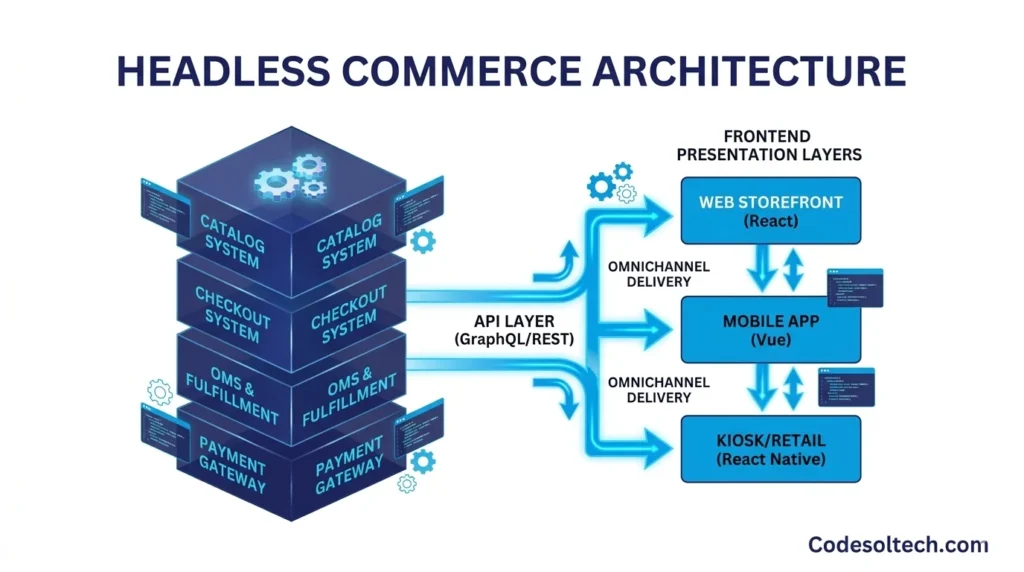
Headless architecture delivers 3 structural advantages:
- Omnichannel Delivery: One backend serves the web storefront, mobile app, kiosk, and voice commerce simultaneously via a shared API layer.
- Frontend Autonomy: Marketing and design teams deploy storefront changes without modifying backend business logic or requiring backend deployments.
- Performance: Next.js SSR (Server-Side Rendering) and SSG (Static Site Generation) reduce Time to First Byte (TTFB) to under 200ms, improving Google Core Web Vitals scores.
Composable Commerce Architecture (MACH)
Composable commerce architecture assembles best-of-breed components using the MACH principle: Microservices, API-first, Cloud-native, and Headless. Each business capability — catalog, checkout, OMS, payment — is sourced from specialized vendors and composed into a unified commerce platform.
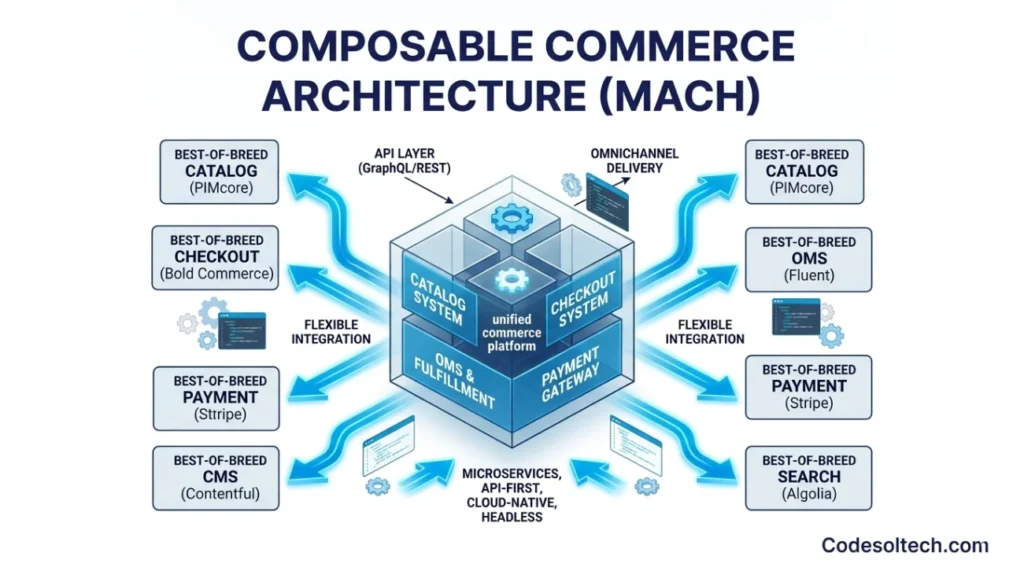
A typical MACH stack configuration:
- Catalog / PIM: Commercetools or Akeneo
- Checkout: Bold Commerce or Fabric
- OMS: Fluent Commerce or IBM Sterling
- Payment Gateway: Stripe or Adyen
- CMS + Frontend: Contentful + Next.js
- Search: Algolia or Elasticsearch
Composable architecture reduces system migration time by 60% compared to monolithic re-platforming, because individual components swap out without rebuilding the entire platform. The MACH Alliance certifies vendors operating under this standard.
What Architecture Model Is Right for Your E-commerce Store?
The correct architecture model depends on 4 variables: current order volume, expected growth trajectory, integration requirements, and internal development capability.
- Under 1,000 daily orders / Single channel: Monolithic architecture on a managed SaaS platform (Shopify, BigCommerce) reduces operational overhead and deployment complexity. Custom development is not required at this stage.
- 1,000–10,000 daily orders / Multi-channel: Headless architecture with a SaaS backend decouples the frontend for performance gains while keeping backend operational complexity manageable. This model supports 2–4 sales channels from one API layer.
- 10,000+ daily orders / Enterprise / B2B: Microservices or composable MACH architecture is required. Independent service scaling, dedicated OMS, and ERP integration are non-negotiable at this volume. An experienced ecommerce development team architects this layer to handle 10× traffic spikes without service degradation.
- Marketplace or Multi-Vendor: Composable architecture with a dedicated multi-vendor OMS (e.g., Mirakl) and separate seller catalog management layer is the correct model. A marketplace requires 6–8 core services operating independently.
How Does E-commerce Architecture Affect SEO and Core Web Vitals?
Ecommerce architecture directly determines the 4 Core Web Vitals metrics Google uses to assess Page Experience: Largest Contentful Paint (LCP), Interaction to Next Paint (INP), Cumulative Layout Shift (CLS), and Time to First Byte (TTFB).
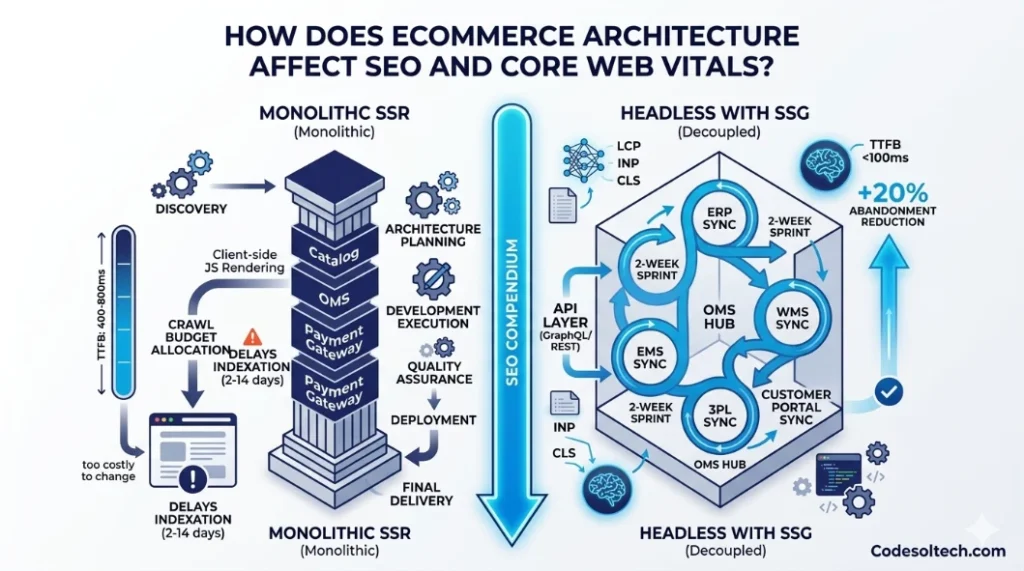
Architecture-to-performance benchmarks:
- Monolithic SSR architecture achieves TTFB of 400–800ms under standard load conditions.
- Headless architecture with SSG achieves TTFB under 100ms, improving Google Page Experience signals.
- Microservices with CDN-layer caching reduce LCP by 35–50% compared to server-rendered monolithic pages.
- API-first architectures enable granular CDN caching (Cloudflare, Fastly), reducing origin database queries per page load by up to 90%.
Google’s crawl budget allocation favors architectures delivering clean, pre-rendered HTML responses. Headless architectures built on Next.js with SSR send fully-rendered HTML to search engine crawlers, eliminating client-side JavaScript rendering dependency. This matters especially for large product catalog pages with thousands of SKUs that require frequent Googlebot indexation.
A monolithic architecture rendering product pages via client-side JavaScript delays Googlebot indexation by 2–14 days on average, compared to SSR pages that are indexed within 24–72 hours. Architecture is, therefore, a direct ecommerce SEO variable — not just a backend engineering concern.
Ecommerce Architecture Models: Side-by-Side Comparison
| Criteria | Monolithic | Microservices | Headless | Composable (MACH) |
|---|---|---|---|---|
| Deployment Unit | Single codebase | Independent services | Decoupled frontend + backend | Best-of-breed components |
| Scaling Model | Full-app duplication | Per-service scaling | Frontend + backend independently | Per-component scaling |
| Failure Isolation | None (full downtime risk) | Per-service containment | Frontend isolated from backend | Per-component containment |
| SEO / TTFB | 400–800ms | 150–400ms | <100ms (with SSG) | <100ms (with CDN) |
| Best Order Volume | <1,000/day | >10,000/day | 1,000–50,000/day | Enterprise / unlimited |
| Development Complexity | Low | High | Medium | High (multi-vendor) |
Final Words
Ecommerce development architecture determines how catalog, checkout, OMS, and payment systems connect and scale. Choosing the wrong model early creates compounding technical debt.
Monolithic suits low-volume stores. Microservices, headless, and composable architectures serve growing and enterprise operations. Align architecture with order volume, channel count, and integration depth before writing a single line of code.
Ready to Build an Ecommerce Architecture That Scales?
Our ecommerce architects design catalog, checkout, OMS, and payment systems that handle 10× traffic spikes without downtime. Get a free architecture review tailored to your business model.