A dynamic pricing system is software that automatically adjusts product prices in real time based on demand signals, competitor data, inventory levels, and predefined discount rules.
Unlike static pricing, where a merchant sets one price and leaves it, a dynamic pricing engine recalculates the optimal price on a per-SKU, per-session, or per-segment basis, often hundreds of times per day.
Amazon executes over 2.5 million price changes every 24 hours across its catalog. That pace is impossible without a pricing engine operating on algorithmic rules.
For mid-market and enterprise ecommerce stores, the same infrastructure is now accessible through platforms and APIs, and ignoring it means competing at a structural disadvantage.
This guide covers every layer of dynamic pricing: the engine architecture, the rule types, discount logic, implementation steps, and the tradeoffs you need to know before deploying one.
What Is Dynamic Pricing in E-commerce?
Dynamic pricing is a revenue management strategy that changes product prices automatically based on real-time market inputs rather than fixed schedules. The core inputs are demand elasticity, competitor pricing, inventory depth, time of day or season, and customer segment.
The pricing engine processes these inputs continuously and outputs the price a specific visitor or customer segment sees at a given moment.
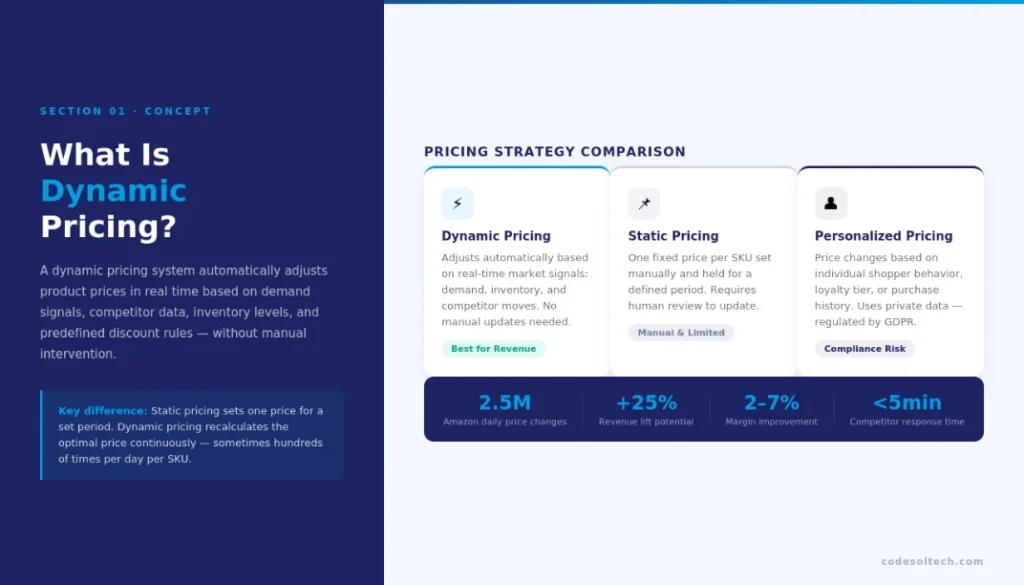
Dynamic pricing differs from two related concepts that merchants often confuse with it:
- Personalized pricing changes the price based on an individual shopper’s browsing history, purchase frequency, or loyalty tier. It uses private behavioral data and is regulated differently in jurisdictions like the EU.
- Promotional pricing applies a fixed discount for a set time window — a Black Friday sale, for example. The price is decided in advance by a human, not by an algorithm reading live signals.
Dynamic pricing sits between these two. It responds to market conditions rather than individual profiles, and it operates automatically rather than manually. The distinction matters for both compliance and customer trust.
Why E-commerce Is the Natural Habitat for Dynamic Pricing
Brick-and-mortar retail requires a physical price tag change for every SKU on every shelf. E-commerce stores change a database record, and every visitor instantly sees the updated price. That technical asymmetry makes dynamic pricing dramatically more feasible online.
A store with 50,000 SKUs cannot manually monitor competitor prices across 10 rival sites, but a pricing engine does it continuously through scraping, APIs, and third-party data feeds.
How a Pricing Engine Works
A pricing engine is the computational core of a dynamic pricing system. It ingests multiple data streams, applies a hierarchy of pricing rules, calculates an output price, and pushes that price to the storefront, catalog API, or cart in real time.
The engine operates as either a standalone microservice or as a module embedded inside the e-commerce platform (Magento, Shopify Plus, BigCommerce, or a headless commerce backend).
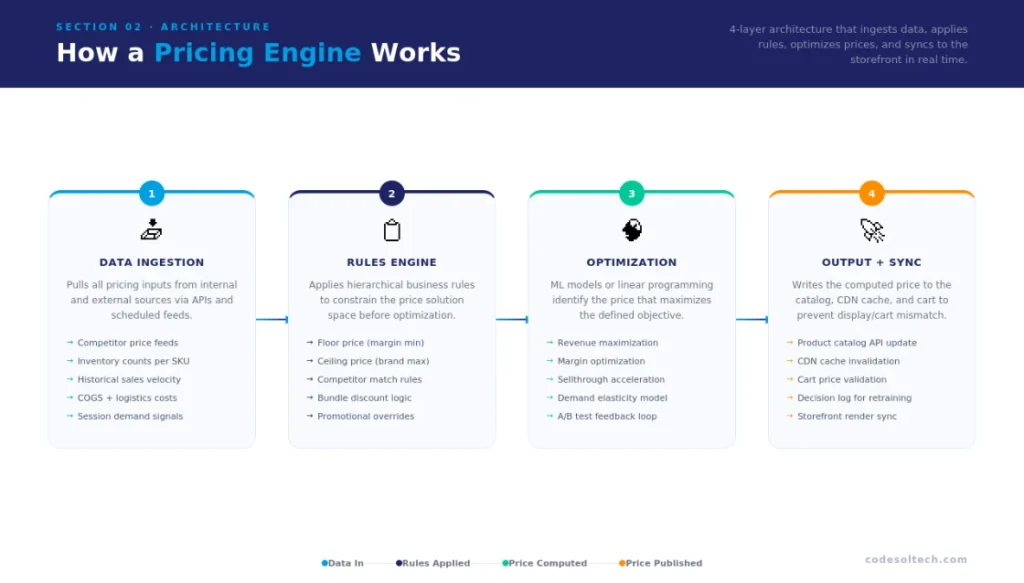
The architecture of a pricing engine includes 4 primary layers:
- Data ingestion layer — pulls competitor prices, inventory counts, demand signals, and cost data from internal and external sources via APIs or scheduled scrapes
- Rules engine layer — applies a sequential or hierarchical set of business rules: floor prices, ceiling prices, margin minimums, bundle discounts, and segment-specific overrides
- Optimization layer — uses machine learning models or mathematical optimization (linear programming, gradient descent) to identify the price that maximizes a defined objective: revenue, margin, or market share
- Output and sync layer — writes the computed price back to the product catalog, CDN cache, or personalization layer, ensuring the displayed price matches the cart price to prevent checkout abandonment
What Data Does a Pricing Engine Actually Need?
The quality of a pricing engine’s output depends entirely on the quality and freshness of its input data. A pricing engine that runs on stale competitor data or inaccurate inventory counts produces suboptimal prices. The 6 core data inputs are:
- Competitor prices (scraped or sourced via competitive intelligence APIs like Prisync or Wiser)
- Current inventory levels per SKU — low stock signals high demand and supports price increases
- Historical sales velocity and conversion rate by price point
- Cost of goods (COGS) and logistics costs — used to calculate margin floors
- Session-level demand signals: page views, add-to-cart events, wishlist additions
- Macroeconomic or seasonal signals: holiday calendars, weather APIs, event data
A pricing engine connected to your SKU management system gains a real-time view of inventory depth per variant.
When a size or color sells down to fewer than 20 units, the engine detects scarcity and can apply a price-increase rule automatically — no human intervention required.
5 Types of Dynamic Pricing Models
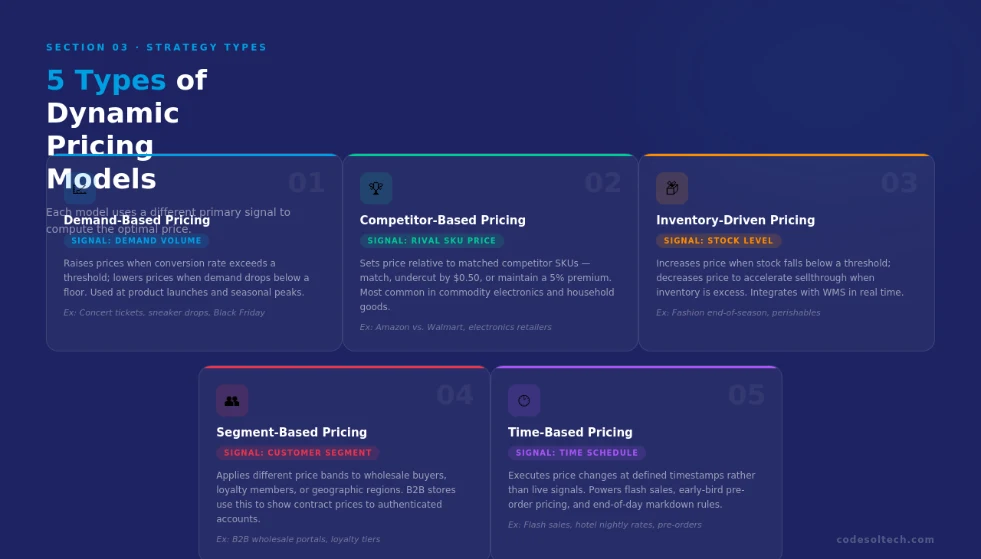
Dynamic pricing is not a single strategy. E-commerce businesses deploy one or more of 5 distinct models, each with a different primary input signal and a different business objective.
1. Demand-Based Pricing
Demand-based pricing raises prices when demand exceeds a threshold and lowers them when demand drops. Airlines pioneered this model. E-commerce stores apply it during product launches, flash sale windows, and seasonal peaks.
The pricing engine monitors conversion rate in real time: if the conversion rate on a product page drops below a defined floor, the engine interprets this as price resistance and adjusts downward.
2. Competitor-Based Pricing
Competitor-based pricing sets prices relative to identified rival SKUs. The engine scrapes or receives competitor prices for matched products and applies a rule: match the lowest price, undercut by a fixed amount (e.g., $0.50), or maintain a premium of 5% above the market average.
This model is most common in commodity categories, electronics, household goods, and consumables, where shoppers actively comparison-shop.
3. Inventory-Driven Pricing
Inventory-driven pricing links price to stock level. When inventory for a SKU falls below a defined threshold, the engine increases the price to slow demand and protect margin. When inventory is in excess, the engine decreases the price to accelerate sell-through and reduce holding costs.
This model integrates directly with warehouse management systems (WMS) and is especially relevant for perishable products, fashion with seasonal relevance, or high-storage-cost items.
4. Segment-Based Pricing
Segment-based pricing applies different prices to different customer segments, such as wholesale buyers, loyalty members, geographic regions, or acquisition channels. The pricing engine reads the session context (logged-in user tier, country code, referral source) and applies the appropriate price band.
B2B ecommerce stores use this model to display contract prices to authenticated wholesale accounts while showing retail prices to anonymous visitors.
5. Time-Based Pricing
Time-based pricing adjusts prices according to a schedule or countdown. Hotels and travel booking platforms use this as their primary model. In e-commerce, time-based rules govern flash sale periods, end-of-day markdowns, and early-bird pricing for pre-orders.
The engine executes price changes at scheduled timestamps rather than in response to live signals, making it the simplest form of dynamic pricing to implement.
Discount Rules and Pricing Logic in a Dynamic System
Every pricing engine executes its price changes through a structured rule set. A rule is a conditional statement: if [condition] then [price action]. Rules fire in a defined priority order, and a well-configured engine prevents conflicting rules from applying simultaneously.
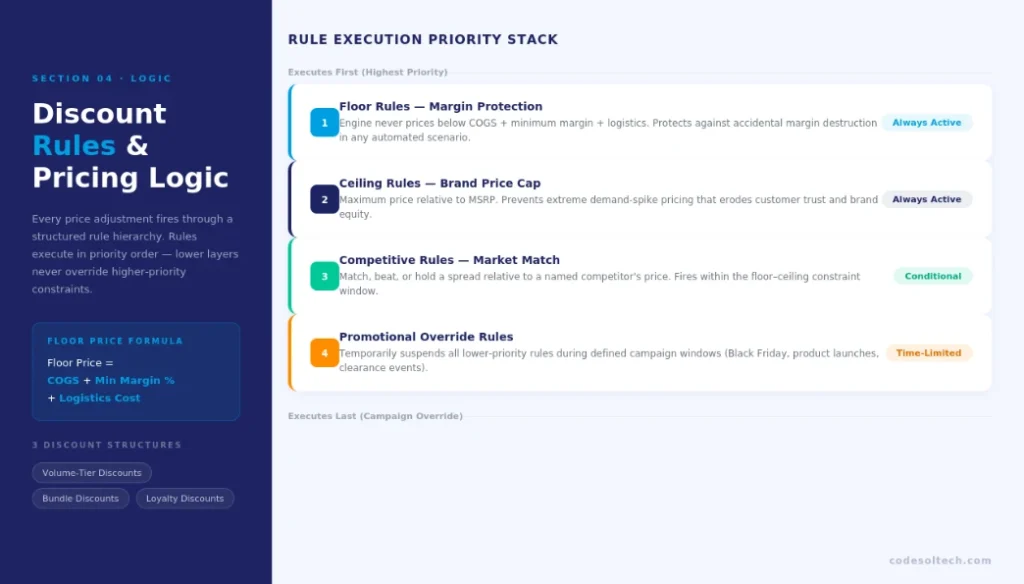
There are 4 categories of pricing rules that most e-commerce engines support:
- Floor rules — set a minimum price below which the engine never goes, protecting margin. The floor price is calculated as: COGS + minimum margin percentage + logistics cost.
- Ceiling rules — set a maximum price above which the engine never goes, protecting brand perception and preventing customer defection.
- Competitive rules — instruct the engine to match, beat, or maintain a spread relative to a named competitor’s price.
- Promotional override rules — temporarily override competitive or demand-based rules during manually defined campaign windows (Black Friday, Cyber Monday, product launches).
How Discount Logic Integrates With Dynamic Pricing
Discounts in a dynamic pricing system are not static percentage reductions applied site-wide. Instead, the engine calculates the effective discount as the difference between the reference price (MSRP or list price) and the computed dynamic price.
This means the displayed “discount percentage” on a product page changes dynamically as the base price changes.
3 discount structures work natively inside dynamic pricing engines:
- Volume-tier discounts — price decreases as quantity increases (buy 3, save 10%; buy 10, save 20%). The engine applies the tier based on the cart quantity in real time.
- Bundle discounts — the engine detects specific product combinations in the cart and applies a bundle price that is lower than the sum of individual dynamic prices.
- Loyalty discounts — authenticated loyalty members receive a price modifier (e.g., −8%) applied on top of the computed base price, without changing the competitive price the engine calculated for the general market.
Managing these discount structures accurately requires a clean, well-structured product catalog. Stores that use consistent SKU management practices can apply discount rules at the variant level, meaning a size-specific or color-specific inventory condition triggers a targeted discount, rather than a blanket markdown across an entire product.
How Dynamic Pricing Algorithms Process Data
A dynamic pricing algorithm is a mathematical model that takes multiple input variables and outputs a price recommendation. Modern pricing engines use one of 3 algorithmic approaches, or a combination:
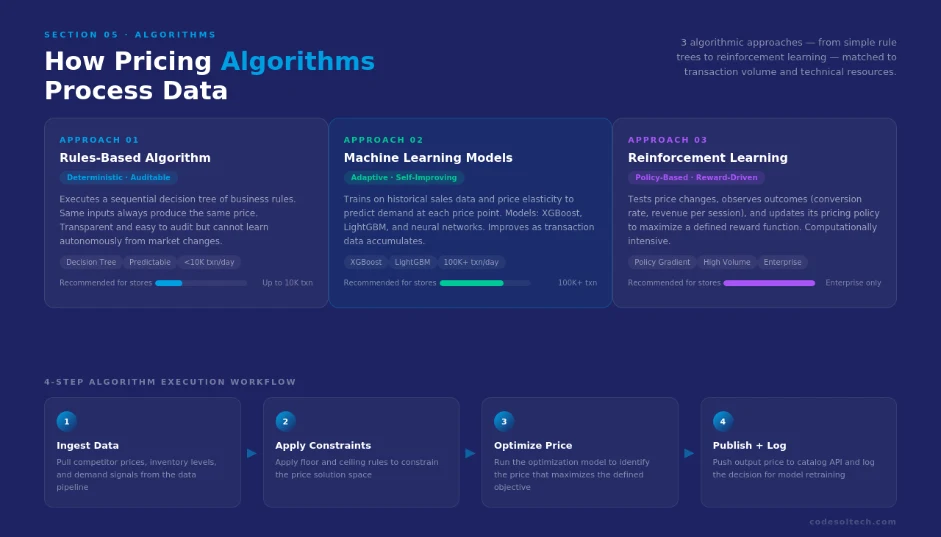
- Rules-based algorithms — execute a sequential decision tree of business rules. They are deterministic: the same inputs always produce the same price. They are transparent and easy to audit, but cannot autonomously learn from market changes.
- Machine learning models — train on historical sales data, price elasticity data, and competitor pricing to predict demand at each possible price point. Common model types include gradient boosting regressors (XGBoost, LightGBM) and neural networks. These models improve over time as more transaction data accumulates.
- Reinforcement learning systems — treat pricing as a sequential decision problem. The algorithm tests price changes, observes outcomes (conversion rate, revenue per session), and updates its policy to maximize a reward function. This approach is computationally intensive and requires high transaction volumes to converge.
The 4-step workflow that a dynamic pricing algorithm executes in production:
- Ingest current competitor prices, inventory levels, and demand signals from the data pipeline
- Apply the floor and ceiling rules to constrain the solution space
- Run the optimization model across the constrained price space to identify the price that maximizes the defined objective (revenue, margin, or sell-through rate)
- Push the output price to the catalog API and log the decision for model retraining
Retailers processing fewer than 10,000 daily transactions get reliable results from rules-based engines. Stores above 100,000 daily transactions benefit measurably from machine learning models, where the algorithm detects price-elasticity patterns across segments that human analysts cannot identify manually.
How to Implement Dynamic Pricing in Your E-commerce Store
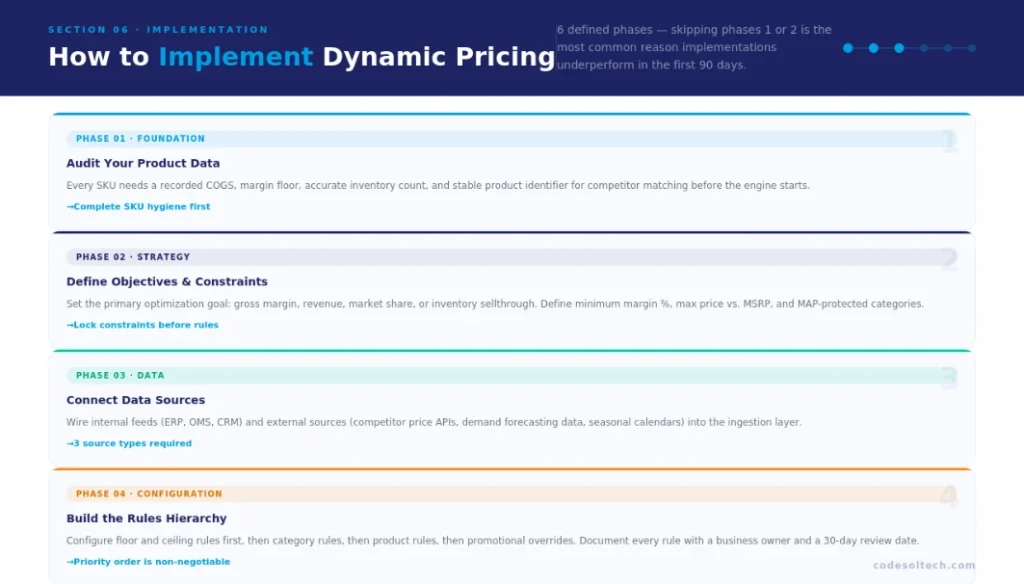
Implementing a dynamic pricing system involves 6 defined phases. Skipping phases, particularly the data audit and rule definition phases, is the most common reason dynamic pricing implementations underperform in the first 90 days.
Phase 1: Audit Your Product Data Foundation
The pricing engine cannot function accurately without clean, complete product data. Every SKU in the catalog must have a recorded COGS, a defined margin floor, accurate inventory counts, and a stable product identifier for competitor matching.
A SKU management system provides the structured data layer that pricing engines consume. Stores without SKU-level data hygiene should complete that step before deploying dynamic pricing software.
Phase 2: Define Business Objectives and Constraints
Decide the primary objective the pricing engine optimizes for: gross margin, revenue, market share, or inventory sell-through.
Define the non-negotiable constraints: minimum acceptable margin percentage, maximum price relative to MSRP, categories excluded from dynamic pricing (premium or MAP-protected products), and competitor matching rules per category.
Phase 3: Select Data Sources for the Engine
Connect the engine to 3 types of data sources:
- Internal data: ERP inventory feeds, order management system (OMS) sales history, customer segmentation data from the CRM
- External competitive data: competitor price feeds via scraping services or competitive intelligence APIs
- Market signals: demand forecasting data, Google Trends API, seasonal calendars
Phase 4: Configure the Rules Hierarchy
Build the rule stack in priority order. Floor and ceiling rules execute first. Category-level rules execute second. Product-level rules execute third. Promotional override rules execute last and temporarily suspend all other rules during campaign windows.
Document every rule with a business owner and a review date to prevent rule drift.
Phase 5: Run a Controlled A/B Test
Deploy dynamic pricing to 20–30% of traffic using a split-test configuration before a full rollout. Measure three metrics during the test period: conversion rate change, average order value change, and gross margin per order change.
A test period of 14–21 days produces statistically significant results for stores with more than 5,000 daily visitors.
Phase 6: Monitor, Retrain, and Iterate
Dynamic pricing is not a set-and-forget system. Pricing rules require review every 30–60 days as competitive conditions change. Machine learning models require retraining on fresh transaction data every 60–90 days to prevent model drift.
Assign a pricing analyst or revenue manager to own the engine’s ongoing configuration and performance monitoring.
Benefits and Risks of Dynamic Pricing
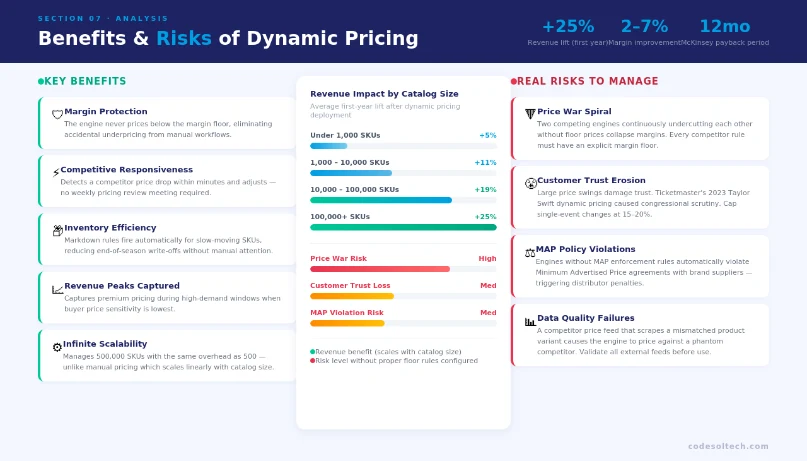
Dynamic pricing produces measurable revenue improvements for retailers who implement it with clean data and clear rules. A 2023 McKinsey study found that companies applying advanced pricing analytics improved their margins by 2–7% within 12 months.
A separate analysis of retail ecommerce deployments showed revenue lifts between 5% and 25% in the first year, depending on category competitiveness and catalog size.
Key Benefits
- Margin protection — the engine never prices below the margin floor, eliminating the accidental underpricing that happens in manual pricing workflows
- Competitive responsiveness — the engine detects a competitor price drop within minutes and adjusts accordingly, rather than waiting for a weekly pricing review meeting
- Inventory efficiency — markdown rules fire automatically for slow-moving SKUs, reducing end-of-season write-offs without requiring a merchandising team’s manual attention
- Revenue maximization during demand peaks — the engine captures premium pricing during high-demand windows (product launches, holidays) when buyers have lower price sensitivity
- Scalability — a rules-based pricing engine manages 500,000 SKUs with the same operational overhead as 500 SKUs, whereas manual pricing scales linearly with catalog size
Real Risks to Manage
- Price war spiral — competitor-matching rules configured without a floor price can trigger a race to the bottom when two retailers’ engines continuously undercut each other. Every competitor rule must include an explicit margin floor.
- Customer trust erosion — shoppers who notice frequent large price swings on the same product lose trust in the retailer. Ticketmaster’s 2023 dynamic pricing controversy for Taylor Swift concert tickets caused a measurable decline in consumer approval ratings and congressional scrutiny. Limit single-event price changes to a defined maximum percentage (typically 15–20%).
- MAP policy violations — brands selling through third-party marketplaces often have Minimum Advertised Price (MAP) agreements. A pricing engine without MAP enforcement rules will violate these agreements automatically and risk distributor penalties.
- Data quality failures — a competitor price feed that scrapes incorrectly (mismatched product, wrong variant) causes the engine to price against a phantom competitor. Validate data quality before making pricing decisions from external feeds.
Dynamic Pricing Tools and Platforms for E-commerce
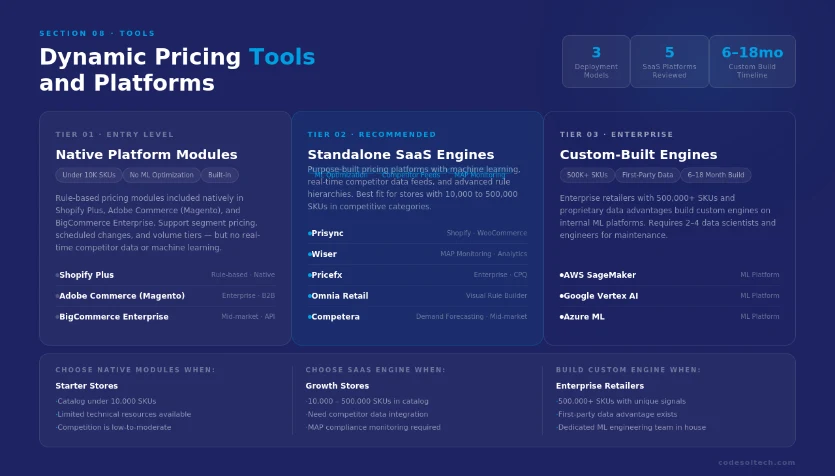
E-commerce businesses access dynamic pricing through 3 deployment models: native platform modules, standalone SaaS pricing engines, and custom-built engines. The right choice depends on catalog size, technical resources, and budget.
Native Platform Pricing Rules
Shopify Plus, Magento Commerce (Adobe Commerce), and BigCommerce Enterprise include rule-based pricing modules as native features. These tools support segment-based pricing, scheduled price changes, and volume tier discounts.
They do not include machine learning optimization or real-time competitor data integration — making them suitable for stores with fewer than 10,000 SKUs and limited competitor exposure.
Standalone SaaS Pricing Engines
Purpose-built pricing platforms offer machine learning optimization, competitor data feeds, and advanced rule hierarchies. 5 widely deployed platforms in the e-commerce space:
- Prisync — competitor price tracking and rule-based repricing, with Shopify and WooCommerce integrations
- Wiser — retail price intelligence with MAP monitoring and analytics dashboards
- Pricefx — enterprise-grade pricing suite with CPQ (configure, price, quote) and AI optimization layers
- Omnia Retail — demand-based and competitor-based pricing with a visual rule builder
- Competera — demand forecasting combined with competitor intelligence for mid-market retailers
Custom-Built Pricing Engines
Enterprise retailers with catalog sizes above 500,000 SKUs and proprietary data advantages often build custom pricing engines. A custom engine uses an internal ML platform (AWS SageMaker, Google Vertex AI, or Azure ML) trained on first-party transaction data.
The development timeline for a production-grade custom pricing engine ranges from 6 to 18 months, with an ongoing team of 2–4 data scientists and engineers for maintenance.
Final Words
A dynamic pricing engine is not a luxury for enterprise retailers only. Any e-commerce store competing in price-sensitive categories benefits from automating its pricing rules.
Start with clean product data, define your margin floors first, and run a controlled test before a full deployment. The technology is accessible. The results are measurable. The competitive cost of inaction compounds daily.
Ready to Build Your Ecommerce Pricing Infrastructure?
At Codesoltech, we design and develop custom e-commerce solutions from pricing engine integrations to full-stack store builds.
If your catalog is growing and manual pricing is slowing you down, let’s talk about what automation looks like for your business.