The right CRM development partner combines verified CRM-specific experience, integration capability across ERP and marketing systems, and transparent pricing.
Evaluate every candidate against a fixed set of criteria, run a paid discovery phase before signing, and confirm source-code ownership and data-security terms in the contract before development starts.
What Is a CRM Development Partner?
A CRM development partner is a company or individual that designs, builds, customizes, or integrates a Customer Relationship Management system for a business. This differs from a CRM vendor, which sells the underlying software license (Salesforce, HubSpot, Microsoft Dynamics 365).
A development partner configures, extends, or replaces that software to match a company’s specific workflows.
Businesses hire a CRM development partner when an off-the-shelf platform cannot support their sales process, when multiple systems require deep integration, or when the company needs full ownership of a proprietary CRM.
A competent partner provides technical architecture, integration engineering, data migration, security implementation, and post-launch support not just interface design.
Five partner types dominate the market. Each carries a different cost structure, capacity ceiling, and risk profile.
| Partner Type | Best For | Main Advantage | Potential Limitation |
|---|---|---|---|
| Freelance developer | Small, single-feature projects | Lower hourly cost | Limited capacity, single point of failure |
| CRM consultant | Strategy and platform selection | Strong requirements planning | Typically does not write production code |
| Software development agency | End-to-end custom builds | Full-stack team and QA process | Higher day rate than freelancers |
| Specialized CRM development company | Complex, integration-heavy CRM projects | Deep CRM-specific expertise | Narrower focus outside CRM scope |
| In-house development team | Long-term, evolving ownership | Maximum control and institutional knowledge | Higher fixed staffing cost |
Related: our team also builds custom software beyond CRM scope when a project requires a broader platform than CRM alone.
An off-the-shelf CRM works when your sales process maps cleanly to standard fields, stages, and workflows. Custom development becomes necessary when a business requires proprietary logic, deep integration across five or more internal systems, or a data model that standard platforms cannot represent without heavy workarounds.
Confirm this distinction before evaluating partners, since it changes which partner type is appropriate.
How Do You Choose the Right CRM Development Partner?
Score each candidate against 15 fixed criteria covering experience, technical depth, and process maturity. A partner that scores well on portfolio but poorly on security or post-launch support still represents high project risk.
Use this list during every vendor call. Treat any category the partner cannot answer directly as an open risk, not a detail to clarify later.
- Relevant CRM development experience (not general software experience)
- Industry experience in your specific vertical
- Technical expertise across backend, frontend, and database architecture
- Integration capability with ERP, accounting, and marketing systems
- Data migration experience from legacy CRM or spreadsheet-based systems
- UI/UX design capability for internal, non-consumer-facing tools
- Security expertise, including authentication and role-based access control
- Scalability experience with user counts similar to your growth projection
- A documented project management process (agile, waterfall, or hybrid)
- Clear communication practices and a named point of contact
- A defined testing and quality assurance procedure
- Post-launch support terms, response time, and escalation path
- A stated development methodology with milestone checkpoints
- Pricing transparency, with itemized rather than bundled quotes
- Verifiable client references and case studies with measurable outcomes
Integration capability deserves particular scrutiny. Confirm the partner has built connections to ERP systems, payment gateways, and marketing automation platforms before assuming they can replicate that work for your stack.
Technical due diligence goes further than asking which technologies a partner uses. The stronger question is whether the partner can explain why a specific architecture fits your CRM requirements data volume, user concurrency, and integration count all change that answer.
A partner who defaults to one standard stack regardless of project shape has not done that analysis.
Portfolio review follows the same logic. Do not judge a portfolio from screenshots alone. Look for evidence across five layers: architecture decisions, delivered functionality, integration depth, scalability under real usage, and a measurable business outcome tied to the project, not just “the client was happy.”
CRM Partner Evaluation Scorecard
A weighted scorecard converts subjective impressions into a comparable number. Assign each criterion a weight based on what matters most for your project, then score every proposal against the same categories side by side.
| Criteria | Weight | Partner A | Partner B | Partner C |
|---|---|---|---|---|
| CRM-specific experience | 15% | |||
| Technical expertise | 15% | |||
| Integration capability | 15% | |||
| Portfolio and references | 10% | |||
| Security approach | 10% | |||
| Communication quality | 10% | |||
| Development process maturity | 10% | |||
| Post-launch support terms | 10% | |||
| Pricing transparency | 5% |
A data-quality gap is one of the most underweighted risks in this comparison.
Validity’s 2025 State of CRM Data Management survey of 602 CRM users found that 76% of organizations report less than half of their CRM data is accurate and complete, and 37% link that data quality directly to lost revenue.
Ask every partner how their migration process addresses deduplication and validation, not only data transfer.
CRM Development Cost Factors
CRM development cost has no single industry-standard figure because scope, user count, and integration complexity vary by project. Use a cost formula instead of a fixed price expectation:
CRM Development Cost = Development + Design + Integrations + Data Migration + Testing + Deployment + Ongoing Support
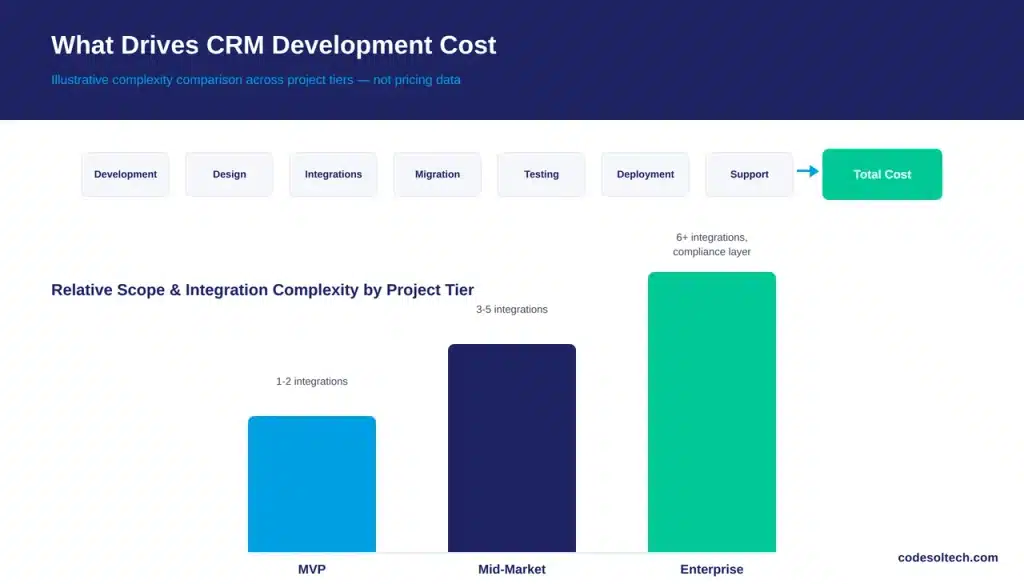
Three project tiers frame realistic budget conversations with a prospective partner.
- MVP tier: A single-department CRM with core contact management, pipeline tracking, and one or two integrations. Shortest timeline, lowest customization depth.
- Mid-market tier: Multi-department CRM with ERP and marketing automation integration, custom reporting, and role-based permissions. Moderate timeline and integration count.
- Enterprise tier: Multi-tenant or highly customized CRM with deep integration across ERP, accounting, support, and e-commerce systems, plus advanced security and compliance requirements. Longest timeline and highest integration complexity.
Integration complexity is the variable most partners underestimate in a quote. Explore how integration architecture affects both cost and long-term maintainability in our guide to CRM integration.
Quotes from different partners can vary substantially for the same project brief because each partner scopes discovery, testing, and support differently.
A proposal that looks cheaper on the total line may exclude data migration or post-launch support entirely. Compare scope line by line, not the bottom-line number alone.
What Red Flags Signal a Weak CRM Development Partner?
The clearest warning sign is a partner that skips architecture discussion entirely and jumps straight to a fixed price and timeline before any discovery phase. Discovery reveals scope; skipping it hides risk until mid-project.
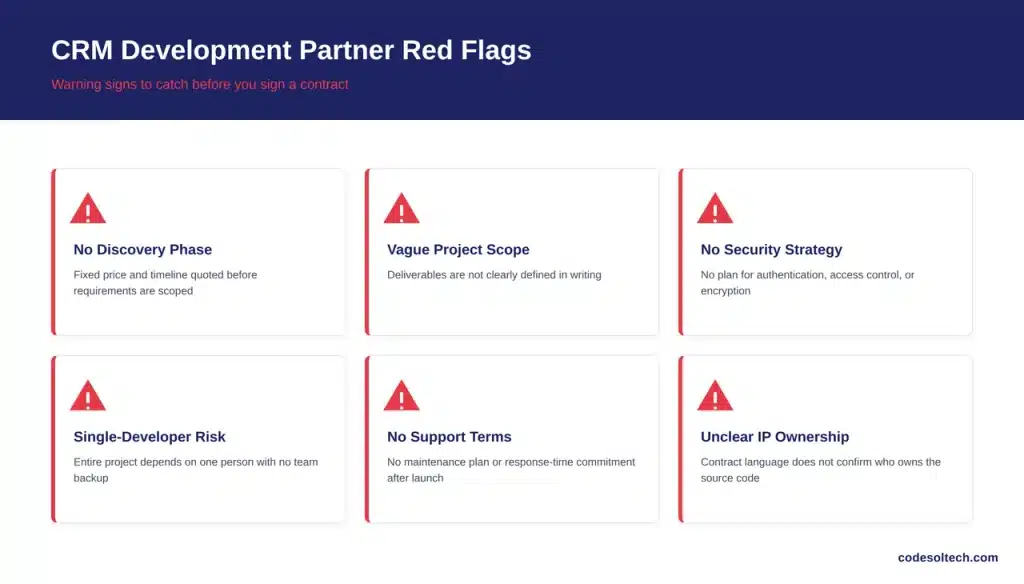
- Unrealistically low estimates with no scope breakdown
- Guaranteed timelines quoted before any discovery session
- No discussion of technical architecture or why it fits your requirements
- Vague project scope with undefined deliverables
- No CRM-relevant portfolio, only general software examples
- Slow or inconsistent communication during the sales process itself
- No stated testing or quality assurance procedure
- No security strategy for authentication, data access, or encryption
- No post-launch support plan or maintenance terms
- Unclear intellectual property ownership language
- Total dependence on a single named developer with no team backup
What to Verify Before Signing a CRM Development Contract
A CRM development contract needs specific, non-negotiable terms beyond price and timeline. Missing terms in these categories create disputes after launch, not during it.
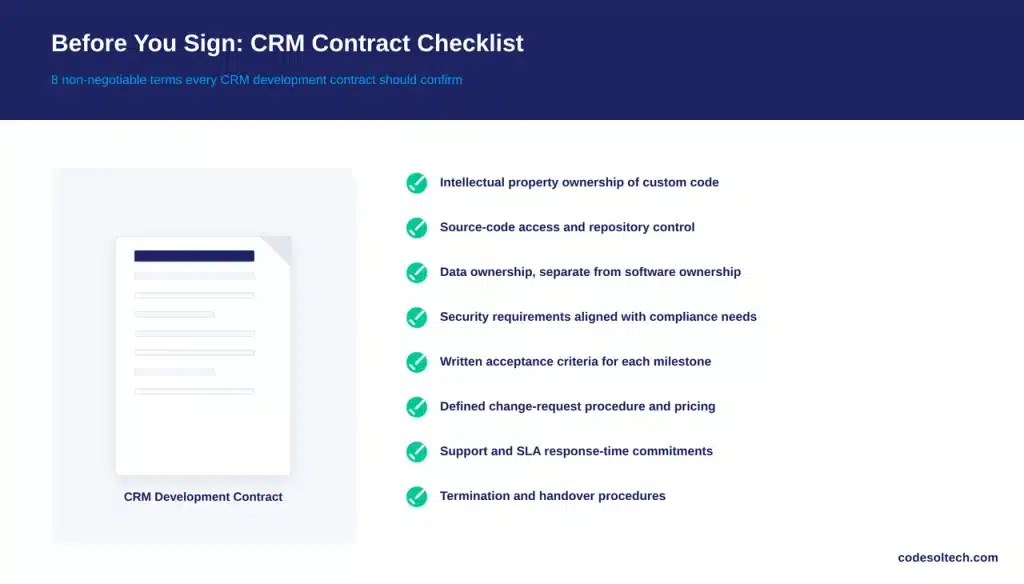
- Intellectual property ownership of custom code
- Source-code access and repository control
- Data ownership, separate from software ownership
- Security requirements aligned with your compliance obligations
- Written acceptance criteria for each milestone
- Defined change-request procedure and pricing
- Support and SLA terms, including response-time commitments
- Termination and handover procedures if the relationship ends
These terms connect directly to how the CRM will support your business after go-live. Review our breakdown of customer lifecycle management to understand what ongoing CRM capability your contract should protect.
FAQs
What does a CRM development partner do?
A CRM development partner designs, builds, integrates, and maintains a CRM system customized to a business’s workflows, distinct from selling CRM software licenses.
How do I choose a CRM development company?
Score candidates against 15 fixed criteria covering experience, technical depth, integration capability, security, and support, then compare proposals using a weighted scorecard.
How much does custom CRM development cost?
Cost depends on tier: MVP, mid-market, or enterprise, driven primarily by integration count, data migration complexity, and security requirements rather than a fixed industry price. Request an itemized quote broken down by development, integration, migration, and support instead of a single bundled figure.
Should I hire a CRM consultant or a CRM developer?
Hire a consultant for strategy and platform selection; hire a developer or development agency when custom code, integrations, or a proprietary CRM must be built.
Who owns the CRM source code after development?
Ownership depends entirely on the contract. Confirm intellectual property terms before signing; do not assume ownership transfers by default.
What is the difference between CRM implementation and CRM development?
Implementation configures and deploys an existing CRM platform. Development builds custom functionality, integrations, or an entirely custom CRM system. Some projects need both, starting with implementation and adding custom development as requirements grow.
Final Words
Choosing a CRM development partner is a due-diligence exercise, not a trust exercise. Score every candidate on the same criteria, request a paid discovery phase, and lock ownership and security terms into the contract before development starts.
That process protects the project more than any single vendor’s reputation.
Need a CRM development partner who leads with discovery, not a sales pitch?