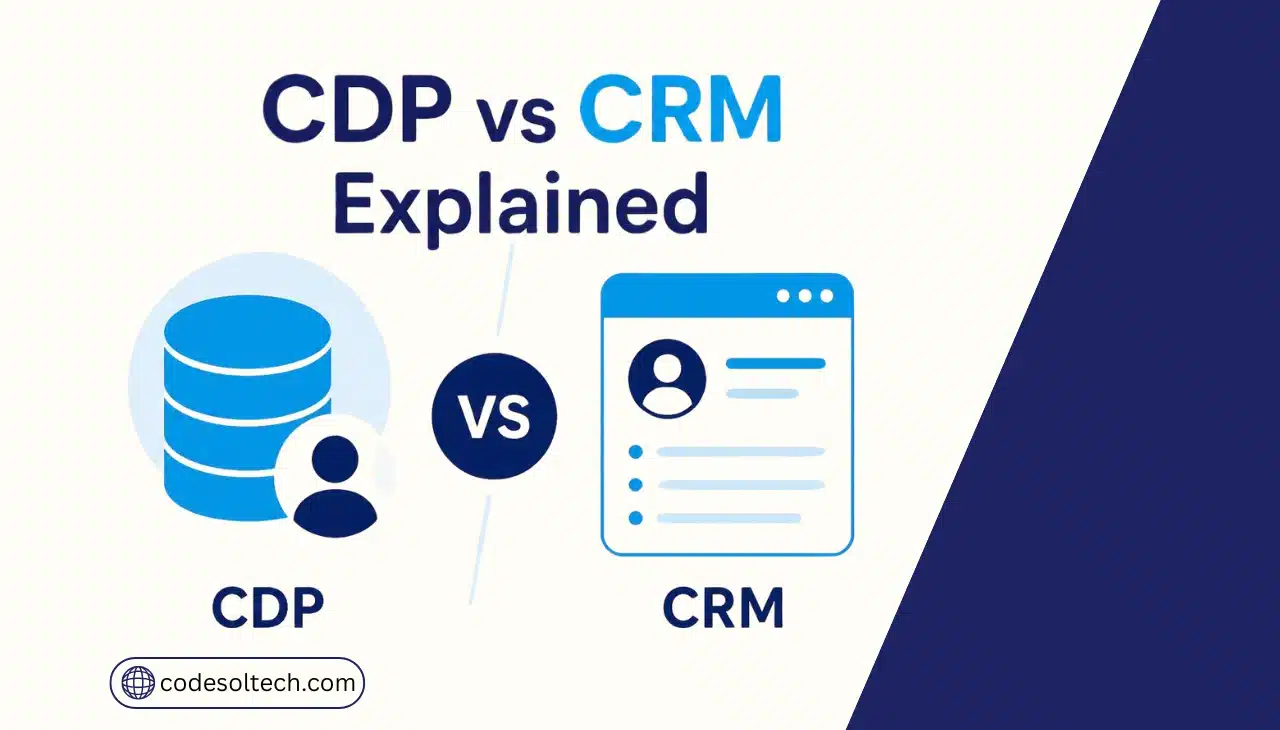
A CRM manages relationships with known customers your sales and support teams already talk to. A CDP unifies raw behavioral, transactional, and identity data from every touchpoint website, app, POS, ads into one real-time customer profile. A CRM is for interaction management. A CDP is for data unification.
What Is a CRM?
A Customer Relationship Management (CRM) system stores and organizes every interaction between a sales or support rep and a customer. A CRM logs call notes, email threads, deal stages, and support tickets against a single contact record. Sales teams use a CRM to track pipeline stages. Support teams use a CRM to manage ticket history and resolution time.
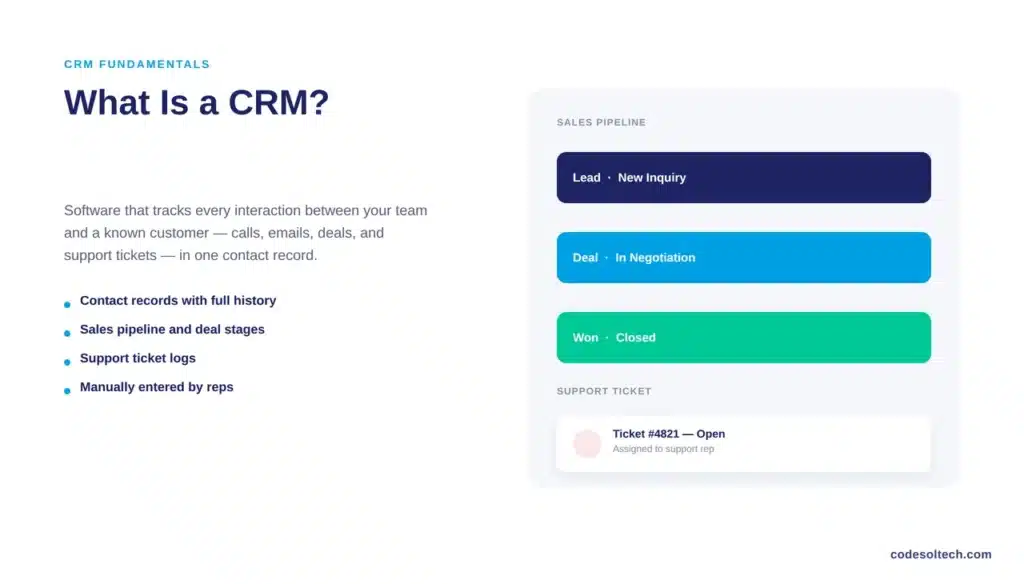
CRM data is entered manually by humans in most cases. A sales rep types call notes after a demo. A support agent logs a resolution summary after closing a ticket.
This makes CRM data structured, but narrow; it only captures what a human chooses to record, and only within sales and support workflows.
- Contact records: name, company, role, communication history
- Deal and opportunity stages across the sales pipeline
- Support ticket logs and resolution notes
- Email and call activity tied to a specific rep
What Is a CDP?
A Customer Data Platform (CDP) collects, cleans, and unifies customer data from every source a business operates: website events, mobile app events, point-of-sale systems, ad platforms, email engagement, and server-side events.
A CDP consolidates these fragmented data points into a single, identity-resolved customer profile, updated in real time.
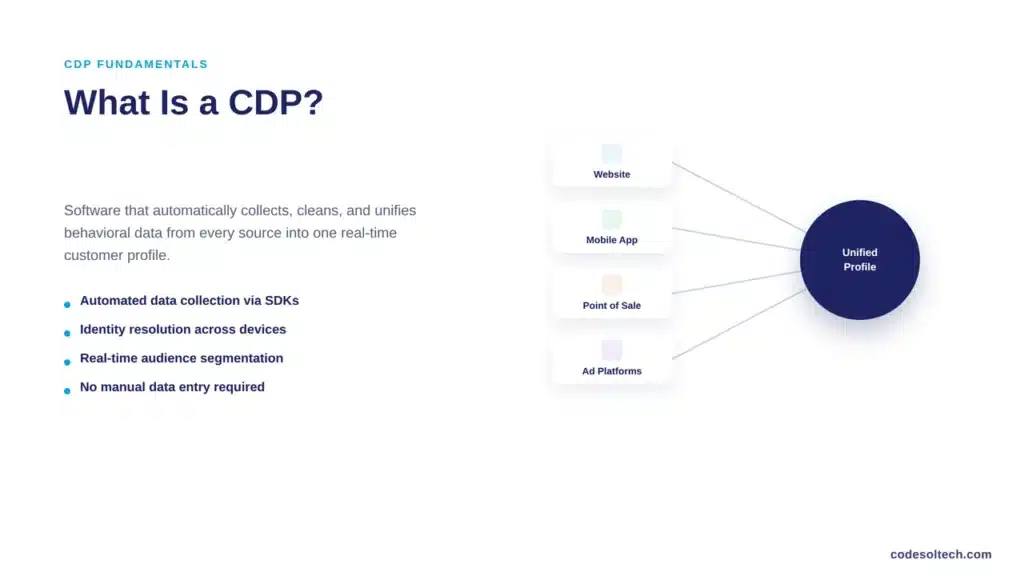
A CDP does not require manual entry. It automatically ingests data via SDKs, APIs, and tracking libraries as customers interact with a brand. This is the core structural difference from a CRM: CDP data is behavioral and automated, while CRM data is relational and manual.
- Website and app event tracking (page views, clicks, cart actions)
- Identity resolution across devices and anonymous sessions
- Real-time audience segmentation for marketing activation
- Data governance: deduplication, validation, and consent management
What’s the Difference Between a CDP and a CRM?
The difference comes down to scope and data source. A CRM manages relationships your team already has with named contacts. A CDP builds a profile of every visitor, anonymous or known, across your entire tech stack.
A CRM answers “what did we say to this customer?” A CDP answers “what did this customer actually do, everywhere?”
| Factor | CRM | CDP |
|---|---|---|
| Primary purpose | Manage sales and support relationships | Unify customer data across all touchpoints |
| Data entry method | Manual, entered by sales/support reps | Automated, collected via SDKs and APIs |
| Data scope | Known contacts only | Known and anonymous users across channels |
| Update frequency | As reps log activity | Real time, event-driven |
| Primary users | Sales and customer support teams | Marketing, data, and product teams |
| Core output | Deal pipeline and ticket history | Unified, identity-resolved customer profile |
| 2024–2025 market growth | 13.4% (Gartner, 2024) | 21.9% within cross-CRM segments (Gartner, 2024) |
Do You Need a CDP, a CRM, or Both?
Most businesses need both, deployed in sequence rather than as competing tools. A CDP feeds a CRM with behavioral context product views, cart abandonment, feature usage that a rep would never manually log.
A CRM feeds a CDP with relationship context, such as deal stage or support sentiment, that pure event tracking cannot capture on its own.
The global CDP market was valued at $8.26 billion in 2025 and is projected to reach $58.41 billion by 2033, growing at a 27.8% compound annual rate, according to Grand View Research. North America held the largest share of the CDP market at 37.6% in 2025.
This growth signals that businesses are not replacing CRMs with CDPs they are layering CDPs on top of existing CRM investments to close the data-unification gap CRMs were never built to solve.
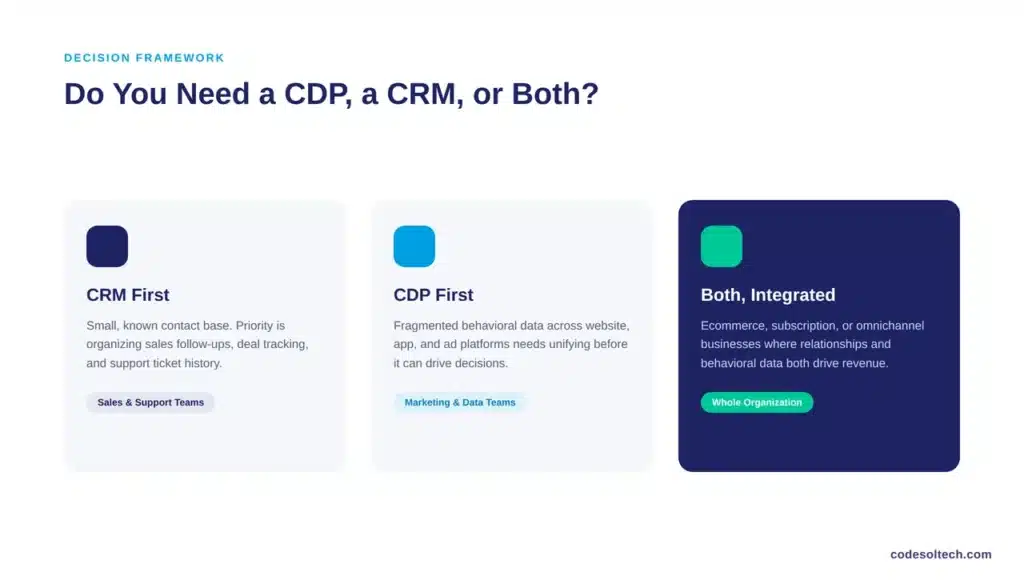
- Choose a CRM first if your priority is organizing sales follow-ups, deal tracking, or support ticket history for a small, known contact base.
- Choose a CDP first if your priority is unifying fragmented behavioral data across a website, app, and ad platforms before that data can drive marketing decisions.
- Deploy both together if your business runs ecommerce, subscription, or omnichannel operations where sales relationships and behavioral data both drive revenue.
How Does This Play Out for Ecommerce and SaaS Businesses?
An ecommerce business without a CDP cannot connect a shopper’s browsing behavior to their eventual support ticket. A CRM alone shows the ticket.
A CDP alone shows the browsing session. Integrated, the support agent sees both the exact product the customer viewed, abandoned, and later complained about in one profile.
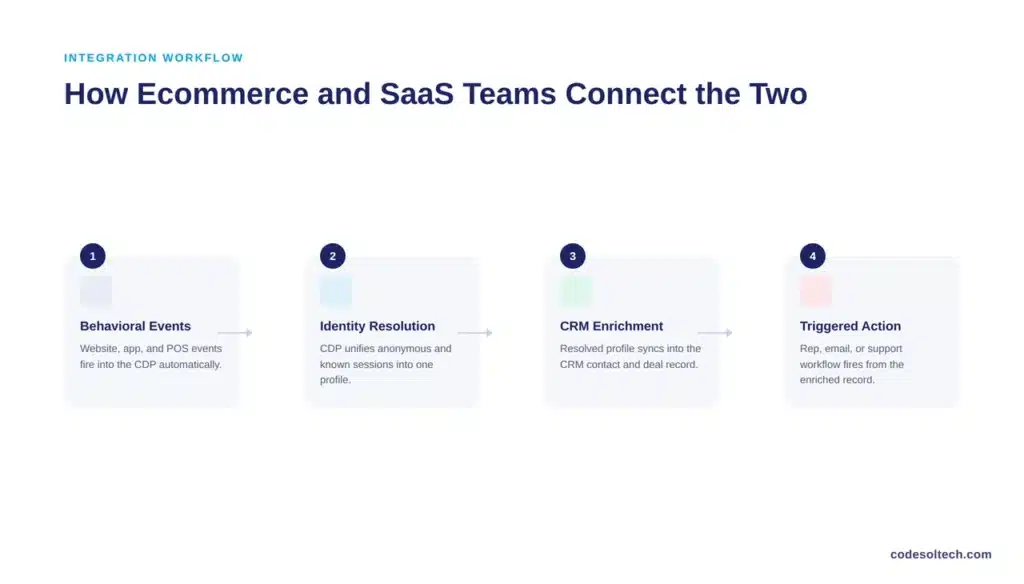
SaaS businesses face the same gap between product usage data and sales relationship data. A sales rep in a CRM sees a renewal date. A CDP shows whether that account’s feature usage is declining before the renewal conversation happens.
Custom CRM integration work that pipes CDP-resolved behavioral signals directly into deal records closes this gap without forcing reps to manually cross-reference two systems.
This is also where workflow automation and ERP integration become relevant: a unified customer profile is only useful if it triggers the right downstream action a re-engagement email, an inventory check, or a support escalation without manual handoff between teams.
Final Words
A CRM and a CDP solve different problems: relationship management versus data unification. Most growing businesses eventually need both, integrated rather than isolated. The decision isn’t which tool wins it’s which one you deploy first, and how well the two are connected once both are running.
Need a CDP and CRM integrated instead of running as disconnected systems? Talk to CodeSol Technologies about a custom integration built for your exact stack.
![CRM Knowledge Base Integration: [Types + 5-Step Setup]](https://www.codesoltech.com/wp-content/uploads/2026/09/CRM-Knowledge-Base-Integration-Definition-Types-and-Setup-Steps.webp)
![Fixing CRM Contact Deduplication [Causes & Fixes Guide]](https://www.codesoltech.com/wp-content/uploads/2026/09/Fixing-CRM-Contact-Deduplication-Causes-Fixes-Guide.webp)