
Most SMEs delay automation for 2 to 3 years past the point it becomes profitable. The delay comes from three factors: perceived cost, fear of disruption, and lack of a clear starting point. During this delay, teams lose an average of 60% of their work week to manual coordination tasks instead of revenue-generating work.
Small and mid-sized businesses treat automation as a future project instead of a current requirement. This mindset creates a measurable gap between automation-ready competitors and businesses still running processes manually. The gap widens every quarter the decision gets postponed.
The consequence is rarely visible on a profit-and-loss statement in the first year. It shows up instead in slower order fulfillment, delayed customer responses, and staff who spend more hours coordinating work than producing it.
By the time the cost becomes visible in revenue numbers, the SME has already lost 12 to 24 months of compounding inefficiency to a competitor running the same process automatically.
Why Do SMEs Delay Automation Even When It Saves Money?
SMEs delay automation because leadership underestimates the manual workload already absorbed by staff. Owners see automation as a cost center rather than a labor-recovery tool. This misjudgment postpones a decision that typically pays for itself within months, not years.

Four specific factors drive the delay:
- Underestimated manual cost: Owners track software cost but rarely track the labor hours a manual process consumes.
- Fear of workflow disruption: Teams avoid changing a process that “already works,” even when it works inefficiently.
- Unclear starting point: Businesses with 5 or more disconnected tools do not know which process to automate first.
- Budget misallocation: Owners classify automation as a Q4 or “next year” line item instead of an operating expense.
The unclear starting point deserves specific attention. Most SMEs run between 5 and 12 disconnected tools across sales, support, and fulfillment by the time they reach 15 employees.
Without a single system mapping how data moves between these tools, leadership cannot identify which process creates the most manual drag. This is why an automation audit, not a software purchase, is the correct first step for most SMEs.
Research from McKinsey confirms this pattern at scale. In its Superagency in the Workplace report, McKinsey found that 92% of companies plan to increase their AI and automation investment over the next three years, yet only 1% report having reached full automation maturity.
The report identifies the primary barrier as leadership hesitation, not employee readiness or technical limitation a finding McKinsey documents directly on its Superagency in the Workplace report page.
How Much Time Does Manual Work Actually Cost a Small Team?
Manual, disconnected workflows cost the average knowledge worker 60% of their working week. Asana’s Anatomy of Work Index, based on a global survey of more than 10,000 knowledge workers, found that employees spend only 25% of their time on skilled work and 13% on strategic planning.

The remaining time goes to what Asana classifies as “work about work”: chasing status updates, re-entering data across disconnected tools, and attending redundant status meetings, as detailed in Asana’s own Anatomy of Work research.
For a 10-person SME team, this translates directly into payroll waste:
- 6 out of 10 working hours go to coordination tasks, not output.
- A $60,000-salary employee effectively delivers $24,000 worth of skilled output annually.
- The remaining $36,000 in payroll funds manual data entry, status chasing, and tool switching.
Automation removes the coordination layer by connecting tools directly, which is the same function a workflow automation system performs when it replaces manual handoffs between departments.
What Does the Cost of Delay Look Like Year Over Year?
The financial gap between manual and automated operations compounds every year a business delays the decision. The table below models a 10-person SME team performing order processing, customer data entry, and support ticket routing manually versus through an automated stack.
| Metric | Manual Process | Automated Process |
|---|---|---|
| Hours spent on coordination tasks per week | 24 hours per employee | 8 hours per employee |
| Order or ticket processing time | 12 to 24 hours | Under 1 hour |
| Data entry error rate | Elevated due to manual re-entry across tools | Reduced through direct system integration |
| Annual payroll spent on non-skilled work (10-person team) | Approximately $360,000 | Approximately $144,000 |
| Market growth trend | Falling behind automated competitors | Aligned with a market projected to grow at a 29.0% CAGR through 2033 |
Grand View Research values the global robotic process automation market at $4.68 billion in 2025, projecting growth to $35.84 billion by 2033 at a 29.0% compound annual growth rate.
Large enterprises currently hold more than 64% of this market share, according to the same Grand View Research market report, which confirms that SMEs remain structurally underrepresented in automation adoption relative to their share of the overall business population.
What Do Automation-Ready SMEs Do Differently?
Automation-ready SMEs treat process mapping as the first step, not software selection. They identify the specific manual task consuming the most labor hours before evaluating any tool.
This sequence prevents the common mistake of buying automation software that does not match the actual workflow bottleneck.

SME automation maturity develops across 3 distinct stages:
- Stage 1 — Manual and reactive: Every process runs through spreadsheets, email, and manual data entry. Staff discover problems after they affect a customer.
- Stage 2 — Partially automated: One or two functions, typically email marketing or invoicing, run on automated tools. Core operations like order processing and CRM data still require manual handling.
- Stage 3 — Integrated automation: CRM, ERP, payment, and fulfillment systems exchange data automatically. Staff manage exceptions instead of routine transactions.
Most SMEs stall at Stage 2 for 2 to 4 years because they automate individual tools without connecting them. A marketing automation platform that does not sync with the CRM still requires manual data transfer, which reintroduces the same labor cost the business tried to eliminate.
Reaching Stage 3 requires CRM integration and ERP integration to work together as one connected system rather than as separate automated islands.
Industry context changes which process to automate first, but the underlying pattern stays consistent. Ecommerce businesses lose the most time to manual order and inventory reconciliation.
Service-based SMEs, including healthcare providers, lose the most time to manual scheduling and follow-up communication.
B2B companies lose the most time to manual quote generation and approval routing. In every case, the fix is the same: replace a repetitive, rule-based manual step with a connected automated one.
What Are the Warning Signs an SME Has Already Waited Too Long?
An SME has already waited too long to automate once specific operational symptoms appear. These symptoms compound quietly before they become visible in revenue reports.

- Staff manually re-enter the same customer or order data into 3 or more separate systems.
- Support tickets or orders sit unprocessed for more than 24 hours due to manual routing.
- Managers spend more time compiling status reports than reviewing strategic decisions.
- New hires take longer than 30 days to learn undocumented manual workarounds.
- Sales and fulfillment teams work from spreadsheets that are not synced in real time.
Each symptom points to a specific automation gap. Disconnected customer data signals a missing CRM integration. Delayed order routing signals the absence of a fulfillment automation layer. Repetitive support queries signal a missing chatbot integration.
These symptoms rarely appear in isolation. A business missing CRM integration typically also lacks fulfillment automation, because both gaps stem from the same root cause: systems that were purchased separately and never connected.
Leadership teams that treat each symptom as an isolated problem end up buying 3 or 4 point solutions that still require manual data transfer between them.
This approach adds software cost without removing the underlying labor cost, which explains why some SMEs report no measurable improvement after a partial automation rollout.
How Does an SME Start Automating Without Disrupting Operations?
An SME starts automating by isolating one high-volume process and running it in parallel with the existing manual method for 2 to 4 weeks before fully switching over.
This parallel-run approach prevents the disruption risk that keeps most SMEs from starting at all. It also gives staff a direct comparison between manual and automated output, which builds internal buy-in faster than a top-down mandate.

The implementation sequence that produces the fewest disruptions follows 4 steps:
- Audit current tools: Document every system that touches customer, order, or payment data, including spreadsheets.
- Select the highest-friction process: Prioritize the task with the highest weekly frequency and the most manual data re-entry.
- Automate in parallel: Run the automated workflow alongside the manual one until the outputs match for 2 consecutive weeks.
- Retire the manual process: Remove manual steps only after the automated workflow handles exceptions correctly, not just standard cases.
Businesses that skip the parallel-run step account for most reported automation failures, because they switch systems before staff trust the new workflow.
A properly scoped workflow automation rollout treats the parallel period as mandatory, not optional, specifically to prevent this failure pattern.
When Should an SME Automate a Process?
An SME should automate a process the moment it becomes repetitive, rule-based, and performed more than 10 times per week.
Waiting for “the right time” after that threshold only adds to the cumulative labor cost calculated in the table above. Automation candidates typically fall into 4 categories:
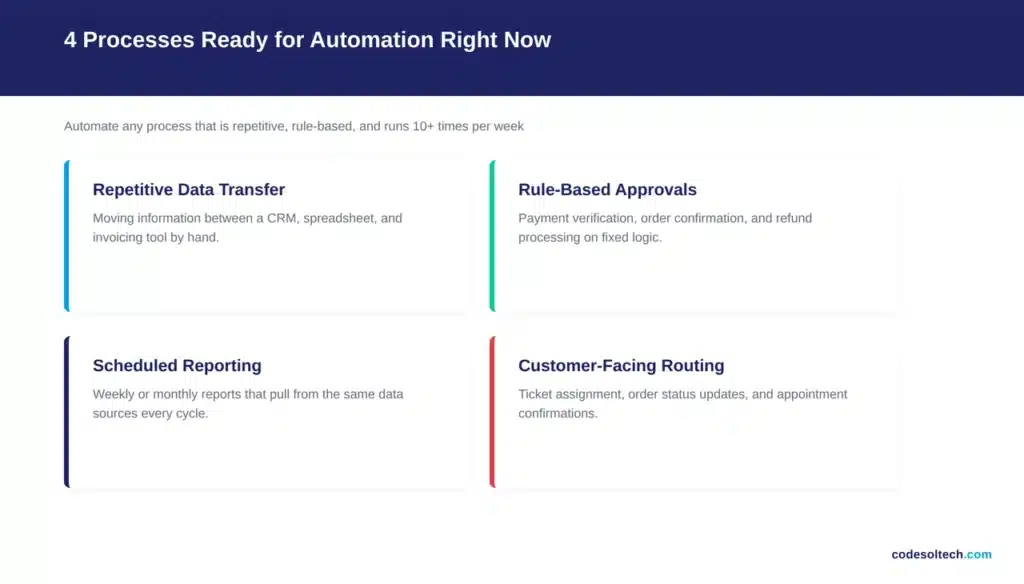
- Repetitive data transfer: Moving information between a CRM, spreadsheet, and invoicing tool manually.
- Rule-based approvals: Payment verification, order confirmation, and refund processing that follow fixed logic.
- Scheduled reporting: Weekly or monthly reports that pull from the same data sources every cycle.
- Customer-facing routing: Ticket assignment, order status updates, and appointment confirmations.
Processes that involve payment logic require a properly configured payment gateway integration before automation, since payment errors carry direct financial and compliance risk.
Businesses running multiple back-end systems typically need ERP integration to unify inventory, finance, and order data before automating downstream workflows.
Businesses without an existing platform to automate around should start with custom software development scoped to their specific process, rather than forcing a generic tool onto a workflow it was not built for.
Off-the-shelf automation tools work for standardized processes like email sequences and basic invoicing. They fail for processes specific to a business’s supply chain, pricing rules, or compliance requirements, because generic tools cannot account for exceptions unique to that operation.
SMEs that force a rigid, generic tool onto a non-standard process typically abandon it within 6 months and revert to manual work, which resets the automation timeline back to zero and adds the wasted software cost on top of the original labor cost.
Final Words
Automation delay is not a neutral decision. Every quarter an SME postpones it, manual work absorbs payroll that should fund growth.
The data is consistent across McKinsey, Asana, and Grand View Research: automated competitors move faster and spend less doing it. The right time to automate was the last time a manual process took more than an hour.
Ready to stop paying for manual work?
Codesoltech builds custom automation systems for SMEs, from CRM and ERP integration to fulfillment and payment workflows.