A medical spa CRM tracks every client’s treatment history, communication preferences, and rebooking timeline, then triggers automated follow-up so clients return on schedule instead of drifting away after one visit.
It replaces manual front-desk memory with a system that flags lapsed clients, sends treatment-specific reminders, and manages loyalty and membership programs.
Medical spas that install this layer convert single-visit clients into a recurring revenue base, which matters because the industry already runs on repeat business.
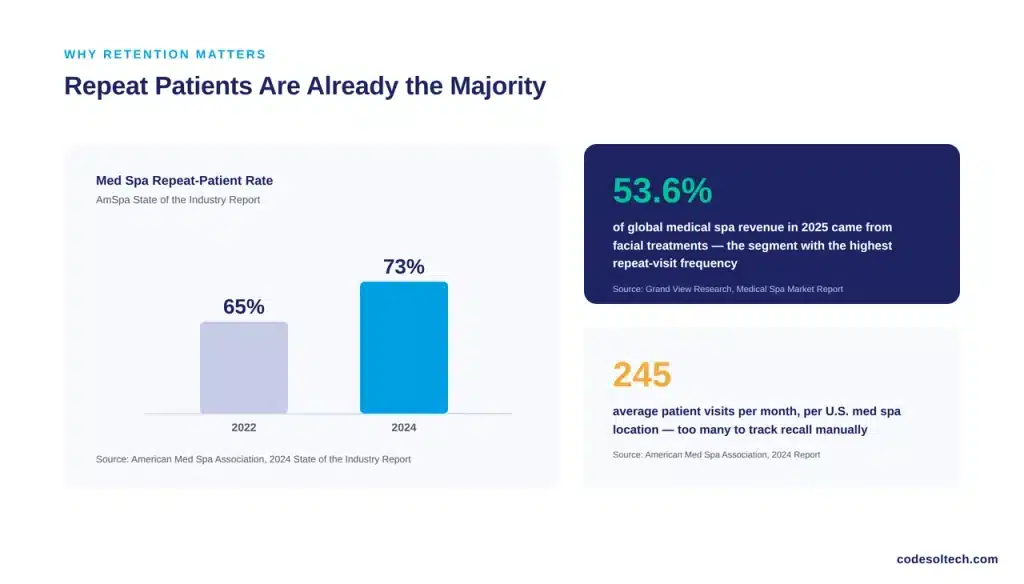
73% of medical spa patients were repeat patients in 2024, up from 65% in 2022, according to the American Med Spa Association’s 2024 State of the Industry Report.
What Is a Medical Spa CRM?
A medical spa CRM is software that centralizes client records, treatment history, communication logs, and rebooking triggers into one system used by front-desk staff, injectors, and marketing teams. It is not the same as scheduling software. A booking calendar reserves a time slot.
A CRM tracks the relationship around that slot: when the client is due for a touch-up, which promotions they responded to, and whether their last visit ended in a rebook or a no-show.
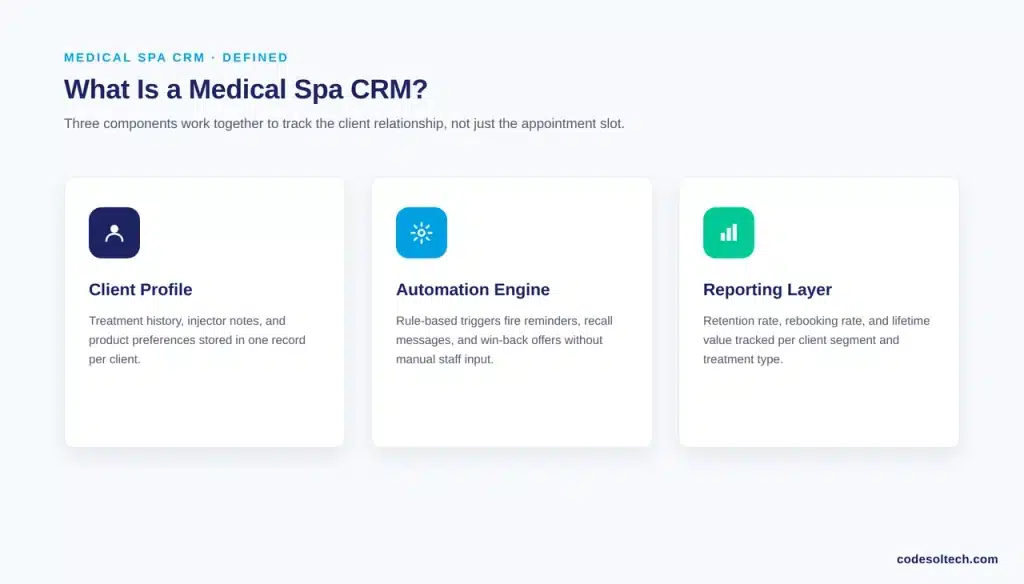
Three components define a functioning medical spa CRM:
- Client profile: treatment history, injector notes, product preferences, and communication opt-ins in one record
- Automation engine: rule-based triggers that fire reminders, recall messages, and win-back offers without staff initiating them manually
- Reporting layer: retention rate, rebooking rate, and lifetime value tracked per client segment and per treatment type
Med spas that also run HIPAA-relevant healthcare and wellness operations alongside cosmetic services need the CRM to separate clinical documentation from marketing automation, since the two carry different compliance requirements.
Most med spas start with a scheduling platform and treat it as sufficient. That assumption breaks down as client volume grows past what a single front-desk coordinator can track by memory.
AmSpa’s 2024 report puts the average U.S. medical spa at 10,488 locations nationally and an average of 245 patient visits per month per location.
At that volume, recall dates, membership renewals, and win-back timing cannot run on a coordinator’s memory or a spreadsheet without silent failures, which is where a purpose-built CRM replaces manual tracking.
Why Does Client Retention Matter More Than New Patient Acquisition?
Retention matters more because a returning client already trusts the injector, converts faster, and costs nothing to reacquire. In contrast, a new client requires paid marketing spend before a single dollar of revenue arrives.
The med spa industry’s own growth data confirms which side of that equation is doing the heavier lifting.
Three data points define the retention case for 2025 and 2026:
- 73% of medical spa patients are repeat patients as of the 2024 AmSpa State of the Industry Report, up from 65% in the 2022 edition
- Facial treatments, the segment with the highest visit frequency, held a 53.6% revenue share of the global medical spa market in 2025, according to Grand View Research
- Grand View Research identifies a personalized, long-term client experience, not a procedure-by-procedure sales model, as the factor that improves retention and increases spend per client
A CRM operationalizes that “personalized, long-term” model. Without one, front-desk staff manages recall dates from memory or a spreadsheet, which fails silently the moment volume increases past what one person can track.
Retention also compounds financially in a way new-client acquisition does not. A client who rebooks four times a year across injectables, facials, and body-contouring services generates four transaction opportunities from a single acquisition cost. A client who visits once and never returns generates one.
The math favors retention even before accounting for the fact that acquiring a new client requires paid advertising, SEO content, or referral incentives, each of which carries a direct cost that repeat business avoids.
How Does CRM Software Increase Repeat Bookings?
CRM software increases repeat bookings through four automated mechanisms: appointment reminders, treatment-cycle recall, loyalty and membership tracking, and win-back sequences for lapsed clients.
Each mechanism addresses a different point where a client would otherwise fall out of the rebooking cycle.
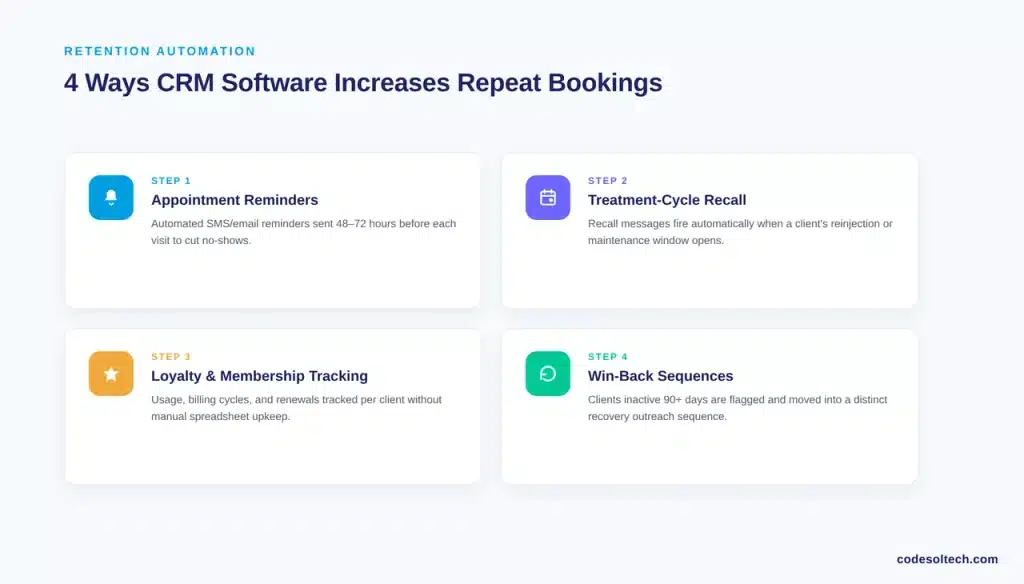
Automated Appointment Reminders Reduce No-Shows
A randomized controlled study published in the American Journal of Medicine compared no-show rates across three groups: no reminder, an automated reminder, and a live staff call.
The no-show rate measured 23.1% with no reminder, 17.3% with an automated reminder, and 13.6% with a staff phone call.
Automated reminders alone cut no-shows by roughly 25% relative to no reminder at all, and a CRM triggers that reminder without staff having to place a single call.
Treatment-Cycle Recall Keeps Clients on Schedule
Injectables, laser treatments, and body-contouring services run on fixed reinjection or maintenance windows. A CRM stores each client’s treatment date and interval, then triggers a recall message when the window opens, rather than waiting for the client to remember and call in.
Loyalty and Membership Programs Run on CRM Data
Membership programs, which bundle a fixed monthly fee against recurring treatments, depend on a CRM to track usage, billing cycles, and renewal dates per client. Without that tracking layer, membership programs collapse into manual spreadsheet management that doesn’t scale beyond a small client base.
Win-Back Sequences Recover Lapsed Clients
A CRM flags any client who has passed a defined inactivity threshold, commonly 90 days since last visit, and triggers a distinct outreach sequence separate from active-client marketing. This segmentation prevents lapsed clients from being lost silently inside a general email list.
CRM-Driven Retention Tactics Compared
| Retention Tactic | Trigger Point | Primary Metric Improved | Staff Effort Required |
|---|---|---|---|
| Automated appointment reminders | 48–72 hours before scheduled visit | No-show rate | None after setup |
| Treatment-cycle recall | Reinjection or maintenance window opens | Rebooking rate | None after setup |
| Loyalty/membership tracking | Ongoing, tied to billing cycle | Client lifetime value | Low, periodic review |
| Win-back sequence | 90+ days of inactivity | Lapsed-client recovery rate | None after setup |
What Features Should a Medical Spa CRM Include?
A medical spa CRM built for retention, rather than generic sales tracking, needs the following capabilities:
- Treatment-specific client profiles with injector notes and product lot tracking
- Rule-based automation for reminders, recall, and win-back messaging across SMS and email
- Membership and package tracking with automated renewal billing
- Segmentation by treatment type, spend tier, and inactivity status
- Retention and rebooking-rate reporting broken down per provider and per treatment
- Integration with the spa’s scheduling system and payment processor so data does not require manual re-entry
Spas already running workflow automation across intake, billing, and follow-up typically extend that same automation logic into the CRM, rather than operating two disconnected systems.
Off-the-shelf CRM platforms built for general retail or sales pipelines rarely cover all six requirements out of the box. Treatment-specific fields, injector-level reporting, and HIPAA-aware data segmentation are aesthetics-industry requirements that generic CRM software treats as an afterthought or an expensive add-on.
Medical spas that outgrow a generic platform typically move to a custom-built system once membership programs, multi-provider scheduling, and compliance reporting exceed what a template can handle.
How Do You Measure Medical Spa Client Retention?
Client retention rate is calculated as: ((clients at period end − new clients acquired during the period) ÷ clients at period start) × 100. For example, a spa that starts a quarter with 500 active clients, ends with 540, and acquired 100 new clients during that period has a retention rate of ((540 − 100) ÷ 500) × 100 = 88%.
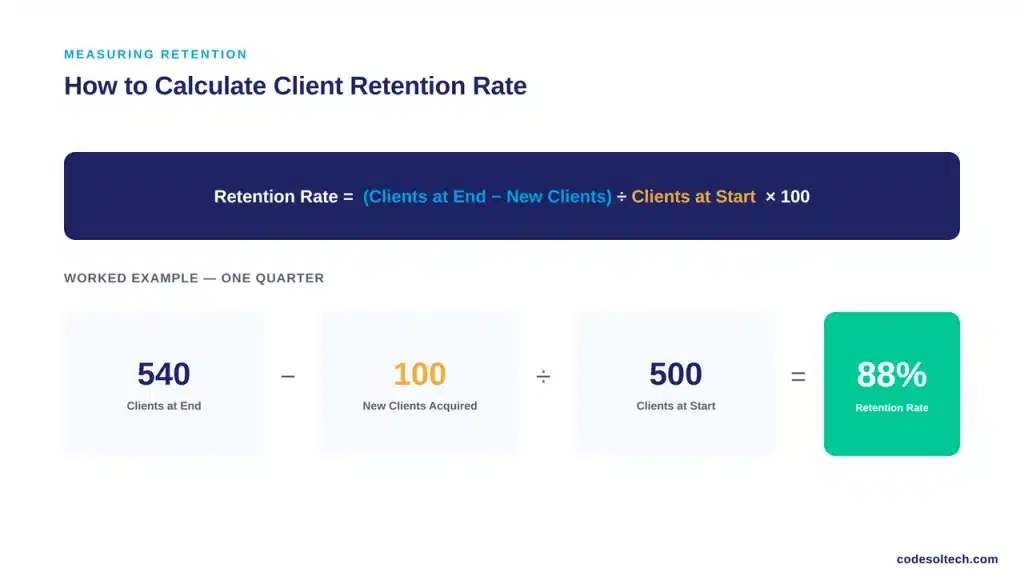
Track this figure on a consistent monthly or quarterly cadence, and break it out by treatment category, since injectable clients and single-visit laser clients typically show different retention curves.
A CRM automates this calculation continuously, instead of requiring a manual export and spreadsheet formula each reporting period.
FAQs
Does a medical spa need a separate CRM if it already uses scheduling software?
Yes. Scheduling software books a time slot. A CRM tracks the client relationship around that slot, including recall timing, communication history, and lifetime value, none of which a calendar system stores.
How long does it take to see a retention improvement after installing a CRM?
Automated reminders reduce no-shows within the first booking cycle. Recall and win-back sequences typically show measurable rebooking improvement within one full treatment cycle, generally 60 to 120 days depending on the service mix.
Can a CRM handle both HIPAA-relevant clinical data and marketing automation?
A properly architected system separates clinical documentation from marketing communication while keeping both linked to the same client record, which requires deliberate system design rather than a generic off-the-shelf marketing tool.
What is a good client retention rate for a medical spa?
Industry reporting from AmSpa places the national repeat-patient rate at 73% as of 2024. A spa tracking below that figure has room to close the gap through automated recall and win-back sequences before assuming the shortfall is a treatment-quality issue.
Final Words
A medical spa’s revenue depends on clients who return, not clients who visit once. CRM automation handles the reminders, recall timing, and win-back outreach that front-desk staff cannot track manually at scale. The spas already capturing 73%+ repeat-patient rates are the ones treating retention as a system, not a hope.
Ready to Build a Retention-Focused CRM for Your Med Spa?
CodeSol Technologies designs and builds custom CRM and client portal systems for medical spas and healthcare practices, built around your treatment mix, membership structure, and compliance requirements.
Talk to CodeSol Technologies about a CRM built for retention, not just booking.