
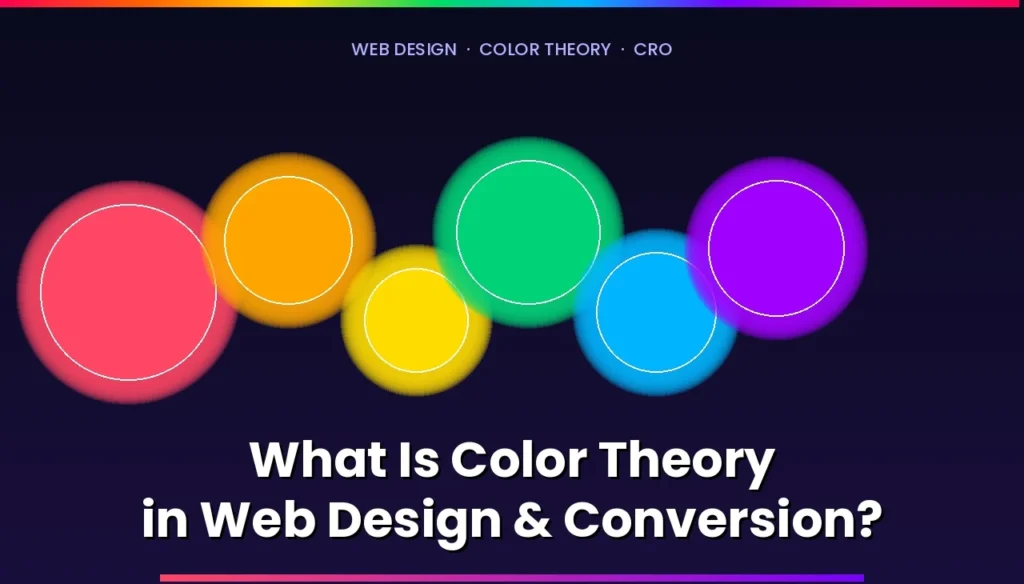
Color theory is the systematic study of how colors interact, communicate meaning, and influence human behavior. In web design, color theory operates as a conversion lever, not a decorative choice. The human brain processes color 60,000 times faster than text, triggering emotional and behavioral responses before any copy is read.
Color theory in digital interfaces operates through 3 primary mechanisms:
- Hue selection — the dominant wavelength that triggers emotional association (e.g., red triggers urgency; blue triggers trust)
- Contrast ratio — the luminance difference between foreground and background, measured on a scale of 1:1 to 21:1
- Color harmony — the structural relationship between colors using complementary, analogous, or triadic schemes
The Web Content Accessibility Guidelines (WCAG) 2.1 require a minimum contrast ratio of 4.5:1 for normal text and 3:1 for large text to ensure readability and legal compliance.
How the F-Pattern Governs User Attention on Web Pages
The F-pattern is a predictive eye-tracking model that maps how users read digital content. Jakob Nielsen and the Nielsen Norman Group established the F-pattern through a 2006 eye-tracking study of 232 users across dozens of websites.
Users read the first 2 horizontal lines of content fully, then scan down the left vertical axis in a pattern that forms the letter “F.”
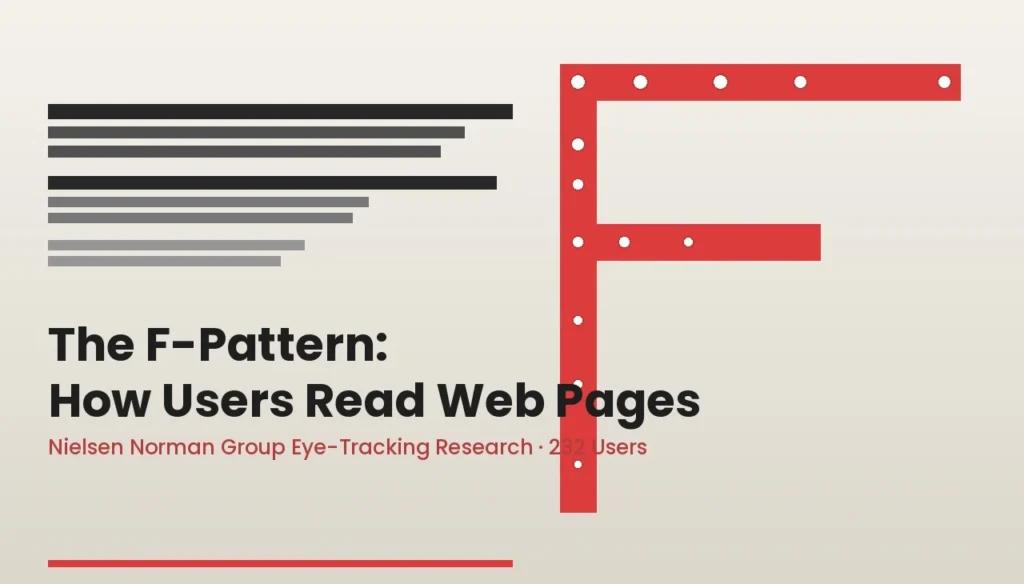
The F-pattern produces 3 distinct reading zones:
- Top horizontal band — the highest-attention area; users read this line almost entirely
- Second horizontal band — a shorter scan, capturing roughly 60–70% of the line width
- Left vertical strip — a rapid downward scan where users seek anchor words, subheadings, and bullet points
This behavior pattern confirms that content positioned in the top-left quadrant of a webpage receives the maximum amount of user attention and cognitive processing time. Conversion elements placed outside the F-pattern receive statistically lower engagement.
The Neurological Basis of Color-Driven Conversion
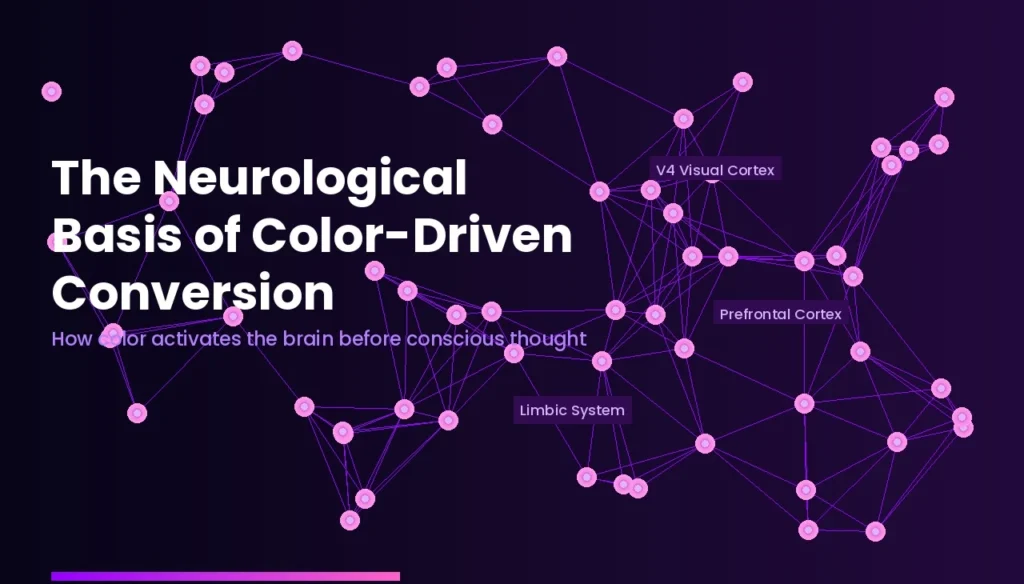
Color perception activates the V4 region of the visual cortex before engaging the prefrontal cortex responsible for decision-making. This neurological sequence means color communicates intent faster than any text-based message. The conversion impact of color is therefore neurological — not purely aesthetic.
Research by the Pantone Color Institute identifies 4 primary emotional responses tied to color in commercial contexts:
- Red — urgency, excitement, and appetite stimulation (used in clearance sales and food brands)
- Blue — trust, security, and authority (used in finance, healthcare, and SaaS platforms)
- Green — safety, permission, and environmental alignment (used in CTAs and eco-focused brands)
- Orange — energy, affordability, and immediacy (used in impulse-purchase triggers)
A/B testing data from HubSpot’s 2011 CTA button study demonstrated that a red CTA button outperformed a green button by 21% on a landing page with a predominantly green background — a direct result of contrast-driven attention, not color symbolism alone.
How F-Pattern and Color Theory Intersect to Drive CRO
Conversion Rate Optimization (CRO) is the practice of increasing the percentage of users who complete a desired action on a web page. The intersection of F-pattern layout and color theory creates a predictive framework for CTA (Call to Action) placement and visual hierarchy design.
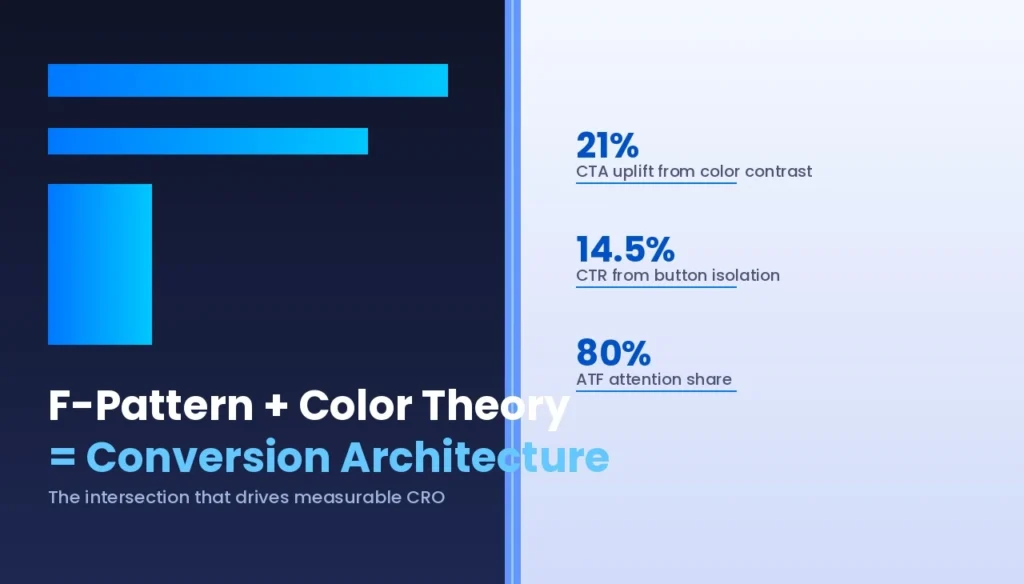
The 3 core principles of this intersection are:
- F-pattern hotspot + high-contrast color — Place CTAs at the end of the first horizontal F-band using a color that contrasts with the surrounding palette by a minimum 4.5:1 ratio
- Left-axis anchoring with semantic color — Position trust indicators (security badges, testimonials) along the F-pattern’s left vertical strip using blue or green to reinforce credibility
- Above-the-fold color temperature — Use warm hues (red, orange, yellow) above the fold to trigger immediate emotional engagement and cold hues (blue, grey) below the fold to reinforce rational decision-making
Eye-tracking studies from the Baymard Institute confirm that users spend 80% of their viewing time above the fold, making this zone the highest-leverage placement area for conversion-focused color decisions.
Visual Hierarchy: The Structural Engine of F-Pattern Design
Visual hierarchy is the arrangement of design elements to guide a user’s eye in a deliberate sequence. In F-pattern design, visual hierarchy functions as the structural engine that controls where attention lands at each stage of the F-path. Designers construct visual hierarchy using 5 variables:
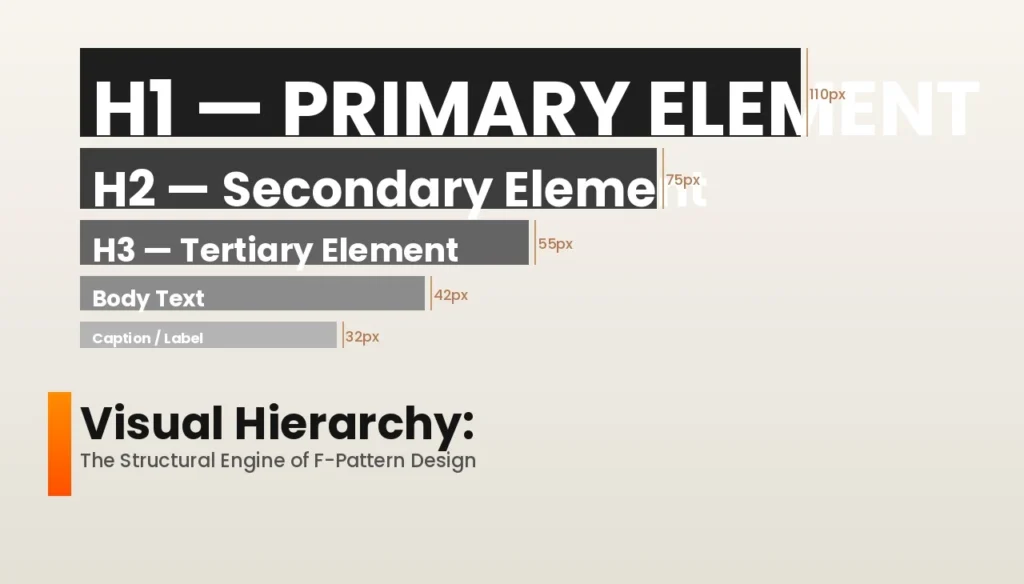
- Size — larger elements attract attention before smaller elements
- Color weight — saturated or high-contrast colors draw the eye before muted tones
- Whitespace — negative space isolates elements and increases their perceived importance
- Typography weight — bold and heavier font weights (600–900) rank higher in the attention sequence than regular weights (300–400)
- Position — elements placed in the top-left quadrant receive priority processing due to F-pattern reading behavior
The Gestalt principle of “figure-ground” directly supports this hierarchy: a CTA button with a high-contrast background color separates itself from the “ground” (page background) and becomes the focal point of the visual field.
The Role of Color Contrast in CTA Button Performance
A CTA button is the primary conversion element on any landing page, product page, or checkout screen. The color contrast ratio of the CTA button against its surrounding background is the single most measurable color-based conversion variable. WCAG 2.1 Level AA compliance sets 4.5:1 as the minimum — but high-performing CTA buttons operate at contrast ratios between 7:1 and 10:1.
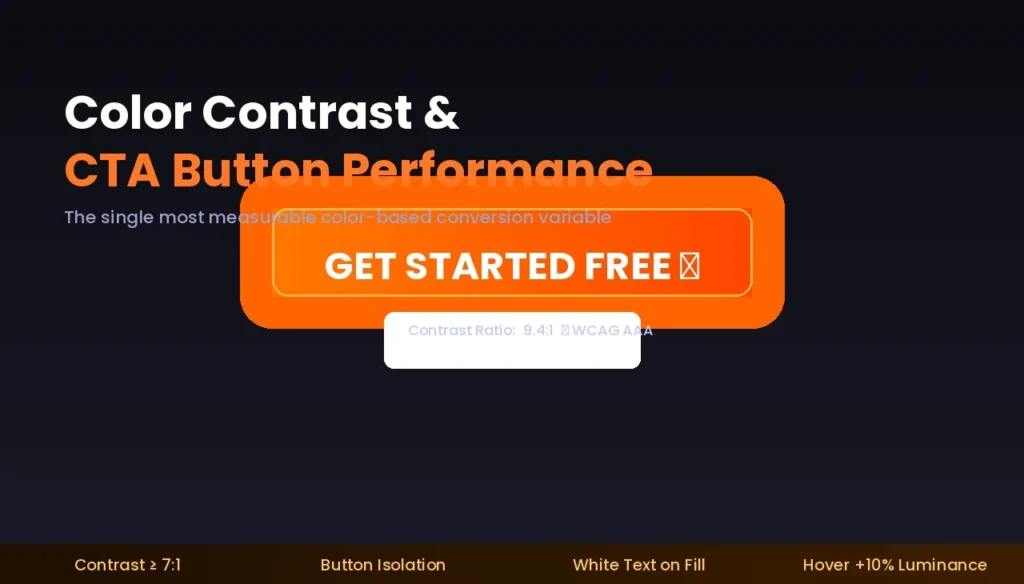
The 4 technical properties that define a high-converting CTA button are:
- Contrast ratio ≥ 7:1 against background
- Button hue — a color not used elsewhere on the page (isolation effect)
- Text contrast — white (#FFFFFF) or near-black (#1A1A1A) against the button fill for internal readability
- Hover state — a 10–15% luminance shift on hover to confirm interactivity without destroying contrast
ConversionXL (now CXL Institute) conducted multivariate tests across 17 landing pages and identified that button isolation — using a hue absent from the rest of the design increased click-through rate by an average of 14.5%.
Cognitive Load, Color Saturation, and Conversion Friction
Cognitive load is the total amount of mental effort required to process a webpage. High cognitive load decreases conversion rates by increasing decision fatigue and reducing the clarity of the intended user action. Color saturation directly affects cognitive load: pages with more than 3 dominant saturated hues increase visual noise and raise cognitive load measurably.
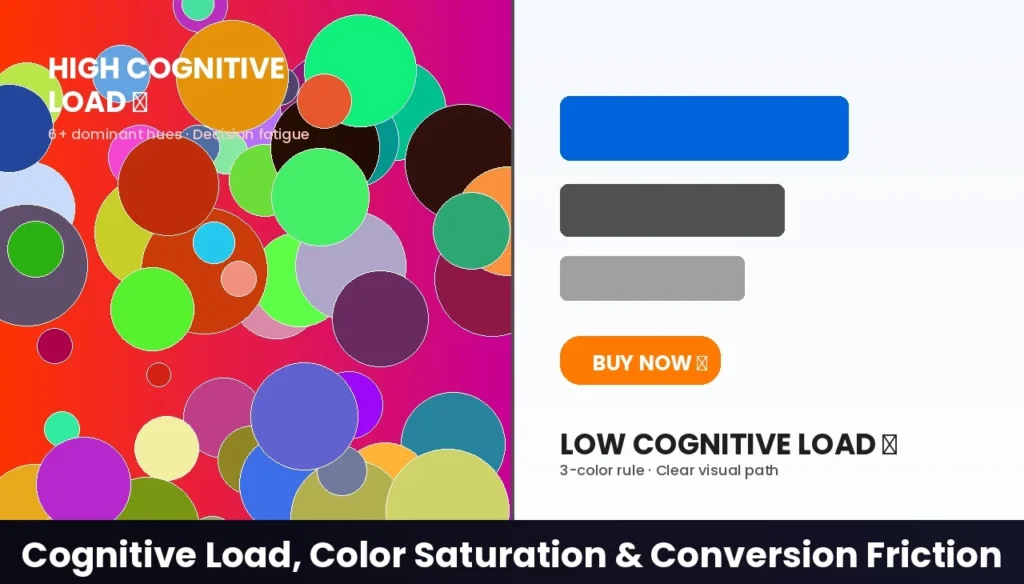
The 3-color rule in web design limits dominant palette colors to 3 values:
- Primary color — used for the brand identity and header elements
- Secondary color — used for supporting UI components and informational sections
- Accent color — used exclusively for CTAs and high-priority conversion triggers
Google’s Material Design specification enforces a primary, secondary, and surface color system precisely to manage cognitive load. This principle aligns with Hick’s Law — conversion time increases logarithmically with the number of available choices or visual stimuli presented simultaneously.
F-Pattern Optimization: Layout Rules for Conversion-Focused Pages
An F-pattern optimized page layout positions every critical conversion element at one of the 3 F-pattern hotspots: the first horizontal band, the second horizontal band, or the top of the left vertical axis. This layout discipline reduces the distance between a user’s natural eye path and the conversion trigger, lowering the behavioral activation cost of clicking.
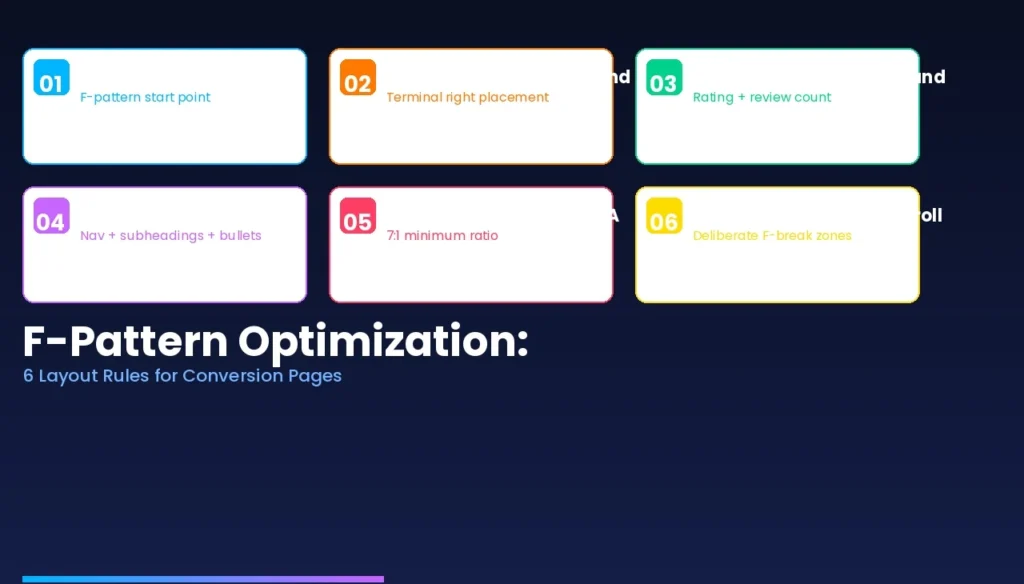
The 6 layout rules for F-pattern optimization are:
- Place the H1 headline at the top-left origin point of the first F-band
- Position the primary CTA at the end of the first horizontal scan line
- Place a supporting trust signal (rating, review count, or security badge) at the start of the second F-band
- Use the left vertical strip for navigation, anchor links, or subheadings
- Apply the highest-contrast color to the first CTA encountered in the F-path
- Use whitespace to break the F-pattern deliberately at key scroll depths to reset attention
The Nielsen Norman Group’s 2017 follow-up eye-tracking study confirmed that F-pattern behavior intensifies on pages with dense text and weakens on pages with strong visual hierarchy — validating that layout and color interventions measurably reshape scanning behavior.
Color Psychology in E-Commerce: Conversion Data by Sector
Color psychology applied to e-commerce produces measurable, sector-specific conversion outcomes. The emotional associations of color shift based on industry context, user intent, and brand positioning. A single color does not universally increase conversion — the conversion effect is a function of color-context fit.
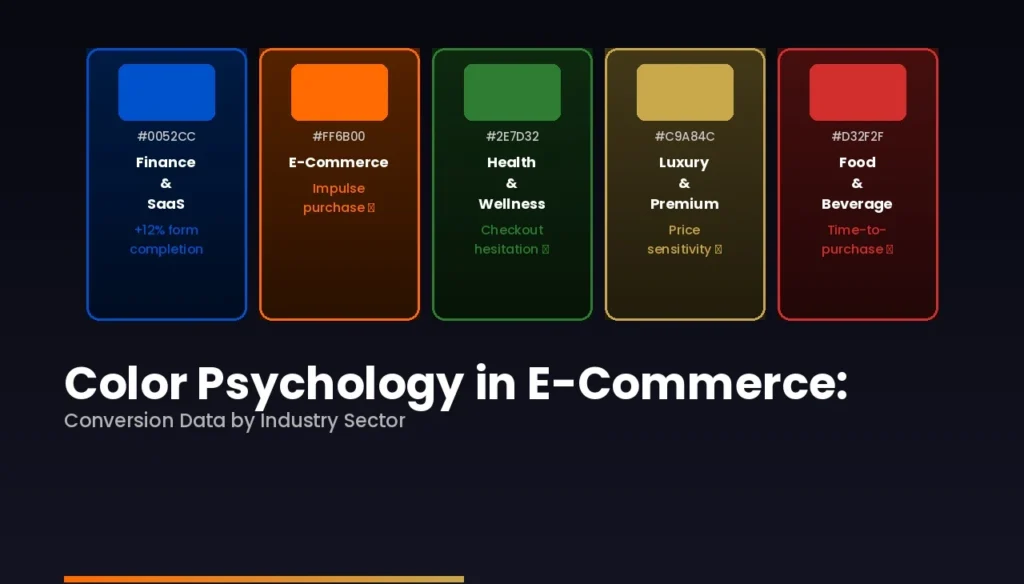
Documented color-conversion relationships by sector include:
- Finance & SaaS — Blue (#0052CC, #1E3A5F range) increases trust perception and reduces form abandonment by up to 12% in A/B tests
- E-commerce retail — Orange CTAs (#FF6B00–#FF8C00 range) increase impulse purchase rates on product pages with high SKU density
- Health & wellness — Green (#2E7D32–#4CAF50 range) aligns with safety perception and reduces checkout hesitation
- Luxury & premium — Black and gold combinations (#000000 with #C9A84C) signal exclusivity and reduce price sensitivity in target demographics
- Food & beverage — Red-orange combinations increase perceived appetite and reduce time-to-purchase on menu and delivery pages
These sector-specific patterns emerge because color creates a semantic frame around the product — users process the color before the price, triggering a pre-rational emotional judgment about value and trust.
Heatmap Analysis: Validating F-Pattern and Color Decisions
Heatmap analysis is the process of visualizing aggregate user interaction data — clicks, scrolls, and mouse movements — as a color-gradient overlay on a webpage. Tools including Hotjar, Microsoft Clarity, and Crazy Egg generate heatmaps that confirm or refute F-pattern predictions and color hierarchy decisions with real behavioral data.
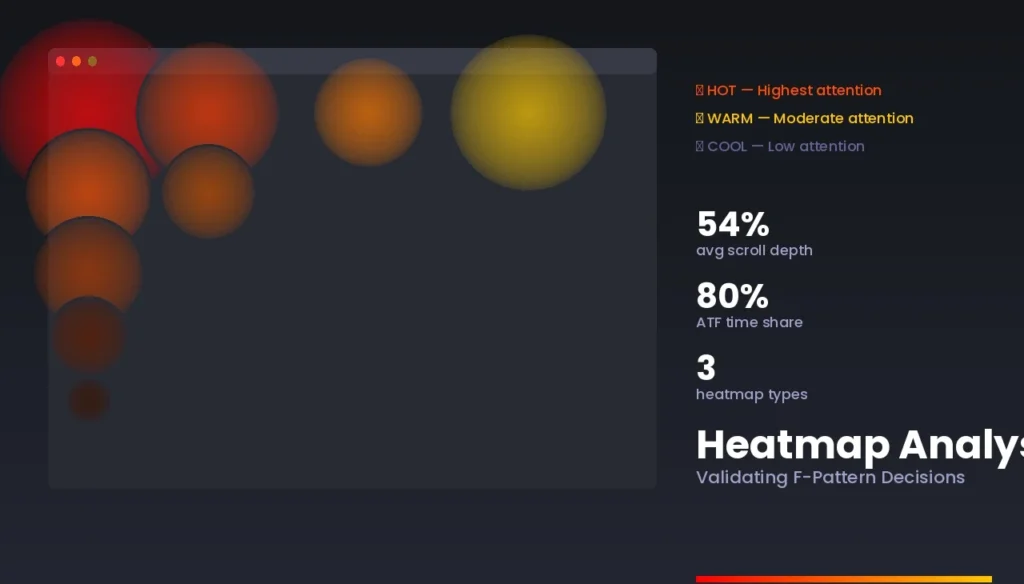
The 3 heatmap types used in CRO analysis are:
- Click maps — show the exact coordinates of all user clicks, identifying whether CTAs placed at F-pattern hotspots receive disproportionate engagement
- Scroll maps — reveal the scroll depth distribution across users, indicating where the F-pattern’s vertical drop-off occurs
- Move maps — track cursor movement as a proxy for eye movement on desktop sessions, validating F-pattern predictions without formal eye-tracking hardware
A quantitative benchmark from Hotjar’s 2022 industry data shows that the average scroll depth on a landing page is 54% of total page length — meaning that all conversion elements below the midpoint of the page are invisible to nearly half of all visitors. This benchmark makes above-the-fold color and F-pattern decisions critical to conversion architecture.
Accessibility, Color Blindness, and Inclusive Conversion Design
Color blindness affects 8% of men and 0.5% of women globally, equating to approximately 300 million people worldwide. Designing conversion elements that rely exclusively on color hue to communicate intent (e.g., a red error state or a green success state) excludes this population and violates WCAG 2.1 Success Criterion 1.4.1.
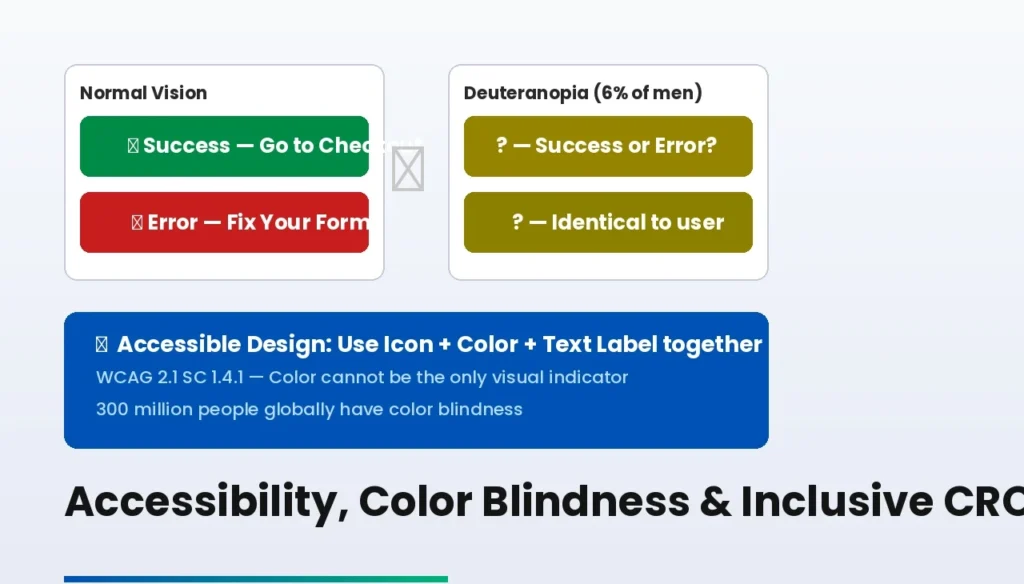
The 4 design rules for accessible, conversion-safe color use are:
- Never use color as the only visual indicator — pair color changes with iconography, text labels, or border weight changes
- Test all CTAs with deuteranopia simulation — the most common form of red-green color blindness, affecting 6% of men
- Maintain contrast ratios for all interactive states — hover, focus, active, and disabled states must each meet WCAG 4.5:1 minimum
- Use pattern or texture as secondary differentiators — in data visualization and form validation states where multiple colors convey distinct meanings
Inclusive conversion design does not reduce conversion rates — Fable Tech’s 2023 accessibility benchmarking study found that pages meeting WCAG AA compliance showed a 7% average increase in task completion rate across all user groups, including non-disabled users who benefit from increased visual clarity.
Above-the-Fold Architecture: Where F-Pattern Meets Color Priority
Above-the-fold (ATF) architecture refers to the layout and design decisions visible to a user without scrolling. The ATF zone is the highest-leverage area of any webpage because it contains the first F-band — the line that receives 100% horizontal read completion. Every color, typographic, and CTA decision in the ATF zone directly influences the user’s commitment to scroll further or exit.
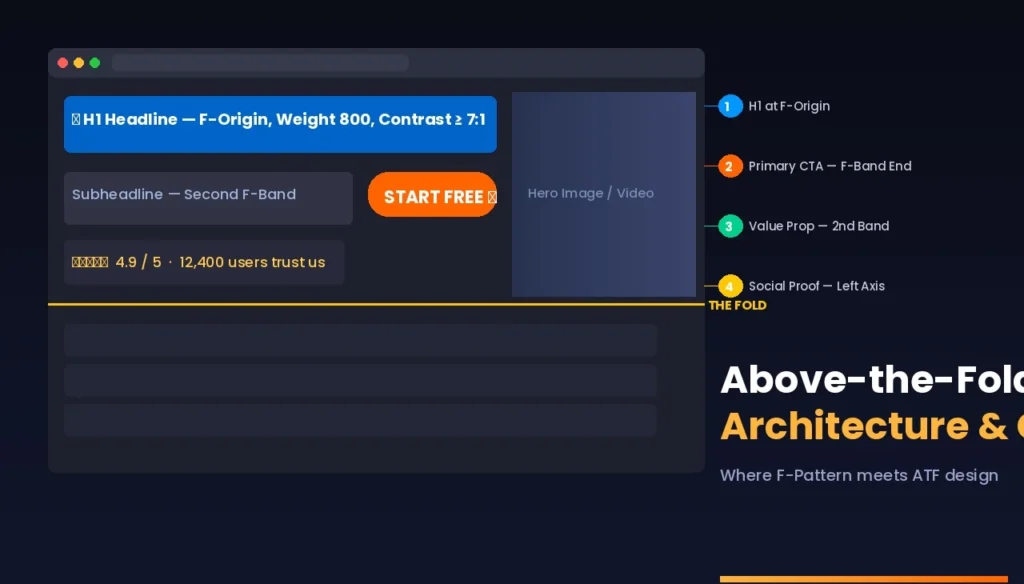
The 5 ATF architecture elements ranked by conversion impact are:
- H1 headline — positioned at the F-origin, set in a weight of 700–900, with a color contrast ≥ 7:1 against the background
- Hero image or video — occupies the right half of the first F-band; uses warm accent tones to draw attention toward the CTA
- Primary CTA button — placed at the terminal right of the first F-band in the page’s isolated accent color
- Value proposition subheadline — positioned at the start of the second F-band, set in weight 400–500 in the secondary color
- Social proof micro-element — a star rating, user count, or logo strip placed at the left axis below the CTA to reinforce the decision made at the F-hotspot
This ATF structure follows the AIDA model (Attention, Interest, Desire, Action) and maps it directly onto the F-pattern’s neurological sequence of user attention.
Final Words
Color theory and the F-pattern are not design preferences; they are conversion infrastructure. The exact placement of a high-contrast CTA at the terminal point of the first F-band produces measurable click-through gains.
Color contrast ratios, cognitive load reduction, and accessible design operate together as a system. Every pixel placement is a behavioral hypothesis. Test it, measure it, optimize it.
Ready to redesign your pages for maximum conversions? Audit your above-the-fold layout against the F-pattern today. Map your CTA contrast ratios. Run a heatmap session. The data will show you exactly where attention dies — and exactly where revenue is being left on the table.