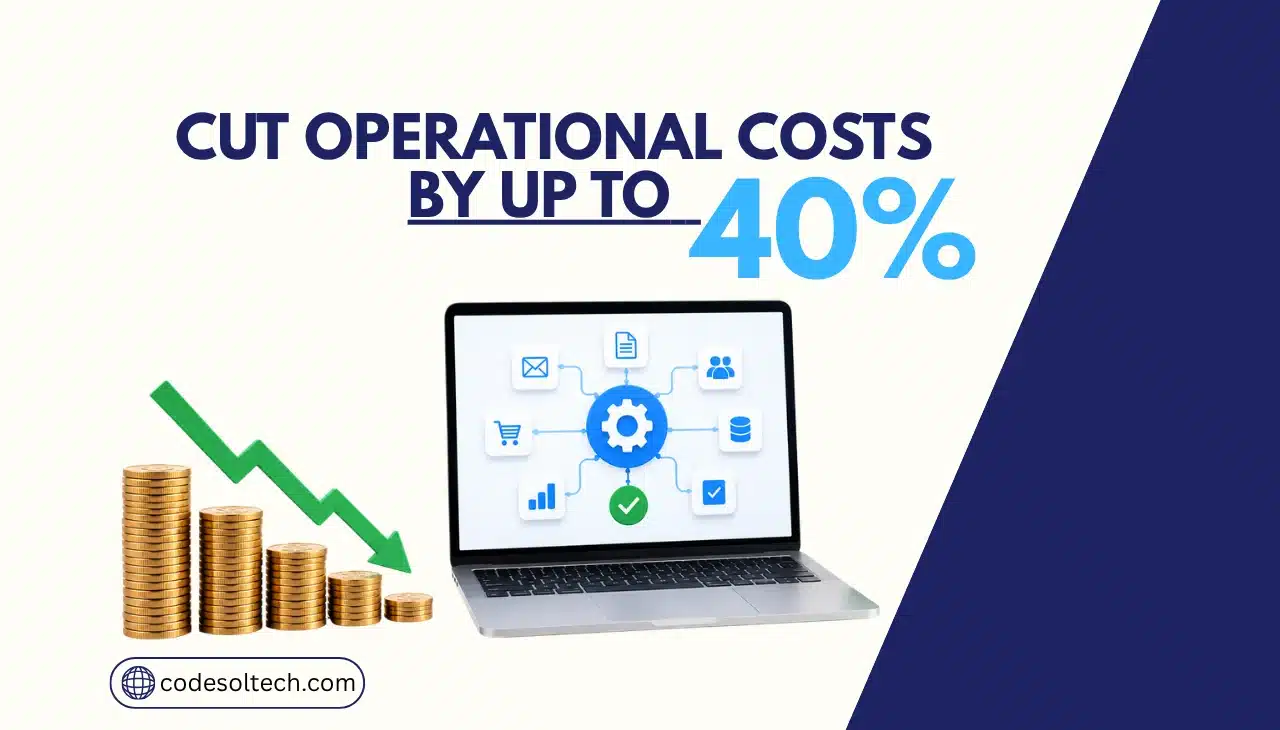
Operational cost automation replaces manual, repetitive business tasks with software systems that execute the same work faster and with fewer errors. Companies deploy automation across four core areas: workflow management, customer service, inventory control, and financial processing. Each area produces measurable, trackable cost reductions within 12 months of deployment.
Operational costs fall into three categories that automation targets directly: labor costs from repetitive manual tasks, error costs from manual data entry mistakes, and delay costs from slow, sequential handoffs between departments.
A software development team addresses each category separately, because the technical solution for labor cost differs from the solution for error cost.
Labor cost reduction comes from removing manual steps; error cost reduction comes from validation rules built into the automated workflow.
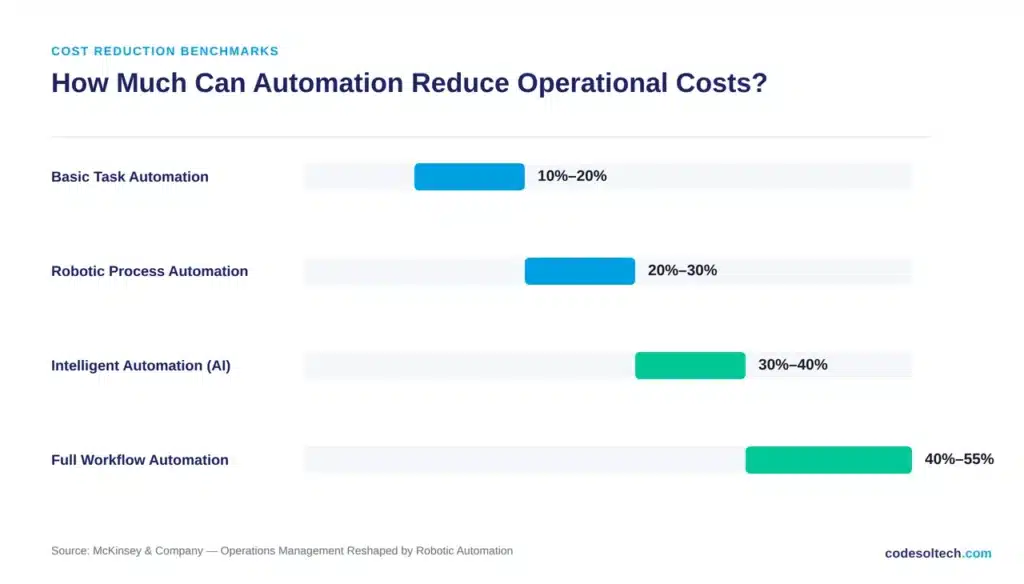
How Much Can Automation Reduce Operational Costs?
Automation reduces operational costs between 20% and 60%, depending on process complexity and automation maturity. McKinsey’s operations research documents that robotic automation reduced technical call center costs by more than 40% while simultaneously increasing service quality.
The same research shows operations centers cutting costs by 30% to 60% after automating manual, repetitive workflows.
Deloitte’s Global Intelligent Automation survey confirms this range at the enterprise level. Organizations that move beyond pilot programs report an average cost reduction of 32% in their targeted process areas, up from 24% two years earlier.
Gartner projects that organizations combining hyperautomation technologies with redesigned operational processes lower operational costs by 30%.
The savings scale with the type of automation a company deploys:
- Basic task automation: reduces costs by 10% to 20% (data entry, form processing, notifications)
- Robotic process automation (RPA): reduces costs by 20% to 30% (invoice matching, order entry, reconciliation)
- Intelligent automation with AI: reduces costs by 30% to 40% (chatbots, demand forecasting, dynamic routing)
- Full workflow automation across departments: reduces costs by 40% or more (integrated ERP, CRM, and fulfillment systems)
4 Types of Operational Automation
Businesses classify operational automation into four distinct types based on the technology involved and the complexity of the decisions it makes. Each type requires a different development approach and produces a different cost-reduction range.
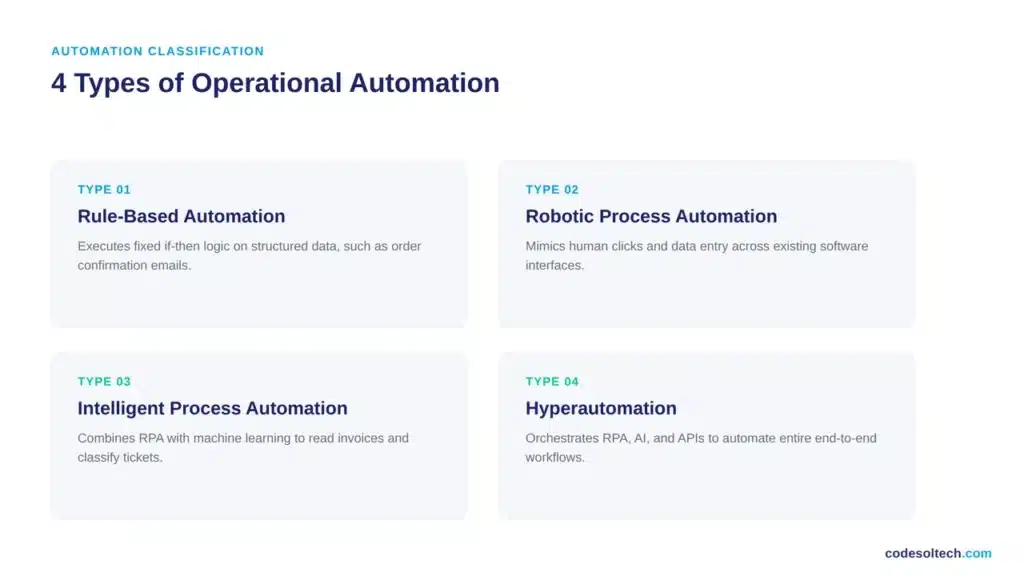
- Rule-based automation: executes fixed if-then logic on structured data, such as auto-sending order confirmation emails
- Robotic process automation (RPA): mimics human clicks and data entry across existing software interfaces without changing the underlying systems
- Intelligent process automation (IPA): combines RPA with machine learning to handle unstructured data, such as reading invoice PDFs or classifying support tickets
- Hyperautomation: orchestrates RPA, AI, and API integrations across multiple departments to automate entire end-to-end workflows
A company selects the automation type based on process complexity, not budget alone. Rule-based automation suits simple, high-volume tasks.
Hyperautomation suits cross-department workflows that span order management, finance, and customer service simultaneously.
Which Business Processes Deliver the Highest Automation ROI?
Customer service, inventory management, and financial processing deliver the highest automation ROI because they involve high transaction volume and repetitive decision logic.
A software development team configures automation rules for each process, then deploys bots or AI agents to execute the transactions without human input.
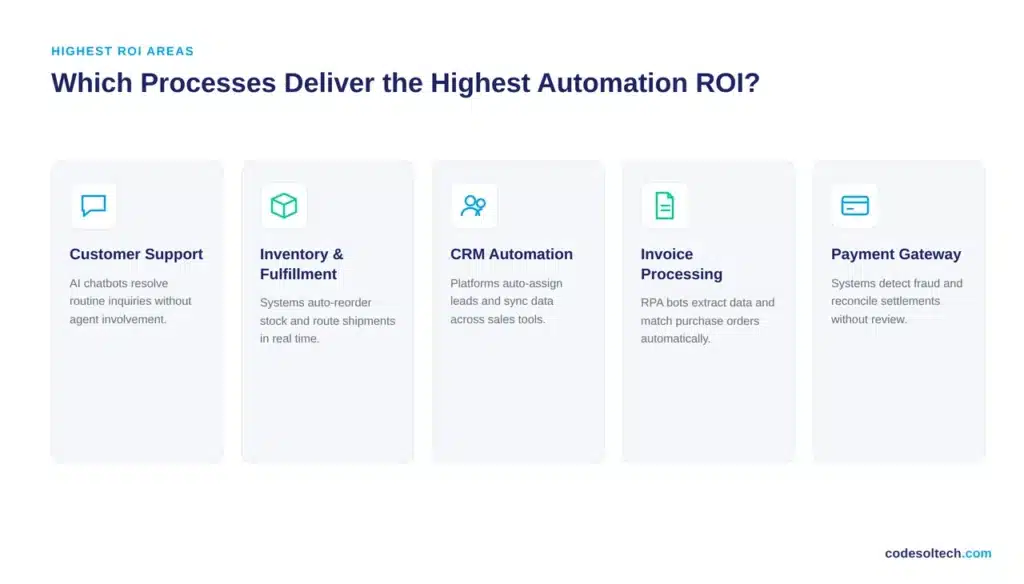
The following processes consistently produce the largest cost reductions:
- Customer support automation: AI chatbots handle routine inquiries, order status checks, and returns processing without agent involvement
- Inventory and fulfillment automation: systems auto-reorder stock, route shipments, and update warehouse records in real time
- CRM automation: platforms auto-assign leads, trigger follow-up sequences, and sync customer data across sales tools
- Invoice and payment processing: RPA bots extract invoice data, match purchase orders, and execute payment reconciliation
- Payment gateway automation: systems detect fraud, retry failed transactions, and reconcile settlements without manual review
Each process shares a common structure: high volume, clear rules, and structured data. Software developers build integrations that connect these systems through APIs, allowing data to move between platforms without manual re-entry.
This integration layer is what separates automation that reduces costs from automation that merely shifts the workload.
Manual vs. Automated Process Comparison
| Process | Manual Cost Driver | Automated Outcome |
|---|---|---|
| Order processing | Staff re-key order data across 3-4 systems | API sync updates all systems in real time |
| Customer inquiries | Agents handle repetitive status questions | Chatbot resolves 60-80% of tier-1 tickets |
| Invoice reconciliation | Finance team matches invoices line by line | RPA bot matches and flags exceptions only |
| Inventory updates | Manual stock counts and reorder decisions | System auto-reorders at defined thresholds |
How Long Until Automation Pays for Itself?
Automation typically pays for itself within 12 months of deployment. Deloitte’s Global RPA Survey reports that organizations achieve payback in less than 12 months, with automated bots providing an average of 20% of full-time equivalent capacity.
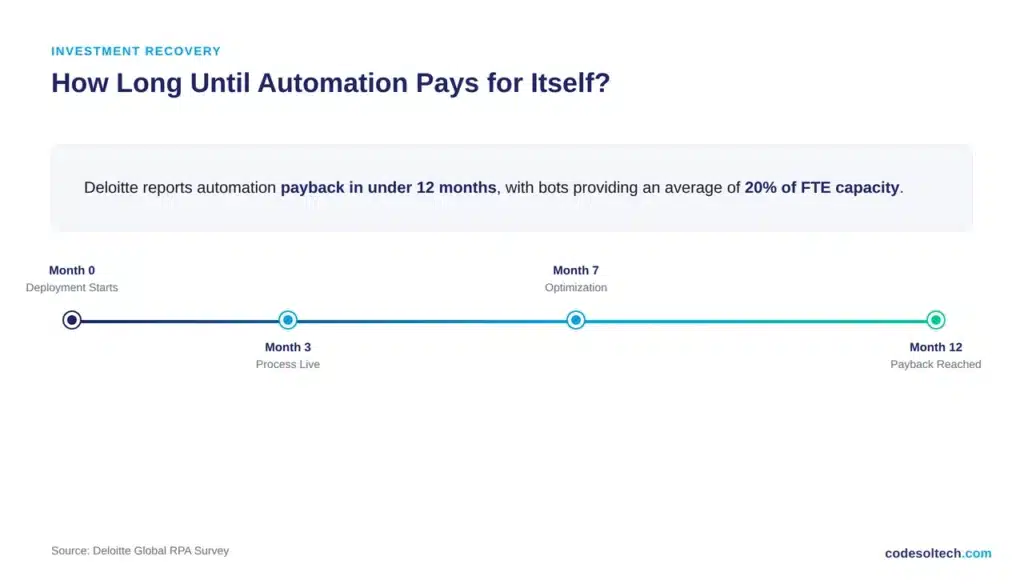
Payback speed depends on transaction volume: high-volume processes like invoice processing and customer service reach breakeven faster than low-volume, complex workflows.
Three factors determine how fast a company recovers its automation investment:
- Transaction volume: higher volume processes generate savings faster per dollar invested
- System integration complexity: fewer legacy systems mean faster deployment and earlier savings
- Process standardization: standardized rules automate faster than exception-heavy workflows
How to Calculate Automation ROI
Companies calculate automation ROI using a single formula: (annual labor cost saved plus error cost avoided, minus annual automation cost) divided by annual automation cost.
This calculation requires three inputs before deployment begins: current process cost, expected automation cost, and projected time savings per transaction.
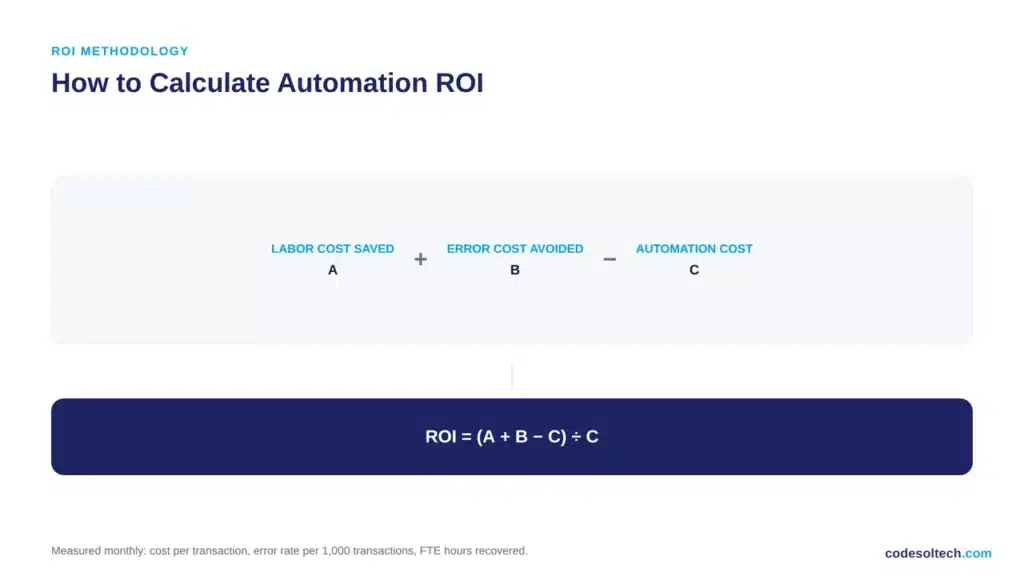
Finance teams track three metrics to validate the calculation after deployment:
- Cost per transaction before and after automation, measured monthly
- Error rate in automated versus manual processing, measured per 1,000 transactions
- Full-time equivalent (FTE) hours recovered and redirected to higher-value work
Ecommerce businesses apply this formula most directly to fulfillment and customer service, where transaction volume is highest and the cost per manual transaction is easiest to isolate.
A company processing 10,000 monthly orders manually spends significantly more per order than one running automated inventory sync and chatbot-first support, because automation removes the marginal labor cost per transaction.
How Codesoltech Builds Cost-Reducing Automation Systems
Codesoltech develops automation systems in four stages: process audit, integration architecture, bot or AI deployment, and performance monitoring.
Each stage targets a specific cost driver identified during the audit phase, ensuring the automation build addresses measurable inefficiencies rather than generic process changes.
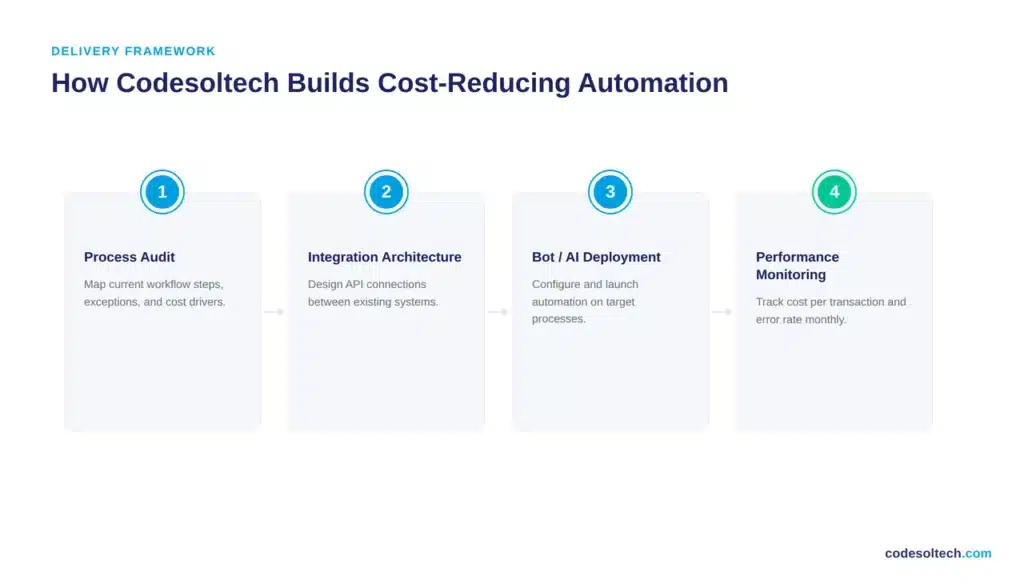
The technical build typically includes:
- Workflow automation connecting order management, inventory, and shipping systems through APIs
- CRM integration that syncs customer data across sales, support, and marketing platforms
- Chatbot deployment trained on product data and support history to resolve tier-1 tickets
- Payment gateway configuration with automated fraud checks and reconciliation rules
- Fulfillment automation that triggers reorders and routes shipments based on real-time stock data
The monitoring stage is where most cost savings either compound or disappear. Codesoltech configures dashboards that track cost per transaction, error rate, and FTE hours recovered on a monthly basis, so the client sees whether the automation is meeting its projected ROI.
If a bot’s error rate rises above the defined threshold, the monitoring system flags it for review before it erodes the savings already achieved.
Read more about how Codesoltech structures individual builds in our workflow automation services, CRM integration services, and payment gateway integration guides. [Pre-publish note: verify these internal slugs exist and are live before publishing; update links to match final site structure.]
Common Mistakes That Erode Automation Savings
Companies lose projected savings when they automate a broken process instead of fixing it first. Automating a flawed workflow increases the speed of errors rather than eliminating them. The following mistakes consistently reduce automation ROI:
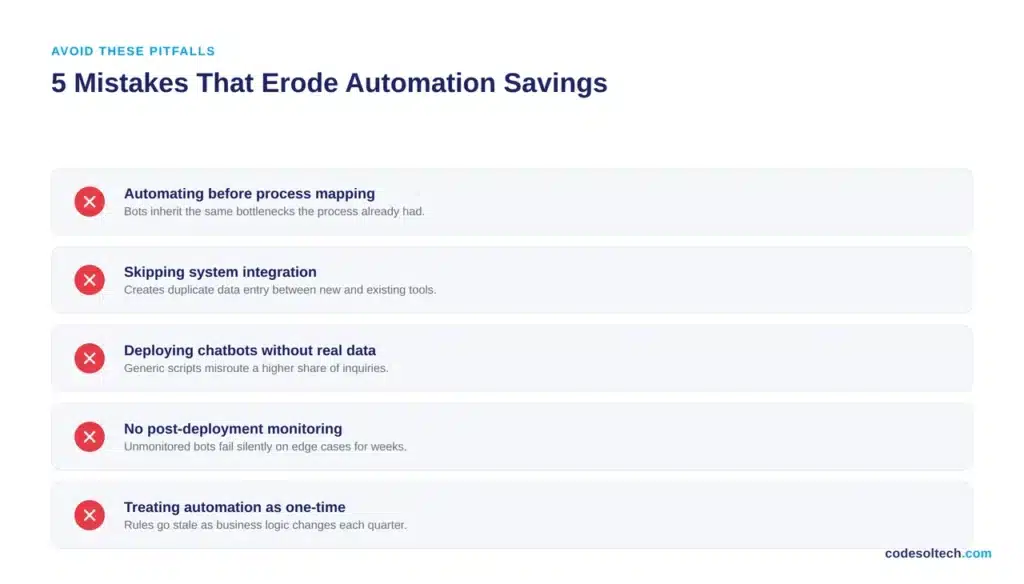
- Automating before process mapping: teams skip documenting actual steps and exceptions, so the bot inherits the same bottlenecks it was meant to remove
- Skipping system integration: automating one tool in isolation creates duplicate data entry between the new system and existing platforms
- Deploying chatbots without real training data: bots trained on generic scripts instead of actual support tickets misroute a higher percentage of inquiries
- Failing to monitor bot performance post-deployment: unmonitored bots silently fail on edge cases, and errors accumulate for weeks before detection
- Treating automation as a one-time project: processes change, and automation rules require quarterly review to match current business logic
Each mistake shares a root cause: automation applied to an unstructured or undocumented process. A software development partner audits the process first, identifies which steps qualify for rule-based automation versus AI-based automation, and only then configures the technical build.
Final Words
Automation cuts operational costs by 20% to 40% when deployed on the right processes. Customer service, inventory, and finance workflows deliver the fastest returns. The data from McKinsey, Deloitte, and Gartner confirms the same pattern: cost reduction scales with automation maturity, not company size.
Ready to cut your operational costs?
Talk to Codesoltech about auditing your current workflows and building an automation roadmap tailored to your business.